
Emotional Maturity: What It Is, Signs You Have It, and How to Build It

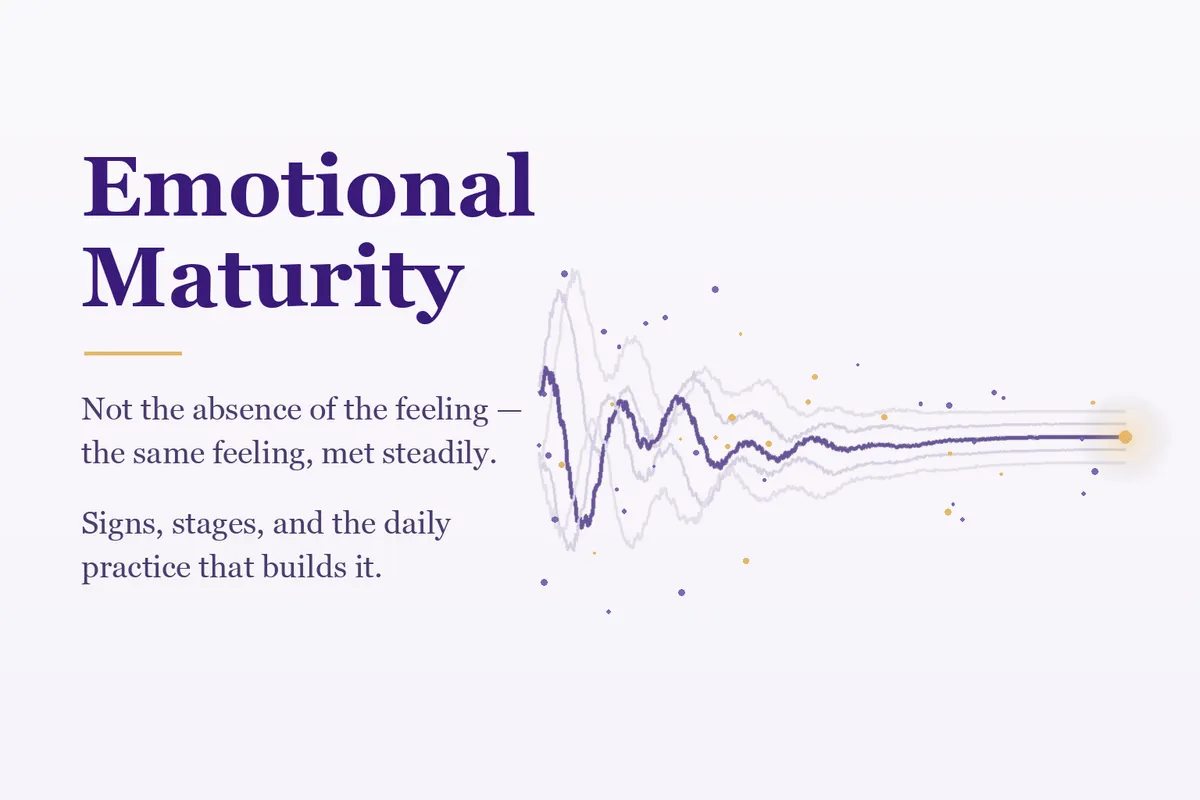
You know the feeling. Someone cancels plans without an apology, deflects the smallest piece of feedback into a fight, or goes quiet for three days after a disagreement — and you think, that's just not emotionally mature. Then you catch yourself doing your own version of it: snapping at a partner because you're actually anxious about work, or scrolling instead of naming what you feel. Emotional maturity isn't a trait some people have and others don't. It's a skill set, and like any skill set, it can be built on purpose.
What Is Emotional Maturity?
The first thing to clear up: emotional maturity is not the same as being older, calmer-seeming, or successful. Plenty of 45-year-olds still deflect responsibility the same way they did at 15. Plenty of 19-year-olds have already learned to sit with hard feelings instead of running from them — often because circumstances (a difficult household, an unstable childhood) forced the skill early. If you grew up in a home where feelings were dismissed or punished, you may have had to build these skills later in life, and that's not a personal failing — it's a predictable result of childhood emotional neglect shaping what felt safe to express.
At its core, emotional maturity rests on a few underlying capacities: self-awareness (knowing what you feel and why), self-regulation (choosing your response instead of being hijacked by the feeling), and accountability (owning your impact on others without spiraling into defensiveness or self-punishment). None of these are fixed personality traits — they're closer to muscles. You strengthen them the same way you strengthen anything: through repeated, deliberate practice.
Signs of Emotional Maturity
Emotional maturity looks less like a personality and more like a set of repeatable behaviors. Someone practicing it tends to:
- Name their emotions specifically — "I feel dismissed" instead of a vague "I'm fine" that isn't.
- Pause before reacting — creating even a few seconds of space between a trigger and a response.
- Apologize without over-explaining or self-flagellating — a clean "I was wrong, I'm sorry" rather than a defense disguised as an apology.
- Ask for what they need directly instead of hinting, punishing silence, or expecting others to guess.
- Tolerate being disliked or misunderstood in the short term rather than abandoning a boundary to keep the peace.
- Sit with uncertainty instead of forcing a premature resolution just to relieve their own discomfort.
- Take feedback without collapsing or counterattacking — hearing criticism as information, not an attack on their worth.
- Own their impact even when their intent was good — "I didn't mean to hurt you, and I did — I'm sorry" instead of "I didn't mean it, so it shouldn't matter."
None of this requires perfect calm. Emotionally mature people still get angry, hurt, and overwhelmed — the difference is what they do with it. Strengthening self-awareness through practical, repeatable steps is usually the entry point, because you can't regulate what you haven't first noticed.
Signs of Emotional Immaturity
It's worth naming immaturity clearly — not to shame anyone (including your past self), but because vague language makes patterns harder to spot and interrupt. Common markers include stonewalling instead of engaging, minimizing someone else's feelings ("you're too sensitive"), needing to win every disagreement, and what's sometimes called weaponized incompetence — performing helplessness so someone else absorbs the emotional or practical labor. Another common one is emotional hijacking, where a small trigger produces a reaction far bigger than the moment calls for, because an old wound got activated rather than the present situation.
| Emotional Maturity | Emotional Immaturity |
|---|---|
| Says "I'm hurt" directly | Goes silent and expects you to guess why |
| Apologizes and changes behavior | Apologizes and repeats the same pattern |
| Hears feedback, sits with it | Hears feedback, counterattacks or shuts down |
| Can be alone with discomfort | Numbs, distracts, or offloads discomfort onto others |
| Owns their part, even if partial | Makes it entirely the other person's fault |
| Sets and respects boundaries | Tests, ignores, or punishes boundaries |
If the pattern you're recognizing isn't your own but a parent's, partner's, or friend's, that's a different (and equally valid) path — our guide on healing from emotionally immature parents and people covers how to disentangle from someone else's patterns rather than absorbing them as your own. This article focuses on the inward work: building your own capacity, regardless of what anyone around you is doing.
Emotional Maturity vs. Emotional Intelligence
These two get used interchangeably, but they're distinct skills. Someone can be highly perceptive — reading a room instantly, sensing when a friend is upset before they say a word — and still handle their own emotions badly. High emotional intelligence with low emotional maturity often looks like someone who can articulate exactly why they're behaving badly and does it anyway, or who uses emotional insight to manipulate rather than connect.
Emotional maturity is intelligence put into practice — consistently, especially when it's inconvenient. If you're curious where you currently stand on the perception side, an emotional intelligence test can give you a useful starting snapshot, and pairing that awareness with regular reflection — like journaling for emotional intelligence — is how insight actually becomes a habit rather than just a fact about yourself.
Emotional Maturity in Relationships
Relationships are where emotional maturity gets tested most, because there's another person's feelings in the mix and no way to control them. A mature approach to conflict looks like naming the issue while it's still small, instead of stockpiling resentment until it detonates. It means being able to say "I need a minute before I can talk about this productively" instead of either exploding or disappearing. And it means repair — actually circling back after a rupture, rather than pretending it didn't happen.
Boundaries are part of this too. Emotionally mature people can hold a boundary without turning it into a punishment, and can hear someone else's boundary without treating it as rejection. If boundaries are a struggle, working through journal prompts for boundaries can help you get specific about where yours are and why they keep getting crossed. It's also worth checking your own patterns for codependency — over-functioning for someone else's emotions at the cost of your own is its own kind of immaturity, just one that looks selfless from the outside. And because a lot of relationship friction is really an attachment-system reaction rather than a character issue, it can help to understand your own patterns with an attachment style quiz before assuming the conflict is purely about maturity.
What Actually Builds Emotional Maturity
Nobody wakes up mature. It accumulates from specific, repeated practices:
Self-regulation — the ability to feel an intense emotion without it driving the car. This is a skill you build through small reps: noticing a trigger, naming the physical sensation, and choosing to pause before you speak or act. Learning how to process emotions rather than suppress or react to them is the foundation everything else sits on.
Distress tolerance — sitting with discomfort long enough for it to pass instead of numbing it away. Anger is a common testing ground for this, since it demands an immediate outlet; working through anger journal prompts gives that energy somewhere to go that isn't a text you'll regret sending.
Accountability without shame — owning a mistake without spiraling into "I'm a terrible person," which paradoxically makes people defensive rather than more responsible. Learning how to forgive yourself is part of this: guilt that never resolves tends to curdle into either denial or self-punishment, neither of which helps you actually change.
Reflection — reviewing what happened after the fact, honestly, so the same trigger produces a slightly different response next time. This is where most people quietly give up, because it requires revisiting moments you'd rather forget. It's also the step with the most leverage.
How Journaling Builds Emotional Maturity
Writing works because it forces specificity. "I'm upset" on the page tends to become "I'm upset because I asked for help and got dismissed, and that reminds me of being ignored as a kid" by the third sentence — and that specificity is what makes a pattern visible instead of just felt. A small but real body of research supports this: Smyth's 1998 meta-analysis of 13 studies found a moderate effect (d = 0.47) for expressive writing on wellbeing outcomes, and a larger 2006 meta-analysis by Frattaroli, covering 146 randomized studies, found a smaller but statistically significant average effect (r = .075). Baikie and Wilhelm's 2005 review found that just 3–5 sessions of 15–20 minutes of writing about a stressful event outperformed writing about neutral topics — though people often feel worse in the short term before they feel better. It's worth being honest about the limits here too: a later meta-analysis by Mogk and colleagues (2006), covering 30 randomized trials, found a near-zero overall effect (g = 0.04) — the evidence is genuinely mixed, and results vary a lot by person and method. Journaling isn't a guaranteed fix; it's a tool that works for many people, not everyone, not every time.
For the regulation piece specifically, journaling for emotional regulation walks through techniques for using writing in the moment a feeling spikes, not just after. And if you want the fuller picture of how consistent writing sharpens self-perception over months, not just single sessions, our complete guide to journaling for emotional awareness covers the long-arc version of this practice.
Journal Prompts to Grow Emotional Maturity
- What did I actually feel today, and what word is more specific than "fine," "stressed," or "annoyed"?
- When did I react faster than I meant to this week? What was I really protecting?
- Where did I blame someone else for something that was at least partly mine?
- What's a piece of feedback I dismissed too quickly — and what might be true about it?
- When did I avoid a hard conversation, and what was I afraid would happen if I had it?
- What does my body do right before I lose my temper? What's the earliest warning sign?
- Who do I owe an apology to — not an explanation, an apology?
- What boundary have I been hinting at instead of stating directly?
- When did someone else's emotion feel like my responsibility to fix? What would it look like to let it be theirs?
- What old moment does my current trigger actually remind me of?
- What's one thing I did this month that my future self will be proud of, emotionally?
- If I handled today's hardest moment again, what's the one thing I'd change?
When Emotional Immaturity Needs More Support
It's worth being honest about where this article's advice stops working. Emotional maturity is not a clinical diagnosis, and journaling is not therapy. If immature patterns — yours or someone else's — are tangled up with active substance use, untreated trauma, or a personality disorder, self-directed reflection alone usually isn't enough; a licensed therapist can work with what's actually underneath the behavior.
None of this is meant to gatekeep the practice — most people benefit from the reflection work described above. It's simply a reminder that "try harder to be mature" is the wrong prescription for patterns rooted in trauma or danger.
Frequently Asked Questions
What are the signs of emotional maturity?
Core signs include naming emotions specifically, pausing before reacting, apologizing without excuses, tolerating being disliked or misunderstood in the short term, and taking ownership of your impact on others even when your intentions were good.
What causes emotional immaturity?
It often develops from environments where feelings weren't modeled, validated, or safely expressed — a household that dismissed emotions, for instance — combined with never having had the chance or need to practice regulation and accountability skills. It's a developmental gap, not a fixed character trait.
Can emotional immaturity be fixed?
Yes, in most cases — emotional maturity is built through practice, not inherited. Consistent self-reflection, tolerating discomfort instead of avoiding it, and taking ownership of mistakes can shift long-standing patterns, though deeply rooted patterns tied to trauma may need professional support to fully change.
Is emotional maturity the same as emotional intelligence?
No. Emotional intelligence is the ability to perceive and understand emotions; emotional maturity is what you do with that understanding — whether insight actually changes your behavior, especially under stress.
What age do people become emotionally mature?
There's no fixed age. Emotional maturity depends on practice and environment, not years lived — some people build these skills young out of necessity, while others reach adulthood without ever having had to.
How do I know if I'm emotionally immature?
Common signs include getting defensive at small feedback, going quiet instead of naming what's wrong, struggling to apologize without over-explaining, or noticing the same conflict pattern repeat across different relationships. Noticing these patterns is itself the first step toward changing them.
Related Reading

Journal with 1,000+ of History's Greatest Minds
Carl Jung, Marcus Aurelius, Lao Tzu: replies grounded in their original works, each citing its source. Co-developed with a licensed psychotherapist.
Try Life Note Free