
Window of Tolerance: The 3 Zones & How to Widen Yours (+ 25 Prompts)

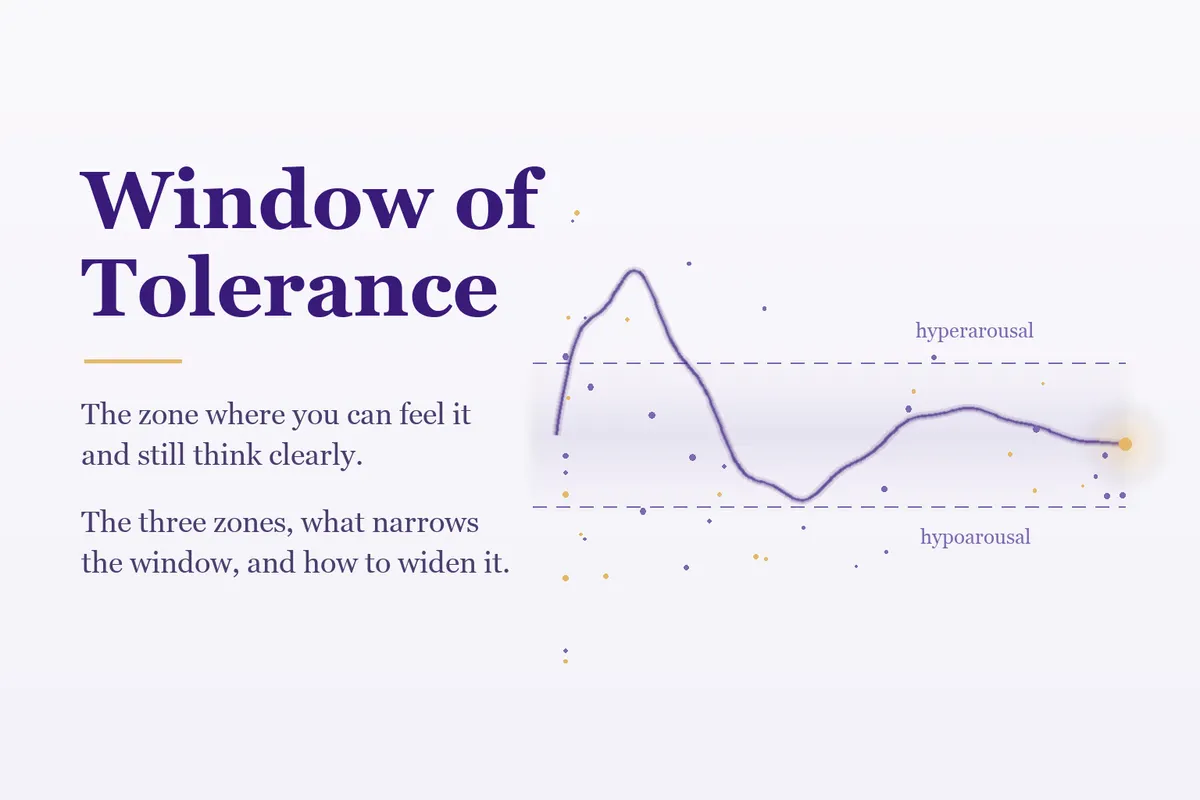
Quick answer: The window of tolerance is the zone of arousal where you can think, feel, and respond flexibly instead of reacting on autopilot. Outside it, you tip into hyperarousal (fight-or-flight: panic, racing thoughts, anger) or hypoarousal (freeze/shutdown: numbness, fog, collapse). The term was coined by psychiatrist Dan Siegel in The Developing Mind (1999), and the model is now widely used in trauma-informed and sensorimotor therapy. You can widen your window over time with regulation practices — journaling, breath, movement, grounding — done consistently, not just in the moment.
What Is the Window of Tolerance?
The window of tolerance is the range of nervous system arousal where you stay present, think clearly, and respond to stress without flipping into panic or shutdown.
Psychiatrist Dan Siegel introduced the term in his 1999 book The Developing Mind, using it to describe the band of physiological arousal within which a person can receive, process, and respond to information without their nervous system hijacking the moment. Inside the window, you're regulated: you can hear hard feedback without spiraling, feel anger without acting it out, notice sadness without drowning in it. You have access to your full range of thinking — the part of your brain that plans, weighs options, and stays curious instead of just reacting.
Outside the window, something different takes over. Your nervous system reads the moment as too much or too little, and your body responds before your thinking mind gets a vote. That's not a character flaw or a failure of willpower — it's biology doing what it evolved to do. Understanding where your own window sits, and what pushes you outside it, is the first step toward actually working with your nervous system regulation instead of feeling at its mercy.
The window isn't fixed. It's wider on a good night's sleep and narrower after a rough week. It's wider for people with a history of consistent safety and narrower for people who grew up or lived through periods where the world genuinely wasn't safe. That's useful news, because it means the width of your window is something you can influence — not overnight, but reliably, with the right practices repeated over time.
The Three Zones: Hyperarousal, Window, Hypoarousal
There are three zones of nervous system arousal: hyperarousal (too activated), the window of tolerance (regulated), and hypoarousal (too shut down) — each with a distinct feel and behavior pattern.
It helps to picture arousal as a vertical band. The window of tolerance sits in the middle. Above it is hyperarousal. Below it is hypoarousal. Most people don't live neatly inside their window all day — everyone dips out sometimes. What matters is noticing which direction you tend to go, and how far.
| Zone | What It Feels Like | Common Behaviors |
|---|---|---|
| Hyperarousal | Racing heart, tight chest, flooded thoughts, panic, irritability, feeling like everything is urgent | Snapping at people, pacing, catastrophizing, fight-or-flight impulses, talking fast, difficulty sitting still |
| Window of Tolerance | Calm alertness, grounded, present, able to feel emotion without being overwhelmed by it | Clear thinking, flexible responses, able to listen and problem-solve, emotionally honest without reactivity |
| Hypoarousal | Numbness, fog, heaviness, disconnection, feeling far away from your body or your life | Withdrawing, shutting down mid-conversation, procrastinating, low motivation, going through the motions |
Hyperarousal is the sympathetic nervous system stepping on the gas. Hypoarousal is closer to a parasympathetic shutdown response — sometimes called freeze or collapse. Neither is "wrong." Both are protective responses your body learned somewhere along the way. The goal isn't to eliminate them; it's to recognize them faster and have a way back. Practices that work with the vagus nerve — the main highway between your brain and your body's stress response — are especially useful for both directions, because vagal tone influences how quickly you swing and how easily you return.
Signs You're Outside Your Window
Hyperarousal signs cluster around fight-or-flight urgency; hypoarousal signs cluster around freeze and shutdown — learning your personal pattern is the fastest way to catch it early.
Most people have a dominant direction. Some of us go up first — heart racing, mind spinning, temper short. Others go down first — going quiet, going blank, feeling like we're watching our own life from behind glass. Some days you'll do both, moving from hyperarousal into a hypoarousal crash once the activation burns out. Learning to name where you are, instead of just being swept along by it, is a skill — and it starts with naming what you feel with more precision than "fine" or "stressed."
Signs of hyperarousal (fight-or-flight):
- Heart pounding, shallow or rapid breathing
- Thoughts moving faster than you can track them
- Irritability, snapping, or a short fuse
- Feeling like you need to move, fix, or escape right now
- Catastrophizing — jumping straight to the worst-case outcome
- Difficulty sitting still, restlessness, jaw or shoulder tension
Signs of hypoarousal (freeze/shutdown):
- Feeling numb, foggy, or far away from yourself
- Struggling to access words or finish a thought
- Low energy that doesn't lift with rest
- Withdrawing from people or conversations mid-way
- A sense of heaviness in the body, like moving through mud
- Losing track of time or feeling disconnected from your surroundings
If you tend toward hyperarousal, rumination is often part of the picture — the mind loops on the same worry without resolving it. If that's a pattern for you, journaling to break the rumination loop can slow the spiral enough to think again instead of just spinning.
What Narrows Your Window
Chronic stress, unresolved trauma, poor sleep, and ongoing overwhelm all shrink the window of tolerance, making it easier to tip into hyperarousal or hypoarousal from smaller triggers.
A wide window can absorb a lot — a hard conversation, an unexpected bill, a bad night's sleep — without knocking you out of your regulated zone. A narrow window means the smallest thing can send you into fight-or-flight or shutdown. Several things reliably narrow the window:
- Chronic stress — an accumulation of ongoing pressure that never fully resolves, so your baseline arousal creeps upward and your margin for error shrinks
- Unprocessed or complex trauma — experiences the nervous system never got to fully complete or make sense of, which can leave it primed for threat long after the danger has passed. This is a core focus of CPTSD-informed journaling
- Poor or inconsistent sleep — sleep is when your nervous system recalibrates; without it, your baseline arousal runs higher and your capacity to self-regulate drops
- Attachment history — early relationships shape how safe your body expects the world to be, which is part of why attachment style tends to correlate with window width
- Unacknowledged parts of yourself — emotions, needs, or memories you've pushed out of awareness don't disappear; they tend to resurface as reactivity. This is part of what shadow work is designed to address
- Physical depletion — hunger, illness, dehydration, and exhaustion all lower your threshold before anything "emotional" even happens
- Isolation — co-regulation with safe people is one of the ways humans widen their window; without it, you're regulating entirely alone
None of this is about blame. A narrow window is almost always the result of a nervous system that learned, somewhere, that vigilance or shutdown kept it safer. The work is in widening it back out, gently, on your own timeline.
What Widens Your Window
Regular regulation practices — body-based work, breath, movement, grounding, and reflective writing — gradually widen the window of tolerance over weeks and months, not in a single session.
Widening your window is less like flipping a switch and more like strength training. No single session transforms your capacity, but consistent, repeated practice shifts your baseline. A few approaches with real staying power:
- Somatic practices — working with body sensation directly, rather than only thoughts, because dysregulation lives in the body first. Somatic journaling is one accessible entry point
- Breathwork — slow, extended exhales signal safety to your nervous system and can shift you out of hyperarousal within minutes
- Grounding techniques — orienting to the present moment through your senses, especially useful when anxiety pulls you into hyperarousal. See grounding techniques for anxiety
- Movement — walking, stretching, or shaking out tension helps discharge activation that's stuck in the body with nowhere to go
- Consistent sleep and food — unglamorous, but they raise your baseline capacity more reliably than almost anything else
- Co-regulation — time with people or even pets who feel safe helps your nervous system borrow calm until it can generate its own
- Reflective writing — naming what you feel and tracking your patterns over time, which is where journaling for emotional regulation comes in
The model is widely used in trauma-informed and sensorimotor psychotherapy — an approach that works with the body's stored responses, not just the story of what happened — as well as in polyvagal-informed therapeutic work more broadly. If you're actively working through trauma, this article is a map, not a substitute — work with a licensed professional who can support you directly.
How to Come Back Into Your Window in the Moment
Returning to your window in real time means first naming which zone you're in, then applying a matched response — calming for hyperarousal, activating for hypoarousal — rather than one generic fix.
The in-the-moment move is different depending on which direction you've gone. Reaching for a stimulating strategy while you're already hyperaroused can make things worse. Reaching for a calming strategy while you're shut down can leave you stuck. Match the tool to the direction.
If you're hyperaroused (too activated):
- Slow your exhale — make it longer than your inhale, several times in a row
- Splash cool water on your face or hold something cold
- Name five things you can see, four you can hear, three you can touch
- Unclench your jaw, drop your shoulders, soften your hands
- Step outside or change rooms — a change of environment interrupts the loop
If you're hypoaroused (too shut down):
- Move your body — stand, stretch, walk, even just wiggle your fingers and toes
- Splash your face with cool water or hold an ice cube
- Name the room out loud — colors, textures, temperature
- Play music with a clear rhythm and let your body respond to it
- Reach out to someone — a text, a call, a few minutes of real contact
These are first-response tools. They bring you back into your window for the next five minutes. Widening the window itself — so you need these tools less often — is slower work, and that's where a daily practice like reframing unhelpful thought patterns through CBT journaling tends to pay off over weeks rather than minutes.
How Journaling Widens Your Window
Journaling widens your window of tolerance by building the habit of noticing arousal early, naming it accurately, and reflecting on patterns — turning a vague reaction into information you can work with.
Journaling isn't a bypass around regulation work — it's a form of it. Three specific mechanisms make it useful for window-of-tolerance work in particular:
It builds interoceptive awareness. Writing regularly about how your body feels, not just what happened, trains you to notice the early signs of hyperarousal or hypoarousal before they take over. That earlier catch is often the difference between a five-minute wobble and a full-day spiral.
It creates a record of your pattern. A single bad day looks random. Thirty days of tracking usually reveals a shape — certain people, certain times, certain kinds of conversations that reliably push you outside your window. Once you can see the pattern, you can plan around it instead of being ambushed by it.
It offers a place to process without an audience. Some of what pushes you outside your window needs to be metabolized, not just managed. A private page gives you room to feel something all the way through, at your own pace, without performing composure for anyone. That's often where self-compassion takes root too — including learning to forgive yourself for reactions that happened when you were outside your window, not because you failed, but because your nervous system did what it was built to do.
Track your window with Life Note.
Pair your daily entries with gentle prompts and pattern tracking, so you can actually see when your window narrows and what widens it back out — instead of relying on memory alone. Start journaling with Life Note.
Journal Prompts to Track & Widen Your Window
Use these prompts across four categories — noticing your edges, regulating up, regulating down, and widening over time — to build a working map of your own nervous system.
You don't need to use all of these in one sitting. Pick the category that matches where you are today, or rotate through them across the week.
Noticing your edges:
- Where in my body do I first notice when I'm leaving my window — and what does it feel like?
- What was happening right before I noticed myself tip into hyperarousal or hypoarousal today?
- On a scale from shut down to activated, where do I feel right now, and what tells me that?
- What's one thing I said or did in the last week that only makes sense if I was outside my window?
- Which direction do I tend to go first when I'm overwhelmed — up into activation, or down into shutdown?
- What time of day, or what kind of interaction, most often pushes me outside my window?
Regulating up (coming back from hypoarousal):
- What's one small movement I could make right now to bring some energy back into my body?
- What does my body actually need in this moment — warmth, sound, contact, air?
- Who is someone I could reach out to right now, even briefly, to feel less alone in this?
- What's something with texture, temperature, or sound I can focus on to come back into the room?
- If I imagine my most alive, engaged self, what's the smallest step toward that right now?
- What has helped me come back from feeling numb or far away before?
Regulating down (coming back from hyperarousal):
- What would it feel like to let my exhale be twice as long as my inhale, just for a minute?
- What's the worry my mind is racing toward, and is it today's problem or a future one?
- Where am I holding tension right now — jaw, shoulders, hands — and can I soften it, even slightly?
- What's one thing in this room I can look at slowly, on purpose, to slow everything else down?
- If I could set this urgency down for ten minutes, what would that make room for?
- What has helped me come down from feeling flooded or panicked before?
Widening over time:
- Looking back over this week, has my window felt wider or narrower than usual — and why?
- What's one practice that, done consistently, seems to expand my capacity to stay regulated?
- What relationship or routine reliably helps me feel more grounded, more often?
- What's something outside my window right now that used to be inside it — a sign of growth worth noticing?
- What conditions — sleep, food, connection, rest — most affect the width of my window this month?
- If I imagine my window six months from now, what would "wider" actually look like day to day?
- What's one thing I'm proud of noticing about my own patterns this week?
FAQ
Quick answers to the most common questions about the window of tolerance, its origin, and how to work with it.
What is the window of tolerance in simple terms?
It's the range of stress or emotional intensity you can handle while staying present and thinking clearly. Inside the window, you're regulated. Outside it, you swing into hyperarousal (panic, anger, racing thoughts) or hypoarousal (numbness, fog, shutdown) — automatic nervous system responses rather than conscious choices.
Who coined the term window of tolerance?
Psychiatrist Dan Siegel coined the term in his 1999 book The Developing Mind. He used it to describe the zone of nervous system arousal within which a person can process information and respond flexibly, rather than reacting from fight-or-flight or freeze.
What are the signs I'm outside my window of tolerance?
Hyperarousal signs include a racing heart, fast thoughts, irritability, and an urge to fix or escape immediately. Hypoarousal signs include numbness, brain fog, low energy, and a sense of disconnection from your body or surroundings. Most people have a direction they tend toward first.
Can the window of tolerance actually get wider?
Yes, gradually. Repeated regulation practices — somatic work, breathwork, grounding, movement, consistent sleep, co-regulation with safe people, and reflective journaling — shift your baseline capacity over weeks and months. It's a slow build, not a one-time fix.
Is the window of tolerance the same as emotional regulation?
They're closely related but not identical. Emotional regulation is the broader skill of managing feelings; the window of tolerance is the specific nervous-system zone in which that regulation is actually possible. Widen the window, and regulation gets easier by default.
Does trauma affect the window of tolerance?
Yes. Unresolved or complex trauma tends to narrow the window, making the nervous system more reactive to smaller triggers. This is a central idea in trauma-informed and sensorimotor approaches to therapy. If trauma is part of your picture, working with a licensed professional alongside any self-guided practice is worth it.
How is journaling connected to the window of tolerance?
Journaling builds the awareness needed to notice you're leaving your window earlier, and it creates a record over time that reveals your personal patterns — what narrows your window and what reliably widens it back out. It's a low-cost, consistent way to support the same nervous system you're trying to regulate.

Journal with 1,000+ of History's Greatest Minds
Carl Jung, Marcus Aurelius, Lao Tzu: replies grounded in their original works, each citing its source. Co-developed with a licensed psychotherapist.
Try Life Note Free