
End of Year Reflection: 48 Questions + 50 Prompts

50 thoughtful journaling prompts to reflect on the past year, uncover lessons, release what no longer serves you, and enter the new year with clarity.

📌 TL;DR — End of Year Reflection Prompts
50 prompts to reflect on your year and prepare for the next one. Categories include: Wins & Accomplishments, Challenges & Growth, Relationships, Health & Wellbeing, Career & Purpose, and Looking Ahead. Start with: "What am I most proud of this year?" and "What would I do differently?" Don't try to answer all 50 — pick 5-10 that resonate and journal deeply on those.
End-of-Year Journaling Prompts Aren’t About “Being Productive.” They’re About Being Free.
Most people end the year the same way they lived it: slightly rushed, slightly numb, and weirdly convinced they “didn’t do enough.”
See also: benefits of journaling and journal prompts
End-of-year journaling prompts are a gentle rebellion against that trance.
They help you do three things humans are strangely bad at doing without structure:
- Remember accurately (not just the highlights, not just the regrets).
- Make meaning (so the year becomes wisdom, not just time).
- Choose the next step (without turning January into a self-punishment ritual).
A good year-end reflection isn’t a diary dump. It’s a structured review that turns experience into insight and next steps. And it doesn’t need to be long. Brief, structured writing has research support for improving well-being for many people.
In other words: you don’t need a new personality. You need a mirror.
This guide gives you that mirror—through prompts that help you close the year with honesty, softness, and a little holy mischief.
How to Use These End-of-Year Journaling Prompts
Pick a format that fits your real life (not your fantasy self)
Choose one:
Option A: The 20-Minute Reset (fast, powerful)
- 2 minutes: settle in (breathe, tea, candle, stare at a wall like a monk with Wi-Fi)
- 15 minutes: answer 6–8 prompts
- 3 minutes: write your “Next Year, but kinder” intention
Option B: The 60-Minute Deep Review (full-circle closure)
- 10 minutes: memory scan (month-by-month highlights)
- 40 minutes: prompts across wins, pain, patterns, meaning
- 10 minutes: choose 3 intentions + 3 “if-then” plans
Option C: The 7-Day Year-End Ritual (low pressure, high depth)
- 10–15 minutes per day
- One theme each day (wins, lessons, relationships, etc.)
This works because consistency is easier when the dose is small.
A quick tip: start with “mindful arrival”
Take 60–90 seconds, slow your breath, name what you feel, then write. This “arrival” practice helps you shift from busy mind to reflective mind.
The Two Traps That Ruin Year-End Reflection (and the fix)
Trap 1: Turning your journal into a courtroom
If your end-of-year journaling sounds like a prosecution—“Exhibit A: My failures”—you’ll avoid it or rush it.
Fix: write like a wise witness, not a harsh judge.
Trap 2: Confusing insight with action
Insight feels like progress. But action is progress.
Fix: end each section with one “tiny next step,” ideally an if-then plan (implementation intention), which can increase follow-through.
What is an end of year reflection?
An end of year reflection is a structured written review of the past twelve months that moves from factual recall, through what you learned, to what you are carrying into the next year. It covers the whole year in a fixed order, which is what separates it from an ordinary journaling session about whatever is on your mind today.
Most year-end writing is a list of prompts answered in whatever order feels good until the page is full. That works for mood. It is weaker for recall, because the prompts that feel good to answer are the ones you already have an answer for, and the last six weeks of the year crowd out the first six months. A year in review runs differently. You start with what happened, in order, and you interpret none of it until the facts are down.
The 48 questions further down are organized into six sections meant to be worked through from first to last: inventory, wins, hard, people, learned, forward. The 50 free-form prompts on the rest of this page still work well on their own, and plenty of people use both. The structured review gives you the shape of the year. The prompts give you room for the parts that need more than a few sentences. If you want to see what finished reflective writing looks like before starting your own, these reflection examples and this guide to journaling for self-reflection show worked pieces rather than prompt lists.
How do you do a year in review, step by step?
Block 60 to 90 minutes, gather your calendar, photos, messages and statements first, then answer six sections in order: inventory, wins, hard, people, learned, forward. The order matters because interpretation contaminates memory. Once you have decided what the year meant, you stop retrieving the parts that do not fit.
- Pull your sources before you write anything. Calendar, camera roll, messages, card statements, work tickets, medical appointments. Memory for a twelve-month span is poor without them, and a review done from memory alone produces a shorter, flatter year than the one you actually lived.
- Do the inventory cold. Month by month, one or two lines each, facts only. No verdicts, no lessons, no gratitude yet.
- Work through wins, hard and people. About ten minutes each. Use full sentences where you can manage them, since a bullet list records the label and loses the detail.
- Answer the learned section with the first four in front of you. This is the section people want to jump straight to. Asked cold, it produces the same four platitudes every December.
- Finish with forward, then stop. Do not turn the review into goal setting the same evening. Sleep on it first. Deciding what to do about a year is a separate sitting.
The six sections, in order
| Section | What it asks | Why it goes in this order | Roughly how long |
|---|---|---|---|
| 1. Inventory | What actually happened: months, moves, jobs, illnesses, endings, firsts. | Facts first. Once you have started interpreting a year, you stop retrieving the parts that do not fit the story. | 15 to 20 min |
| 2. Wins | What went well, including the ones nobody saw and the ones that cost more than they looked. | Easiest while the inventory is still in front of you, and it puts evidence on the page before you reach the hard part. | 10 min |
| 3. Hard | What was genuinely difficult, what getting through it took, what you would not repeat. | Placed after wins so it lands on a full picture of the year instead of an empty one. | 10 to 15 min |
| 4. People | Who mattered, who went quiet, who you were for other people. | Most of what happened to you this year involved somebody. This section usually corrects the inventory. | 10 min |
| 5. Learned | What you know now that you did not in January, including what you were wrong about. | Takes all four earlier sections as its input. Asked first, it produces platitudes. | 10 min |
| 6. Forward | What you are carrying into next year and what you are deliberately leaving behind. | Last, so what you choose is grounded in the year you actually had. | 10 min |
What questions should you ask in a yearly reflection?
Ask questions specific enough that a stranger could not answer them on your behalf, and put factual recall questions before meaning questions. Forty-eight questions across six sections covers a full year, and eight per section keeps any single one of them from turning into an interrogation.
Specificity is what separates a review that changes something from a review that confirms what you walked in believing. "What are you grateful for this year" gets roughly the same three answers out of almost everyone every December. "Which five people did you spend the most actual hours with, and is that list what you would have predicted in January" gets you something you did not already know.
The six sections split the work so no single question has to carry too much. Inventory asks for months, moves, endings and firsts. Wins asks for the ones nobody saw and the ones that cost more than they looked from outside. Hard asks what getting through it required in hours, money, sleep and help. People asks who showed up, who went quiet, and who you were for others. Learned asks what you know now that you did not in January, including what you were wrong about. Forward asks what you are carrying and what you are putting down. If a section runs dry, gratitude prompts and self-awareness prompts restock the wins and learned sections without changing the structure.
If the year was hard, is this still worth doing?
Reviewing a bad year will not fix the bad year, and writing about it often feels worse before it feels like anything. Baikie and Wilhelm’s 2005 review of expressive writing notes that a short-term rise in distress during the first sessions is common. The evidence on whether this kind of writing improves health outcomes is genuinely mixed. Smyth’s 1998 meta-analysis of 13 studies found a mean effect of d = 0.47 across well-being and health measures. Frattaroli’s 2006 meta-analysis of 146 randomized studies found a small positive average of r = .075. Mogk’s 2006 meta-analysis of 30 randomized trials found g = 0.04, which did not reach significance. Results vary by person, by method, and by what is being written about.
What a written review does give you is an accurate record. From inside a bad stretch, the stretch looks like the whole year. Set down month by month, it is often four months, or two, with specific events that made it worse and specific people who helped. Having that on paper is a modest thing and it is the honest claim to make. Nobody should tell you that an hour of writing repairs a year.
When should you do it, and how long does it take?
Any quiet block from mid-December through the end of January works, and the full 48-question review takes 60 to 90 minutes. A short version covering inventory, learned and forward runs about 25 minutes, which beats a full review you keep postponing.
The week between Christmas and New Year is the usual slot, and it works because the year is nearly complete and most people have an unstructured afternoon in it. Mid-January is also fine and in some ways easier: the holidays are over, the house is quiet, and the pressure to feel something on December 31 has passed. February still beats skipping it.
Splitting the review across several evenings works well. Baikie and Wilhelm describe typical expressive-writing protocols of three to five sessions of 15 to 20 minutes, which maps onto two sections a night for three nights. If you want next December to be easier, the work happens during the year: keeping a daily reflection journal, or even a one sentence a day habit, leaves you a record to read back instead of a blank March.
What do you do with it once it is written?
File it where you will find it next December, then treat it as the input to next year’s planning rather than as the planning itself. Reading last year’s review before you write this year’s is where the patterns show up.
Three things are worth doing with a finished review. First, put it somewhere you will actually find it in twelve months, and read the old one before you write the new one. Two consecutive reviews show patterns a single review cannot: the same complaint across three different jobs, the same friendship cycle, the same month that goes badly every single year. Second, pull out the three or four things that appeared in more than one section. Those tend to be values rather than goals, and a values worksheet names them faster than arguing with yourself. Third, keep the file private by default. The hard section and the wrong-about questions only produce honest answers when you know nobody else is going to read them.
If you came here to plan the year ahead rather than close the one behind you, the forward-looking versions of this work live on other pages: new year resolution journal prompts for turning a review into commitments, 100 achievable resolutions if you would rather choose from a list, and the word of the year exercise if a single theme suits you better than a set of goals.
The 48 questions are below, in order. The first section asks only what happened.
The 48-Question Year Review (Full Text)
All 48 questions are written out below in the order you answer them. Work straight down, or take one section per sitting across a week.
1. Inventory: What actually happened, before you interpret any of it.
- Go month by month from January to December and write one line for each: what was the main thing happening in your life that month?
- Where did you live this year, and did anything change about your home, your commute, or your daily route?
- What did you spend the most hours on this year, counting work, sleep, caregiving, commuting, and screens?
- What did you do for the first time this year, including small firsts like a food, a route, a tool, or a conversation?
- What ended this year: a job, a lease, a treatment, a contract, a habit, a subscription, a living arrangement?
- Who or what did you lose this year, and roughly when in the year did it happen?
- Which five events from this year had you already half forgotten until something reminded you of them?
- What was your health like across the twelve months: sleep, energy, pain, appointments, anything you were treated for?
2. Wins: Including the ones nobody saw, and the ones that cost more than they looked.
- What did you finish this year that nobody else would recognize as an accomplishment?
- Which win cost you more than it looked like from the outside, and what exactly did it cost?
- What did you say no to this year that turned out to be the right call?
- Where did you keep a promise to yourself on a day when dropping it would have been easy and unnoticed?
- What did you get better at this year without setting out to?
- What went well this year that you had almost nothing to do with, and how did you handle that luck?
- Which of this year's wins would mean the most to the version of you from five years ago?
- What did you do for someone else this year that you are glad about even though it changed nothing for you?
3. What Was Hard: What it took, and what you would not repeat.
- Which week or month of this year would you not want to live through again, and what specifically made it that bad?
- What did getting through the hardest stretch actually require in practical terms: money, hours, sleep, medication, someone covering for you?
- What did you drop or neglect while you were dealing with it, and have you picked any of it back up?
- Which problem is still unresolved going into next year, and what is the honest reason it is still open?
- What did you try this year that did not work, and how long did you keep at it before you stopped?
- Where did you ask for help, and where did you decide against asking even though you needed it?
- What would you refuse to do again on the same terms: a project, a trip, a favor, an arrangement, a job?
- What are you still angry about from this year, and who or what is it aimed at?
4. People: Who mattered, who you lost touch with, who you were for others.
- Name the five people you spent the most actual hours with this year. Is that list what you would have predicted in January?
- Who showed up for you this year in a way you never asked for?
- Which friendship went quiet this year, and was that drift, distance, or a decision somebody made?
- Who did you turn to first when something went wrong this year?
- What did someone need from you this year that you were not able to give them?
- Who did you meet for the first time this year who is still in your life?
- What is the kindest thing you did for someone this year, and do they know you did it?
- Which relationship took the most energy this year, and what were you getting back from it?
5. What You Learned: Including what you were wrong about in January.
- What do you understand about your work or your field now that you did not understand in January?
- What were you wrong about this year, and when did you find out?
- What advice did you get this year that you ignored, and how did that turn out?
- What did this year teach you about how you handle waiting, uncertainty, or bad news?
- What did you learn well enough this year that you could teach it to someone concretely?
- Which assumption about another person turned out to be false this year?
- What did you find out about how much you can take on before the quality of your work or your mood drops?
- Which decision from early this year looks different to you now that you know how it played out?
6. Forward: What you are carrying, and what you are deliberately leaving.
- Which commitment from this year are you keeping next year on purpose rather than by default?
- What is on next year's calendar or in next year's budget only because it was on this year's?
- What are you carrying into next year that belongs to this one: an obligation, a grudge, an unread pile, a half-finished thing?
- Which single open loop from this year would you most like closed by March, and what would closing it take?
- Which recurring cost of this year, in hours or in money, are you willing to cut in half?
- If you change nothing at all, what does next year look like by June?
- What do you want to be true about your life next December that is not true today?
- Which part of this year do you actually want to repeat?
End of Year Reflection FAQ
Should I do a year in review alone or with a partner?
Alone first. Write your own answers before you compare, or you will end up reviewing the relationship instead of the year. Once you have both written, trading the inventory and people sections is useful, since each of you will remember months the other one lost. Leave the hard section private unless you both want to open it.
Is a year in review worth doing if the year was mostly bad?
Yes, with lower expectations. What you get is an accurate record rather than relief. Writing about a difficult year can feel worse in the first session before it settles. Go shorter, stay with the inventory and people sections, skip anything that reads like an interrogation, and stop if you feel worse for more than a day.
How is a year in review different from setting resolutions?
A review looks backward and describes: what happened, what it cost, who was there, what you learned. Resolutions look forward and prescribe. Doing both in one sitting usually means the resolutions get written out of whatever mood the review left you in. Review in December, decide in January, and let a few days sit between them.
Is it too late to do a year in review in January?
January is fine and February is fine. Nothing about the calendar makes reflection work better on December 31. The one practical argument for doing it before the year closes is that your memory of the fall is still fresh. If you are reading this in March, run it on the twelve months behind you and keep the date you used.
Should I keep my year in review private?
Private by default. The questions about what was hard and what you were wrong about only produce honest answers when nobody is going to read them, and knowing an audience exists quietly edits what you put down. Share a summary later if you want to. Keep the raw file somewhere only you can open.
End-of-Year Journaling Prompts by Theme
Below are prompts grouped by what people actually want at the end of the year: closure, clarity, self-trust, and a path forward.
Use them like a menu. You’re not “supposed” to answer them all.
Wins Worth Celebrating
Why this matters
Most people undercount their progress because their brain remembers threat more easily than growth. Year-end reflection corrects that bias by forcing retrieval of evidence.
Prompts
- When did you feel most proud of yourself—whether or not anyone noticed?
- What small victory did you forget to celebrate?
- What personal strengths helped you succeed this year?
- What did you do that surprised you—in a good way?
- What problem did “old me” not know how to handle, that “current me” can handle now?
- What did you complete that once felt heavy, scary, or impossible?
- What did you do consistently (even imperfectly) that improved your life?
- What are three moments you wish you could bottle and keep on your desk?
- If your best friend wrote your highlight reel for the year, what would they include?
- What did you do this year that required real courage?
Mini-closure line (optional)
Finish this section with:
“I’m allowed to be proud of this.”
Challenges and Growth
Why this matters
End-of-year journaling prompts shouldn’t be only celebratory. Closure requires naming what hurt and what you learned—otherwise the same lesson returns wearing a different costume.
Prompts
- What was the hardest thing you faced this year, and how did you respond?
- What did that challenge reveal about what you value?
- Where did you grow slowly—so slowly you almost didn’t notice?
- What did you learn about yourself through a difficult moment?
- When things didn’t go as planned, what was your default coping strategy?
- What did you avoid this year—and what did it cost you?
- What boundary did you fail to set? What boundary did you finally set?
- What did you “outgrow” that used to run your life?
- What do you need to forgive yourself for—specifically?
- What’s one painful event that later showed you something true?
Reframe prompt
Write one paragraph titled:
“If this was training, what was it training me for?”
Moments of Joy and Aliveness
Why this matters
A good life isn’t just the absence of problems. It’s the presence of aliveness.
Prompts
- What people, places, or experiences made you feel alive this year?
- When did you feel truly present—without distraction?
- What did you do “just because,” and how did that change your mood?
- Which day this year felt strangely simple and good? Why?
- What did you laugh at so hard you forgot to manage your image?
- What beauty did you notice that you would’ve missed in a busier year?
- What was one perfect ordinary moment?
- What did your body enjoy this year (sleep, food, movement, nature)?
- What do you want more of—not because it’s impressive, but because it’s true?
- How can you design your next year to include more of these moments?
Habits, Patterns, and the Hidden Scripts
Why this matters
Your year was not random. It was shaped by patterns—some nourishing, some sneaky.
Prompts
- Which habits consistently supported your well-being, even on hard days?
- Which habits quietly drained you?
- What emotional pattern kept repeating (stress cycle, relationship loop, procrastination loop)?
- What did you reach for when you felt uncomfortable (scrolling, sugar, work, avoidance)?
- What was the “price” of your numbing strategy—and what was it trying to protect you from?
- Where did you over-control? Where did you under-commit?
- What did you consistently say yes to that should’ve been a no?
- What environment changes helped you the most (people, places, routines)?
- What is one habit you’d like to experiment with next year to support who you’re becoming?
- If your year had a default setting, what was it? (e.g., “rush,” “prove,” “hide,” “serve,” “create,” “recover”)
Pattern-to-plan (simple but lethal)
Pick one pattern and write:
- Trigger: When ___ happens
- Old move: I usually ___
- New move: Next time, I will ___
This turns reflection into a lever.
Relationships: Love, Friendship, Family, Community
Why this matters
Your year is largely made of people. Even when you’re alone, you’re carrying someone’s voice in your head.
Prompts
- How did your relationships change this year?
- Who felt like home to you this year—and why?
- Who did you feel you had to perform around?
- What conversation are you still carrying unfinished?
- Where did you choose peace over truth—and where did you choose truth over peace?
- What relationship taught you the most this year (even if it was painful)?
- Who did you miss? What does that reveal?
- Who did you grow closer to? What did you do differently?
- Where did you abandon yourself to keep a connection?
- What kind of friend/partner/child/parent were you this year? What would you like to be next year?
Optional: The unsent letter prompt
Write an unsent letter to one person:
- Thank you for ___
- I’m sorry for ___
- I wish ___
- Next year, I hope ___
You don’t have to send it. The point is truth.
Work, Craft, Money, and Contribution
Why this matters
Work is where a lot of our self-worth tries to cosplay as productivity.
Prompts
- What work are you most proud of this year—and what made it good?
- Where did you trade too much life for too little meaning?
- What skill did you improve the most? What did you do that actually worked?
- What did you ship, publish, finish, or contribute that mattered to someone?
- What drained you at work—and what energized you?
- What money decision helped you breathe easier?
- What money decision caused stress (and what was the lesson)?
- What did you learn about your relationship with status?
- What would “enough” look like next year—in time, money, energy?
- If you were optimizing for pride instead of approval, what would change?
Body, Health, and Inner Weather
Why this matters
Your body kept the receipts all year. Your nervous system has been taking notes, even if you weren’t.
Prompts
- What did your body try to tell you this year?
- When did you feel most regulated, calm, and safe?
- When did you feel chronically tense or depleted? What was happening then?
- What health habit actually helped (sleep, food, movement, sunlight, therapy, walks)?
- What did you do that your future body will thank you for?
- What did you do that your future body will invoice you for?
- What emotion showed up the most this year? What was it protecting?
- What emotion did you avoid the most? Why?
- What does your “inner weather report” say about your environment and obligations?
- What’s one kind thing you can do for your body in January?
Meaning, Spirituality, and the Quiet Questions
Why this matters
A year can be “successful” and still feel empty. Meaning is the missing metric.
Prompts
- When did you feel aligned with yourself this year?
- When did you feel spiritually awake—even for a minute?
- What did you stop believing this year? What did you start believing?
- What part of you is asking for deeper honesty?
- What do you want your life to be about—beyond survival?
- What sacred thing did you neglect?
- What did suffering teach you (that comfort couldn’t)?
- What practices brought you back to yourself (meditation, prayer, journaling, nature, art)?
- What do you want to devote yourself to next year?
- If the year had one lesson with your name on it, what was it?
Tiny koan-style prompt
Finish this section with one sentence:
“The truth I can’t unsee anymore is ____.”
Gratitude (Without Toxic Positivity)
Why this matters
Gratitude isn’t pretending everything was fine. It’s noticing what was real and good inside a complicated year.
Prompts
- What are you most grateful for from this year, and why?
- Who helped you more than they know?
- What ordinary convenience made your life easier?
- What did you learn that made you wiser?
- What “bad” event redirected you toward something better?
- What did you survive that proves you’re stronger than you thought?
- What part of your life is quietly working?
- What did you receive this year (support, love, opportunity, forgiveness)?
- What did you give that you’re proud of?
- What are three things you’re grateful for that cost zero dollars?
Closure: What You’re Leaving Behind
Why this matters
End-of-year journaling prompts should end with a clean exit. Otherwise you drag the same emotional luggage into January and call it “new goals.”
Prompts
- What are you done tolerating?
- What identity are you ready to retire?
- What belief about yourself is outdated?
- What are you ready to release—one small thing at a time?
- What would “closure” actually look like for you?
- What do you want to stop chasing?
- What unfinished business needs a plan, not just anxiety?
- What relationship dynamic are you no longer available for?
- What habit are you willing to outgrow?
- Write a one-paragraph goodbye to the year.
A clean closing line
“I take the lesson. I release the weight.”
Reset for the Year Ahead: Intentions That Don’t Collapse by February
Why this matters
Most New Year planning fails because it’s built on self-disgust and adrenaline. A better approach: gentle clarity + small systems.
Prompts to reset forward
- What do you want more of next year—emotionally, not just materially?
- What do you want less of?
- What kind of person are you practicing becoming?
- What would you attempt if you trusted yourself 10% more?
- What is one habit that would make many things easier?
- What relationships do you want to deepen, and how will you show it?
- What are three experiences you want to have next year?
- What are three things you want to create or build?
- What does “success” mean next year if nobody is watching?
- What is one brave decision you’re willing to make in Q1?
Turn intentions into “if-then” plans
Pick 1–3 intentions, then write:
- If it is ___ (day/time/situation), then I will ___ (tiny action).
Examples:
- If it’s Sunday at 7pm, then I’ll do a 10-minute weekly review.
- If I feel overwhelmed, then I’ll write 5 lines before I scroll.
- If I skip a habit, then I’ll restart tomorrow with the smallest version.
This is how your future stops being a motivational poster and becomes a calendar event.
A Simple End-of-Year Journaling Template (Copy/Paste Friendly)
The 4-Box Grid
Draw four boxes on a page:
1) What happened this year (facts + highlights):
- 5 bullets.
2) What it cost / what it taught (lessons):
- 5 bullets.
3) What patterns I see (habits + relationships + inner weather):
- 3 patterns.
4) What I’m choosing next (intentions + next steps):
- 3 intentions + 3 if-then plans.
This template works because it follows the natural arc of reflection: look back, make meaning, plan next.
If You Don’t Know What to Write, Start Here (10 “First Prompt” Starters)
- The moment I keep replaying from this year is…
- The biggest thing I learned the hard way is…
- The best thing I did for myself was…
- The thing I avoided most was…
- The relationship that changed me was…
- The pattern I’m ready to break is…
- The part of me I’m learning to accept is…
- The truth I kept dodging is…
- What I want next year, underneath the noise, is…
- One gentle next step I can take in January is…
How Life Note Fits Into Year-End Reflection (Soft, Useful, Not Salesy)
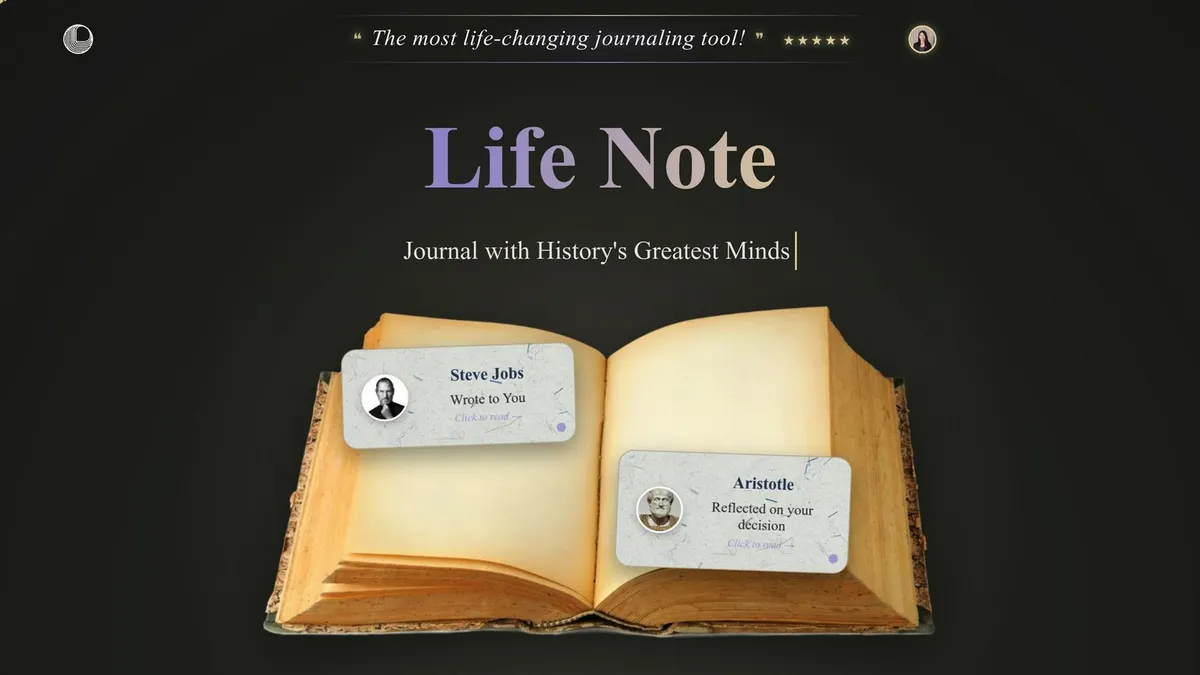
A year-end review is easier when you’re not doing it alone inside your own biases.
In Life Note, many people do this as a conversation: you write the truth, then a mentor reflects it back—helping you see patterns, name themes, and turn insights into next steps.
Not because you need another app. Because sometimes the fastest way to clarity is to let a wiser voice ask the next question.
“Most AI journaling apps feel like chatbots that flatter you.
Life Note balances empathy and challenge — gentle nudges, thoughtful invitations, and wisdom from many fields.
It’s deepened my self-awareness and changed how I teach reflection.”
— Sergio Rodriguez Castillo, Licensed Psychotherapist & University Professor
Frequently Asked Questions
1) How many end-of-year journaling prompts should I answer?
Enough to feel clear. For most people, that’s 6–12 prompts in one session, or one theme per day for a week.
2) When should I do end-of-year journaling?
Anytime you can create a quiet pocket—late December, the last weekend of the year, or even the first week of January. The value is reflection + follow-through, not the exact date.
3) What if this year was painful and I don’t want to revisit it?
Go gently. Use prompts that focus on survival, support, and the smallest next step. If you feel overwhelmed, pause, shorten the session, or consider professional support.
4) Should I journal digitally or on paper?
Whichever makes you more honest. Paper can feel intimate and slow. Digital can be searchable and easier to maintain. The best choice is the one you’ll actually use consistently.
5) What’s the fastest way to do a meaningful year-end reflection?
Use a 4-box review:
Wins → Lessons → Patterns → Next steps.
Ten minutes can be enough if you finish with one small next step.
6) What if I don’t remember much from this year?
Use a quick “memory ladder”: scan your camera roll, calendar, or top messages, then write:
- 3 moments you remember
- 3 people who mattered
- 3 things that changed you
7) How do I turn reflection into action without making huge resolutions?
Choose 1–3 intentions, then write an if–then plan:
“If it’s ____, then I will ____ (tiny action).”
Keep it small enough to do on a tired day.
8) Can I do this if I’m not a “good writer”?
Yes. This isn’t literature—it’s clarity. Write in bullets, fragments, or even single sentences. The goal is truth, not polish.
Closing: A Good Year-End Review Makes You Harder to Manipulate (Including by Your Own Moods)
Without reflection, you’re at the mercy of your most recent emotion.
With reflection, you get a wider view: the whole year, the whole arc, the whole you.
So do this—not as a “self-improvement task,” but as an act of respect. (Once you've closed out 2025, the natural next move is a 2026 rebrand journal — identity-shift work for the year ahead, treated like a personal brand overhaul.)
You lived a year of your one wild life.
Give it the dignity of meaning.
If you want a final one-line prompt to end on, make it this:
Knowing everything I know now, the gentle next step for me is _____.

Journal with 1,000+ of History's Greatest Minds
Carl Jung, Marcus Aurelius, Lao Tzu: replies grounded in their original works, each citing its source. Co-developed with a licensed psychotherapist.
Try Life Note Free