
2026 Rebrand Journal: 60 Prompts + 7 Spreads for Identity-Shift That Actually Holds

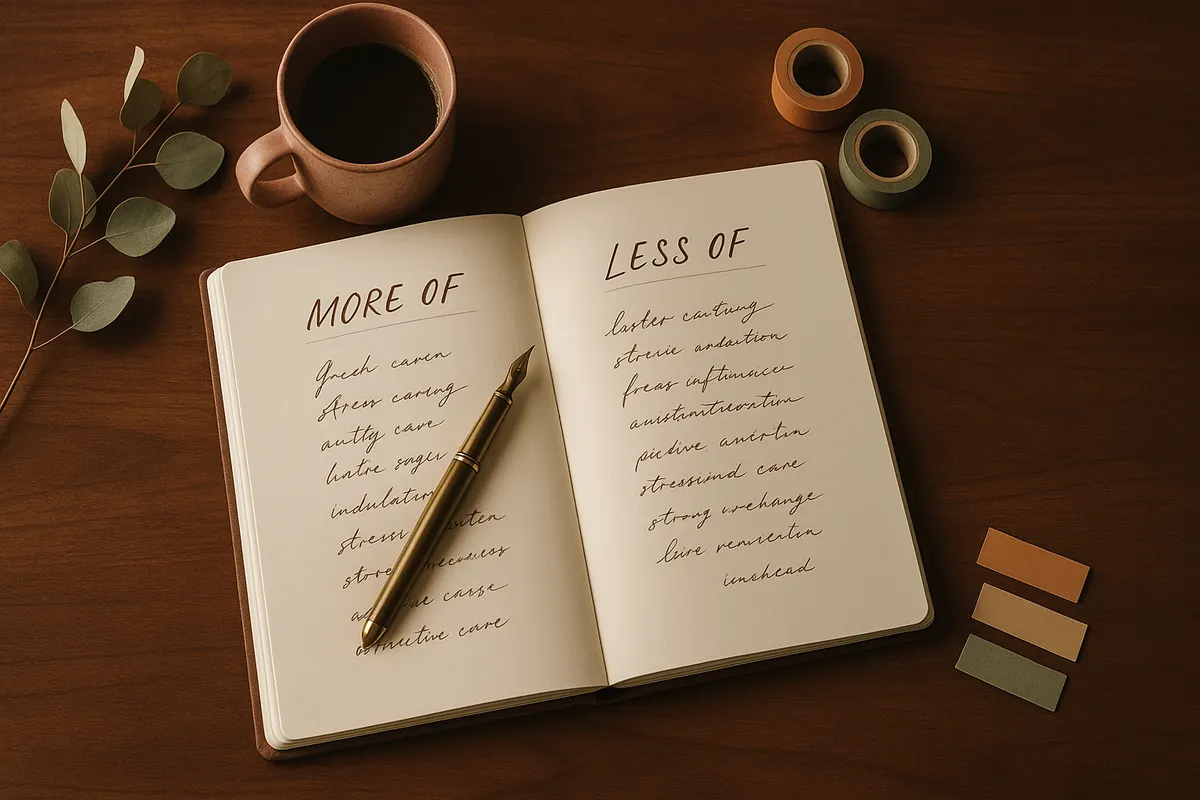
A rebrand journal is identity-shift work disguised as a creative project. You redesign your life the way a company redesigns itself: audit what isn't working, name new values, design what's next, then track the shift on the page until it becomes the thing you actually live. Resolutions promise behavior change. A rebrand journal changes who's behaving.
📌 TL;DR — 2026 Rebrand Journal
A rebrand journal is identity-shift work disguised as a creative project — the viral TikTok format treating 2026 like a personal brand overhaul. This guide includes 60 prompts across 7 journal spreads (cover page, more of/less of, audit, core values, bingo, year in pixels, song of the month), the psychology of why identity-based change holds where resolutions don't, and a 90-day integration structure rooted in James Clear's identity-based habits + Jungian individuation.
What Is a 2026 Rebrand Journal?
A 2026 rebrand journal is a structured multi-spread practice that treats the year as an identity shift, not a goal list — viral on TikTok in late 2025 / early 2026, ancient as Jungian individuation underneath.
A rebrand journal is a structured, multi-spread journaling practice that treats the move into 2026 as an identity shift rather than a goal list. The trend went viral on TikTok in late 2025 and early 2026, where creators like @tayynoell posted spreads showing how they were "rebranding" themselves the way a company would — defining new values, designing new visuals, choosing what stays and what gets retired.
The framing sounds corporate, and it is, but the underlying psychology is older than marketing. What people are really doing when they build a rebrand journal is what Jung called individuation: making conscious the version of you that has been waiting underneath, then deliberately living it forward. The 2026 packaging is new. The work is ancient.
Why "Rebrand Yourself" Works Where "New Year Resolutions" Don't
Resolutions target behavior without changing identity, and behavior loses to identity every time — rebrand journals flip the order.
Most resolutions fail in February because they target behavior without changing identity. You decide to run three times a week, but you still think of yourself as someone who isn't really a runner. The behavior loses to the identity, every time.
A rebrand journal flips the sequence. You don't start with what you'll do. You start with who you are now, who you have been pretending to be, and who you would be if no one were watching. James Clear's identity-based habit work, Carol Dweck's growth mindset research, and Jungian individuation all converge on the same insight: durable change is downstream of self-concept.
This is also why the format matters. A rebrand journal is not a one-page intention list. It is a 7-to-12-spread document you build over weeks, where each section forces you into a different layer of the question. The depth is the point.
The Anatomy of a Rebrand Journal: 7 Spreads
TikTok-viral creators converged on the same seven-spread architecture, which usually means it maps to something real about how identity shift actually moves.
The TikTok-viral structure has standardized around seven spreads, in roughly this order. You don't have to do all seven, and you don't have to do them in this order. But this is the working architecture most creators have arrived at independently, which usually means it maps to something real about how identity shift actually moves.
Spread 1: The Cover Page (Naming the Year)
The cover is where you name what 2026 is going to be. Not a list of goals. A single phrase or sentence that captures the texture you are pointing at. "The year of decisive movement." "The reclaim year." "Soft and ambitious." The naming forces specificity. It also gives you something to come back to in March when motivation has gone quiet.
Spread 2: More Of / Less Of
The most-replicated spread on the trend. A clean two-column page: things you want more of in 2026, things you want less of. This works because it sidesteps the abstract ("be happier") and goes straight to texture ("more long walks, less doom-scrolling"). It is also one of the few places in self-improvement writing where naming what you want less of is treated as equally important as naming what you want more of.
Spread 3: The Audit (What Isn't Working)
This is the spread most rebrand-journal content skips because it feels uncomfortable — closest in spirit to shadow work, which most rebrand-curious searchers eventually find themselves doing. The audit is where you write, without softening, what about your current life is not working — relationships, habits, environments, identities, beliefs about yourself. The audit is the foundation. You cannot rebrand without first naming what the old brand was failing at.
Spread 4: Core Values
The values spread (the deeper version of our core-values prompts) is where you name the four to six principles you want the new version of you to be organized around. Specificity matters more than virtue: "consistency over intensity" is more useful than "discipline." "Curiosity before judgment" is more useful than "open-mindedness." The values are the filter you will run decisions through later in the year.
Spread 5: The Bingo Board (2026 Achievements Grid)
A 5x5 grid of specific experiences, accomplishments, or risks you want to have crossed off by year's end. Bingo turns goals into a game and uses the same dopamine loop that habit trackers use, but with more variety per square. Mix small experiments ("take a pottery class," "have one stranger conversation a week") with bigger asks ("ship the project," "have the hard conversation with X").
Spread 6: Year in Pixels (Mood Tracker)
A grid of 365 small squares, color-coded by mood as the year unfolds. The point isn't the prettiness. The point is the data: by November, your year in pixels tells you which months actually held what you thought they held. Most people who do this for the first time are surprised by how different the pattern is from how they remembered the year going.
Spread 7: Song of the Month
Twelve squares (often drawn to look like mixtapes), one for the song that captured each month. This sounds purely aesthetic and it isn't. Music is one of the most reliable autobiographical memory anchors human brains have. A year of songs gives you something that the goal list can't — emotional autobiography to pair with your end-of-year reflection: emotional texture you can revisit later.
The Psychology of Identity Shift (Why This Works)
Three research streams converge: identity changes precede durable behavior changes, not the reverse — James Clear's habit research, Carol Dweck's mindset work, and Jungian individuation all point at the same mechanism.
Three research streams converge on the same finding: identity changes precede durable behavior changes, not the other way around. James Clear's identity-based habit framework, Carol Dweck's mindset research, and Walter Mischel's marshmallow studies all point at the same mechanism. You become the thing first by deciding that's who you are, then by acting from that decision repeatedly, until the gap between identity and behavior closes.
The rebrand journal works because it makes the identity layer explicit. You don't just decide to journal more. You decide that you are a person whose interior life is worth the time. The journaling is downstream of the deciding. And the spreads are the place where the deciding gets written down, dated, and made hard to walk back.
There is also a Jungian layer worth naming. What Jung called individuation — the lifelong process of making your unlived self conscious and incorporating it into who you are — is the deeper version of what a rebrand journal does at the scale of one year. The 2026 framing is small. The work behind it is the work of a lifetime, done in 12-month increments.
🛠️ Build the foundation alongside the rebrand
The audit spread (the one most rebrand-journal content skips) pairs naturally with our free shadow work worksheet generator. Most rebrands have a shadow dimension underneath — the worksheet helps you find it in 60 seconds, before it derails the rest of the work.
60 Rebrand Journal Prompts (Organized by Spread)
Pick the spread you most want to build, take the first five prompts, and let what surfaces tell you which spread to go to next. The order is not sacred; the structure is.
You don't need all 60 to start. Pick the spread you most want to build, take the first five prompts in that section, and let what surfaces tell you which spread to go to next. The order is not sacred. The structure is.
For the Cover Page (Naming 2026)
- If 2026 were a sentence, what would the sentence be?
- What did 2025 teach me that I want 2026 to reflect?
- What is the texture I want my days to have by year's end?
- What one word, if I lived from it all year, would change everything else?
- What would I want a stranger to be able to tell about me by December that they couldn't tell in January?
For More Of / Less Of
- What activities, when I look back at them, made me feel most like myself?
- What am I doing weekly that I would not miss if I never did it again?
- Who in my life do I always feel better after spending time with? Who do I always feel worse after?
- What environment, room, or location consistently improves my mood? Which one drains it?
- What did I do less of last year that I wish I had done more of?
For the Audit
- What part of my current life would I be embarrassed to defend to my future self?
- What pattern keeps showing up no matter how many times I try to change it?
- What am I tolerating that I have stopped noticing?
- What lie about myself have I been telling for the longest?
- What identity am I performing that I am actually exhausted by?
- What relationship am I in (with a person, a habit, a story) that I should have ended a year ago?
- Where in my life am I waiting for permission that no one is ever going to grant?
- What part of me have I been outsourcing — to a partner, a job, an app, a substance?
- What am I afraid would happen if I told the truth about what I really want?
- What would I have to grieve if I admitted that the old version was working?
For Core Values
- What are three moments from my life when I felt most aligned with myself? What do they have in common?
- What do I admire in others that I want to embody more deliberately?
- What boundary, if I held it for all of 2026, would change the most about how my year goes?
- What value have I been preaching but not actually practicing?
- If my values had to fit on a Post-it, which four would make the cut?
- Which value, when I betray it, makes me feel the worst about myself?
- Which value do I want to be known for by the people I love most?
- What would it look like to make decisions, just for this year, from each of these values rather than from convenience?
For the Bingo Board
- What is something I have been talking about doing for years that I could actually attempt in 2026?
- What three small experiments would tell me whether a bigger life shift is real?
- Who is one person I would love to know better that I have not reached out to?
- What skill, if I learned the basics this year, would still pay off in a decade?
- What is a place I want to have been to by December?
- What conversation have I been avoiding that I want to have had by Q3?
- What would surprise the people closest to me if I did it this year?
- What is a small bet I could make on myself that the cautious version of me would talk me out of?
For the Mood Pixels Tracker
- Which season of last year held the most aliveness? What was happening then?
- When in the year do I historically slump? What might I plan ahead for to soften that?
- What sensory cue (light, weather, sound, smell) shifts my mood the most reliably?
- What kind of week do I want to be having every single week, regardless of season?
- What was the best day of last year, and what was different about it?
- What recurring weekly ritual would be worth its own pixel?
For Song of the Month / Yearly Soundtrack
- If my year had a single album, what would the cover look like?
- What song captures the version of me I am writing toward?
- What lyric, if I lived it this year, would change something?
- What is the song from a hard period in my past that I now hear differently?
- What music am I afraid to admit I love? What would I play if no one were listening?
- If I made a playlist for the future version of me, what would be on it?
Cross-Spread Integration Prompts (The Hard Ones)
- If I lived the next 12 months as if I already were the new version, what would I do differently this week?
- What is the first piece of evidence I would need to see in February to know the rebrand is real?
- What would the old version of me say about this journal? What would I want to say back?
- Who would be most threatened by my rebrand? What does that tell me?
- What is the smallest, most boring habit that, if I held it daily, would shift everything else?
- What is the difference between a rebrand and a performance?
- If I gave the new version of me a name, what would I call them?
- What letter would I write to myself on December 31, 2026, if everything went well?
- What is the rebrand actually for? Who am I becoming, and what is the becoming in service of?
- What part of the old me, despite everything, do I want to keep?
- What is the one thing I am committing to today that I will look back on as the moment the rebrand started?
- What kind of question do I want to be the one I am still asking by year's end?
Rebrand Journal vs. New Year Resolutions: What's Different
Resolutions are willpower contracts; rebrand journals are documents — which is why one tends to last and the other dissolves by mid-February.
Resolutions are commitments. Rebrand journals are documents. That distinction is the entire reason one tends to last and the other tends to dissolve by mid-February.
Resolutions are made in a single sitting, usually under the influence of late-year emotion, and held as private willpower contracts. They are also almost always behavior-level: do X more, do Y less. They fail because they target the symptom rather than the self that produced it.
A rebrand journal is built over weeks, revisited monthly, and treats identity as the unit of change. You aren't promising to exercise. You are deciding that you are a person who moves. You aren't promising to write more. You are deciding that you are someone whose interior life is worth the time. The behavior follows the becoming, which is the order that holds.
How to Tell Your Rebrand Is Working
You will not feel like a new person by March — that's not how identity shift works. The signs are quieter: smaller decisions made differently, a January page that no longer describes you.
You will not feel like a new person by March. That is not how identity shift works, and anyone selling you otherwise is selling you a feeling, not a change. The signs are quieter than that:
- You catch yourself making a decision that the old you wouldn't have made. Not a heroic one. A small one. Saying no to the meeting. Putting the phone down at the right time. The rebrand shows up first in micro-decisions.
- The audit gets harder to read. You open the page from January and the things you wrote no longer describe you. That is the moment to celebrate, briefly, and then update the page.
- People who know you well notice something specific. Not a generic compliment. A particular observation: you seem less anxious in this kind of situation, you respond differently when X happens.
- You stop needing to talk about the rebrand. The first signal that a new identity has taken is that you stop having to perform it. The work goes underground because it has become the floor you are standing on, not the project you are running.
The Common Mistakes That Make a Rebrand Journal Fail
Four patterns kill rebrand journals faster than anything else, and all four are avoidable — aesthetic over structure, all-spreads-at-once, skipping the audit, and never reviewing.
Four patterns kill rebrand journals faster than anything else, and all four are avoidable.
- Treating it as aesthetic instead of structural. Beautiful spreads with no audit underneath are decoration. The journal works when the design is in service of the depth, not the reverse.
- Building all seven spreads in week one. The journal is supposed to unfold across January and February. Building it all at once means the deeper layers don't get the time they need to surface honest material.
- Skipping the audit. Most people want to build the values and bingo spreads and avoid the audit. The journal does not work without the audit. Naming what isn't working is the first creative act of the new version.
- Reviewing it once and never again. The rebrand journal is a living document. Monthly reviews (last Sunday of each month works) are where the journal becomes more than a January artifact.
Rebrand Journaling With a Mentor in the Room
The hardest part of a rebrand journal isn't writing the spreads. It's looking at what you wrote and not flinching away from it. Most people can identify the audit material; few can stay with it long enough to let it actually change something.
This is where journaling with an AI mentor shifts the practice. Inside Life Note, you can put your audit spread into dialogue with Carl Jung, who treated identity shift as the central work of adulthood. You can take your values draft to the Stoics, who refined the art of values-led living for two thousand years. You can run your bingo board past Marie Curie or Maya Angelou or whoever in our 1,000-mentor library best matches the kind of becoming you are pointed at.
For the foundational journaling skills the rebrand depends on, our free shadow work worksheet generator pairs naturally with the audit spread. Most rebrands have a shadow dimension; the worksheet helps you find it before it derails the rest of the work.
Research and Inspiration
The rebrand journal is a popular framing of a much older idea. The intellectual lineage worth citing:
- Clear, J. (2018). Atomic habits: An easy & proven way to build good habits & break bad ones. Avery. (For the identity-based habit framework underneath what makes rebrands stick.)
- Dweck, C. S. (2006). Mindset: The new psychology of success. Random House. (For the growth mindset research showing that beliefs about identity precede behavior change.)
- Jung, C. G. (1933). Modern man in search of a soul (W. S. Dell & C. F. Baynes, Trans.). Harcourt, Brace. (For the philosophical foundation of individuation as identity work.)
- Pennebaker, J. W., & Smyth, J. M. (2016). Opening up by writing it down: How expressive writing improves health and eases emotional pain (3rd ed.). Guilford Press. (For the underlying mechanism by which structured journaling produces change.)
- Burkeman, O. (2021). Four thousand weeks: Time management for mortals. Farrar, Straus and Giroux. (For the framing of why year-anchored identity work matters more than productivity work.)
Frequently Asked Questions
How long does it take to set up a rebrand journal?
Plan on three to four weeks of intermittent work, not one weekend. You can build the cover page and more-of/less-of spreads in an evening. The audit, values, and integration prompts work better when spread across January and into February — material surfaces over time that doesn't surface in a single sitting.
Do I need a physical journal or can I do this digitally?
Either works. The TikTok-viral version is heavily physical because of the aesthetic component, but the psychological mechanism (writing identity shift into specific language and revisiting it) is medium-neutral. If you'd rather work in a digital tool with a mentor that responds to what you write, that's what Life Note was built for.
What if I'm starting this mid-year, not in January?
Start anyway. Rename it. "Q2 rebrand" or "Summer rebrand" or "After-the-breakup rebrand" all work. The framing isn't sacred to the calendar; it's a frame for identity-shift work, and identity-shift work happens whenever you're ready to do it.
Can a rebrand journal help with depression or anxiety?
It can complement clinical work, but it is not a treatment. If you are in active depression or anxiety severe enough to disrupt daily functioning, the rebrand journal is best done alongside therapy, not instead of it. For mid-life flatness that doesn't meet clinical thresholds, see our companion piece on languishing — which is closer to what most "rebrand-curious" searchers are actually trying to address.
How is this different from a vision board?
A vision board is aspirational; it shows where you want to go. A rebrand journal is structural; it works on who you are now, what you are leaving behind, and what new identity the goals are downstream of. The vision board is the destination. The rebrand journal is the redesign of the vehicle.
What if my rebrand stalls by March?
Most do, and that is information, not failure. A stalled rebrand usually means one of three things: the audit was too shallow, the values were too generic, or the goals were behavioral when they needed to be identity-level. Revisit those three spreads — in that order — and ask which one isn't pulling its weight. The rebrand restarts from there.

Journal with 1,000+ of History's Greatest Minds
Carl Jung, Marcus Aurelius, Lao Tzu: replies grounded in their original works, each citing its source. Co-developed with a licensed psychotherapist.
Try Life Note Free