
Word of the Year 2026: 100+ Word Ideas + Free Generator to Find Yours

Instead of a hundred resolutions, choose one word. A single word that captures who you want to become in 2026.

📌 TL;DR — Word of the Year 2026
A word of the year is a single word that captures your intention for the next 12 months. Unlike resolutions, it's flexible and memorable—a compass for decisions throughout the year. Popular words for 2026 include: Growth, Balance, Courage, Peace, Joy, Focus, and Connection. Choose one that creates genuine emotional resonance when you say it.
🔮 Find Your Word of the Year
Answer 5 quick questions to discover your perfect word for 2026
Word of the Year 2026: Your Complete Guide to Word Ideas & Finding Your Perfect 2026 Word
Every January, millions of people write down ten, twenty, sometimes fifty resolutions. By February, most have forgotten them. By March, the list is buried under a stack of papers or lost in a notes app they never open.
There's a simpler approach.
Instead of a list, choose one word. A single word that captures:
- Who you want to become
- How you want to feel
- What you want to focus on for the entire 12 months
This is the Word of the Year practice—and it's quietly become one of the most effective tools for personal change because it works with human psychology rather than against it.
This guide will help you find your word for 2026. Not a word that sounds impressive, but one that actually means something to you—one you'll remember in July when the new year enthusiasm has faded and real life has taken over.
What Is a Word of the Year?
A word of the year is a single guiding intention you choose to shape your decisions, replacing rigid resolutions with a flexible north star for growth.
A Word of the Year is a single word chosen as your guiding theme, intention, or focus for the next twelve months. It is not a goal, a resolution, or a measurable target. It functions more like a compass bearing — a direction you want to move toward that can adapt to changing circumstances throughout the year. Where goals are specific and measurable ("lose 15 pounds," "save $10,000"), a word is expansive and flexible enough to apply to your career, relationships, health, creativity, and every other area of life simultaneously. The practice has roots in contemplative traditions: monks and spiritual practitioners have long used single words or short phrases as anchors for attention and intention. In modern usage, the Word of the Year practice gained widespread popularity through bloggers, educators, and personal development communities in the early 2010s. Research on goal-setting by psychologist Edwin Locke, published in American Psychologist (2002), supports the principle that broad, meaningful intentions can be more psychologically sustainable than narrow targets because they activate intrinsic motivation rather than relying on external accountability. A 2020 survey by Christine Kane found that 78% of people who chose a single word reported feeling more aligned with their values at year’s end, compared to 35% of resolution-setters.
Where goals are specific and measurable ("lose 15 pounds," "save $10,000"), a word is expansive and adaptable. It can apply to your career, your relationships, your health, your creativity—every area of your life.
The practice has roots in various traditions. Monks and contemplatives have long used single words or short phrases as anchors for attention. In Zen Buddhism, a koan—a paradoxical statement or question—serves a similar focusing function. The modern Word of the Year practice adapts this ancient wisdom for contemporary life.
Why One Word Works Better Than Many Goals
The human brain has limited executive function. Every decision, every act of willpower, draws from the same finite pool. When you set fifteen resolutions, you're asking your brain to track, prioritize, and execute on fifteen different fronts simultaneously. No wonder most people fail.
A single word solves this problem. Instead of remembering a list, you remember a feeling, an orientation, a way of being. The word becomes a filter for decisions. When an opportunity arises, you can ask: "Does this align with my word?" When you're unsure how to respond to a situation, you can ask: "What would someone embodying this word do?"
Research on implementation intentions—the psychology of follow-through—shows that simple, memorable cues dramatically increase behavior change. A word is the simplest cue possible.
Word of the Year Categories
| Category | Example Words | Best For |
|---|---|---|
| Growth | Expand, Evolve, Rise, Flourish | Career or personal development focus |
| Peace | Calm, Rest, Stillness, Ease | Reducing stress or anxiety |
| Action | Begin, Create, Build, Launch | Starting new projects |
| Connection | Love, Together, Belong, Community | Improving relationships |
| Self-Worth | Worthy, Enough, Brave, Confident | Building self-esteem |
| Presence | Now, Here, Present, Mindful | Living in the moment |
The Psychology Behind Why This Practice Works
Single-word intentions activate your brain's reticular activating system, filtering decisions through one clear lens instead of scattering focus across multiple resolutions.
The Word of the Year practice succeeds where traditional resolutions fail because it aligns with several well-documented principles of behavioral psychology. First, it leverages identity-based change rather than outcome-based goal-setting. James Clear, in Atomic Habits, explains that lasting behavior change occurs when people shift their self-concept ("I am becoming someone who embodies courage") rather than pursuing external targets ("I will speak up in three meetings this month"). Second, the practice exploits what psychologists call the "priming effect" — research by John Bargh at Yale University, published in the Journal of Personality and Social Psychology (1996), demonstrated that exposure to a single concept can unconsciously influence subsequent decisions and behaviors for extended periods. When you choose a word and encounter it repeatedly throughout the year, it primes your brain to notice opportunities and make choices consistent with that intention. Third, the Word of the Year practice leverages the reticular activating system (RAS), a network of neurons in the brainstem that filters incoming information based on current priorities. Once you declare a focus word, your brain begins selectively attending to information, people, and opportunities related to that word — a cognitive phenomenon similar to why you suddenly notice a car model everywhere after deciding to buy one.
Identity Over Behavior
James Clear, in Atomic Habits, distinguishes between outcome-based goals and identity-based goals. Outcome-based: "I want to lose weight." Identity-based: "I want to become someone who takes care of their body."
A Word of the Year is inherently identity-based. You're not saying "I will exercise more." You're saying "I am becoming someone who embodies vitality" or "strength" or "movement." This shift matters. When behavior change is tied to identity, it becomes self-reinforcing rather than requiring constant willpower.
Flexibility Within Structure
Life is unpredictable. The resolution you set in January may become irrelevant by April due to circumstances you couldn't foresee. A specific goal can become a source of guilt when conditions change.
A word adapts. If your word is "courage," it applies whether you're facing a difficult conversation, a career change, a health challenge, or a creative project. The word stays constant while its applications evolve. Unlike fake news or social media trends that change daily, your 2026 word provides stable direction.
Priming and the Reticular Activating System
Your brain filters millions of bits of information every second, letting through only what it deems relevant. The reticular activating system (RAS) is partly responsible for this filtering. When you choose a word and hold it in your awareness, you're programming your RAS to notice opportunities, resources, and connections related to that word.
Choose "abundance," and you'll start noticing abundance everywhere—in small moments you previously overlooked. Choose "simplicity," and you'll find yourself naturally drawn to decisions that reduce complexity.
This isn't magical thinking. It's how attention works. What you focus on expands—not because the universe is rearranging itself, but because your perception is sharpening.
How to Choose Your Word of the Year for 2026
Choose your word by reflecting on what you most need right now — not what sounds impressive — then test it against real decisions you're currently facing.
Choosing a Word of the Year requires honest self-reflection and a willingness to sit with uncertainty rather than rushing to a decision. The goal is resonance — selecting a word that produces an immediate felt sense of recognition, a quiet internal "yes" that signals alignment between the word and your deeper aspirations. Research on "felt meaning" by psychologist Eugene Gendlin, author of Focusing (1978), suggests that the body often registers the rightness of a choice before the rational mind can articulate why. The most effective approach combines backward reflection (examining the past year’s patterns, challenges, and growth) with forward imagination (envisioning who you want to become in the year ahead). Psychologist Daniel Kahneman’s research on the "peak-end rule," published in Psychological Science (1993), demonstrates that people remember experiences primarily by their emotional peaks and endings, which means reviewing the most intense and most recent moments of your past year will reveal your deepest needs more reliably than trying to recall every event chronologically. The word that sounds impressive on a vision board is not necessarily the word that will serve you. The right word often surprises you.
Step 1: Reflect on the Year Behind You
Before looking forward, look back. Understanding where you've been helps clarify where you want to go.
Ask yourself:
- What were my biggest wins this year? What made them possible?
- What were my biggest struggles? What was I lacking or needing?
- What moments made me feel most alive, most myself?
- What moments made me feel drained, frustrated, or lost?
- If I could change one pattern from this year, what would it be?
- What did I start that I want to continue? What did I avoid that I want to face?
Write your answers down. Don't censor yourself. The patterns that emerge will point toward what you need.
Step 2: Imagine Your Ideal Year Ahead
Now project forward. Imagine it's December 2026. The year has gone as well as you could hope. What happened? How do you feel?
Ask yourself:
- What would make 2026 a successful year for me—not by society's standards, but by my own?
- How do I want to feel on a typical day?
- What relationships do I want to strengthen or heal?
- What work do I want to be doing, and how do I want to be doing it?
- What do I want to stop tolerating?
- What do I want to start prioritizing?
Again, write it down. The act of writing externalizes your thoughts and makes them easier to examine.
Step 3: Identify the Gap
Compare your reflection on the past year with your vision for the year ahead. Where's the gap? What quality, mindset, or energy would bridge the distance between who you were and who you want to become?
This gap is where your word lives.
If you felt scattered and want to feel focused, your word might be: clarity, intention, or depth.
If you felt isolated and want connection, your word might be: belonging, openness, or community.
If you felt stagnant and want growth, your word might be: momentum, courage, or expansion.
Step 4: Brainstorm Candidate Words
Don't commit to the first word that comes to mind. Generate options. Write down every word that resonates, even if it seems too simple or too ambitious.
Try different angles:
- Feeling words: How do you want to feel? (alive, peaceful, grounded, joyful)
- Being words: Who do you want to become? (present, generous, bold, authentic)
- Action words: What do you want to do more of? (create, rest, connect, explore)
- Relationship words: How do you want to relate to others? (kindness, boundaries, intimacy)
Aim for at least 10-15 candidates before narrowing down.
Step 5: Test Your Finalists
Once you have a shortlist, test each word against real scenarios from your life:
- How would this word guide me if I faced a difficult conversation with a family member?
- How would this word influence a decision about my work or career?
- How would this word help me when I'm feeling anxious, stuck, or overwhelmed?
- Can I imagine returning to this word in August when new year motivation has faded?
The right word should feel applicable across multiple domains. If a word only works for one area of your life, it might be too narrow.
Step 6: Choose—and Commit
At some point, you have to decide. Don't wait for perfect certainty. Choose the word that creates the strongest pull, even if it also creates some fear or discomfort.
Often, the word that slightly scares you is the word you need. Growth lives at the edge of comfort.
Write your word down. Say it out loud. Let it become real.
100 Word of the Year Ideas for 2026
These 100 words span ten life categories — from courage to creativity — so you can find the single intention that resonates with where you are right now.
If you're stuck, these words can spark ideas. Don't just pick one because it sounds good—use this list as a starting point, then do the reflection work to find what truly fits.
Words for Grounding and Presence
- Presence
- Stillness
- Grounded
- Anchor
- Rooted
- Slow
- Breathe
- Here
- Embodied
- Settled
Words for Growth and Expansion
- Growth
- Expand
- Bloom
- Rise
- Stretch
- Evolve
- Ascend
- Flourish
- Unfold
- Thrive
Words for Courage and Action
- Courage
- Bold
- Brave
- Leap
- Dare
- Action
- Move
- Risk
- Forward
- Initiative
Words for Peace and Calm
- Peace
- Calm
- Ease
- Serenity
- Tranquil
- Rest
- Gentle
- Soft
- Release
- Surrender
Words for Connection and Love
- Love
- Connection
- Belonging
- Intimacy
- Community
- Together
- Warmth
- Heart
- Tender
- Open
Words for Focus and Clarity
- Focus
- Clarity
- Intention
- Purpose
- Direction
- Precision
- Depth
- Essence
- Priority
- Simplicity
Words for Joy and Lightness
- Joy
- Play
- Delight
- Wonder
- Light
- Fun
- Laughter
- Spark
- Alive
- Celebrate
Words for Strength and Power
- Strength
- Power
- Resilience
- Endurance
- Solid
- Fierce
- Unshakeable
- Steadfast
- Backbone
- Capable
Words for Freedom and Space
- Freedom
- Space
- Liberate
- Unbound
- Breathe
- Spacious
- Limitless
- Flow
- Detach
- Unburdened
Words for Authenticity and Truth
- Authentic
- Truth
- Real
- Honest
- Integrity
- Genuine
- Voice
- Self
- Unapologetic
- Whole
What to Do After You Choose Your Word
Anchor your word into daily life by placing visual reminders, journaling weekly, and using it as a decision filter for every meaningful choice you face.
Choosing a Word of the Year is the starting point; the real transformation comes from integrating that word into the daily fabric of your life so it becomes a living practice rather than a forgotten concept. Research on implementation intentions by psychologist Peter Gollwitzer at New York University, published in American Psychologist (1999), shows that abstract intentions ("I want to be more courageous") become dramatically more effective when paired with concrete environmental cues and daily rituals. The integration process involves three layers: visibility (placing your word where you encounter it passively throughout the day), reflection (scheduling regular check-ins where you assess how the word is showing up in your decisions), and application (creating specific if-then plans for how to act on your word in predictable situations). Studies on "spaced repetition" in cognitive science, originally documented by Hermann Ebbinghaus in 1885 and confirmed by modern research at the University of California, demonstrate that repeated, distributed exposure to a concept strengthens neural encoding far more effectively than a single intense session. A word you see on your bathroom mirror every morning and revisit in a weekly journal entry will reshape your decision-making patterns more powerfully than a word you chose enthusiastically in January and forgot by March.
Make It Visible
Write your word where you'll see it regularly. Options:
- A sticky note on your bathroom mirror
- The lock screen on your phone
- A piece of jewelry or object that reminds you
- The first page of your journal
- A small card in your wallet
The goal is passive reminding. You want your word to catch your eye when you're not actively thinking about it, bringing you back to your intention throughout ordinary moments.
Create a Morning Anchor
Spend 30 seconds each morning connecting with your word. This can be as simple as:
- Writing it in your journal
- Saying it silently during your first few breaths
- Asking yourself: "How can I embody [word] today?"
This brief ritual primes your subconscious for the day ahead.
Use It as a Decision Filter
When facing choices—big or small—run them through your word. If your word is "spacious," ask: "Will this choice create more space or less?" If your word is "courage," ask: "Which option requires more courage?" If your word is "depth," ask: "Which path leads to deeper experience?"
You won't always follow the word's guidance, and that's fine. But asking the question keeps your intention active.
Journal with Your Word
Use your word as a journaling prompt throughout the year. Questions to explore:
- How did I embody [word] today?
- When did I forget my word? What can I learn from that?
- What does [word] mean to me this month that it didn't mean last month?
- Where am I resisting my word? Why?
- How is my word showing up in my relationships? My work? My inner life?
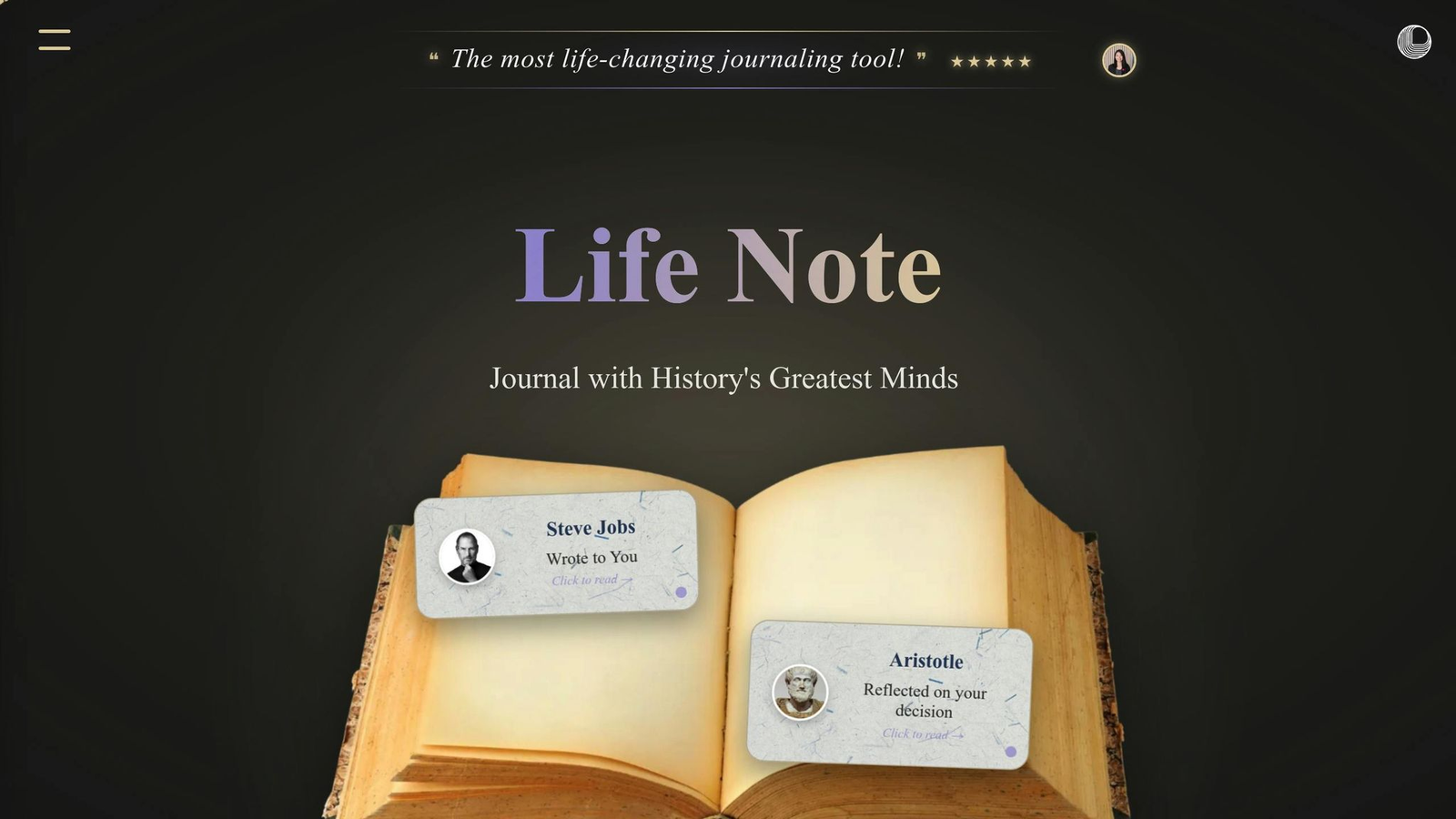
Life Note has a goal planning feature designed exactly for this—you can set your word or theme for the year and journal your progress with guidance from history's greatest minds. Imagine reflecting on your word with Aristotle asking about virtue, or Carl Jung prompting you to explore what your word reveals about your shadow. These AI mentors help you see dimensions of your word you might miss on your own.
Review Monthly
Set a recurring reminder—perhaps the first of each month—to check in with your word. Ask:
- Is this word still relevant?
- How has my understanding of it changed?
- What actions has it inspired?
- What am I avoiding that my word is calling me toward?
These monthly check-ins prevent the word from becoming background noise. They keep it alive and active.
Let It Evolve
Your understanding of your word will deepen over the year. "Courage" in January might mean speaking up at work. "Courage" in September might mean setting a difficult boundary with family. The word stays the same, but its application grows.
Some people discover by mid-year that their word has layers they didn't initially see. Others find that a different word is calling them. Both are valid. The practice is about awareness and intention, not rigid adherence.
Common Mistakes to Avoid
The biggest mistake is choosing an aspirational-sounding word you don't actually need, then abandoning it by March because it never felt personally relevant.
Choosing a Word That Sounds Good but Doesn't Fit
Words like "abundance" or "manifestation" are popular, but if they don't connect to your actual life and struggles, they'll ring hollow. Choose for resonance, not aesthetics. This isn't about finding a word that would trend on social media—it's about finding one that moves you.
Picking a Word Someone Else Would Choose for You
If your boss would pick "hustle" for you, that's probably not your word. If your partner would pick "balance" for you because they think you work too much, that's their projection, not your truth. Your word should come from your own inner knowing, not external expectations.
Selecting a Word You've Already Mastered
The word should stretch you. If "organization" comes easily to you, it's not the word you need. Look for the edge—the quality that would represent growth, not comfort.
Forgetting the Word by February
A word without integration is just a nice idea. Use the practices above to keep your word alive. If you find yourself forgetting, that's information too—what's getting in the way?
Being Too Rigid
Your word is a guide, not a cage. If life takes unexpected turns and a different word emerges as more relevant, you can pivot. The goal is intentional living, not perfect adherence to a word you chose in January.
What If You Can't Choose Just One?
If you cannot narrow down to one word, choose two or three that complement each other — your true word will naturally emerge as the year unfolds.
Some people genuinely can't narrow to one word. If you're torn between two, consider:
Are they actually the same thing? "Peace" and "calm" might be close enough that either would work. Choose the one that feels more alive.
Is one the path to the other? Maybe "courage" is what you need to practice to eventually feel "free." In that case, "courage" is your word—"freedom" is the destination.
Can you make them a phrase? Some people use a two-word phrase like "gentle strength" or "bold rest." This can work, though one word is easier to remember and more versatile.
If you're still stuck, pick one for the first half of the year and give yourself permission to switch at the six-month mark. Starting with one imperfect word beats waiting for the perfect word that never comes.
💡 Make your word stick: Use AI journaling to reflect on your word weekly. It helps you notice when you're living your word—and when you're drifting from it.
Examples of Words in Action
Real examples show how abstract words like 'boundaries' and 'surrender' translate into concrete daily decisions, career pivots, and relationship changes throughout an entire year.
To make this concrete, here's how different words might play out across a year:
Word: Boundaries
- January: Say no to a commitment that doesn't serve you
- March: Have a conversation with a family member about your limits
- June: Set work hours and actually stick to them
- September: Recognize emotional boundaries, not just time boundaries
- December: Notice how much easier "no" has become—and how much more meaningful "yes" feels
Word: Play
- January: Try a new hobby with no goal of being good at it
- March: Bring more lightness to serious conversations
- June: Take a trip without a rigid itinerary
- September: Notice when you're taking yourself too seriously and choose differently
- December: Realize play has made you more creative and less anxious, not less productive
Word: Depth
- January: Read one book slowly instead of racing through five
- March: Have longer conversations with fewer people instead of surface chat with many
- June: Go deeper in your journaling practice instead of starting new habits
- September: Choose mastery in one skill rather than dabbling in three
- December: Feel the richness that comes from depth rather than breadth
What Dictionary Publishers Chose as Word of the Year 2026
Major dictionaries select words reflecting cultural shifts — these editorial picks capture the collective mood but shouldn't replace your personal, intentional choice.
Each year, major dictionary publishers select their own Word of the Year based on search trends, cultural relevance, and linguistic significance. These choices often reflect what's happening in the English language and broader society.
Merriam-Webster's Approach
Merriam-Webster, the oldest American English dictionary publisher, bases their selection on lookup data and cultural impact. Recent years have seen them choose words reflecting technology, social media culture, and societal shifts.
Their word lists often include terms that gained prominence through:
- Artificial intelligence and technology advances
- Political and social discourse
- Viral moments and social media trends
- Scientific developments
Understanding Word Trends
The words that trend on social media often differ from traditional dictionary selections. Slang terms like "aura farming" (building your personal energy or reputation) emerge from internet culture, while phenomena like "rage bait"—online content deliberately designed to elicit anger or outrage—reflect how we engage with digital spaces.
Your personal Word of the Year doesn't need to match what Merriam-Webster or other publishers choose. It should reflect your individual journey for the next 12 months, not trending vocabulary.
Beyond Trending Words
While dictionary selections and social media trends are interesting, your 2026 word should be timeless enough to guide you through the entire year. Words like "authentic," "courage," or "depth" transcend viral moments and offer lasting direction.
How to Use a Word of the Year Generator
A word-of-the-year generator asks reflective questions about your current life and suggests words aligned with your actual needs, removing overthinking from the process.
If you're stuck, a word of the year generator or word generator tool can help spark ideas. These tools work by asking you questions about your values, challenges, and aspirations, then suggesting words that match your responses.
How Word Generators Work
Most word generator tools use one of these approaches:
- Quiz-based: Answer questions about your goals and personality, get word suggestions
- Random generation: Browse word lists organized by theme or category
- AI-powered: Use artificial intelligence to analyze your journal entries or responses
The Life Note Word Generator
Life Note offers an AI-powered approach to finding your word. Instead of generic quizzes, it analyzes your journal reflections and suggests words based on patterns in your actual thoughts and feelings—making the suggestion deeply personal.
DIY Word Generation
You don't need a tool to generate word options. Try this simple exercise:
- Set a timer for 5 minutes
- Write down every word that comes to mind when you think about 2026
- Don't filter—include feelings, qualities, actions, even random associations
- Review your list and circle words that create an emotional response
- Narrow to your top 3-5 candidates
This DIY word generator approach often produces more meaningful results than automated tools because it comes from your own subconscious.
Important Considerations and Limitations
Choosing a word of the year can be a powerful intention-setting practice, but it works best when approached with realistic expectations.
A word is not a plan. Research on goal-setting (Locke & Latham, 2002) consistently shows that specific, measurable goals outperform vague intentions. A word of the year works best as a guiding theme alongside concrete goals — not as a replacement for actionable planning. "Growth" as a word is inspiring; "read 24 books and complete one online course" is effective.
Watch for toxic positivity. Words like "joy," "peace," or "abundance" can inadvertently pressure you to suppress difficult emotions when life gets hard. Grief, frustration, and uncertainty are normal parts of any year. If your word starts to feel like an obligation rather than an inspiration, give yourself permission to let it evolve or release it entirely.
Abandonment is common — and fine. Most people stop thinking about their word of the year by March. This is not a personal failing — it reflects how motivation naturally fluctuates. If your word stops resonating, choose a new one. The value is in the reflection process itself, not in rigid year-long adherence.
It works better with structure. Simply choosing a word produces a brief motivational boost. Pairing it with regular check-ins — monthly journaling, quarterly reviews, or visual reminders — creates the reinforcement loop that turns intention into sustained behavior change.
FAQ
These frequently asked questions address the most common concerns about choosing, changing, and living with a word of the year throughout all twelve months.
When should I choose my Word of the Year?
Many people choose in late December or the first week of January. But there's no wrong time. Some prefer to wait until mid-January when the holiday chaos has settled. Others choose on their birthday or at the start of a new season. The "right" time is when you have space to reflect honestly.
What if my word doesn't resonate anymore mid-year?
Words can evolve, and so can you. If your circumstances change dramatically—a job loss, a new relationship, a health crisis—your word might no longer fit. It's okay to choose a new word. The practice is about intention, not rigidity. That said, sometimes discomfort with a word means you're avoiding what you need to face. Journal on it before switching.
Should I share my word with others?
This is personal. Some people find accountability and conversation valuable—sharing with a close friend can deepen your commitment. Others prefer to keep their word private, letting it be an intimate dialogue between themselves and their intentions. There's no right answer.
Can I have different words for different areas of life?
You can, but it dilutes the power of the practice. The beauty of one word is its simplicity and universal applicability. If you have separate words for work, health, and relationships, you're back to managing a list. Try finding the one word that threads through all areas.
Research Foundation
| Study | Finding | Implication |
|---|---|---|
| Gollwitzer & Sheeran (2006) | Meta-analysis of 94 studies found implementation intentions have a medium-to-large effect on goal attainment (d=.65) | Frame your word as an if-then plan to double follow-through |
| Sheldon & Elliot (1999) | People pursuing self-concordant goals (aligned with values) exert more sustained effort and reap greater well-being | Choose a word reflecting core values, not external pressure |
| Locke & Latham (2002) | 35-year review: specific, challenging goals produce higher performance than vague goals (d=.42-.80) | A single specific word gives a clearer target than broad resolutions |
| Cascio et al. (2016) | fMRI showed self-affirmation activates brain reward and self-processing systems, predicting behavior change | Reflecting on your chosen word activates the same circuits as achievement |
| Steele (1988) | Affirming core personal values restores self-integrity after threat and reduces defensiveness | A values-based word acts as a self-affirmation anchor during setbacks |
| Cohen & Sherman (2014) | Self-affirmation interventions improve education, health, and relationship outcomes through recursive cycles | Even brief daily reconnection with your word compounds over time |
What if nothing feels right?
If no word resonates after genuine reflection, you might be overthinking it. Sometimes the "right" word is the one that keeps coming back, even if it doesn't feel exciting. Sometimes you need to live with a word for a few weeks before it clicks. Choose something, commit for a month, and reassess.
Is this just positive thinking dressed up?
No. A Word of the Year isn't about pretending everything is fine or forcing positivity. Your word can be "grief" if you're processing loss. It can be "boundaries" if you're learning to protect yourself. It can be "slow" if you're recovering from burnout. The word reflects what you need, not what looks good on Instagram.
Your Word Is Waiting
Your perfect word already exists in the gap between where you are and where you want to be — trust the one that keeps pulling your attention back.
Somewhere in your reflection—in the gap between who you've been and who you're becoming—your word is already there. It might be obvious, arriving with quiet certainty. It might be surprising, uncomfortable, even a little scary.
Whatever it is, trust it. A single word, held with intention over twelve months, can reshape a life. Not through magic, but through the accumulated power of focused attention, repeated choice, and consistent return to what matters.
The new year doesn't need a hundred resolutions. It needs one word, chosen with care and carried with commitment.
What will yours be?
Related Resources
Journal with 1,000+ of History's Greatest Minds
Marcus Aurelius, Maya Angelou, Carl Jung — real wisdom from real thinkers, not internet summaries. A licensed psychotherapist called it "life-changing."
Try Life Note Free