
Ultimate Guide to Journaling for Creativity

Science-backed journaling methods, prompts and visual techniques to spark creativity, reduce stress, and build a 5–10 minute daily writing habit.

Explore More
Continue your journey:
- Creative Journaling: 40+ Prompts — The complete guide
📌 TL;DR — Journaling for Creativity
Journaling unlocks creativity by capturing ideas, overcoming blocks, and connecting disparate thoughts. Techniques: morning pages (stream of consciousness), idea capture (always carry a notebook), creative prompts, mind mapping, and reviewing old entries for forgotten inspiration. Creativity is a practice, not just a gift.
Journaling is a simple yet powerful way to boost your thinking, improve focus, and organize your thoughts. By writing regularly, you can reduce mental clutter, sharpen problem-solving skills, and even enhance emotional clarity. Research shows that journaling can improve performance by 25% and reduce stress, making it a great tool for personal growth.
Key takeaways from the guide:
- Daily Writing: Even 5–10 minutes can make a difference.
- Techniques: Use methods like stream-of-consciousness writing, prompts, or visual journaling.
- Benefits: Improves memory, emotional regulation, and generates new ideas.
- Historical Examples: Figures like Leonardo da Vinci and Frida Kahlo used journaling for reflection and idea generation.
- Tools: Apps like Life Note combine journaling with AI insights for deeper reflection.
Whether you're new to journaling or experienced, this guide provides practical methods and tools to make journaling a regular part of your routine. Start small, stay consistent, and let your journal become a space to organize and design your ideas.
The Science and Benefits of Journaling for Creativity
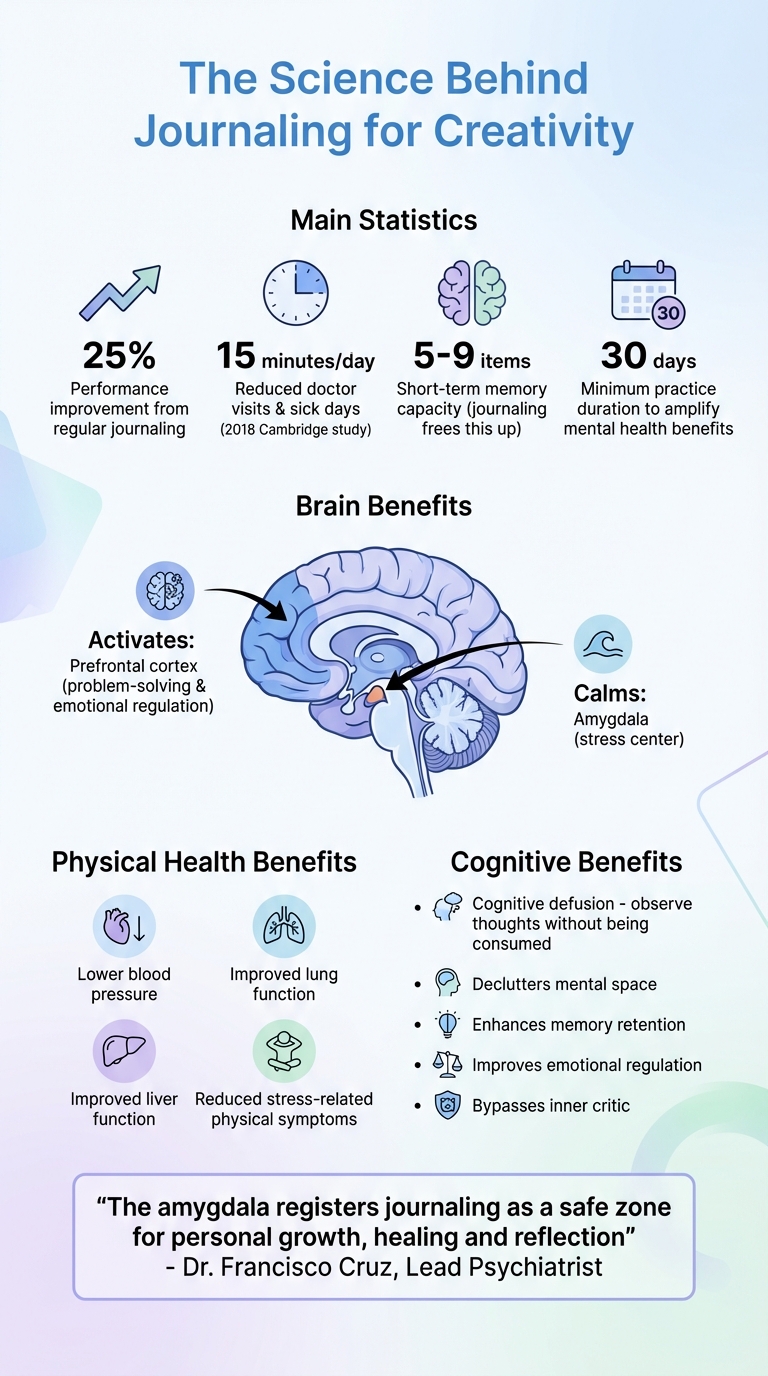
Science-Backed Benefits of Daily Journaling for Creativity and Mental Health
How Journaling Improves Creative Thinking
Journaling taps into both the conscious and subconscious parts of your mind. When you use structured prompts, like tracking habits, you engage your conscious mind to organize and process information. On the other hand, open-ended prompts, such as asking yourself, "What’s holding me back from doing this?", encourage your subconscious to uncover solutions you might not have considered before [5].
This practice fosters what psychologists call cognitive defusion - the ability to observe your thoughts without being consumed by them [8]. Writing your thoughts down turns them into tangible objects you can analyze, challenge, or even reshape. Techniques like stream-of-consciousness writing, exemplified by Julia Cameron's Morning Pages, help bypass the inner critic, allowing ideas to flow freely without judgment. Cameron describes this method as a way to "provoke, clarify, comfort, cajole, prioritize and synchronize the day at hand" [5][3]. Writing early in the day, before self-doubt creeps in, can discover creative energy that often gets stifled later.
Beyond sparking new ideas, journaling promotes emotional clarity and reduces mental strain, creating the perfect environment for creativity to thrive.
Emotional and Psychological Benefits
Creativity often falters when your mind feels overloaded. Journaling helps declutter your thoughts by moving them out of your head and onto the page. This process frees up your short-term memory, which can only juggle 5 to 9 items at a time [10]. Writing also activates the prefrontal cortex - the part of the brain responsible for problem-solving and emotional regulation - while calming the amygdala, the brain’s stress center [9][11]. Dr. Francisco Cruz, Lead Psychiatrist at Ketamine Health Centers, explains that "the amygdala... registers journaling as a safe zone for personal growth, healing and reflection" [6].
The benefits of journaling extend beyond mental clarity. A 2018 Cambridge study revealed that just 15 minutes of reflective writing per day reduced doctor visits and sick days over the following four months [6]. Other research shows that journaling can lower blood pressure and improve lung and liver function, mitigating the physical effects of stress that can stifle creativity [8]. By cultivating self-awareness, journaling helps dismantle creative blocks. Sticking with the practice for at least 30 days seems to amplify these mental health benefits [8].
With a clearer mind and reduced stress, you’re better equipped to explore new ideas - just like some of history’s most creative thinkers.
Examples of Creative Breakthroughs
Many of history’s greatest innovators relied on journaling to fuel their creativity. Leonardo da Vinci’s notebooks, such as the Codex Leicester, are a testament to unstructured thinking. His pages jump between inventions, anatomical drawings, and architectural designs, demonstrating how free-flowing ideas can lead to unexpected connections and innovations that shaped the Renaissance [5].
Frida Kahlo used her diary as a space for raw emotional expression, blending text with sketches to transform her physical and emotional pain into art [5][3]. Similarly, Marcus Aurelius turned his journal into a tool for self-reflection, asking profound philosophical questions and examining his limitations. His writings, later published as Meditations, provided insights that guided his leadership [5]. Even Albert Einstein reportedly used dream journaling and reflective practices to develop his groundbreaking scientific theories [3].
These examples show that journaling isn’t about crafting perfect prose. It’s about creating a private space where your thoughts can roam, connect, and spark ideas that might otherwise remain hidden.
Techniques and Methods for Creative Journaling
Once you understand the benefits of journaling, the next step is to explore techniques that help discover your creativity. Different methods cater to different needs - some are great for overcoming mental blocks, while others encourage deeper reflection. The trick is to find approaches that suit your style and feel natural to maintain. Here are three effective techniques to spark your creativity:
Stream-of-Consciousness Writing
Stream-of-consciousness writing involves letting your thoughts flow onto the page without stopping to edit or critique. This method turns your inner dialogue into written words that you can reflect on later [1]. A well-known example of this is Morning Pages, a practice where you write three pages by hand first thing in the morning. This is when your mind is fresh, and your "ego is still laying low", making it a prime time for creative energy [3]. Julia Cameron, author of The Artist's Way, describes Morning Pages as a way to:
provoke, clarify, comfort, cajole, prioritize and synchronize the day at hand [3].
If you hit a mental block, just keep writing - it’s often during these moments that unexpected ideas surface. Even 15–20 minutes of this practice can clear mental clutter and create space for inspiration.
Prompt-Based Journaling
Prompt-based journaling uses specific questions to guide your thoughts and explore new ideas. It taps into both your conscious and subconscious mind, helping you uncover insights you might not have considered otherwise [5]. For instance, prompts like "What if?" or "What would I do if I wasn’t afraid of failing?" can open the door to fresh perspectives [1]. As Tony Robbins once said:
The quality of your life is directly connected to the questions you are willing to ask [5].
You can also use prompts to dig deeper. Questions like "What’s holding me back?" or "What activities feel effortless to me?" can help you identify hidden barriers or passions. For a quick and structured approach, try the CLAIR framework: Check in, Label your narrative, Ask what you’re avoiding, Identify your intent, and Respond with one action. Spending just 5–10 minutes on this can turn vague feelings into clear, actionable ideas.
Visual Journaling Techniques
Sometimes, words alone aren’t enough to capture your ideas. Visual journaling combines drawing, doodling, mind mapping, and collaging with written entries to help you express yourself in a different way [3][7]. This method activates parts of the brain that written language might not, often revealing unexpected connections. Neurologist Judy Willis, MD, explains:
the practice of writing can enhance the brain's intake, processing, retaining, and retrieving of information… it promotes the brain's attentive focus [7].
You don’t need to be an artist to benefit from this. Start simple - try word association clouds or sketching plants alongside short reflections in a nature journal [3][4]. If you’re stuck, shake things up by rotating your notebook or writing in a new direction to spark fresh ideas [5]. Collaging is another option: add photos, magazine clippings, or other found images that resonate with your thoughts or emotions [2][7]. The focus isn’t on creating a masterpiece but on using your journal as a space for exploration and discovery. Think of it as a "lab notebook" where raw ideas take shape, free from judgment [1].
Tips for Building a Consistent Creative Journaling Practice
Once you've explored different journaling methods, the next challenge is making it a regular part of your life. The good news? You only need 5–10 minutes a day to start seeing results. Research by Dr. Gail Matthews in 2020 revealed that people who write down their goals are much more likely to achieve them compared to those who don’t [6]. The same idea applies to creativity - showing up consistently, even for a short time, can lead to big changes over time.
Set a Consistent Routine
Begin with just 5–10 minutes daily. When it comes to building habits, consistency wins over intensity. A great way to make journaling stick is by using a technique called habit stacking [3][2]. For instance, you could say to yourself: "After I finish my first cup of coffee, I’ll write for 10 minutes" [5]. This creates a mental connection that turns journaling into an automatic part of your day instead of something you have to think about.
Dr. Francisco Cruz, Lead Psychiatrist at Ketamine Health Centers, explains:
Once journaling becomes a daily habit, the amygdala begins to register journaling as a safe zone for personal growth, healing and reflection [6].
Over time, your brain starts associating this time with a sense of safety and creativity, rather than pressure. A steady routine helps set the tone, but your environment also plays a big role.
Create a Conducive Environment
Your surroundings can have a huge impact on your mindset. Megan Logan, LCSW and author, suggests combining journaling with small comforts:
I always like to pair it with doing something special, like having hot tea, wearing fuzzy pajamas, and sitting in your special chair with a candle [4].
These little rituals can help signal to your brain that it’s time to slow down and reflect.
If privacy is a concern, consider using a password-protected app or a physical journal with a lock [4][12]. The goal is to create a space where you feel free to write openly without self-censorship. And if you’re feeling stuck, try changing your scenery - write at a park, a coffee shop, or even on your balcony. A fresh location can spark new ideas and keep the practice from becoming monotonous [6][1].
Experiment and Stay Flexible
Every journaling session doesn’t have to look the same. Adapt your approach to match your mood. Feeling overwhelmed? Try a quick "brain dump" to clear your mind. Struggling with a decision? Use prompts to weigh your options [1]. If staring at a blank page feels daunting, consider Julia Cameron’s Morning Pages - three pages of unfiltered, stream-of-consciousness writing first thing in the morning [3][5]. Or, keep it simple with a "5-Bullet-Log" at the end of the day [5].
Clinical psychologist Ryan Howes, PhD, reminds us that journaling should feel like a tool, not a chore [4]. Switch between analog and ai journaling formats depending on what feels right. Some people even rotate their notebooks or write in unconventional patterns - like vertically or in circles - to break through creative blocks [5]. Staying flexible and open to experimenting keeps the practice fresh and helps you discover what works best for you. The goal is to find a rhythm that feels natural and adjust it as your needs evolve.
How Life Note Improves Creative Journaling

Journaling has long been a tool for unlocking creativity, but Life Note takes it a step further. By combining AI mentorship, pattern recognition, and visualization tools, it transforms your journal into a living record of growth. This approach blends personal reflection with insights inspired by some of history's most brilliant minds.
Journaling With History's Greatest Minds
Life Note connects you with legendary figures like Carl Jung, Mark Twain, J.K. Rowling, Steve Jobs, and Aristotle. When you write about your day, emotions, or creative roadblocks, the system pairs you with a mentor whose perspective aligns with your situation. These mentors provide fresh viewpoints, often challenging assumptions you might not even realize you hold.
This process helps you break free from mental habits that can stifle creativity. By engaging with AI, you can examine your "inner logic" and confront the survival-oriented parts of your mind that cling to routine over innovation. As Life Note explains:
Related: mindsets for effective journaling
Journaling is how you stop letting that committee [in your head] run your life in the dark.
To ensure you're leading the process, start by writing at least five unfiltered sentences of your own thoughts. Then, let the AI mentors dive in to uncover patterns or biases. This keeps you in control while still benefiting from the insights of others.
Deep Reflection and Pattern Recognition
Life Note’s AI doesn’t just store your entries - it learns from them. Over time, it builds a personal "inner dataset" that highlights recurring themes and tracks your growth. Each week, your mentor provides a reflection letter summarizing these patterns, pointing out distortions, and mapping your progress.
This practice culminates in a weekly "Think Day", where you dedicate 60–120 minutes to reviewing your journal. Use this time to ask targeted questions, such as "What cognitive distortions might I be holding onto?" or "What questions could help me find my next step?" The goal is clear: turn self-awareness into meaningful action. Life Note offers this reminder:
If AI is giving you clarity but you're taking no action, you're using it as sedation. Insight plus action is transformation.
Visualization and Insight Tools
Life Note also brings your journaling to life with its Wisdom Library and Inner Gallery. The Wisdom Library organizes powerful ideas into an easily searchable archive, while the Inner Gallery transforms your weekly entries into visually striking, emotion-driven art that uncovers hidden patterns.
These tools act as "intelligent cues", prompting your subconscious to seek creative solutions. By visualizing your thoughts as tangible objects or images rather than abstract feelings, you can break free from subconscious beliefs that may hold you back. Life Note describes this shift perfectly:
Your journal is where your life stops being a reaction - and starts becoming a design.
These features integrate effortlessly into your daily journaling routine, creating a space for consistent, intentional creativity.
Conclusion
Journaling for creativity is more than just jotting down thoughts - it's a practice that reshapes the way you think and approach life. As neurologist Judy Willis, MD, explains:
The practice of writing can enhance the brain's intake, processing, retaining, and retrieving of information… it promotes the brain's attentive focus [7].
Over time, your journal evolves into a personal archive, capturing patterns, triggers, and themes that reveal your growth and transformation [1].
This process isn’t just about recording your day-to-day experiences. It’s an intentional act of reflection and design that helps you gain clarity and move from reacting to life’s pressures to making deliberate, thoughtful choices. Research even shows that regular journaling can reduce stress and support goal achievement [6]. Tools like Life Note take this practice a step further, combining your reflections with wisdom from history’s greatest thinkers and advanced features that turn your ideas into actionable, visual insights [1].
As Daniel W. Chen, founder of Life Note, puts it:
Your journal is where your life stops being a reaction - and starts becoming a design [1].
In a world that often feels chaotic, journaling offers a way to reclaim control and align your life with your values and aspirations. Whether you’re pursuing creative breakthroughs, emotional clarity, or a more intentional way of living, journaling - especially with the right tools - can help you build a life that truly reflects who you are and what matters most to you.
FAQs
How does journaling boost creativity?
Journaling can be a powerful way to boost creativity by helping you sort through and explore your thoughts. When you put your ideas, concerns, or observations on paper, it clears the mental clutter, allowing you to spot connections you might have missed and ignite fresh, creative thinking. It’s like turning a chaotic jumble of thoughts into a clear path, opening the door to new perspectives and innovative ideas.
Techniques such as free writing, where you write without stopping or editing, can quiet that inner critic and let your raw, unfiltered ideas flow. Another popular method, Morning Pages, involves writing three pages of stream-of-consciousness every morning. This simple habit often reveals surprising insights. Even something as straightforward as jotting down a gratitude list can shift your mindset, making it easier to tackle creative challenges with curiosity and a sense of possibility.
If you want to take it a step further, tools like Life Note can turn your journaling into a dynamic experience. By simulating conversations with mentors - whether writers, artists, or scientists - these tools offer personalized prompts and reflections. They can help you approach problems in new ways and turn your thoughts into actionable, creative solutions.
What are the best journaling techniques for beginners to spark creativity?
Starting your journaling journey can feel both straightforward and fulfilling with a handful of beginner-friendly techniques. One simple approach is free writing - sometimes called a "brain dump." This involves setting a timer for 5–10 minutes and writing nonstop without worrying about grammar or structure. It’s a great way to clear your mind and let your creativity flow. Another favorite is Morning Pages, where you fill three pages with stream-of-consciousness thoughts first thing in the morning. This daily habit can help you refocus and spark fresh ideas. If you're short on time but want something uplifting, try keeping a gratitude list by noting three things you're thankful for each day.
For those who prefer a bit more structure, bullet journaling (BuJo) is a fantastic option. It’s a flexible system where you log tasks, events, and emotions in short, concise entries. This method is perfect for tracking habits and staying organized in just a few minutes a day. Need an outlet for emotions? The unsent letter technique might be your go-to. Write a heartfelt letter to someone (or even yourself) that you don’t plan to send. It’s a powerful way to process emotions like anger, forgiveness, or even closure.
To make these practices even more engaging, tools like Life Note can offer tailored prompts, help you identify patterns in your reflections, and turn journaling into a personal growth ritual - all while keeping your privacy and data secure.
How does Life Note make journaling more meaningful and creative?
Life Note reimagines journaling by blending it with AI-driven mentors inspired by some of history's most influential thinkers, artists, and innovators. These mentors respond to your entries with thoughtful, tailored insights, helping you see things from fresh perspectives, discover new ideas, and turn your reflections into meaningful actions.
The platform goes a step further with its smart memory feature, which identifies recurring themes and emotional patterns in your writing. This allows you to track your personal growth over time. Each week, you’ll receive a custom reflection letter summarizing your progress. Plus, your entries are transformed into stunning visual art, creating a calming gallery that captures your journey. Life Note offers a private and secure space for self-exploration, creativity, and growth.
A COMPLETE GUIDE to CREATIVE JOURNALING | How to Journal with ideas, inspiration & tips
Related Blog Posts
Journal with 1,000+ of History's Greatest Minds
Marcus Aurelius, Maya Angelou, Carl Jung — real wisdom from real thinkers, not internet summaries. A licensed psychotherapist called it "life-changing."
Try Life Note Free