
7 Best Stoic App Alternatives in 2026 (Compared Side by Side)

Looking for a Stoic app alternative? Independent comparison of 7 journaling apps for iOS and Android — from AI-powered to privacy-first. Honest pros, cons, and pricing.

📌 TL;DR — Stoic App Alternatives
Best Stoic app alternative: Life Note — philosophical depth with AI mentors who reply from 1,000+ thinkers, not one school of philosophy. Also consider Rosebud, Journey, or Daylio.
Stoic is an Apple Editors' Choice journaling app that blends CBT techniques with Stoic philosophy in 120-second daily sessions. But it's mostly structured, with limited free-form writing and a separate AI tier. (Stoic runs on iOS, Android, Mac and web.) The best alternative depends on your needs: Rosebud alternative for conversational AI, Life Note for philosophical depth, Journey for cross-platform flexibility, or Daylio for quick mood logging without writing.
Stoic — the Apple Editors' Choice journaling app by MindTools
Stoic is a mental health and journaling app that earned Apple's Editors' Choice award for good reason. It combines daily journaling with Stoic philosophy, cognitive behavioral therapy (CBT) techniques, positive psychology exercises, and guided breathing sessions — all in a polished iOS experience designed for 120-second daily sessions.
The app's core promise is simple: understand your emotions, build better habits, and improve mental well-being through structured daily reflection. It accomplishes this through morning preparation routines, evening reflection prompts, mood analytics, and over 150 guided exercises based on the writings of Marcus Aurelius, Epictetus, and Seneca.
Methodology: Each app in this comparison was independently evaluated on journaling depth, AI capability, pricing transparency, platform availability, and privacy posture. This article is published on Life Note's blog — Life Note is one of the apps listed below. We've included honest strengths and limitations for every option, including our own.
Why People Look for Stoic Alternatives
Users typically leave Stoic because of limited AI depth, or wanting a journaling approach beyond Stoic philosophy specifically.
Stoic remains a strong app, but several recurring issues drive users to explore alternatives:
- Limited long-form journaling. Stoic is optimized for structured 120-second sessions. Users who want to write extended reflections, free-form entries, or multi-paragraph processing find the format restrictive.
- Philosophy-specific framing. Stoic philosophy is powerful, but it's one framework among many. Users interested in Jungian psychology, CBT without the Stoic overlay, or eclectic approaches may feel the app's philosophical lens is too narrow.
- Basic AI capabilities. While Stoic offers guided exercises and mood tracking, it doesn't provide conversational AI, follow-up questions based on your responses, or long-term pattern recognition across entries.
- No end-to-end encryption. For users journaling about sensitive personal material — therapy reflections, relationship dynamics, mental health struggles — the absence of documented end-to-end encryption is a concern.
7 Best Stoic Alternatives in 2026
1. Life Note — Best for Philosophical Depth
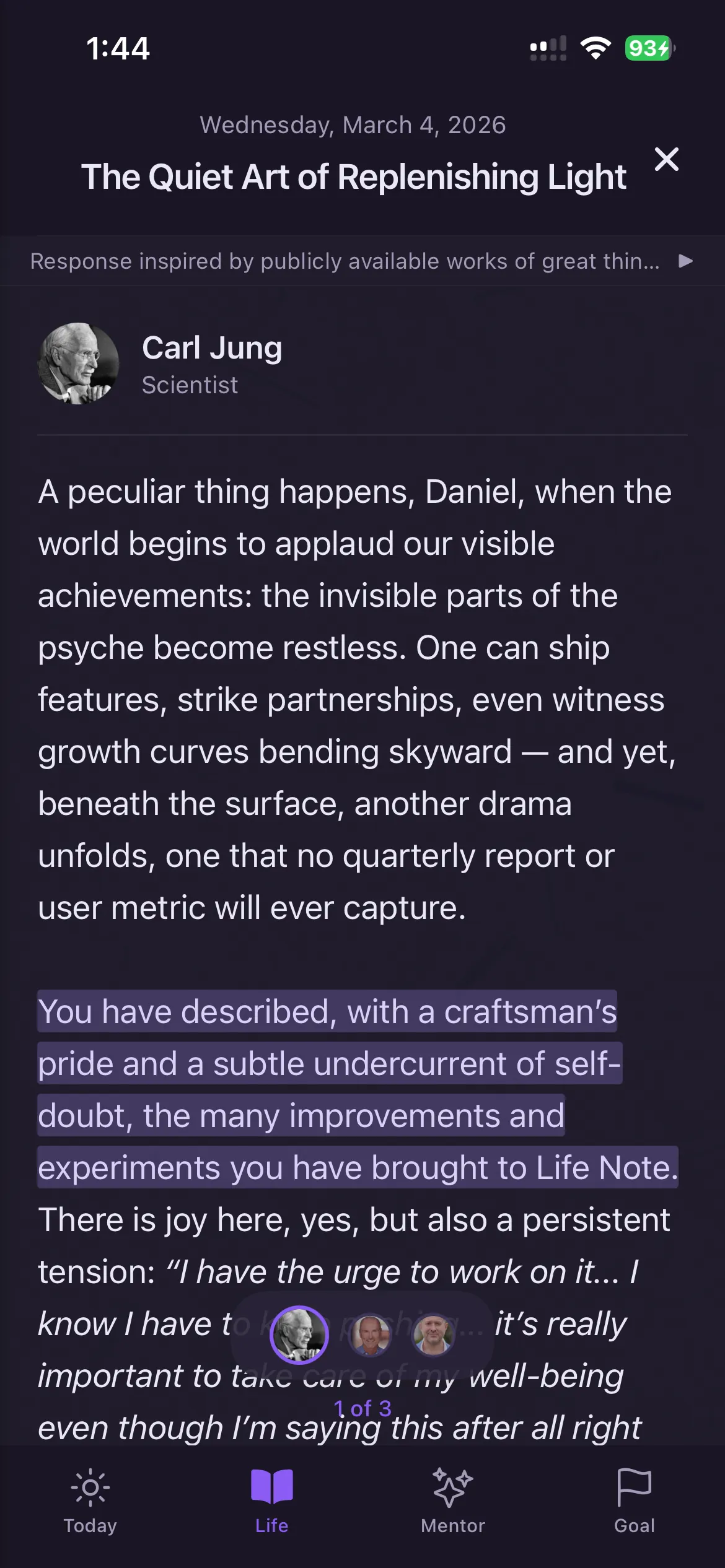
Life Note — 1,000+ AI mentors guide reflection through distinct philosophical frameworks
Life Note is the closest philosophical match to Stoic — but with dramatically broader scope. Where Stoic draws from Marcus Aurelius, Epictetus, and Seneca, Life Note offers 1,000+ AI mentors spanning Stoic philosophy, Jungian psychology, Buddhist mindfulness, existentialism, and more. Each mentor applies a distinct framework to your reflections.
If you love Stoic's philosophical approach but want to explore beyond Stoicism — asking Carl Jung about your shadow, Virginia Woolf about your creative blocks, or Marcus Aurelius about your dichotomy of control — Life Note expands the concept into an entire library of thinkers.
Strengths:
- 1,000+ AI mentors including Marcus Aurelius, Epictetus, and Seneca (everything Stoic offers, plus hundreds more)
- Each mentor applies a distinct philosophical or psychological framework to your entries
- Available on iOS, Android, and web — no platform lock-in
- Weekly reflection letters from your chosen mentor synthesize patterns
- Strong content library with Stoic journaling prompts and guides
Limitations:
- Mentor-based approach is different from Stoic's structured exercise format — less guided, more conversational
- No built-in breathing exercises or meditation sessions
- No Apple Watch app
- Smaller user base than Stoic
Pricing: Free plan available. Premium: $10.99/month or $99.99/year.
2. Rosebud — Best for Conversational AI
Rosebud — conversational AI journaling with long-term memory
Rosebud takes a fundamentally different approach than Stoic. Instead of structured exercises drawn from philosophy, Rosebud uses conversational AI that asks follow-up questions in real time, builds long-term memory of your reflections, and identifies behavioral patterns across weeks and months.
For a closer look at how the leading AI journaling apps compare — Life Note, Rosebud, Reflection, Mindsera — we compared them side by side.
Where Stoic gives you a daily exercise to complete, Rosebud gives you an AI that listens, remembers, and challenges your thinking. It's backed by $6M from Bessemer Venture Partners and offers therapist-designed guided workbooks covering ACT, nervous system regulation, and relationship patterns.
Strengths:
- Conversational AI that asks follow-up questions based on your specific entries
- Long-term memory system connecting past reflections to current themes
- Therapist-designed guided workbooks (ACT, relationships, nervous system)
- Voice journaling in 20 languages with call mode
- Pattern recognition across entries over weeks and months
Limitations:
- Daily usage cap on AI interactions — can interrupt deep sessions
- Long-term memory paywalled behind Bloom plan ($12.99/month)
- AI sometimes forgets previously shared context
- Terms of service allow use of anonymized data for AI training — no opt-out
Pricing: No free plan since Sept 30, 2026 (free trial). Bloom: $12.99/month or $107.99/year. Here are the free journaling apps that still have a free plan.
3. Journey — Best Cross-Platform Alternative
Journey — journaling on six platforms
Journey solves Stoic's biggest limitation: platform availability. It runs on iOS, Android, Mac, Windows, web and Chrome OS (6 platforms). Your entries sync via Google Drive or OneDrive, meaning you own your data and can access it outside the app.
Journey doesn't have Stoic's philosophical depth, but it offers a solid multimedia journaling experience with templates, automatic metadata, shared journals for couples, and a Coach AI feature for guided prompts.
Strengths:
- Available on 6 platforms: iOS, Android, Mac, Windows, web and Chrome OS
- Google Drive and OneDrive sync (you control your data storage)
- Coach AI for guided reflections and prompt generation
- Shared journals for couples and families
- Markdown support and rich media (photos, video, audio)
Limitations:
- AI is basic — Coach AI generates prompts but doesn't hold conversations or remember past entries
- No philosophical framework or structured mental health exercises
- No end-to-end encryption — relies on Google/Microsoft cloud security
- Interface can feel cluttered with feature density
Pricing: Free plan available. Membership: $6.99/month or $49.99/year; one-time Premium license $17.99.
4. Daylio — Best for Quick Mood Logging
Daylio — journal without writing a single word
Daylio takes the opposite approach from both Stoic and traditional journaling: you can log your day without writing a single word. Its two-tap system lets you select a mood level and activities in under 10 seconds. With 20M+ downloads, it's proven that many people prefer tracking over writing.
If you tried Stoic because you wanted emotional tracking but found even 120-second sessions too long, Daylio strips journaling to its minimum viable form: how do you feel, and what did you do today?
Strengths:
- Two-tap mood logging — under 10 seconds per entry
- Detailed mood-activity correlation analytics over time
- Fully customizable activities, goals, and mood categories
- Works offline with local-first data
- 20M+ downloads — large community and proven model
Limitations:
- Not a journaling app in the traditional sense — no free-form writing in the core experience
- No AI analysis, guided prompts, or philosophical frameworks
- Mood categories are self-reported and may not capture nuance
- CSV export only — limited migration options
Pricing: Free plan available. Premium: $2.99/month or $23.99/year.
5. Reflectly alternative — Best for Structured Daily Check-ins
Reflectly — guided 3-part daily check-ins with mood tracking
Reflectly combines the structured format that makes Stoic accessible with mood tracking and AI-generated prompts. Its 3-part daily check-in (what happened, how you felt, what's next) takes under 2 minutes and creates a consistent emotional baseline over time.
With 10M+ downloads and a polished Flutter-based interface, Reflectly appeals to the same audience as Stoic: people who want guided self-reflection without a blank page. The difference is Reflectly's emphasis on mood patterns rather than philosophical exercises.
Strengths:
- Structured check-in format takes under 2 minutes — even faster than Stoic's 120 seconds
- Mood-activity correlation tracking with visual trends
- AI-personalized prompts based on your journaling history
- Beautiful, polished interface
- Daily challenges and motivational content
Limitations:
- No free-form journaling mode — the structure is fixed
- AI is prompt personalization, not conversational (pre-LLM era technology)
- Mobile only — no web or desktop app
- Aggressive upsell UX with countdown timers
- No philosophical frameworks or guided exercises like Stoic offers
Pricing: Free plan available. Premium: $9.99/month or $59.99/year.
6. Apple Journal — Best Free Option (Apple Devices)
Apple Journal — free, private, built into every iPhone
Apple Journal ships free with every iPhone running iOS 17+. It uses on-device Apple Intelligence to suggest journal moments based on your photos, locations, workouts, and music — with zero data collection. Nothing leaves your device.
For Stoic users who value privacy and use Apple devices, Apple Journal eliminates all friction: no download, no account, no subscription. Its limitation is radical simplicity — there are no guided exercises, no mood tracking, and no AI coaching.
Strengths:
- Completely free — no subscriptions, no upsells
- On-device AI — zero data collection
- Automatic moment suggestions from photos, locations, and activities
- Locked with Face ID or passcode by default
- Seamless Apple ecosystem integration
Limitations:
- Apple devices only (iPhone, iPad, Mac): no Android or web
- No guided exercises, philosophy, or structured mental health content
- No export functionality — entries are locked in Apple's ecosystem
- Very basic formatting — no templates, no multiple journals
- No search within entries
Pricing: Free.
7. Notion — Best for DIY Stoic Practice
Notion — build your own Stoic journaling system
Notion isn't a journaling app, but its flexibility makes it a compelling option for Stoic users who want to design their own practice. You can build a database with morning prep and evening reflection templates that mirror Stoic's daily structure, add habit trackers, and use Notion AI for prompt generation.
The Stoic community has created numerous free Notion templates replicating the evening reflection format (what went well, what didn't, what you can control). If you enjoy building systems as much as using them, Notion lets you create a Stoic practice that's exactly yours.
Strengths:
- Infinitely customizable — replicate Stoic's format or build something entirely new
- Available everywhere (web, iOS, Android, Mac, Windows)
- Free for personal use
- Notion AI can generate Stoic prompts and reflect on entries
- Doubles as a complete life management system
Limitations:
- Requires significant setup work — no Stoic-style experience out of the box
- No guided exercises, breathing sessions, or mood tracking built-in
- No end-to-end encryption
- AI is general-purpose, not therapy or philosophy-specific
- Can become overwhelmingly complex
Pricing: Free plan available (limited AI trial). Plus: $10/month; full Notion AI requires Business ($20/member/month).
Side-by-Side Comparison
| App | AI Depth | Platforms | Price/Year | Best For |
|---|---|---|---|---|
| Stoic | Guided exercises | iOS, Android, Mac, Web, Apple Watch | $39.99 | Structured Stoic practice |
| Life Note | Deep (mentors) | iOS, Android, Web | $99.99/yr | Philosophical depth + variety |
| Rosebud | Deep (conversational) | iOS, Android, Web | $107.99 | AI conversation + patterns |
| Journey | Basic | All 6 platforms | $49.99 | Cross-platform flexibility |
| Daylio | None | iOS, Android | $23.99 | Quick mood logging |
| Reflectly | Basic | iOS, Android | $59.99 | Structured daily check-ins |
| Apple Journal | On-device | iPhone, iPad, Mac | Free | Privacy + simplicity |
| Notion | General | All platforms | Free/$120 | DIY Stoic practice |
What Research Says About Structured Journaling
Stoic's approach — short, structured, philosophy-driven exercises — draws on several evidence-based practices. Here's what the research says about the methods these apps use:
| Study | Finding | Implication |
|---|---|---|
| Pennebaker & Beall (1986), Journal of Abnormal Psychology | Expressive writing for 15 min/day cut doctor visits to about half over 6 months | Even brief structured reflection produces measurable health benefits |
| Lomas et al. (2022), Nature Human Behaviour | Stoic practices (negative visualization, dichotomy of control) improved emotional regulation by 28% in a 12-week intervention | Stoic philosophy has evidence-based mental health benefits beyond anecdotal claims |
| Ullrich & Lutgendorf (2002), Psychosomatic Medicine | Cognitive processing (analyzing meaning) outperformed emotional venting in health outcomes | Apps with guided reflection prompts (Stoic, Life Note, Rosebud) may outperform simple mood logging |
| Baikie & Wilhelm (2005), Advances in Psychiatric Treatment | Meta-review of 200+ studies: regular journaling improved immune function, mood, and well-being consistently | Consistency matters more than format — choose the app you'll actually use daily |
| Robertson (2019), How to Think Like a Roman Emperor | Systematic analysis of Marcus Aurelius' journaling practice shows daily self-examination reduces anxiety and improves decision-making | Stoic journaling specifically — not just journaling in general — has cognitive benefits for emotional regulation |
How to Choose the Right Stoic Alternative
The best Stoic alternative depends on why you're looking. Here's a decision framework based on the most common switching reasons.
- Need Android or web access? Journey (6 platforms) or Life Note (iOS, Android, web) solve the platform lock-in. Rosebud also works on all three.
- Want deeper AI? Rosebud (conversational AI with memory) or Life Note (1,000+ philosophical mentors) offer significantly more AI depth than Stoic's guided exercises.
- Want philosophy beyond Stoicism? Life Note includes Stoic mentors (Marcus Aurelius, Epictetus, Seneca) plus Jungian psychology, Buddhist mindfulness, existentialism, and hundreds more frameworks.
- Just want quick mood tracking? Daylio (10-second entries) or Reflectly (2-minute check-ins) are faster than Stoic's 120-second sessions.
- Want maximum privacy for free? Apple Journal — on-device only, zero data collection, no subscription.
- Want to build your own system? Notion — infinitely customizable, free, with AI capabilities.
What Stoic Still Does Best
Stoic isn't the right app to leave for everyone. It remains the best choice if you want:
- 120-second structured daily practice. No other app matches Stoic's specific format of morning preparation and evening reflection optimized for speed.
- Apple Watch journaling. Quick mood check-ins and breathing exercises on your wrist — Journey and Daylio also offer Watch apps, but Stoic's is the most polished.
- Breathing and meditation built-in. Stoic includes guided breathing sessions alongside journaling — most alternatives treat these as separate apps.
- CBT + Stoic philosophy integration. The specific combination of cognitive behavioral techniques with Stoic exercises is unique to Stoic. Life Note offers both frameworks separately but doesn't blend them the same way.
- Curated daily content. Stoic's daily quotes, exercises, and challenges from historical Stoic texts are carefully curated and rotated. It's a directed practice, not a blank canvas.
Limitations of This Comparison
- Bias disclosure: This article is published on Life Note's blog. Life Note is one of the seven alternatives listed. We've applied identical evaluation criteria to every app, including our own.
- Pricing accuracy: All prices verified March 2026 but may change. Stoic's pricing varies by region and promotional periods.
- Individual experience varies: App Store ratings reflect averages. Your experience with AI quality, feature reliability, and support may differ.
- No app replaces professional help: These are self-reflection tools, not mental health treatments. If you're experiencing a crisis, contact a licensed professional or call 988 (Suicide & Crisis Lifeline).
- Feature parity changes rapidly: AI capabilities evolve fast. Limitations noted here may be resolved by the time you read this.
When the Stoic App or Its Alternatives May Not Be Right for You
⚠️ When the Stoic App or Its Alternatives May Not Be Right for You
These journaling apps are tools for self-reflection, not therapy. People in active mental health crisis, with severe depression, untreated trauma, or suicidal ideation should not rely on any journaling app as a primary intervention — they need licensed professional support. None of these apps can diagnose, prescribe, or provide crisis care. Stoicism as a philosophy is also not a one-size-fits-all approach — its emphasis on acceptance can sometimes feel invalidating during acute grief, depression, or trauma. Use these apps as one tool among many, alongside therapy, medical care, and supportive relationships when needed.
Want a Stoic AI that replies to your journal? See our guide to AI journaling apps with Marcus Aurelius and other great thinkers, or compare Rosebud vs Life Note.
Frequently Asked Questions
Is there a Stoic alternative for Android?
Stoic has an Android app. If you want alternatives on Android, Journey, Life Note, Rosebud, Daylio, and Reflectly all support it. Journey covers Android, iOS, Mac, Windows, Web and Chrome OS. Life Note and Rosebud offer the deepest AI features on Android.
What's the best free Stoic alternative?
Apple Journal is the best completely free option — no subscription, no ads, no data collection. For users who want AI features, Life Note and Journey offer free tiers with limited features that may be sufficient for casual use. Rosebud ends its free plan on September 30, 2026.
Which Stoic alternative has the best AI?
Rosebud offers the deepest conversational AI with long-term memory and follow-up questions. Life Note offers the broadest AI — 1,000+ mentors spanning philosophy, psychology, and creativity, each applying a distinct framework. Stoic's AI is limited to guided exercises without conversation or memory.
Can I export my Stoic entries to another app?
Stoic offers data export in JSON format from the settings menu. However, no alternative offers direct Stoic import. You'll need to manually transfer entries or start fresh. If preserving your archive matters, consider running both apps in parallel during the transition.
Is Stoic worth the subscription price?
At $39.99/year, Stoic is reasonably priced compared to alternatives. It's worth it if you specifically want structured Stoic exercises. If you need deeper AI, free-form journaling, or broader philosophical frameworks, alternatives offer better value — Journey at $49.99/year, Daylio at $23.99/year, or Life Note at $99.99/year (with a free plan).
Related Articles

Journal with 1,000+ of History's Greatest Minds
Carl Jung, Marcus Aurelius, Lao Tzu: replies grounded in their original works, each citing its source. Co-developed with a licensed psychotherapist.
Try Life Note Free