
Top 10 Journaling Prompts for Overcoming Goal-Setting Challenges

Use 10 journaling prompts to clarify values, reframe setbacks, break goals into small steps, plan for obstacles, and build accountability to stay on track.

📌 TL;DR — Journaling for Goal-Setting Challenges
Common goal-setting obstacles: vague goals, lack of motivation, perfectionism, and overwhelm. Use journaling to clarify your "why," break goals into micro-steps, identify limiting beliefs, and track progress. Key prompt: "What's the smallest step I could take today that would move me forward?"
Struggling to stick to your goals? Journaling can help. Studies show writing down your goals boosts success rates by 42%. But staring at a blank page can feel overwhelming. That’s where prompts come in - they guide your thoughts, help you clarify your goals, and uncover what’s holding you back.
Here’s a quick overview of the 10 journaling prompts covered in this article:
- Reflect on past habits to identify what works.
- Explore why you feel stuck or unmotivated.
- Align your goals with personal values.
- Reframe setbacks and failures as opportunities.
- Imagine goals without fear or self-doubt.
- Break big goals into three simple steps.
- Define the smallest, achievable version of your goal.
- Plan for obstacles and how to handle them.
- Identify accountability partners and tools.
- Track progress and celebrate small wins.
These prompts help you turn vague intentions into clear, actionable steps while staying motivated and aligned with what matters most to you.
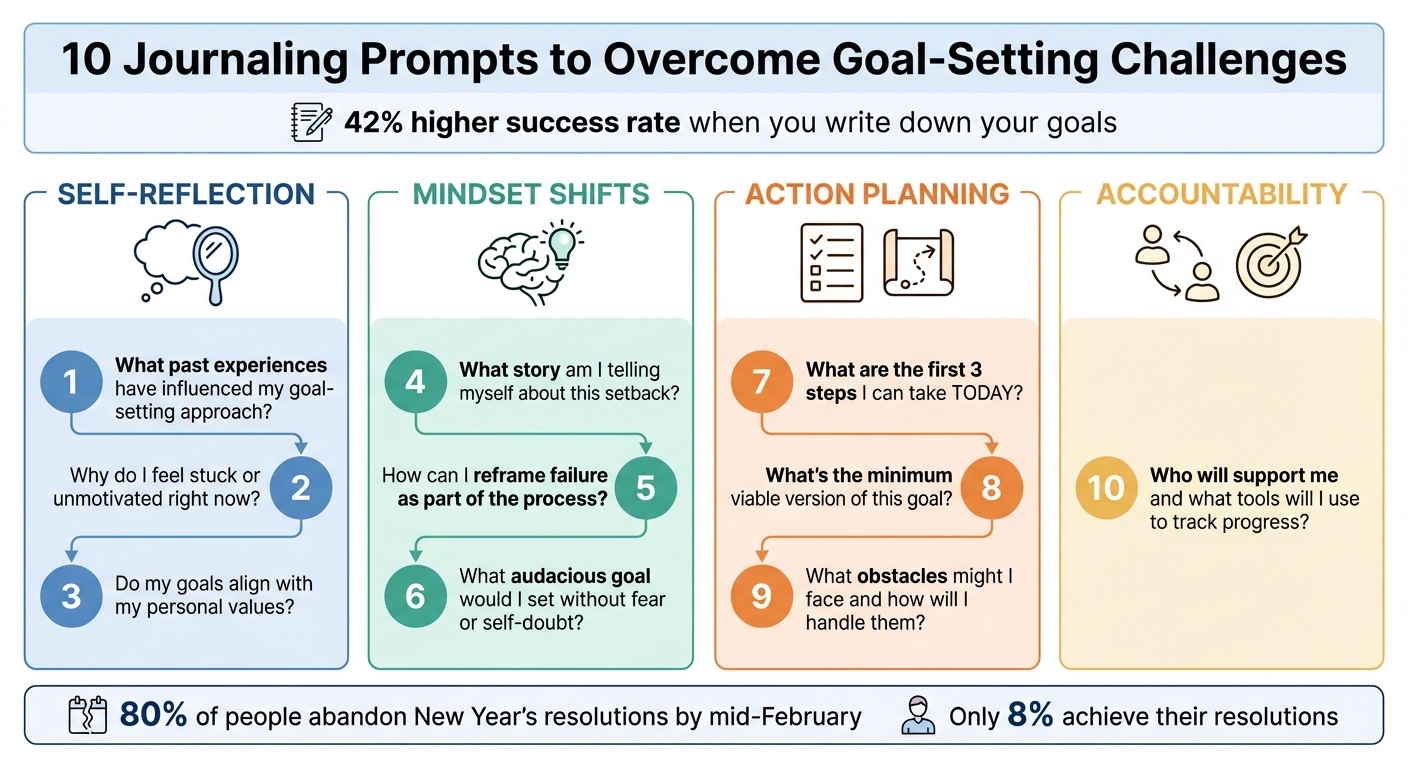
10 Journaling Prompts for Goal-Setting Success
1. Self-Reflection
"What past experiences or habits have influenced my approach to setting and achieving goals?"
Your past can be a goldmine of insights into what works and what doesn’t. Reflecting on the previous year allows you to spot patterns in your behavior and learn from both your successes and setbacks [1]. For instance, maybe you nailed a big work project by breaking it into manageable weekly tasks, but your fitness journey derailed because you went from no workouts to attempting five gym days a week. These patterns reveal which habits propel you forward and which ones hold you back.
This process isn’t about dwelling on failures or beating yourself up. It’s about setting goals that genuinely fit your life, not some unrealistic ideal [1][4]. When you analyze goals you’ve abandoned, you often uncover recurring obstacles. Were those goals something you truly wanted, or were they based on what you thought you should want? This distinction is critical, especially when you consider that only 8% of people actually achieve their New Year’s resolutions [3].
A helpful exercise is the "Why" Drill: Ask “why” three times about any goal to dig into the deeper values or motivations behind it [1]. For example, if your goal is to “get healthier,” ask why. Maybe it’s to have more energy. Why does that matter? To keep up with your kids. Why is that important? Because being present for them aligns with your core values. Suddenly, you’ve shifted from a vague idea to a meaningful commitment. These insights form a strong foundation for changing your mindset in the next step.
"Why do I feel stuck or unmotivated in pursuing my current goals, and what emotions are tied to this feeling?"
Feeling stuck often points to a misalignment between your goals and your personal values. You might be chasing objectives based on external pressures rather than your own ambitions, strengths, or desires [2]. When motivation fades, it’s usually because you’ve lost touch with why the goal matters in the first place [1].
What feels like a lack of motivation is often an issue of energy. Balancing daily stresses while pursuing big dreams can lead to burnout [3][1]. Take a moment to write down the narrative you’ve created around feeling stuck and question its accuracy [1]. Are you genuinely “too busy,” or have you been prioritizing everyone else’s needs over your own?
"How do my personal values align with the goals I've set, and are these goals truly meaningful to me?"
Goals often fail because they’re built on “shoulds” instead of what you actually want [2]. If your goals don’t align with your core values, they’ll feel like chores, and you’ll likely be chasing approval from others instead of finding fulfillment for yourself.
Try the "No-Audience" Test: Would you still pursue this goal if you couldn’t share your progress or achievement with anyone? [1] If the answer is no, it’s likely more about external validation than personal meaning. To dig deeper, list your top three values and rate how well each of your current goals supports them [2][4]. If a goal scores low, it might be time to reconsider or let it go. Aligning your goals with your values creates a stronger foundation to overcome common challenges in goal-setting.
"Writing forces clarity. It transforms vague intentions into specific commitments. It makes the abstract concrete." – Life Note [1]
2. Mindset Shifts
Now that you've taken a closer look at your personal history, it's time to shift your attention to the stories you tell yourself about your mindset and setbacks.
"What story am I telling myself about this setback? Is it true?"
When you face a setback, your brain naturally creates a story to make sense of it. Maybe it's something like, "I'm terrible at this" or "I always fail." But here's the thing - those stories often mix emotion with fact. Take a moment to write down the narrative you're telling yourself and then question it. Did you actually fail, or was it just a single hurdle along the way? Separating fact from feeling can help you see setbacks as temporary rather than defining.
"When we lead with a growth mindset, failures are never the end of the story; they're a new opportunity - a chance to learn, adapt, and grow." – Karen Allen, growth mindset coach [6]
Instead of treating setbacks as proof of inadequacy, think of them as feedback. Writing these narratives down can help you uncover actionable lessons [6][7]. Once you clarify the story you're telling yourself, you can start redefining what failure really means.
"What does failure mean to me? How can I reframe it as part of the process?"
A lot of struggles with goal-setting come from seeing failure as an endpoint instead of a stepping stone. If failure feels like proof you're not capable, it's easy to abandon your goals at the first sign of trouble. But if you start viewing failure as useful data - something that helps you adjust your approach - you can keep refining your strategy until it works.
Did you know that about 80% of people give up on their New Year's resolutions by the second week of February [1]? The difference between those who stick with it and those who don't often boils down to mindset. Successful people see setbacks as chances to recalibrate, not as disasters. Use this prompt to figure out your next smallest step - the minimum action that still moves you forward [1]. Shifting how you see failure can empower you to set bigger, braver goals.
"If fear, self-doubt, or limiting beliefs were not holding me back, what audacious goal would I set for myself?"
This prompt encourages you to imagine what you'd aim for if fear and self-doubt weren't in the picture. When you start writing, you might realize that your current goals are playing it safe. This isn't about chasing unrealistic dreams - it’s about identifying which beliefs are protecting you and which are unnecessarily limiting you. By connecting bold goals to your core values, you'll find the confidence to tackle challenges head-on.
3. Action Planning
Now that your mindset is in the right place, it’s time to turn your goals into tangible actions. Writing things down can help clarify what needs to be done, how to do it, and when to start. Below are three journaling prompts designed to take you from reflecting on your goals to making real progress. These prompts break your goal into manageable actions, realistic steps, and strategies to tackle obstacles.
"What are the first three steps I can take today to move closer to my goal?"
Big goals can feel overwhelming, leaving you unsure of where to start. This prompt helps cut through that paralysis by focusing on three simple actions you can take right now. These steps don’t need to be monumental - think small but meaningful actions. Maybe it’s researching a course, drafting an email, or setting a reminder on your phone. Writing these down turns vague ideas into clear commitments, making it easier to take that first step [2].
"What is the minimum viable version of this goal that fits my actual life right now?"
Perfectionism can derail even the best intentions. This prompt encourages you to define the simplest, most achievable version of your goal that fits your current circumstances. For instance, if you want to exercise five times a week but your schedule is packed, consider starting with a 10-minute walk three times a week [1]. By setting a "good enough" goal, you build a foundation for consistency, even when life gets unpredictable. And consistency matters - about 80% of people abandon their New Year’s resolutions by mid-February [1]. Aiming for small, attainable steps ensures you stay on track, even on tough days.
"What obstacles might I face, and how will I handle them when they arise?"
Planning for challenges in advance can help you maintain momentum [1][2]. Use this prompt to identify potential roadblocks - like a busy schedule, self-doubt, or limited resources - and write down specific strategies to overcome them. For example, if exhaustion is a recurring issue, you might lay out workout clothes the night before and commit to exercising first thing in the morning. Anticipating obstacles and preparing solutions can smooth out your routine, making it easier to keep moving forward, even when things don’t go as planned [1].
4. Accountability
Accountability is what keeps you moving forward when motivation starts to wane. It’s about leaning on a support system and using practical tools to stay on track. Did you know that people who write down their goals are 42% more likely to achieve them? [1][5]. A big part of this success lies in tracking your progress and identifying the people or tools that help you stay focused.
Your social circle plays a surprisingly powerful role in your ability to stick to your goals. Take a moment to think about the five people you spend the most time with. Are they encouraging your growth, or could they be holding you back? Adam Gragg, host of the Decide Your Legacy Podcast, puts it perfectly:
"Who is pushing you to be the best version of yourself? Who is sabotaging your efforts?" [9]
To strengthen your accountability network, make a list of the people who influence your commitment. Reflect on their impact by asking, “Who has genuinely invested in my well-being lately?” This exercise can help you pinpoint mentors or accountability partners who will stand by you when things get tough.
After identifying your support network, back it up with tools that help you stay consistent. For example, regular journaling is a great way to track your progress [8]. Apps like Life Note can also be useful - they help you spot emotional patterns and recurring themes, giving you a clearer picture of where you’re succeeding and where you might need to refocus.
Related: Browse our complete journal prompts collection →
Conclusion
Journaling can serve as a meaningful link between your intentions and the actions needed to achieve them. By using prompts regularly, you give shape to vague aspirations, turning them into clear commitments. It’s also a way to reconnect with the deeper purpose behind your goals, especially when your motivation starts to waver. Plus, it provides a written record of your journey, helping you celebrate progress and identify recurring patterns that may be holding you back.
The impact of journaling is backed by evidence. Regular reflection has been shown to transform abstract goals into actionable steps, increasing the likelihood of success. In fact, the difference between those who reach their goals and those who fall short often lies in their ability to reflect and adjust along the way. As Life Note aptly states:
"The person who reflects on their goals is the person who achieves them" [1].
To make journaling effective, build a simple routine with consistent check-ins. These moments of reflection help you maintain momentum, make necessary adjustments, and stay aligned with your larger vision [1]. Remember, it’s about consistency, not perfection. Missing a day - or even a week - doesn’t mean you’ve failed. The practice will always be there when you’re ready to return.
If you want to take your journaling to the next level, tools like Life Note can offer valuable support. This platform connects your reflections with insights from historical figures such as Carl Jung, Marcus Aurelius, or Steve Jobs. It also helps you identify emotional patterns and translates your insights into actionable steps that align your daily habits with your long-term goals.
FAQs
How can journaling prompts help me overcome challenges with setting and achieving goals?
Journaling prompts can transform hazy ambitions into clear, actionable plans. When you write things down, your intentions feel more tangible, which can significantly boost your chances of following through. Research even backs this up - people who document their goals are far more likely to achieve them compared to those who don’t. Questions like “What steps can I take this week to move closer to my goal?” or “What challenges might I encounter, and how will I handle them?” encourage thoughtful planning, helping you break big goals into smaller, achievable steps.
But journaling isn’t just about planning - it’s also a powerful tool for staying motivated and on track. By routinely reflecting on your progress, celebrating the small wins, and learning from setbacks, you create a sense of momentum that keeps you moving forward. Prompts can reveal patterns in your efforts and help you adjust your strategies, making the entire process feel more rewarding. Tools like Life Note take this a step further, offering customized prompts, guided reflections, and practical insights to make goal-setting engaging and effective.
What should I do if my goals feel out of sync with my personal values?
If a goal feels off or doesn’t sit right with you, it might be time to revisit your core values - things like family, health, creativity, or integrity. Take a moment to write down how your current goals either align with or go against these principles. Sometimes, putting thoughts into words can make things clearer, helping you figure out if a goal truly supports what’s most important to you.
From there, dig deeper into the disconnect. Ask yourself questions like: “Does this goal reflect the person I want to become?” or “Which of my values does this goal seem to challenge?” If a goal continues to feel out of place, think about reworking it into smaller, more meaningful steps that tie back to your values - or, if necessary, let it go entirely. Regular journaling about your goals and values can keep you grounded and help you carve out a path that feels more genuine.
Once you’ve gained that clarity, it’s time to act. Use what you’ve learned from your reflections to set new goals that truly align with your values. This way, your efforts will not only feel more purposeful but also more sustainable over time.
How can I stay motivated and effectively track my progress when setting goals?
Tracking your progress and staying motivated begins with setting SMART goals - goals that are Specific, Measurable, Achievable, Relevant, and Time-bound. Breaking these goals into smaller, manageable milestones can provide clarity and a sense of accomplishment along the way. Each small win builds momentum and keeps you focused.
Consider using a habit tracker to keep an eye on daily actions that support your goals. For instance, you might track a habit like "walk 30 minutes before work, Monday through Friday." Integrating these actions into your routine, setting reminders, and reviewing your progress weekly can make a big difference. Take time during these reviews to reflect on what’s working, pinpoint areas that need tweaking, and make adjustments as needed. To keep yourself motivated, pair these check-ins with small rewards - like treating yourself to a favorite coffee or enjoying a relaxing break.
Journaling can take this process to the next level. It allows you to reflect on challenges, celebrate milestones, and reconnect with your purpose. Tools like Life Note can amplify this by providing personalized insights and weekly reflections, helping you turn your tracking efforts into meaningful growth. Combining structured tracking with regular self-reflection creates a system that keeps you motivated and moving steadily toward your goals.
2026 Goal Setting Made Easy with THESE Journal Prompts
Related Blog Posts
Journal with 1,000+ of History's Greatest Minds
Marcus Aurelius, Maya Angelou, Carl Jung — real wisdom from real thinkers, not internet summaries. A licensed psychotherapist called it "life-changing."
Try Life Note Free