
How to Find Yourself Again When You Feel Lost

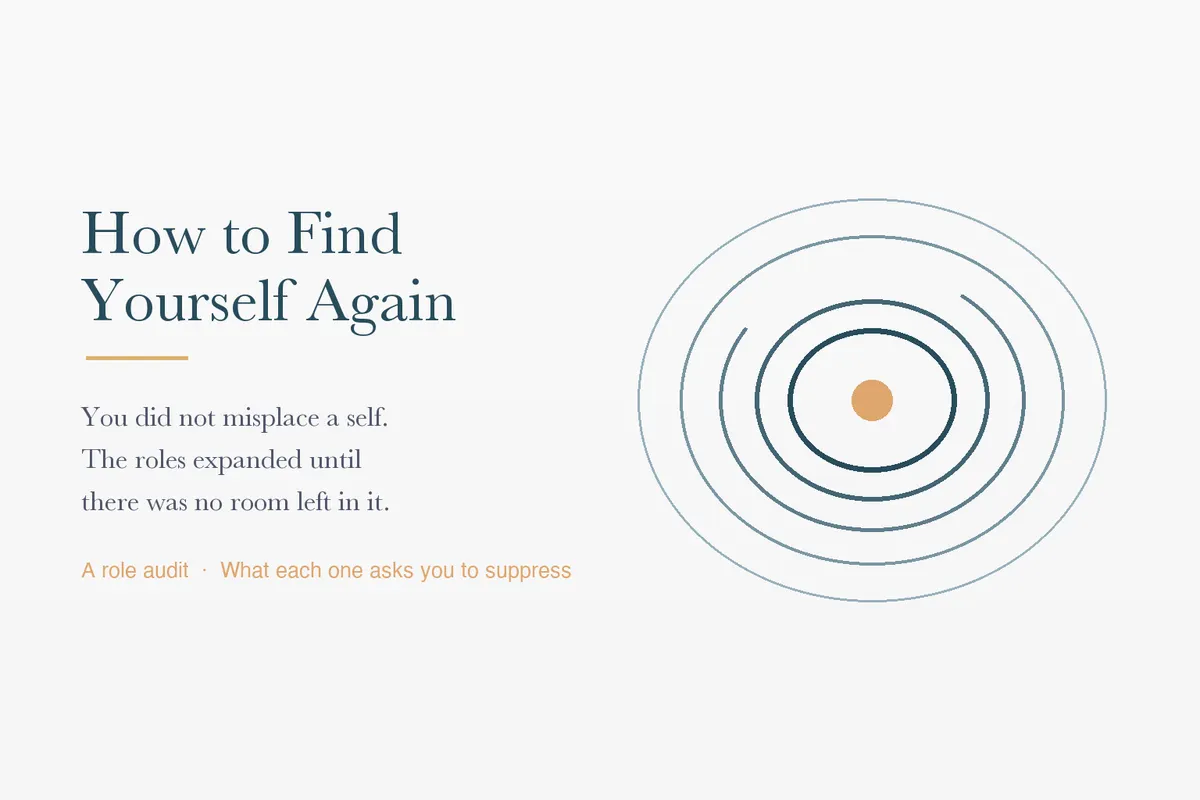
Why "Finding Yourself" Is the Wrong Frame
You can't find a self you misplaced, because there was never a finished, fixed self sitting somewhere waiting to be located. A self is built continuously out of what you do, who reflects you back to yourself, and how much room you have to notice your own reactions. What actually goes missing is a specific, nameable set of conditions, not a person.
The phrase "find yourself" borrows its logic from lost keys: a stable object, complete and finished, that slipped under the couch cushions of adulthood. Search hard enough, the idea goes, and you'll turn it up again, unchanged.
That's a comforting story and a bad map. Psychologists who study identity generally describe the self as closer to an ongoing construction project than a filed document. The term for the felt sense of having a stable, well-defined identity is self-concept clarity, and it behaves like a variable, not a possession — it rises and falls with your circumstances, not your character. When several of the conditions that generate it disappear at once, the feeling of having a self thins out with them. The self didn't leave. The inputs did.
This distinction changes what you do next. If the self is a lost object, the fix is more looking. If it's a construction that depends on specific inputs, the fix is to restore the inputs and let the sense of self follow. Losing yourself is usually a life-architecture problem, not a character problem. Everything below is built on that premise.
What Actually Goes Missing When You Feel Lost
People who say they've "lost themselves" are almost always missing some combination of five specific things: unstructured time, novelty, a context with no role to perform, contact with their own preferences, and people who knew them before the role took over. Naming which ones are gone turns a vague ache into something you can address directly.
Ask someone to describe the last stretch of life when they felt most like themselves, and the description is rarely dramatic. A summer before a first job. A semester somewhere unfamiliar. The months after a breakup and before the next relationship. What made those periods feel more "you" usually wasn't an achievement. It was structural.
Five inputs tend to do most of the work, and they tend to disappear together:
- Unstructured time — hours with no assigned purpose, where a thought can wander somewhere nobody sent it.
- Novelty — anything unfamiliar enough that you have to respond freshly instead of on a script you've run a thousand times.
- A context with no role to perform — a room where you are not "the employee," "the mom," or "the reliable one," just a person.
- Contact with your own preferences — small, low-stakes choices made for taste rather than for logistics or for someone else's convenience.
- People who knew you before the role — witnesses who remember a version of you that predates the job, the marriage, or the diagnosis.
Losing two or three of these barely registers day to day. Losing all five for a couple of years produces exactly the flat, low-grade "who even am I anymore" feeling that sends people looking for the wrong remedy. Writing through it helps more than thinking about it in the shower — a set of structured self-discovery prompts is a faster way to find which of the five is thinnest than trying to reason it out from memory alone.
The Role Audit: A Better Instrument Than "Who Am I?"
List every role you currently occupy, and for each one write down exactly what it requires you to suppress. "Finding yourself" often just means one role — employee, parent, partner, the reliable one — has quietly expanded to fill every hour and every decision, crowding out anything the role doesn't need from you.
Journaling prompts that ask "who are you, really?" tend to fail because the question has no edges. A role audit works because it does: instead of interrogating your identity in the abstract, you inventory the specific roles running your week, and for each one ask what it needs from you and what it needs you to put away.
A caregiving role might need you to suppress irritation and any need that competes with the person you're caring for. A high-performance job might need you to suppress uncertainty and any interest that doesn't compound toward the next promotion. "The reliable one" in a friend group might need you to suppress your own bad days, because everyone else has outsourced their stability to you.
None of this is wrong on its own — every role asks something of you. The problem is when one role's demands become the only demands you ever answer, and the suppressed material never gets any air. Here's what the audit looks like on paper:
| Role | What it asks you to suppress | Smallest reclaim |
|---|---|---|
| Employee | Uncertainty, slowness, interests with no career payoff | One hour a week on something with zero professional upside |
| Parent | Your own bad mood, spontaneity, unstructured time | Fifteen minutes alone with the door closed, no explanation owed |
| Partner | Preferences that differ from your partner's, minor disagreements | State one small preference out loud this week without softening it |
| Caregiver | Fatigue, resentment, needs that compete with the person you care for | Name the resentment in writing, privately, without editing it |
| "The reliable one" | Your own bad days, asking for help, being seen as anything but steady | Tell one person a real, current difficulty instead of a resolved one |
The audit beats most self-reflection because it produces something actionable in the same sitting: not "know yourself better," but "make one specific, small trade this week." A page of practical self-awareness steps extends the same method past roles into daily patterns, and revisiting the roles with self-awareness journal prompts every few weeks shows whether a role's grip is loosening or tightening.
Is It Depression, Burnout, or Something Else?
Feeling like a stranger to yourself is not the same as depression, burnout, or grief, and the response differs for each. Depression usually brings persistent low mood, anhedonia, or hopelessness on top of the identity fog; burnout travels with you into any new context because it's about depletion, not location; grief is about missing a person, not missing yourself.
These three get confused with "losing yourself" because they share a surface symptom — you don't recognize your own reactions anymore. The mechanism, and the fix, differ.
Burnout is exhaustion from sustained output with insufficient recovery. It travels with you — a vacation from a burned-out state produces a rested version of the same emptiness, not a rediscovered self. The fix is rest and reduced load, not novelty.
Depression can look identical to "I don't know who I am" from the outside. The distinguishing signs are persistent low mood, loss of interest in things that used to matter (anhedonia), and hopelessness that doesn't track with your circumstances. If those are present, the right move is a conversation with a doctor or therapist, not a role audit. This article does not diagnose, and it isn't a substitute for that conversation.
Grief is about the absence of a specific person, relationship, or chapter, not a missing self. It can produce identity disruption as a side effect, but the primary work is mourning the loss; a grief journal addresses the actual thing that's missing more directly than general self-discovery prompts. If regulating the intensity itself is the harder part right now, journaling for emotional regulation is the better starting point.
The Structural Truth: Some of This Isn't Psychological
A person working two jobs while raising a toddler has not misplaced their identity — they have no unclaimed hours. No amount of journaling manufactures time that doesn't exist, and the honest first move in that situation is reclaiming a slice of the day, not reflecting harder on who you are.
It's tempting to treat "finding yourself" as purely internal work, because internal work feels within reach when external circumstances aren't. But the five inputs from earlier are resources, and some people genuinely don't have access to them right now. A single parent working a second job, someone in an intensive caregiving season: these are not people who need better introspection. They need a schedule with room in it.
The honest version of this advice includes saying so. If your week has no hour that belongs only to you, the highest-leverage move is negotiating for one — trading a chore, asking a partner to take an evening, saying no to one obligation — before any exercise in this article will do much. This is also where boundaries work earns its keep: a lot of "lost self" is actually an unset boundary that's been quietly costing you the same twenty minutes for years. Boundary journal prompts can help you identify exactly which yes needs to become a no.
Questions That Work Better Than "Who Am I?"
"Who am I?" is too broad to answer honestly; specific, concrete questions get further in five minutes than the abstract version gets in a year. Questions that ask about a recent, checkable moment work because they can't be answered in platitudes.
Try these instead of the identity question directly:
- When did you last change your mind about something that mattered, based on new information rather than social pressure?
- Whose taste is in your home — yours, or the sum of everyone you've lived with?
- What did you used to be curious about that you haven't thought about in over a year?
- If no one would know, what would you do differently tomorrow?
- What's the last thing you did purely because you wanted to, with no productive justification attached?
Notice these point at evidence — a decision, an object, a memory — rather than asking you to generate a self-description from nothing. That's the same principle behind the role audit: specificity produces answers, abstraction produces more searching. Writing the answers, rather than turning them over mentally, is what makes the pattern visible; a rotating set of self-reflection prompts keeps the exercise from going stale, and rereading old entries with a framework for what a useful reflection looks like shows your answers changing over months.
Some of these questions land harder with a second voice in the room. Life Note lets you write these out in conversation with AI mentors like Marcus Aurelius or Carl Jung, and hear a second voice on the answers that surprised you. Open Life Note and start with the version of yourself you miss.
Small Experiments That Rebuild Contact With Yourself
Contact with your own preferences comes back through repeated small choices, not one big realization. Pick one low-stakes decision a day — what to eat, what to read, where to sit — and make it for taste alone, then notice whether you can even tell what your taste is.
Many people discover, doing this, that the honest answer to "what do you want for dinner" is "I don't know" more often than expected — not because they've lost the capacity for preference, but because it's gone unexercised for years while they optimized for other people, or for efficiency. The fix isn't a big decision. It's a rep.
A useful format: once a day, make one choice — a route home, a song, a chair — based only on what you want, and write one line on whether it was easy or strange to identify. Over a few weeks, a pattern shows up: which categories still have a clear "you" in them, and which are blank. Working from an established list, like a values journaling guide, gives the exercise more structure, and keeping the log in a running daily reflection journal turns single data points into a visible trend.
Reclaiming Unstructured Time (Not "Self-Care")
Unstructured time is not the same as scheduled self-care, and the difference matters. A massage or a bath still has a purpose assigned to it in advance; genuinely unstructured time has no agenda at all, which is exactly the condition that lets an unplanned thought or preference surface.
Self-care culture solved the wrong problem. It gave people permission to schedule rest, which is good, but it kept every hour purposeful — even relaxation became a task with an outcome. What seems to matter for the "who am I" feeling specifically is time with no assigned job at all: sitting without a phone, a walk with no destination, an afternoon with nothing planned.
This is hardest to justify precisely because it looks unproductive, and people in a life transition — a new job, a move, a divorce, a new baby — often feel least entitled to claim it, even though transitions are exactly when the old structures that used to generate a sense of self have collapsed and nothing has replaced them yet. If you're mid-shift, journaling through a life transition specifically fits better than general identity prompts, because it works with the disruption instead of trying to bypass it.
Finding People Who Knew You Before the Role
People who knew you before your current role can reflect back a version of you the role has no use for, which is exactly why the contact is valuable. A college roommate, an old coworker, a sibling — anyone who met you before the job, the marriage, or the diagnosis remembers a "you" the present arrangement never had to accommodate.
This is different from socializing in general. A new friend or work friend who only knows the current version of you will relate to the role, because the role is all they've ever seen. Someone from ten or twenty years ago relates to something underneath it.
The reclaim here is often small and overdue: one message, one coffee, one call to someone you let drift for practical reasons rather than a falling-out. Drift like this carries its own quiet grief, worth naming rather than skipped past; journaling for loneliness is a reasonable place to start naming who's missing from your life right now.
What Jung Called Individuation
Carl Jung used the term individuation for the lifelong process of becoming a more complete version of yourself by integrating parts you've pushed aside, rather than by discovering a hidden true self. His related idea of the persona — the mask assembled for public and professional life — describes almost exactly what a role audit measures.
Jung's framing is useful because it doesn't traffic in the lost-object myth either. The persona isn't fake — it's a necessary tool for functioning in the world — but a life lived entirely through it, with no contact with what it excludes, is what produces the flattened feeling people describe as having lost themselves. Individuation is the ongoing work of bringing the excluded material back into view, not a single discovery.
A related, more recent idea is role engulfment: what happens when one role expands to consume someone's entire identity, leaving no bandwidth for anything else. It's a clinical-sounding name for exactly the pattern the role audit is built to catch. A third concept worth knowing is hedonic adaptation — the tendency for any new circumstance, good or bad, to eventually feel normal, which is part of why a once-chosen role can, years later, feel like the only thing left. Sitting with what a role has excluded is uncomfortable work, and shadow work prompts are built for material that's been pushed aside rather than forgotten; framing the current stretch as a chapter in a hero's-journey structure gives the same integration process a shape that's easier to sit with over months.
When to Talk to Someone, Not Just Journal
If the flatness comes with persistent hopelessness, a loss of interest in nearly everything, or a real decline in your ability to function day to day, that's worth raising with a doctor or therapist, not just journaling through. This article is a set of frameworks for a common, non-clinical experience — it does not diagnose, and it isn't a substitute for professional care.
Most of what gets described as "losing yourself" is exactly what this piece has covered: a role that expanded past its edges, a stretch of life with none of the five inputs, a transition that dissolved the old structure before a new one formed. That's uncomfortable, but it's ordinary, and it responds to ordinary tools — an audit, a few honest questions, reclaimed time, old friends.
It's a different situation if the feeling comes bundled with anhedonia that doesn't lift, hopelessness disproportionate to your actual circumstances, or a functional decline — missed work, neglected relationships, an inability to do things you used to manage. That combination points toward something clinical, and the right next step is a conversation with a professional, not another framework. If self-blame has been part of the pattern — a habit of assuming every setback is a character flaw rather than a circumstance — working through self-forgiveness directly can loosen a grip that a role audit alone won't touch. Sometimes the roots go back further than any current role, and if a caregiver relationship shaped how much of yourself you learned to suppress in the first place, that's worth its own dedicated look at disentangling from an emotionally immature parent rather than folding it into a general exercise.
Frequently Asked Questions
Why do I feel like I've lost myself?
Most often because several specific inputs disappeared at once: unstructured time, novelty, a context where you aren't performing a role, contact with your own preferences, and people who knew you before the role took over. It's rarely one dramatic event. It's usually a slow accumulation of a demanding role expanding to fill every hour, which crowds out anything the role doesn't need from you.
How long does it take to find yourself again?
There's no fixed timeline, because it isn't a single discovery you make once. It's closer to restoring a handful of conditions — some unstructured time, a low-stakes choice made for taste, a reconnection with an old friend — and noticing the sense of self return gradually as those conditions come back. Some people notice a shift within weeks of reclaiming even a small amount of unstructured time; for others, especially in an ongoing caregiving or high-demand season, it's a slower, more incremental process.
Is losing yourself a sign of depression?
It can overlap with depression, but they aren't the same thing. Depression typically involves persistent low mood, loss of interest in things you used to enjoy, and hopelessness that doesn't track with your actual circumstances. If those are present alongside the identity fog, it's worth raising with a doctor or therapist. If it's more a flat, generic feeling without those other signs, it's more likely the ordinary result of a role or routine that's crowded out everything else.
What's the difference between losing yourself and burnout?
Burnout is exhaustion from sustained output without enough recovery, and it travels with you — a change of scenery produces a rested version of the same emptiness, not a rediscovered self. Losing yourself is more about missing structural inputs like unstructured time, novelty, and contact with your own preferences. The fix for burnout is rest and reduced load; the fix for a lost sense of self is restoring the specific conditions that generate one.
What questions help you find yourself again?
Specific, evidence-based questions work better than abstract ones. Try: when did you last change your mind about something that mattered? Whose taste is actually in your home? What were you curious about a year ago that you haven't thought about since? These work because they point at a checkable moment or object rather than asking you to generate a self-description out of nothing.
What is a role audit?
A role audit is a written inventory of every role you currently occupy — employee, parent, partner, caregiver, the reliable one — with a note on what each role requires you to suppress, and one small way to reclaim a piece of what it's asking you to give up. It's more useful than asking 'who am I?' because it produces a specific, actionable answer instead of another round of abstract reflection.
Can journaling actually help you find yourself again?
Journaling helps when it's specific — a role audit, concrete evidence-based questions, a daily log of preferences — because writing forces you to notice a pattern that stays invisible when it only lives in your head. It helps less when it stays abstract ('who am I really?'). It also isn't a substitute for structural change: if your week has no unclaimed hours, reclaiming time matters more than any amount of writing about it.
Is it normal to lose yourself after having kids or a demanding job?
Yes. Parenthood and demanding jobs are two of the most common triggers, because both roles are structured to expand — a parent's or a high-performer's role rarely comes with a natural edge that says 'stop here.' Without a deliberate boundary, the role absorbs the unstructured time, novelty, and role-free space that used to generate a sense of self, which is exactly why the feeling is so common in both situations and not a sign anything unusual is wrong with you.

Journal with 1,000+ of History's Greatest Minds
Carl Jung, Marcus Aurelius, Lao Tzu: replies grounded in their original works, each citing its source. Co-developed with a licensed psychotherapist.
Try Life Note Free