
Best Journaling Techniques for Trauma Recovery

Practical journaling methods—freewriting, gratitude, shadow work, guided prompts and AI-assisted reflection—to help process trauma, identify patterns, and build resilience.

📌 TL;DR — Journaling for Trauma Recovery
Journaling supports trauma recovery but requires safety-first approaches. Techniques: containment writing (putting painful memories in a 'container'), titration (processing small amounts at a time), resource journaling (focusing on strengths), and grounding exercises. Go slowly — flooding yourself with trauma can retraumatize. Professional support recommended.
Journaling can help you process trauma by organizing emotions and memories into a manageable story. Studies show that writing about your experiences can reduce depression, anxiety, and even improve physical health. Here are five effective journaling methods to support recovery:
- AI-Assisted Journaling with Life Note: Engage in reflective conversations with historical mentors like Carl Jung or Brené Brown. Analyze recurring themes and gain structured insights.
- Freewriting: Write continuously for 15–20 minutes without worrying about grammar to release emotions and clarify thoughts.
- Gratitude Journaling: Focus on three things you're thankful for daily to shift your perspective and build resilience.
- Shadow Work: Explore hidden aspects of yourself to process suppressed emotions and uncover strengths.
- Guided Prompts: Use shadow work prompts and exercises to ground yourself, reflect, and find meaning in your experiences.
Consistency is key - just 20 minutes a few times a week can make a difference. These techniques, combined with professional therapy if needed, can help you regain control and move forward.
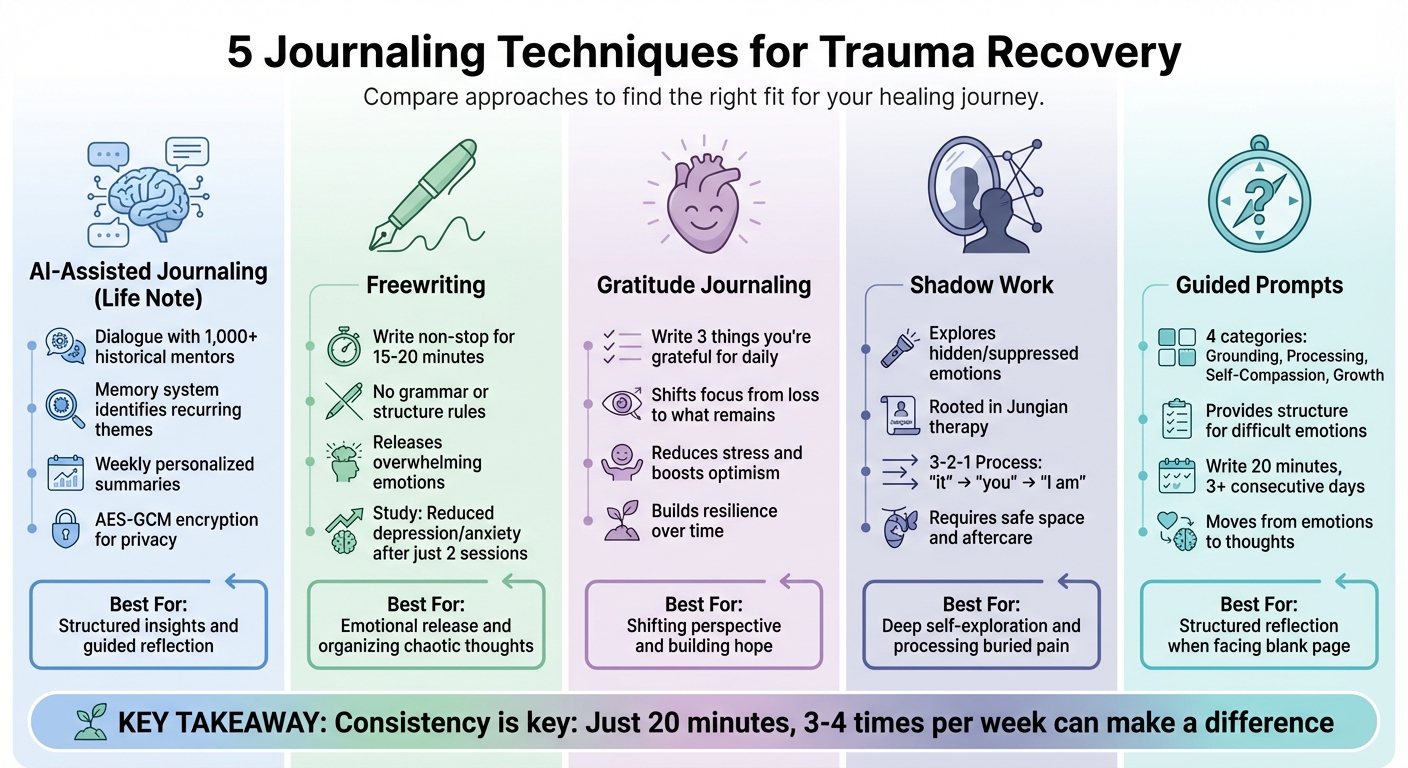
5 Journaling Techniques for Trauma Recovery Comparison Guide
1. Life Note: AI-Powered Journaling for Emotional Processing

When trauma disrupts your sense of self, traditional journaling can sometimes feel isolating. Life Note offers a fresh approach, turning solitary reflection into an engaging dialogue with over 1,000 historical mentors from 20+ fields. Imagine exploring your thoughts alongside psychologists like Carl Jung, vulnerability expert Brené Brown, or philosopher Marcus Aurelius. This interactive process can help deepen emotional understanding in a way that feels both personal and guided.
What sets Life Note apart from basic chatbots is its foundation in authentic source materials. For instance, when reflecting with Carl Jung, you're engaging with genuine Jungian psychology. This includes structured exercises like Shadow Work, specifically tailored to help navigate trauma and explore the depths of self-awareness.
Life Note also features a memory system that identifies recurring themes in your reflections - such as rejection, control, or perfectionism. Each week, it compiles a personalized summary with actionable insights. This process mirrors techniques like cognitive restructuring used in therapy, helping you reframe difficult memories and view them with less emotional intensity.
Your privacy is a priority. Life Note uses AES-GCM encryption to ensure your reflections remain secure, giving you the freedom to focus entirely on your healing journey. While it’s not a substitute for professional therapy, it can complement licensed treatment by helping you track patterns and organize your thoughts. This secure, structured journaling process supports your path toward recovery and self-discovery.
2. Freewriting for Emotional Release
Spend 15–20 minutes writing non-stop about your deepest thoughts, without worrying about grammar or structure. This simple act can help you process overwhelming emotions by getting them out of your head and onto the page.
For a more structured creative approach, poetry therapy uses verse and metaphor to process trauma — research shows it activates different neural pathways than freewriting and can reach emotions that prose sometimes cannot.
Trauma often leaves thoughts scattered and disorganized, but freewriting helps bring order to the chaos. By turning fragmented emotions into a clear narrative, you take an important step toward regaining control. In fact, a 2006 study involving nearly 100 young adults found that journaling for just 15 minutes twice in one week significantly reduced depression and anxiety - even for the 80% of participants who rarely journaled before [2]. Another study revealed that individuals who wrote about traumatic experiences for four consecutive days reported greater happiness three months later and even visited the doctor less frequently in the following six weeks [6]. This process helps ease emotional overload, paving the way for broader healing.
"I'm able to organize thoughts and feelings on paper so they no longer take up room in my head." - Allison Quatrini, Assistant Professor, Eckerd College [2]
To get started, find a quiet, private space and set a timer. Forget about spelling, punctuation, or grammar - this exercise is about releasing, not refining. If you hit a mental block, repeat the last phrase you wrote until new thoughts emerge. Noticing physical sensations as you write can also deepen your self-awareness. Keep in mind, writing about trauma may stir up difficult emotions at first. Be prepared with a safety plan, like practicing deep breathing, calling a friend, or spending time with a pet, to help you navigate those feelings [4][5].
Over time, the most impactful journaling shifts from raw emotion to recognizing patterns and making observations. Research even suggests that expressive writing can strengthen your immune system by increasing antibody production [2]. While freewriting isn’t a substitute for therapy, it’s an accessible and powerful way to organize your thoughts and bring clarity to emotional chaos.
Up next, discover how gratitude journaling can shift your perspective and complement the benefits of freewriting.
3. Gratitude Journaling to Shift Perspective
When trauma feels overwhelming, gratitude journaling can help rebalance your emotions by shifting your focus to what you still have, rather than what you've lost. Think of it as a way to spotlight the positive moments within the pain. This doesn't mean ignoring or dismissing your struggles - it simply makes room for moments of gratitude to coexist with your challenges. Over time, this practice can strengthen your resilience and bring a sense of calm to emotional chaos. And it's not just a feel-good idea - there's science to back it up.
Studies suggest that gratitude journaling helps reduce stress, ease worry, and boost optimism [7]. By redirecting your attention from the weight of trauma to the positives in your life, you can encourage personal growth even in the face of hardship [3][4].
"Ending your day by writing three things you appreciate can help you feel a sense of hope and keep you from becoming mired in victimhood."
- Dawn Altman, LPC, Choosing Therapy [5]
A simple way to start is by jotting down three specific things you're grateful for each evening. Go a step further by reflecting on how you contributed to these positives - this can build both self-confidence and a sense of control [7][5]. You might also explore prompts like, "What gift has come with my greatest wound?" or "What has this experience taught me that is good?" These kinds of questions can help you uncover hidden silver linings [5][4].
The key is consistency, not length. Even just a few minutes a day can help you refocus and ease physical tension [3]. Over time, you'll begin to notice patterns of growth and strength in your entries, reminding you that your trauma is a part of your story, but it doesn't define who you are. Using a dedicated gratitude journal can keep you on track and allow you to see your progress more clearly. This practice blends seamlessly with other journaling techniques, helping you craft a recovery narrative rooted in resilience.
4. Shadow Work Journaling for Self-Exploration
Shadow work journaling takes self-reflection to a deeper level, exploring the parts of yourself that often stay hidden. Rooted in Jungian therapy, this practice helps uncover suppressed emotions and aspects of your identity that you might avoid facing. For trauma survivors, these hidden elements often carry the weight of unresolved pain. Writing about them creates a safe space to process and release those buried feelings.
"Journaling or expressive writing... gives survivors a place to say what is often unsayable."
- Dawn Altman, LPC
This process not only organizes chaotic thoughts but also provides cognitive defusion - a way to observe your feelings objectively. By putting words to your shadow, you create a healthy distance between yourself and your pain. To take this further, focused prompts can guide you in uncovering the hidden layers of your inner world.
Building on the clarity gained from practices like freewriting or gratitude journaling, shadow work invites you to confront deeper questions. Start by identifying your shadow with prompts like, "What shame do I carry in my body and soul?" or "What keeps me stuck and unable to move forward?" Then, shift perspectives to find growth opportunities by asking, "How has this pain revealed unexpected strengths?" A helpful tool is the 3-2-1 Shadow Process: describe a troubling experience in the third person ("it"), address it in the second person ("you"), and finally, own it in the first person ("I am…"). This method allows you to integrate the parts of yourself you may have disowned.
Because shadow work can stir up intense emotions, it’s essential to create a setting where you feel safe and supported. Find a private, comforting space - maybe a cozy corner with soft blankets or a candle’s warm glow. Write freely without holding back, and plan an after-care routine to ground yourself afterward. This might include deep breathing, spending time with a pet, or talking to someone you trust. Keep in mind that shadow work is most effective when done alongside professional therapy, as revisiting past trauma can be overwhelming without proper guidance. This reflective practice paves the way for deeper self-discovery in the next steps.
5. Guided Prompts for Trauma Reflection
Staring at a blank page can feel overwhelming, especially when you're trying to process difficult emotions. This is where guided prompts come in - they offer a starting point, giving structure to your thoughts and helping you piece together the fragments of your experience into something more manageable. Like freewriting or shadow work, prompts provide a framework to support your healing journey.
Trauma prompts generally fall into four main categories: grounding, processing, self-compassion, and growth. Grounding prompts help you feel anchored in the present. For example, you could describe "a real or imagined place where you feel safe" in vivid detail or reflect on reliable sources of stability in your life, like routines or supportive relationships. Processing prompts encourage you to explore the effects of trauma, such as asking, "How does my daily life differ from before the trauma?" or "What thoughts most often disrupt my happiness and progress?" Self-compassion prompts invite kindness toward yourself, like writing a comforting letter to your younger self or beginning with, "I wish I could forgive myself for…" Growth-oriented prompts, on the other hand, help you find meaning in your experiences. Questions like "What lesson has emerged from my greatest pain?" or "When was a moment I recognized my own strength or patience?" guide you toward discovering resilience and purpose. These categories work together to guide you from grounding in the present to finding growth in the past.
Studies show that regular guided journaling can significantly reduce emotional distress and help you better understand your feelings. Writing about the same traumatic experience for at least three days in a row - spending around 20 minutes each time - can lead to clearer insights and emotional processing over time [4]. The goal is to move from raw, unfiltered emotion to recognizing patterns and making sense of your thoughts.
"The point here is that the most effective journaling moves from emotions to thoughts over time."
- Kira M. Newman, Managing Editor, Greater Good [2]
Conclusion
Healing from trauma is rarely a straight path, and the same can be said for the journaling practices that aid in the process. The techniques we've discussed - freewriting, gratitude journaling, shadow work, and guided prompts - each serve a unique purpose in supporting your recovery. Freewriting allows you to channel raw emotions into a narrative you can begin to understand. Gratitude journaling shifts your focus, helping you build resilience when negativity feels overwhelming. Shadow work and guided prompts, on the other hand, help you pinpoint triggers and patterns. Together, these methods create a powerful combination: freewriting releases emotions, guided prompts provide structure, and gratitude journaling reinforces a sense of strength and hope [3][9].
You can adapt these techniques to fit where you are in your recovery. Start with freewriting to release pent-up emotions, then follow it with a gratitude list to help ground yourself and end your session on a positive note [3][8]. If exploring into deeper emotions feels overwhelming, focus on structured prompts or gratitude journaling until you're ready to explore further - ideally with the guidance of a trauma-informed therapist if needed [3][8]. Research highlights that consistency is key; even writing for just 20 minutes three to four times a week can yield meaningful benefits [1].
"Journaling helps in constructing a coherent and more accurate narrative, integrating the traumatic events into a broader context. This narrative-building can restore a sense of continuity and control." - Jordie Vander Wal, Grand Rapids Therapy Group [3]
For those seeking additional support, tools like Life Note can elevate your journaling practice. Instead of staring at a blank page, you can engage in reflective dialogues with figures like Carl Jung or Brené Brown, drawing on their wisdom to navigate your emotional landscape. Life Note's advanced memory feature helps you uncover recurring themes in your entries, transforming scattered thoughts into a cohesive story of growth. Plus, its weekly reflection summaries offer insights into your progress, helping you maintain balance and focus. With Life Note, your journal becomes more than a record - it evolves into a testament to your healing journey.
FAQs
How is journaling with Life Note different from traditional journaling?
Journaling with Life Note takes the age-old practice to a whole new level, blending tradition with technology for a more engaging and guided experience. Unlike traditional journaling, where you're left to come up with prompts, reflect, and uncover patterns on your own, Life Note introduces AI into the mix to make the process more dynamic and personalized. It generates tailored prompts, connects you with historical mentors to gain fresh perspectives, and even tracks your past entries to highlight emotional trends and recurring themes.
Another standout feature is the weekly reflection letters. These summaries capture your growth and insights, making it easier to see how far you've come and where you might want to focus next. Instead of being entirely self-directed, Life Note acts as a supportive guide, combining mentorship, pattern recognition, and actionable insights to help you turn self-reflection into meaningful progress.
How can gratitude journaling support trauma recovery?
Gratitude journaling - taking a moment to jot down what you're thankful for - can be a powerful ally in trauma recovery. It shifts your attention away from painful memories and toward positive experiences, helping to ease stress and soften negative emotions. This simple practice supports emotional stability, builds resilience, and nurtures a sense of hope - key ingredients for healing.
When you regularly highlight the good in your life, you’re creating a personal archive of positivity to lean on during tough moments. This habit not only sharpens mindfulness and strengthens emotional control but also encourages a mindset geared toward growth. Over time, it can even help your brain respond to stress in a calmer, more balanced way.
For those seeking a structured approach, Life Note offers a fresh take on gratitude journaling. By combining your reflections with wisdom from inspiring mentors, it turns ordinary gratitude entries into meaningful dialogues that can deepen and enrich your healing journey.
Is it safe to practice shadow work journaling without professional help?
Shadow work journaling can be a safe and rewarding practice when done thoughtfully. Setting clear boundaries and prioritizing self-care are key to ensuring a positive experience. Studies suggest that structured journaling - such as writing for 15–20 minutes over several days - can bring emotional and physical benefits, even without professional support. That said, working with a therapist can provide added support, particularly when exploring into more intense emotions.
If you’re journaling on your own, keep sessions short and manageable at first. Create a calming atmosphere and use grounding techniques like deep breathing to stay centered. If things feel overwhelming, it’s okay to pause and step away. Tools like Life Note can make the process smoother by providing personalized prompts and reflective feedback, helping you explore your inner world while staying emotionally balanced.
How I Journal For Trauma Processing and Complex PTSD
Related Blog Posts
- Journaling for Emotional Awareness: Complete Guide
- 25 Therapist-Informed Journaling Prompts for Mental Health
- How to Start Anxiety Journaling in 10 Minutes (with 10 Prompts)
- Best Shadow Work Journals in 2026: Tested Picks and Who They Fit
Need more prompts for processing difficult emotions? Our 100+ journaling prompts for mental health includes dedicated sections for trauma, grief, and anxiety.
Trauma recovery often requires reconnecting with younger parts of yourself. See our complete guide to inner child work for a step-by-step approach.
Trauma recovery journaling techniques are structured writing methods specifically designed to help you safely process traumatic experiences, reduce PTSD symptoms, and rebuild emotional safety through guided self-expression.
Journal with 1,000+ of History's Greatest Minds
Marcus Aurelius, Maya Angelou, Carl Jung — real wisdom from real thinkers, not internet summaries. A licensed psychotherapist called it "life-changing."
Try Life Note Free