
What Is Cognitive Behavioral Therapy: Your Practical Guide


📌 TL;DR — What Is CBT?
Cognitive Behavioral Therapy (CBT) is a structured, evidence-based therapy that helps you identify and change negative thought patterns. Core principle: thoughts → feelings → behaviors. Key techniques include cognitive restructuring (challenging distorted thoughts), behavioral experiments, and exposure therapy. CBT is typically 12-20 sessions and is effective for anxiety, depression, PTSD, and more.
Cognitive Behavioral Therapy (CBT) isn't just a clinical term; it's a practical, evidence-based toolkit for understanding and reshaping your mind. It’s built on a simple yet profound idea: your thoughts, feelings, and actions are deeply interconnected. By learning to change one, you gain the power to change the others.
This guide promises to show you exactly what cognitive behavioral therapy is, how it works, and how you can use its core techniques to build lasting emotional resilience—starting today.
Your Guide to Practical Mental Wellness
So, what is cognitive behavioral therapy, really? Think of it as learning to be the architect of your own mind. We all have automatic thought patterns—the mental blueprints that dictate how we react to life's challenges. CBT provides the tools to examine that blueprint, identify the parts that cause distress, and redesign them for better mental health.
Unlike therapies that focus extensively on the past, CBT is forward-looking and solution-oriented. It's about building practical skills to deal with what’s happening right now. In a structured, collaborative way, you learn to spot, question, and reframe the thoughts that hold you back. This focus on real-world strategies is why CBT is one of the most effective and trusted psychological approaches used today.
The Trusted Origins of CBT
CBT isn't a fleeting wellness trend; it’s built on decades of solid scientific research. It originated in the 1960s with psychiatrist Dr. Aaron T. Beck, who observed that his patients’ emotional struggles were often tied directly to distorted, negative thinking patterns.
Since then, CBT has become a globally recognized, evidence-based therapy used for a wide range of conditions, from depression and anxiety to PTSD. Its growth and acceptance are well-documented; market analysis from firms like Precedence Research highlights its mainstream adoption.
This strong scientific backing ensures you’re working with a reliable framework for growth. The techniques are designed to be learned and practiced, empowering you to become your own therapist. At Life Note, our goal is to offer insights that are both profound and practical—a philosophy refined after working with the therapist who helped Life Note go deeper.
The goal of CBT is simple: to help you develop a more balanced and constructive way of responding to life’s challenges by changing how you think and act. It equips you with a lifelong toolkit for emotional resilience.
To make this crystal clear, let's break down how these pieces fit together. The core of CBT is a simple but powerful model connecting our internal and external worlds.
The CBT Model at a Glance
This table breaks down the core components of the CBT model to provide a quick, digestible summary of its foundational principles.
| Component | Description | Example |
|---|---|---|
| Situation | The event or trigger. It's an external, neutral fact. | A friend doesn't reply to your text message. |
| Thoughts | Your automatic interpretation of the situation. This is where meaning is made. | "They must be mad at me. I did something wrong." |
| Feelings | The emotions that arise directly from your thoughts. | Anxiety, sadness, or rejection. |
| Behaviors | The actions you take as a result of your thoughts and feelings. | Sending multiple follow-up texts or avoiding the friend. |
Understanding this cycle is the first step. Once you see how a neutral situation is filtered through your thoughts to create a specific emotional and behavioral outcome, you’ve found the exact place where you can intervene and make a change.
Understanding the Core Principles of CBT
To truly grasp what Cognitive Behavioral Therapy is, you must understand its engine: the Cognitive Model. The entire approach rests on a powerful truth: it’s not events that disturb us, but the meaning we assign to them.
Our thoughts, feelings, and actions are not separate; they operate in a constant feedback loop.
Imagine you send an important email to your boss and hear nothing back for hours. That single event can trigger vastly different reactions, all depending on your internal narrative.
One person might think, “My boss is ignoring me. I must have screwed something up.” This thought immediately sparks feelings of anxiety. The resulting behavior? Compulsively checking their inbox, unable to focus on other work.
Another person could think, “She’s probably swamped with meetings today.” This interpretation leads to a calm, neutral feeling, allowing them to continue their work productively. Same situation, entirely different outcome. That’s the Cognitive Model in action.
This is the cycle CBT helps you understand and, more importantly, interrupt.
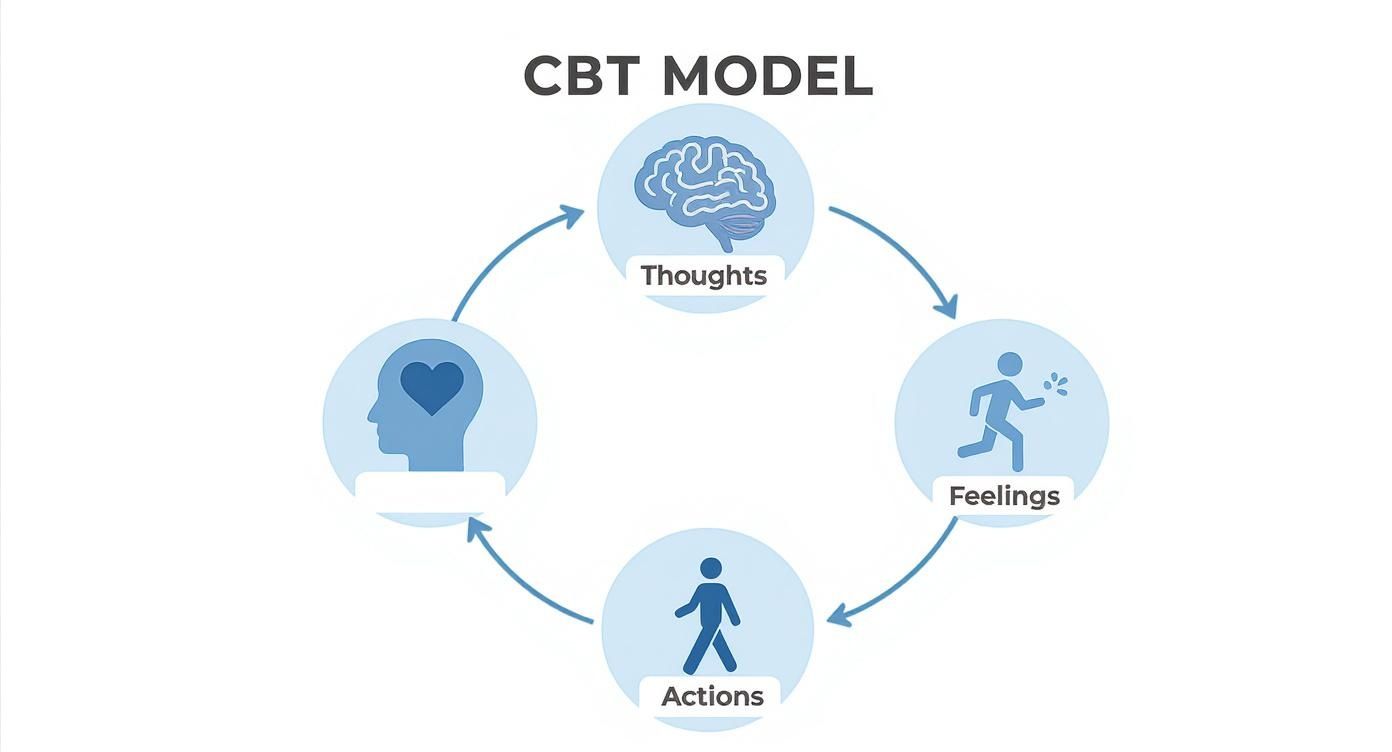
As the diagram shows, you can intervene at any point—your thoughts, feelings, or actions—to shift the entire dynamic.
Identifying Your Thinking Traps
Our unhelpful thoughts are rarely random. They often follow predictable patterns called cognitive distortions, or "thinking traps." These are mental shortcuts that feel true but actually warp our perception of reality. Learning to spot them is the first step toward breaking free.
Here are a few common culprits:
- All-or-Nothing Thinking: Viewing things in rigid, black-and-white terms. If you aren't perfect, you're a total failure.
- Jumping to Conclusions: Making a negative assumption without sufficient evidence. This includes "mind reading" (assuming you know what others think) or "fortune telling" (predicting a negative outcome).
- Catastrophizing: Automatically expecting the worst-case scenario. A minor setback spirals into a predicted disaster.
These distortions are like wearing sunglasses indoors. They tint everything you see. CBT is the process of learning to take them off and see things as they really are.
Going Deeper: Core Beliefs and the Hidden Rules You Live By
Cognitive distortions are the visible layer of the iceberg. They’re the thoughts you can catch in real time: catastrophizing, mind reading, all-or-nothing thinking. But CBT becomes truly life-changing when you start noticing what fuels those distortions underneath the surface: your core beliefs.
Core beliefs are the deepest assumptions you carry about yourself, others, and the world. They’re not everyday thoughts like “I’m nervous about this meeting.” They’re more like hidden operating systems that quietly shape how you interpret everything. Common examples include:
- “I’m not enough.”
- “I’m unsafe unless I’m perfect.”
- “People leave.”
- “My needs are too much.”
- “If I relax, I’ll fall behind.”
Once a core belief is installed, your mind becomes a loyal lawyer for it. It filters reality to preserve the story. If your core belief is “I’m incompetent,” your brain will highlight every mistake as proof and minimize every win as luck. This is why distorted thinking can feel so convincing—even when evidence suggests otherwise.
In CBT, this layer matters because you can’t fully reframe the surface without occasionally updating the foundation. If you only challenge automatic thoughts but never examine the belief underneath, you may notice improvements, but you’ll keep returning to familiar emotional gravity. The deeper work is not about turning your mind into a positivity factory. It’s about turning it into a truth factory.
A simple way to locate a core belief is the “downward arrow” method. When you notice a distressing thought, ask:
- “If that were true, what would it mean about me?”
- “And if that were true, what would it mean?”
- “What am I afraid this proves?”
Example:
Automatic thought: “My friend didn’t reply.”
Meaning: “They might be upset.”
Downward arrow: “If they’re upset, I did something wrong.”
Deeper meaning: “If I did something wrong, I’m unlovable.”
Now you’ve reached the root.
Once a core belief becomes visible, you can work with it in a disciplined, compassionate way:
- Name it without drama
“I’m noticing a ‘not enough’ belief.” - Look for disconfirming evidence
Not grand wins. Small, repeated counterexamples. - Build a balanced replacement belief
Not “I’m perfect.”
Rather:
“I’m learning and improving.”
“I can be imperfect and still valued.” - Pair it with behavior
Core beliefs change fastest when your actions start sending new data.
This is also where self-compassion becomes a practical CBT tool, not just a feel-good extra. Many core beliefs were originally survival strategies—ways a younger version of you explained chaos, rejection, criticism, or uncertainty. When you treat those beliefs like outdated protective rules rather than personal defects, you can update them without shame.
The point isn’t to erase your past. The point is to stop letting it run your present. When you begin working at the core belief layer, CBT shifts from “fixing bad moods” to something bigger: identity-level freedom.
The Action-Oriented Approach
Finally, it is crucial to understand that CBT is not a passive therapy. It’s not just about talking; it’s about doing.
The “behavioral” part of its name is key. The goal is to actively change unhelpful behaviors that keep you stuck and build new, more effective habits.
This means doing practical exercises and running real-world "experiments" to challenge old beliefs and build confidence. You are an active participant learning skills you can use for life. This focus on actionable strategies makes CBT a powerful and practical tool for lasting change.
Actionable CBT Techniques You Can Use Today

Understanding the theory is great, but the real power of CBT is in its application. The beauty of what cognitive behavioral therapy offers lies in its practical, hands-on tools. These are concrete strategies you can use right now to start rewiring your mental habits.
Let's explore a few of the most powerful CBT techniques. Each one provides a clear path to interrupt the cycle of unhelpful thoughts, feelings, and actions.
A Simple 7-Day CBT Journaling Sprint (That Actually Builds Momentum)
Most readers love CBT in theory and struggle in practice for one reason: they try to do everything at once. The antidote is a short, simple structure that builds confidence through repetition. Here’s a seven-day sprint that turns CBT tools into something lived rather than admired.
Day 1: Map the Loop
Write one recent emotional episode and label it using the CBT model:
- Situation
- Automatic thoughts
- Feelings
- Behaviors
Keep it factual and short. Your goal is not insight fireworks. Your goal is pattern visibility.
Day 2: Identify Your Top 3 Thinking Traps
Scan the episode from Day 1 and ask:
- Where did I jump to conclusions?
- Where did I catastrophize?
- Where did I treat feelings like facts?
Write the three distortions you use most often. This becomes your personal “mental weather report.”
Day 3: Run a Thought Record
Use your structured thought record and rewrite one key belief from the episode:
- Evidence for
- Evidence against
- More balanced alternative thought
Aim for high credibility. The best CBT reframe is one your brain can accept on a difficult day.
Day 4: Behavioral Activation Micro-Test
Schedule one small activity that tends to lift your mood or restore agency:
- 10-minute walk
- tidy one area
- brief social connection
- creative micro-task
Before and after, rate mood 0–10. This turns improvement into data.
Day 5: Exposure Lite (If Anxiety Is Your Theme)
Choose something mildly uncomfortable, not terrifying:
- send a message
- make a small request
- speak up once in a meeting
- practice a short presentation alone
The goal is to teach your brain: “Discomfort is survivable.”
Day 6: Core Belief Check
Use the downward arrow once:
- “If this fear were true, what would it say about me?”
Then craft a replacement belief that is realistic and empowering.
Day 7: Build Your Personal Protocol
Create your “CBT minimum viable routine”:
- One thinking trap you will watch for
- One replacement statement you will practice
- One daily action that supports the new belief
- One regulation habit (breath, walk, sleep anchor)
This is where CBT becomes sustainable.
A sprint like this works because it pairs cognition with behavior. You’re not just journaling about change—you’re collecting evidence that change is possible. That’s how your nervous system learns to trust the process.
If you want to make this even more user-friendly in your article, add a short line after this section:
“Repeat this 7-day cycle twice. Most people notice a measurable reduction in emotional reactivity by the second round.”
No exaggerated claims. Just a clean, encouraging path forward.
Cognitive Restructuring: The Art of Reframing Your Thoughts
Cognitive restructuring is the heart of CBT. It is the process of identifying, challenging, and changing unhelpful thought patterns. Think of yourself as a detective for your mind, seeking evidence that either supports or debunks your automatic negative thoughts.
One of the most effective tools for this is the thought record, a simple but profound journaling exercise.
How to Use a Thought Record:
- Situation: Describe the trigger factually. (e.g., "My friend canceled our plans last minute.")
- Automatic Thought: Write the first thing that popped into your head. (e.g., "They don't really want to see me.")
- Emotion: Name the feeling that followed. Rate its intensity from 0-100. (e.g., "Sadness, 80%. Rejection, 70%.")
- Challenge: Question your automatic thought. Is it 100% true? What is the evidence against it? (e.g., "They have been a reliable friend for years. Maybe they are just genuinely busy.")
- Alternative Thought: Craft a new, more balanced thought based on your evidence. (e.g., "I'm disappointed, but their cancellation probably has nothing to do with me personally.")
This structured process moves you from an emotional reaction to a rational response.
Behavioral Activation: Scheduling a Better Mood
If cognitive restructuring targets your thoughts, behavioral activation targets your actions. This technique is based on a simple premise: when we feel down, we stop doing things we enjoy, which makes us feel worse.
Behavioral activation breaks this cycle by having you intentionally schedule positive or meaningful activities into your day—even when you don’t feel like it. It’s about acting your way into a better feeling, rather than waiting for motivation to strike.
The core idea is that positive action, no matter how small, can create upward spirals of mood and motivation. It’s a direct intervention to counteract avoidance and isolation.
Start small. Plan one or two enjoyable activities for each day this week. It could be a 10-minute walk, listening to a favorite album, or calling a friend. You can also explore different journaling exercises for behavior change to help you build this powerful habit.
Exposure Therapy: Gently Facing Your Fears
For anxiety, phobias, and OCD, exposure therapy is an incredibly effective technique. It involves gradually and repeatedly exposing yourself to feared situations in a safe, controlled way. Through this process, called habituation, your brain learns that the feared outcome is unlikely, and the anxiety response diminishes over time.
For instance, someone with a fear of public speaking might start by imagining giving a speech, then practice in front of a mirror, and eventually present to a small, supportive group. Each step is manageable, building confidence without causing overwhelm.
These techniques highlight the practical, skill-building nature of CBT. They work. Studies have shown that approximately 60% of adults using CBT-based methods report significant improvement. Incorporating other self-help strategies can be a great boost. For example, practices like the 3 Simple Ways to Practice Gratitude Daily can be a fantastic addition to your CBT toolkit.
Who Can Benefit from Cognitive Behavioral Therapy?
Embedded iFrame
One of the biggest myths about Cognitive Behavioral Therapy is that it’s only for those with a clinical diagnosis. While CBT is an effective treatment for specific mental health conditions, its principles can help anyone seeking to improve their mental and emotional well-being.
Think of CBT as mental fitness training. You don't need a specific diagnosis to benefit from strengthening your mind. The sheer versatility of what cognitive behavioral therapy can do is its greatest strength.
A Proven Treatment for Clinical Conditions
CBT has a long track record as a first-line treatment for numerous psychological challenges. It is one of the most rigorously researched forms of psychotherapy, with thousands of studies backing its effectiveness.
It is particularly powerful for:
- Anxiety Disorders: Including generalized anxiety, panic disorder, social anxiety, and specific phobias.
- Depression: It helps people break the cycle of negative thinking that fuels depressive episodes.
- Post-Traumatic Stress Disorder (PTSD): CBT provides tools to process trauma and re-examine related beliefs.
- Obsessive-Compulsive Disorder (OCD): It often involves Exposure and Response Prevention (ERP) to reduce compulsive behaviors.
The table below breaks down how CBT is specifically applied to some of these common conditions.
CBT Applications for Different Conditions
| Condition | Primary Goal of CBT | Common Techniques Used |
|---|---|---|
| Depression | To challenge negative automatic thoughts and core beliefs that maintain low mood. | Cognitive Restructuring, Behavioral Activation, Thought Records. |
| Anxiety Disorders | To reduce avoidance behaviors and re-evaluate exaggerated beliefs about threat. | Exposure Therapy, Relaxation Techniques, Cognitive Reappraisal. |
| PTSD | To process traumatic memories and change unhelpful beliefs related to the trauma. | Trauma-Focused CBT (TF-CBT), Cognitive Processing Therapy (CPT). |
| OCD | To break the cycle of obsessions and compulsions by facing feared situations without rituals. | Exposure and Response Prevention (ERP), Cognitive Restructuring. |
As you can see, the therapy is adapted to target the specific thought and behavior patterns driving each condition.
This widespread recognition isn't just clinical—it's economic. The global market for CBT is projected to grow significantly, largely due to its high success rates. You can explore the data on the growth of the CBT market on BioSpace.
A Practical Toolkit for Everyday Life
Beyond the clinic, CBT offers a powerful framework for navigating everyday stressors. It equips you with skills to become more resilient, self-aware, and emotionally balanced.
CBT is fundamentally about empowerment. It teaches you that while you can't always control what happens to you, you can learn to control how you respond.
You can use CBT principles daily to:
- Manage stress: Spot thought patterns that blow minor hassles out of proportion.
- Overcome procrastination: Address the beliefs and avoidance habits holding you back.
- Improve relationships: Understand how your interpretations affect your reactions and improve communication.
- Build self-esteem: Challenge your inner critic and replace self-defeating thoughts with more compassionate ones.
At its core, anyone who wants to better understand their mind can find immense value in CBT.
How Journaling Amplifies Your CBT Practice

The real work of Cognitive Behavioral Therapy happens between sessions. This is where journaling becomes your most powerful ally, turning abstract concepts into concrete, personal insights.
Journaling provides a structured space for self-observation—catching your thoughts and behaviors as they happen. This gives you the raw data needed to make meaningful changes.
The Thought Record: Your Key to Cognitive Restructuring
One of the cornerstone techniques of CBT is the thought record, a specific journaling method designed for cognitive restructuring. It’s a systematic way to slow down, examine an automatic negative thought, and find a more balanced perspective.
Instead of letting a fleeting thought hijack your mood, you capture it on the page and put it on trial.
The process is straightforward: note the situation, identify the automatic thought, name the resulting emotion, and then actively challenge that thought with evidence. This isn't about forced positivity; it's about becoming a detective of your own mind, learning to separate fact from feeling.
Journaling externalizes your thoughts. Once they’re on the page, they lose some of their power, and you can engage with them more objectively instead of being swept away by them.
Behavioral Activation and AI-Powered Reflection
Journaling is also a major advantage for behavioral activation. You can use your journal to plan mood-lifting activities, track how you feel before and after, and pinpoint what truly improves your well-being. This creates a powerful feedback loop that motivates you to keep going.
To get the most out of it, consider incorporating effective strategies for keeping a journal that emphasize mindful awareness.
This is where a modern tool like Life Note can accelerate your progress. It offers structured, CBT-based prompts that guide you through creating a thought record or planning behavioral activation experiments. Over time, the AI can help spot recurring cognitive distortions and reflect on your progress.
By combining timeless journaling methods with smart tools, you build a robust system for developing lasting journaling for emotional awareness and resilience.
Frequently Asked Questions About CBT
Let's clear up a few common questions about how Cognitive Behavioral Therapy works.
How Is CBT Different from Other Therapies?
The biggest difference is its focus and structure. While many traditional therapies explore into your past to understand why you feel a certain way, CBT is squarely focused on the present. It's less about the historical roots of a problem and more about giving you practical tools to manage it right now. The question CBT asks is, "How can we change your current thoughts and actions to help you feel better today?" It is an active, hands-on approach that builds a mental toolkit you can use for the rest of your life.
How Long Does CBT Actually Take?
CBT is designed to be a short-term therapy. Many people see meaningful change within 12 to 20 sessions. The goal is to empower you to become your own therapist, not to keep you in therapy indefinitely. The exact timeline depends on your goals and engagement, but the focus is always on efficient, goal-oriented progress.
Can I Do CBT On My Own?
Absolutely. Many of CBT's core techniques can be practiced using self-help books, workbooks, or guided journaling apps. You can start using thought records or behavioral activation on your own and see a real difference. However, working with a trained therapist can provide personalized feedback and accountability, often speeding up progress. For most, a blend of professional guidance and consistent self-practice is the winning combination.
Cognitive Behavioral Therapy offers a clear, actionable path toward a healthier mind. It demystifies our internal worlds and empowers us with the skills to navigate life's challenges more effectively. By understanding the link between our thoughts, feelings, and actions, we discover the ability to create lasting, positive change.
Ready to see how journaling can support your mental wellness journey? Life Note offers a unique space to practice CBT principles with guidance from AI mentors. Start transforming your reflections into actionable wisdom today. Discover the future of self-discovery.
Looking for more? See our complete collection of 100+ journaling prompts for mental health.
Journal with 1,000+ of History's Greatest Minds
Marcus Aurelius, Maya Angelou, Carl Jung — real wisdom from real thinkers, not internet summaries. A licensed psychotherapist called it "life-changing."
Try Life Note Free