How Visualization Reduces Stress in Journaling

Learn three short visualization journaling techniques—Calm Place, Letting Go, Future Self—to lower stress, improve mood, and track progress.

📌 TL;DR — Visualization Reduces Stress
Visualization activates the same brain regions as actual experiences, making it a powerful stress reduction tool. Combine with journaling by writing detailed sensory descriptions of peaceful scenes or successful outcomes. Just 5-10 minutes of guided visualization can lower cortisol and activate the parasympathetic nervous system.
Visualization journaling combines mental imagery with writing to help reduce stress and process emotions. By imagining calming scenes or positive outcomes, you can activate your brain's relaxation response, lower cortisol levels, and improve mood. Writing about these visualizations deepens the experience, helping you organize thoughts and reduce intrusive worries.
Key Takeaways:
- Calm your nervous system: Visualization activates the parasympathetic system, reducing heart rate and tension.
- Boost emotional clarity: Writing about images helps process emotions and uncover patterns.
-
Three techniques to try:
- Calm Place: Picture a serene setting and immerse all your senses.
- Letting Go: Visualize stress as an object floating away.
- Future Self: Imagine yourself confidently tackling challenges.
Tools like Life Note can support this practice by tracking emotional patterns and offering personalized insights. Regular sessions (5–15 minutes) can help you feel more grounded and manage stress effectively.
How Visualization Reduces Stress
How Visualization Calms Your Nervous System
When you picture a peaceful scene in your mind, your body reacts as though you're actually experiencing it. This activates your parasympathetic nervous system, triggering a relaxation response that slows your heart rate, lowers blood pressure, and eases muscle tension[1]. Essentially, it shifts your body out of the "fight or flight" mode often associated with chronic stress.
A study conducted in June 2020 by Nancy A. Nicolson and Madelon L. Peters at Maastricht University explored this effect. They had 66 students participate in a two-week "Best Possible Self" (BPS) visualization exercise. The results? Those in the BPS group experienced a noticeable decrease in their cortisol awakening response and lower cortisol levels when faced with acute social stress. They also reported worrying less and feeling more positive overall[8].
Even as little as five minutes of imagining a calming scene - like a quiet beach or a lush forest - can slow your heart rate and improve heart rate variability[6]. This relaxation not only soothes your body but also primes your mind for deeper reflection when you write about these visualizations.
Why Writing About Visualizations Matters
The act of writing about your visualizations takes the calming effects a step further. Studies show that journaling, especially when it combines emotional expression with cognitive processing, can help you better understand the positive aspects of stressful experiences[9]. Writing helps you organize your thoughts, uncover patterns, and capture the details of your mental imagery. It also reduces the tendency to dwell on negative thoughts, as imagery-based processing has been found to limit intrusive worries more effectively than abstract verbal thinking[7].
3 Visualization Techniques for Stress Relief
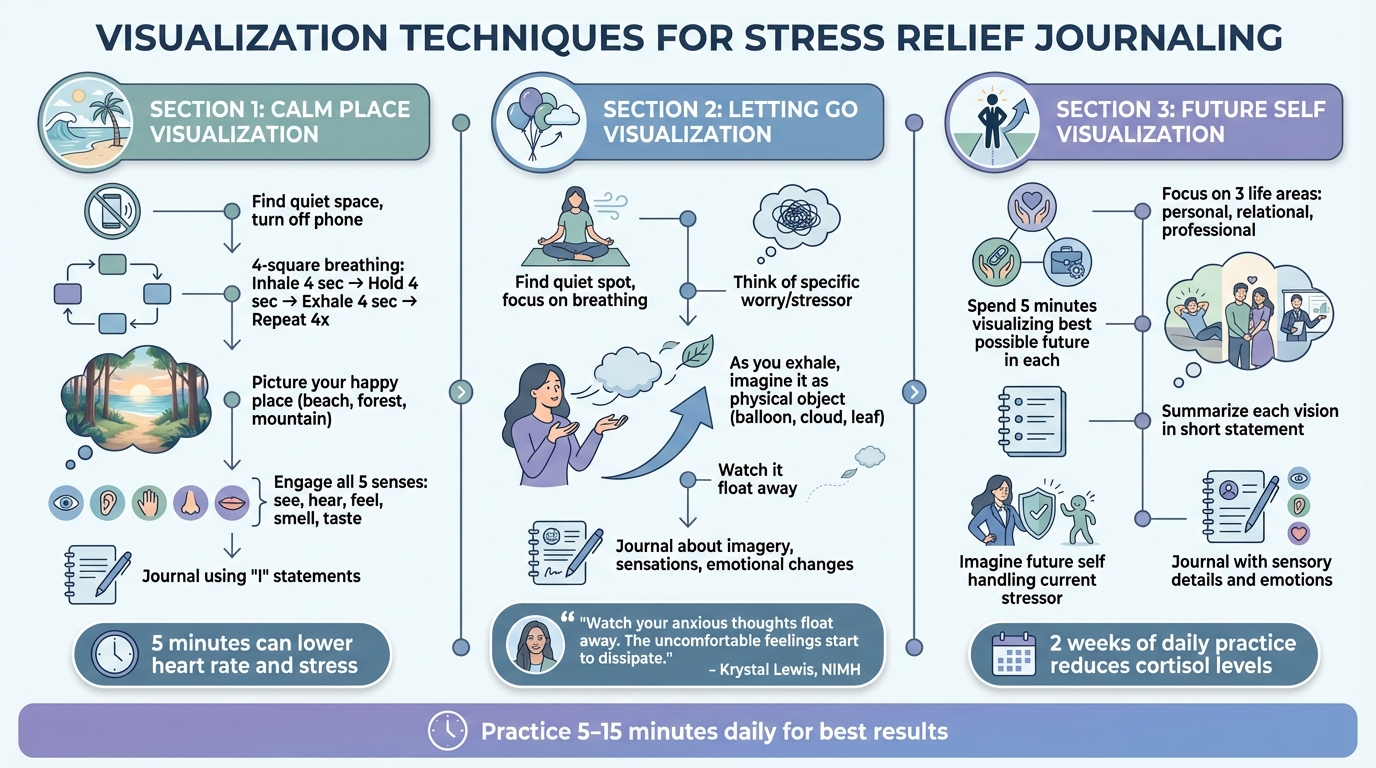
3 Visualization Techniques for Stress Relief Journaling
These three visualization techniques - Calm Place, Letting Go, and Future Self - offer simple yet effective ways to ease stress and regain a sense of balance.
Calm Place Visualization
Start by finding a quiet space where you can relax without interruptions. Turn off your phone and sit comfortably with your back straight to support deep breathing. Begin with 4-square breathing: inhale for 4 seconds, hold for 4 seconds, exhale for 4 seconds, and repeat 4 times. This is a great way to start your ai journaling journey. This helps calm your nervous system and prepare your mind for the exercise[5].
Now, picture your "happy place." This could be a serene beach, a lush forest, a mountain view, or any setting that feels peaceful to you. It might be a real memory or something entirely imagined[4][5]. The key is to immerse yourself fully by engaging all five senses - see the colors, hear the sounds, feel the textures, smell the air, and even imagine the taste of the environment[4][5].
After a few minutes in this mental space, take time to journal what you experienced. Use "I" statements to make it personal, like "I hear the waves gently lapping against the shore" or "I feel the warmth of the sun on my skin." Reflect on how the scene looks and how you feel being there. Write down how your emotions shifted before and after the exercise and note any reduction in tension or discomfort[2][4].
"Visualization, an image-based imaginative process, has been used as a powerful therapeutic tool for decades and can be practiced anywhere at pretty much any time."
– Kelsey Schultz, Ph.D. Candidate, Berkeley Well-being Institute[3]
Studies suggest that even five minutes of visualizing nature can significantly lower perceived stress and physical markers like heart rate[6]. This technique taps into the brain's visual centers, helping shift your state from stress to calm[3][4].
Once you've mastered creating a calm mental space, the next step is learning how to let go of stress.
Letting Go Visualization
This technique shifts from peaceful imagery to actively releasing stress. Begin in a quiet spot and focus on calm, steady breathing[5].
Think of a specific worry or stressor. As you exhale, imagine it taking on a physical form - like a balloon, a cloud, or a leaf - and watch it float away[3][4].
Krystal Lewis, a Licensed Clinical Psychologist at the National Institute of Mental Health, explains:
"Watch your anxious thoughts float away. The uncomfortable feelings start to dissipate."[4]
Pay attention to how the object looks, moves, and even sounds as it drifts away[7]. Afterward, journal about the imagery you used, the sensations you felt, and how your emotions changed during the process. Research shows that using imagery to process anxiety can reduce intrusive negative thoughts, while focusing solely on words may actually intensify them[7].
Once you've released your stress, you can shift your focus to envisioning a more empowered version of yourself.
Future Self Visualization
This technique helps you imagine handling challenges with confidence and calm. Research by Nancy A. Nicolson and Madelon L. Peters at Maastricht University found that practicing "Best Possible Self" visualization daily for two weeks significantly reduced cortisol levels and improved mood, even under acute stress[8].
To try this, focus on three key areas of your life: personal, relational, and professional[8]. Spend about five minutes visualizing your best possible future in each area. Afterward, summarize each vision in a short, clear statement[8].
As you journal, imagine your future self facing a current stressor. Write about how this confident version of you handles the situation with ease. Describe the scene in detail - what you see, hear, and feel - and note the emotions that arise. This exercise not only boosts confidence but also shifts your perspective, helping you focus on solutions instead of stress. As Bo Bennett puts it, "Visualization is daydreaming with a purpose", a practice that trains your brain to engage its problem-solving abilities[3].
Try to dedicate 5 to 15 minutes daily to this exercise, followed by a brief journaling session to track how your mood and confidence evolve over time[3][8].
How Life Note Supports Stress-Relief Journaling
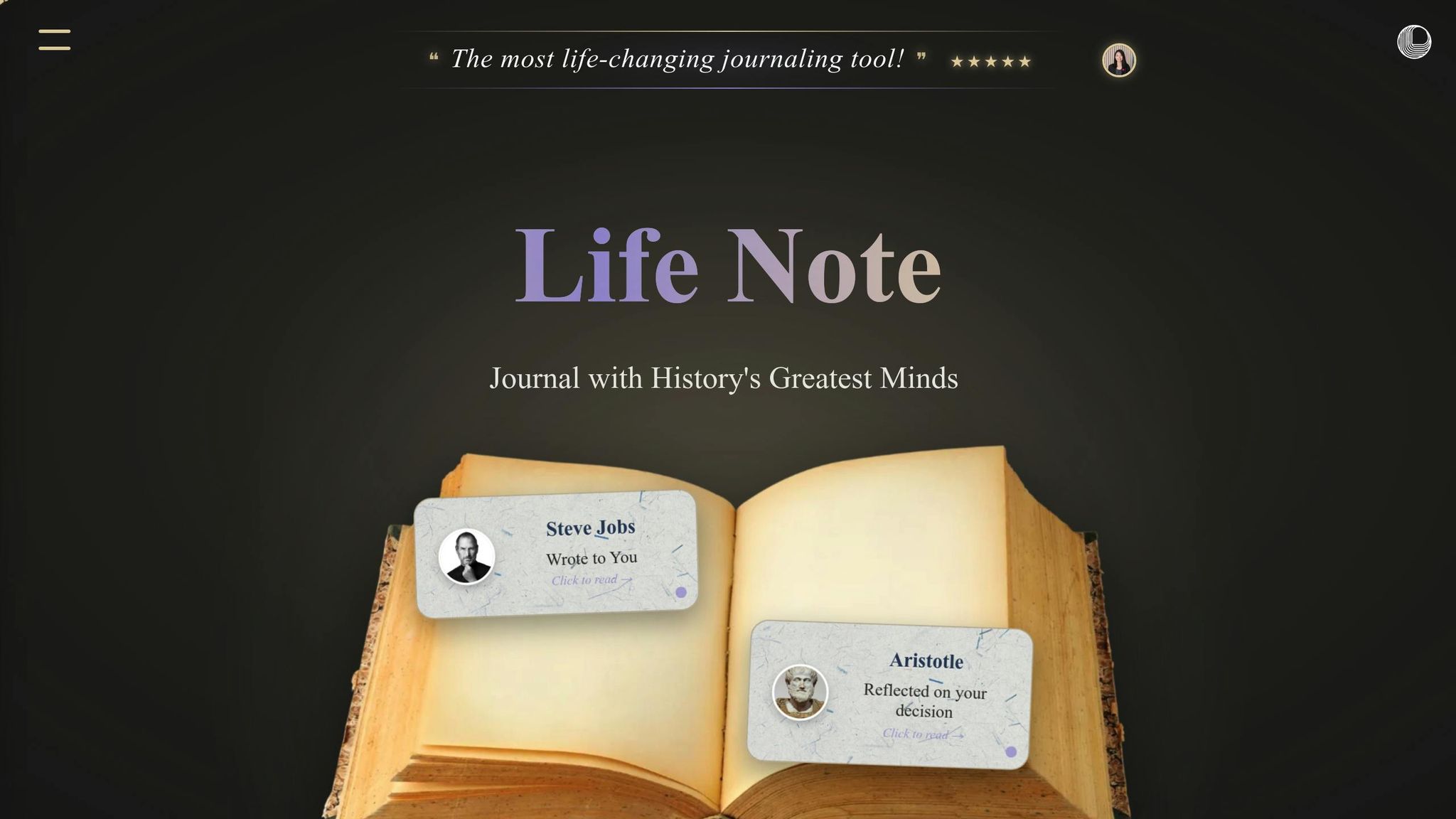
To help you get the most out of this practice, Life Note offers tools to turn your visualizations into meaningful insights. Whether you're imagining a peaceful natural setting, letting go of a burden, or envisioning your future self, Life Note's mentoring system guides you in exploring what these images reveal about your emotions and needs.
The platform’s memory feature tracks your visualizations over time, highlighting patterns in the mental images that consistently bring you calm. Additionally, personalized reflection letters connect these visualizations to recurring themes in your life, helping you deepen your self-awareness and build a stronger foundation for managing stress.
Building a Consistent Visualization Journaling Practice
Making visualization journaling a regular habit can strengthen your brain's ability to handle stress more effectively [1]. Practicing this technique even during calm moments helps ensure it works better when you face high-pressure situations [1].
Setting Up Your Journaling Space
Find a quiet spot where you won’t be interrupted, and make it as comfortable as possible [5]. Keep distractions - especially your phone - out of reach to maintain focus [5].
Start your session with a grounding exercise to shift your mind from daily stress to a more focused state. You could try something like the 4-squared breathing method or a quick body scan to release built-up tension [5].
Reviewing Your Progress
Looking back on past journal entries can help you process emotions more deeply [9]. In one study involving 122 students, those who focused on both their thoughts and feelings while journaling reported greater awareness of positive outcomes compared to those who focused solely on emotions [9].
Pay attention to how your mental imagery evolves over time. For example, notice whether recurring metaphors - like "a path" or "a building" - change in tone or complexity as the weeks go by [2]. Also, track how often negative thoughts interrupt your visualizations. Research shows that imagery-based journaling can significantly reduce these interruptions, whereas journaling focused only on words may actually increase them [7]. Set aside time each week to review your entries and identify which visualization techniques work best for you.
Life Note can enhance this process by helping you monitor your growth and stay on track with your stress-management journey.
Using Life Note to Track Your Growth
After reviewing your progress, use Life Note’s features to take your practice further. Life Note analyzes themes and emotional patterns in your entries, offering personalized weekly reflections to deepen your self-awareness.
These reflections provide what researchers call "corrective learning", helping you recognize when past catastrophic thoughts were exaggerated and guiding you toward healthier ways to view current stressors [7]. On top of that, your journal entries are transformed into artistic representations in your Inner Gallery, creating a meditative visual record of your emotional journey. This can help you uncover symbolic patterns you might not notice otherwise.
The Wisdom Library feature allows you to save and revisit key insights that have shaped your growth. It also helps you track which sensory details - like sights, sounds, or smells - are most vivid in your visualizations. Practicing consistent sensory engagement enhances your visualization skills over time [2]. By combining visualization, reflection, and actionable insights, Life Note helps you stay aligned with your stress-reduction goals.
When to Seek Professional Support
Understanding the Limits of Self-Help
While visualization journaling offers a powerful way to manage stress, it's important to recognize its boundaries. It’s a helpful tool, but it’s not a substitute for professional mental health care. If you find that your stress symptoms persist or even worsen despite consistent journaling, it’s time to consult with a primary care doctor or a mental health professional [10].
Physical signs of chronic stress are worth noting. As Krystal Lewis of the National Institute of Mental Health explains, "When we're constantly experiencing stress and our brains are on alert or on edge, our body's not going to be relaxed and sometimes we might have physical effects of that stress" [4]. These effects can show up as ongoing headaches, stomach aches, muscle tension, or simply feeling drained from being in a constant state of alertness [4]. When your body is stuck in fight-or-flight mode, self-help methods like journaling might not be enough.
It’s also essential to monitor how journaling impacts you emotionally. Research indicates that focusing only on negative emotions without finding ways to process them can backfire. For example, one study found that people who vented their emotions without working through solutions experienced more severe physical symptoms of illness [9]. If visualization exercises leave you feeling more distressed or anxious, reaching out for professional support is a wise step [2][7].
For immediate help, the Substance Abuse and Mental Health Services Administration (SAMHSA) National Helpline is available at 1-800-662-4357. They provide treatment referrals and information [10]. Keep in mind, self-help tools are meant to complement - not replace - professional care for conditions like clinical anxiety, depression, or trauma.
While self-help techniques like journaling are valuable, combining them with professional guidance can take your mental health journey to the next level.
How Life Note Works Alongside Therapy
Life Note doesn’t just stand alone - it works seamlessly with therapy to enhance your self-reflection and emotional growth. Through its AI mentors, inspired by figures like Carl Jung and Brené Brown, the platform helps you navigate complex emotions and uncover recurring patterns. This can provide rich insights to bring into your therapy sessions.
Psychologist Jeremy Sutton highlights the value of visualization in therapy: "Visualization, whether picturing a journey or image, can open the therapeutic dialogue and help the client express complex emotions" [2]. Life Note’s Wisdom Library captures these spontaneous images and metaphors from your journaling, creating a record of recurring themes. These patterns can offer your therapist a deeper understanding of your emotional state. Additionally, the platform’s weekly reflection letters encourage cognitive processing - an approach where you think through events instead of merely venting emotions. Research shows this method leads to better outcomes [9].
Preparing for therapy sessions becomes easier with Life Note. By reviewing your Inner Gallery, you can identify recurring symbols or “framing images” (like paths or buildings) that might hold deeper meaning [2]. However, it’s essential to remember that while Life Note provides advanced AI-guided reflection, it’s not a replacement for the expertise of a licensed therapist. Professional therapy is particularly important for addressing deeper issues like trauma or long-standing harmful thought patterns [2].
Life Note is a powerful companion to therapy, offering tools that enrich your reflective practice while keeping professional care at the center.
Related: Explore all the benefits of journaling →
Conclusion
Key Takeaways
Visualization journaling offers a practical way to manage stress effectively. By tapping into your imagination, you engage the same brain areas involved in actual visual experiences. This allows your nervous system to respond to imagined tranquility as though it were real [3][1]. Studies indicate that committing to this practice for just two weeks can significantly improve how your body copes with stress [8].
Short, consistent sessions - just 5 to 15 minutes - can create neural pathways that make calm more accessible, even in challenging moments [10]. Whether you’re imagining a peaceful place, letting go of worries, or envisioning your future self, writing about these mental images strengthens their impact. Research shows that processing emotions through imagery leads to greater mood improvements compared to verbal methods alone [3].
Life Note takes this practice further by helping you track recurring themes and symbols through its Wisdom Library and Inner Gallery. With AI mentors inspired by thinkers like Carl Jung, the platform helps identify emotional patterns across your entries, turning individual journaling sessions into a cohesive story of personal growth. Weekly reflection letters provide structured cognitive processing, which research suggests is more effective than simply venting emotions.
With these tools and insights, you can start your visualization journaling journey today.
Getting Started
Dive into the benefits of visualization journaling with a simple exercise. Begin with a technique like the calm place visualization. Dedicate 5 minutes to it today. Find a quiet space, fully immerse yourself in the mental image, and engage all your senses. What do you see, hear, feel, or even smell in this imagined setting? Once you’ve visualized, open your journal and describe the experience in detail - include colors, textures, sounds, and emotions.
Afterward, use the platform’s mentoring tools to reflect on your entry. Life Note’s memory features can reveal patterns you might not notice, such as recurring symbols or common challenges, guiding you toward deeper self-awareness. As Albert Einstein famously said, "Imagination is more important than knowledge. For while knowledge defines all we currently know and understand, imagination points to all we might yet discover and create" [3]. Through visualization journaling, you can connect inner clarity with meaningful personal growth.
FAQs
How does visualization in journaling help reduce stress and improve emotional clarity?
Visualization in journaling serves as a powerful way to ease stress by turning vague emotions into clear mental pictures. This process makes it easier to understand and work through your feelings. Plus, it can trigger a calming effect on your body, redirect your mind away from overthinking, and help you develop a more upbeat outlook.
By tapping into your imagination, this type of journaling encourages you to explore your inner thoughts in a creative way. It can offer fresh perspectives on challenges and help you connect more deeply with your emotions. Over time, this practice can enhance your self-awareness and bring a sense of emotional steadiness.
How does visualization help reduce stress while journaling?
Visualization is a powerful tool for easing stress, as it taps into the parasympathetic nervous system - the part of your body responsible for promoting relaxation. By picturing calming scenes, uplifting outcomes, or tranquil environments while journaling, your brain begins to treat these images as if they were real. This can help slow your heart rate, loosen tense muscles, and quiet those racing, anxious thoughts.
Blending visualization with journaling can also sharpen self-awareness and bring emotional clarity. Whether you're imagining serene landscapes or mentally working through solutions to challenges, this practice creates a safe and reflective space. It not only helps reduce stress but also deepens your understanding of your own thoughts and feelings, encouraging a sense of mindfulness and balance.
How does Life Note make visualization journaling more effective for stress relief?
Visualization journaling is a powerful way to ease stress by turning your thoughts into vivid, sensory-rich mental images. These imagined scenes can help calm both your mind and body, reducing stress hormones, relieving tension, and encouraging relaxation. By focusing on soothing or uplifting imagery, you can break the cycle of worry and cultivate a more peaceful state of mind.
Life Note takes this practice to the next level by weaving visualization into your journaling routine. It connects your entries with historical mentors who provide personalized, sensory-driven visualizations tailored to your emotions. The platform’s smart memory feature tracks recurring themes, offering insights into your progress or stress patterns over time. On top of that, Life Note transforms your entries into symbolic artwork, visually capturing your emotional journey. This blend of guided imagery, reflective insights, and creative expression makes visualization journaling an even more engaging and effective tool for stress management.
Best Possible Future Self visualization exercise 4 minutes
Related Blog Posts
- How to Start Anxiety Journaling in 10 Minutes (with 10 Prompts)
- Visual Journaling for Emotional Healing
- Stress Journaling: Common Mistakes to Avoid
- Daily Journaling Habits for Staying Focused
Related: AI journaling can enhance your visualization practice with personalized prompts and pattern tracking.
Looking for more ways to journal for stress relief? See our journaling prompts for mental health for prompts targeting anxiety and emotional regulation.
Journal with 1,000+ of History's Greatest Minds
Marcus Aurelius, Maya Angelou, Carl Jung — real wisdom from real thinkers, not internet summaries. A licensed psychotherapist called it "life-changing."
Try Life Note Free