
CBT Journaling: Mental Health Journal Prompts & Techniques

CBT journaling builds self-awareness and reduces anxiety by teaching thought records, mood tracking, and distortion logs you can practice daily.
📌 TL;DR — CBT Journaling
CBT journaling applies cognitive behavioral therapy techniques on paper — thought records, Socratic questioning, behavioral experiments, cognitive restructuring, and the downward arrow method. Research shows structured writing reduces anxiety symptoms by 25-50% and improves emotional regulation in as little as 4 weeks. Below: 5 techniques with worked examples, 50 prompts organized by category, a comparison of CBT vs. DBT vs. ACT journaling, and a step-by-step starter framework. See also: worry journal.
You already know journaling helps. But "write about your feelings" is vague — and vague advice produces vague results.
CBT journaling is different. It gives your writing structure. Instead of free-flowing thoughts, you follow specific techniques drawn from cognitive behavioral therapy — the same evidence-based framework therapists have used since the 1960s. You identify a thought, test it against evidence, and replace it with something more accurate. The result is a journal practice that actually changes how you think, not just how you feel in the moment.
This guide covers five core CBT journaling techniques, walks you through getting started, presents the research behind the practice, and gives you 50 prompts organized by the specific cognitive skill each one targets.
What Is CBT Journaling?
CBT journaling is a structured writing practice that applies cognitive behavioral therapy principles — identifying automatic thoughts, testing them against evidence, and developing balanced alternatives — to reduce anxiety, depression, and emotional reactivity.
Traditional journaling asks you to write whatever comes to mind. CBT journaling asks you to write and then examine what you wrote. The distinction matters because most emotional distress comes not from events themselves but from how we interpret those events. Aaron Beck, the psychiatrist who developed CBT in the 1960s, called these snap interpretations "automatic thoughts" — and he demonstrated that they could be systematically identified, tested, and corrected.
A CBT journal is the tool for that correction. When you write down a stressful situation, capture the thought it triggered, examine the evidence for and against that thought, and then craft a more balanced interpretation, you are performing cognitive restructuring — the core mechanism of CBT — on paper.
The practice sits at the intersection of two evidence-based traditions: expressive writing (Pennebaker's research showing that structured writing about emotional experiences improves physical and psychological health) and cognitive behavioral therapy (which targets the thought patterns that maintain anxiety and depression). CBT journaling combines the emotional processing benefits of writing with the analytical rigor of therapy.
The CBT Model: How Thoughts, Feelings, and Behaviors Connect
The CBT model shows that your interpretation of an event — not the event itself — determines your emotional and behavioral response, and that changing the interpretation changes everything downstream.
CBT operates on a simple but powerful framework: situations trigger thoughts, thoughts trigger emotions, and emotions drive behaviors. This chain is not one-directional — behaviors can reinforce thoughts, and emotions can color perceptions — but the leverage point is always the thought.
Consider two people who receive the same ambiguous text from their manager: "Can we talk tomorrow?" Person A thinks, "I must be getting fired," feels anxious (8/10), and spends the evening catastrophizing. Person B thinks, "Probably a project update," feels calm (2/10), and goes about their evening. Same event, entirely different experience — because the automatic thought was different.
CBT journaling targets three components of this model:
- Automatic thoughts — The rapid, often unconscious interpretations that pop into your mind when something happens. Most people don't notice these thoughts until they learn to slow down and write them out.
- Cognitive distortions — Systematic errors in thinking that skew automatic thoughts toward the negative. Common examples: catastrophizing (assuming the worst), all-or-nothing thinking (seeing only extremes), mind reading (assuming you know what others think), and overgeneralization (drawing broad conclusions from single events).
- Core beliefs — Deep, often unspoken assumptions about yourself, others, and the world ("I'm not good enough," "People always leave," "The world is dangerous"). These beliefs act as filters that shape which automatic thoughts arise.
Your journal becomes the laboratory where you make these invisible processes visible — and then change them.
5 CBT Journaling Techniques
Five evidence-based techniques — thought records, behavioral experiments, Socratic questioning, cognitive restructuring, and the downward arrow — give you a complete toolkit for identifying and changing unhelpful thought patterns.
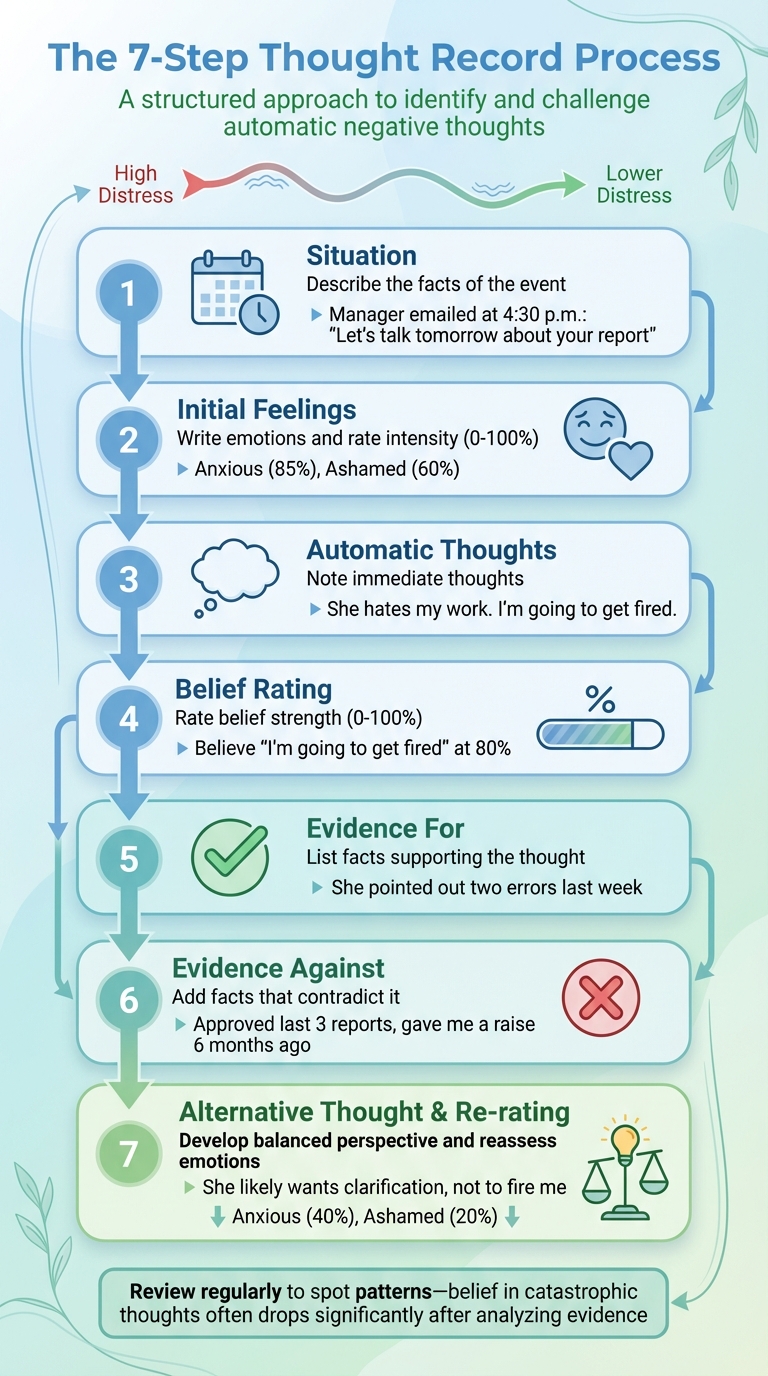
7-Step CBT Thought Record Process for Challenging Negative Thoughts
If you're working with a therapist across multiple modalities, our guide to journaling exercises organized by therapy type covers CBT, DBT, IFS, EMDR, and somatic approaches.
1. Thought Records
The thought record is the foundational CBT tool, developed by Aaron Beck and refined over decades of clinical use [10]. It breaks an emotional experience into components so you can examine each one individually.
The 7-column thought record:
- Situation: What happened? (Just the facts — who, what, when, where.)
- Emotions: What did you feel? Rate intensity 0-100%.
- Automatic thought: What went through your mind? Rate belief 0-100%.
- Cognitive distortion: Which thinking error applies?
- Evidence FOR the thought: What facts support it?
- Evidence AGAINST the thought: What facts contradict it?
- Balanced thought: What's a more accurate interpretation? Re-rate emotions.
Worked example:
- Situation: Colleague didn't respond to my Slack message for 4 hours.
- Emotions: Anxious (75%), rejected (60%).
- Automatic thought: "They're ignoring me because my idea was stupid." Belief: 80%.
- Distortion: Mind reading, personalization.
- Evidence for: They usually reply within an hour. They seemed quiet in yesterday's meeting.
- Evidence against: They had three back-to-back meetings today. They praised my last proposal. Slow replies happen to everyone.
- Balanced thought: "They're likely busy. A delayed reply doesn't mean they dislike my idea." Anxiety: 30%, rejected: 15%.
Notice that the anxiety dropped from 75% to 30% — not because anything externally changed, but because the interpretation shifted to match the evidence. Research by Schroder et al. (2017) found that even a single thought record before a stressor can reduce negative affect and alter cortisol responses [2][4][6].
"Sometimes the feedback from my mentors has been able to stop a negative thought pattern that had been bothering me the entire day." - Eddie Fidler, Life Note user [1]
2. Behavioral Experiments
While thought records examine evidence that already exists, behavioral experiments create new evidence by testing beliefs in the real world.
The process:
- Identify the belief: "If I speak up in meetings, people will think I'm incompetent."
- Design a test: Share one idea in the next team meeting.
- Predict the outcome: "No one will respond, or they'll dismiss my point."
- Run the experiment: Actually do it.
- Record the result: "Two people built on my suggestion. My manager asked me to elaborate."
- Update the belief: "Speaking up sometimes leads to positive engagement, not the rejection I predicted."
Behavioral experiments are especially powerful for beliefs you've held so long that they feel like facts. By journaling the prediction before the test and the actual result after, you create a permanent record that your fear-based predictions are often inaccurate.
3. Socratic Questioning
Socratic questioning is the art of interrogating your own thoughts with the same rigor a skilled therapist would use. Instead of accepting a thought at face value, you probe it with structured questions.
Core Socratic questions for your journal:
- What is the evidence for this thought? What is the evidence against it?
- Is there an alternative explanation?
- What's the worst that could happen? Could I survive it? What's the most likely outcome?
- What would I say to a friend who had this thought?
- Am I confusing a thought with a fact?
- What will matter about this in 5 years?
Worked example:
Thought: "I'll never be good enough at my job."
- Evidence for: I made an error in last week's report.
- Evidence against: I've received positive performance reviews for two consecutive years. I was promoted 8 months ago. My manager specifically cited my analytical skills.
- Alternative explanation: One mistake doesn't define my competence. Even experts make errors.
- What would I tell a friend? "One report error doesn't erase two years of strong performance. You're being too hard on yourself."
- Revised thought: "I made a mistake, and I can correct it. My overall track record is strong."
4. Cognitive Restructuring (ABCDE Method)
Cognitive restructuring is the broader process of identifying distorted thoughts and systematically replacing them with accurate ones. While thought records are a tool for cognitive restructuring, you can also practice it through free-form journaling using the ABCDE method (adapted from Albert Ellis).
- A — Activating event: What triggered the emotional response?
- B — Belief: What belief or interpretation arose?
- C — Consequence: What emotional and behavioral consequences followed?
- D — Dispute: Challenge the belief with evidence and logic.
- E — Effective new belief: What's a more accurate, helpful belief?
The power of writing this out rather than doing it mentally: your brain can hold only a few variables in working memory at once, but a journal page can hold them all simultaneously. This external processing space makes cognitive restructuring significantly more effective than trying to "think differently" without writing.
5. The Downward Arrow Technique
The downward arrow moves from surface-level automatic thoughts to the core beliefs underneath them. It's one of the most powerful techniques in CBT because core beliefs — not individual thoughts — drive recurring patterns of distress.
How it works: Take an automatic thought and keep asking "If that were true, what would it mean about me?" until you reach the core belief.
Worked example:
- Automatic thought: "My partner seemed annoyed when I asked for help."
- ↓ If that's true, what does it mean? → "They think I'm too needy."
- ↓ If that's true, what does it mean? → "People get tired of me."
- ↓ If that's true, what does it mean about me? → "I'm a burden." ← Core belief
Once you identify the core belief ("I'm a burden"), you can examine it with the same evidence-based approach: When have people chosen to help you? When have people expressed that they enjoy spending time with you? The core belief often turns out to be a childhood conclusion that was never updated with adult evidence.
Mood and Trigger Tracking
Mood tracking complements thought records by revealing emotional patterns across days and weeks, helping you identify consistent triggers and make informed lifestyle adjustments.
While thought records focus on specific events, mood tracking offers a wider lens, helping you identify trends in your emotional state over days or weeks. The aim is to uncover patterns — like certain times, people, or activities that consistently affect your mood — so you can make informed adjustments.
How to Track Daily: At set times (morning, afternoon, evening), rate your mood on a 0–10 scale, where 0 is the worst and 10 is the best. Then, jot down the context, thoughts, and actions. For example: "Tuesday, 8:00 p.m. – Mood: 3/10. Spent 45 minutes scrolling social media. Thought: 'Everyone else has their life together.' Stayed in bed instead of going to the gym."
Review your entries every few weeks. Digital tools can generate trend charts, making it easier to spot recurring triggers. You might find that most of your low-mood days coincide with late-night social media use or that your mood consistently improves after exercise or spending time with friends [2][3]. Turning these observations into actionable steps — like reducing screen time or scheduling regular social activities — can help you feel more in control.
Mood tracking is also a great way to monitor the impact of changes, such as therapy, medication, or new habits. Comparing your average mood ratings over time can reveal whether those adjustments are making a difference [9][15][12].
"I see AI journaling not as a replacement for therapy, but as a powerful tool to complement it." - Sergio Rodriguez Castillo, Licensed Psychotherapist & University Professor [1]
Step-by-Step: How to Start a CBT Journal
Start with 10 minutes a day, one technique at a time, and build from there — consistency matters more than duration.
Step 1: Choose Your Format
Paper journals work well for people who find handwriting slows down racing thoughts. Digital tools work well for people who want searchable entries, mood tracking, and pattern detection over time. AI journaling tools like Life Note can act as a thinking partner — asking the Socratic questions for you, identifying recurring distortions, and surfacing patterns across weeks of entries that you might miss on your own.
Step 2: Pick One Technique
Don't try all five techniques at once. Start with thought records — they're the foundation of every other technique. Use the 7-column format for 2-3 weeks before adding anything else.
Step 3: Set a Trigger, Not a Time
Rather than scheduling "journal at 8pm" (which you'll skip when you're tired), tie your practice to an emotional trigger: "Whenever I notice my anxiety above a 5/10, I'll do a thought record." This ensures you journal when it's most useful.
Step 4: Write the Situation First
Begin every entry with the bare facts of what happened — no interpretation, no emotion, just the event. This trains you to separate observation from reaction, which is half the battle.
Step 5: Review Weekly
Set aside 15 minutes each week to read through your entries and look for patterns. You might notice that 80% of your thought records involve work situations, or that catastrophizing is your go-to distortion. These patterns tell you where to focus your energy.
Reviewing and Measuring Progress
Use your thought records and mood logs to identify triggers, such as work stress, family issues, or social events. Pay attention to recurring automatic thoughts, like "I always mess up", which may point to cognitive distortions like all-or-nothing thinking. Note which coping strategies have helped, even if the improvement is small — for instance, lowering anxiety from an 8/10 to a 5/10 after challenging a negative thought. Mark these as strategies to use again.
To make this process more visual, create a simple mood chart. Track your daily mood scores alongside key activities like sleep, exercise, and social interactions. You might notice that your mood averages higher on days you journal or that anxiety spikes after nights with less than six hours of sleep. Digital tools can make this even easier by automating mood tracking, tagging entries, and generating visual trends.
Research: Why CBT Journaling Works
Six studies spanning three decades show that structured writing interventions improve emotional regulation, reduce symptoms of anxiety and depression, and produce measurable changes in stress physiology.
| Study | Finding | Implication for CBT Journaling |
|---|---|---|
| Smyth (1998) — Meta-analysis, 13 studies | Written emotional expression produced a mean effect size of d=0.47 across psychological well-being, physiological functioning, and general health | Structured writing produces moderate, clinically meaningful health improvements |
| Pennebaker & Beall (1986); Pennebaker (1997) | Writing with increasing cognitive and causal language ("because," "I realize") predicted the greatest health improvements | The cognitive reframing inherent in CBT journaling — not just venting — is the active mechanism |
| Schroder et al. (2017) | A single thought record completed before a stressor reduced negative affect and altered cortisol responses | Even one CBT journal entry measurably changes stress physiology |
| Ezawa & Hollon (2023) — Meta-analysis | Moderate positive association (r=.35, d=0.85) between cognitive restructuring and treatment outcomes | Written cognitive restructuring — the core of CBT journaling — produces large effect sizes |
| Stice et al. (2007) | Brief CBT program with written exercises reduced depressive symptoms in 225 high-risk adolescents at 6-month follow-up | CBT writing exercises prevent depression onset in at-risk populations |
| Baikie & Wilhelm (2005) | Expressive writing reduced depressive symptoms, with effects stronger when sustained beyond 30 days of practice | Consistency matters — the benefits of CBT journaling compound over time |
The convergent evidence points to a clear conclusion: structured writing that involves cognitive reframing (not just emotional venting) produces measurable improvements in mental health. CBT journaling, by definition, requires cognitive reframing — making it one of the most evidence-aligned forms of journaling available.
50 CBT Journal Prompts (By Category)
50 prompts organized by the specific cognitive skill each one targets — thought identification, distortion labeling, evidence testing, core belief work, behavioral activation, and emotional regulation.
Identifying Automatic Thoughts (Prompts 1-10)
- What situation triggered your strongest emotion today? Write the facts, then the thought that followed.
- What was your very first thought when you woke up this morning? Is it a fact or an interpretation?
- Describe a moment today when your mood shifted suddenly. What thought preceded the shift?
- Write about a recent interaction that left you feeling uneasy. What assumptions did you make about the other person's intentions?
- What thought keeps replaying in your mind this week? When did it first appear, and what triggered it?
- Think of a recent criticism you received. What was the automatic thought? How much do you believe it (0-100%)?
- Write about a time today when you avoided something. What thought made avoidance feel like the safer option?
- What prediction did you make about today that turned out to be wrong? What does that tell you about your predictions?
- Recall a moment when you felt anxious before an event. What did you expect to happen? What actually happened?
- What is one thought you had today that you would never say out loud to someone else? Why?
Labeling Cognitive Distortions (Prompts 11-20)
- Write about a recent all-or-nothing thought (e.g., "If I can't do it perfectly, there's no point"). What would a middle ground look like?
- When did you last catch yourself catastrophizing? Write the catastrophic prediction, then list three more likely outcomes.
- Describe a situation where you "mind-read" — assumed you knew what someone else was thinking. What evidence did you actually have?
- Write about a time you overgeneralized from a single event (using words like "always" or "never"). Rewrite the thought using specific language.
- What emotional reasoning have you used recently — treating a feeling as proof? ("I feel like a failure, therefore I am a failure.")
- When did you last discount a positive experience? Write it out and give it the weight it deserves.
- Identify a "should" statement you hold about yourself. Where did this rule come from? Is it realistic?
- Write about a time you labeled yourself harshly ("I'm lazy," "I'm stupid"). Replace the label with a description of the specific behavior.
- When did you last magnify a negative and minimize a positive in the same situation? Write both at their actual proportions.
- Describe a recent situation where you personalized something that wasn't about you. What other explanations exist?
Testing Evidence and Restructuring (Prompts 21-30)
- Take your most distressing thought from this week. List three pieces of evidence for it and three against it. Which list is stronger?
- Write a thought that's been bothering you, then respond to it as if you were advising your best friend.
- What would a neutral observer say about the situation you're worried about? Write their perspective.
- Choose a negative thought and apply the "5-year test": Will this matter in 5 years? What will matter instead?
- Write about a past worry that never materialized. What does this pattern tell you about your current worries?
- Identify a belief you hold about your abilities. List five specific experiences that contradict this belief.
- Write about a mistake you made recently. Now write what you learned from it. Is it possible the mistake was valuable?
- Take a thought you rated at 80%+ belief and systematically argue against it for one full page. Re-rate after.
- What's the worst-case scenario you're imagining right now? What's the best case? What's the most realistic?
- Write about a compliment you dismissed. Why did you dismiss it? What if you took it at face value?
Core Beliefs and Deeper Patterns (Prompts 31-40)
- Complete this sentence five different ways: "I am..." Then examine each one — is it a fact or a belief?
- Use the downward arrow: Take today's most distressing thought and keep asking "If that were true, what would it mean about me?" until you reach the core belief.
- What did you believe about yourself as a child that you still carry? Has the evidence changed since then?
- Write about a recurring pattern in your relationships. What belief about yourself or others might be driving it?
- If someone you admire faced your exact situation, what would they think and do differently? What belief allows them to respond that way?
- List three things you believe you "can't" do. For each, write one time you did something similar or harder.
- What story do you tell yourself about why you feel stuck? Rewrite the story with you as the protagonist who adapts, not the victim who can't.
- Write a letter to your inner critic. Acknowledge what it's trying to protect you from, then explain why you no longer need that protection.
- What rule do you follow that nobody actually imposed on you? Where did it come from? Is it serving you?
- Write about a time you surprised yourself by handling something better than you expected. What does that reveal about your capabilities?
Behavioral Experiments and Action (Prompts 41-50)
- Design a behavioral experiment: What belief do you want to test this week? What specific action will test it? What do you predict will happen?
- Write about something you've been avoiding. Break it into the smallest possible first step. When will you take it?
- List three activities that consistently improve your mood. How many did you do this week? Plan to do at least one tomorrow.
- What's one thing you'd do if you weren't afraid of judgment? Write a plan for doing it within the next 7 days.
- Record an experiment: Describe an action you took that contradicted a fear. What happened? How did the result compare to your prediction?
- Map your avoidance patterns: What do you avoid, what emotion drives the avoidance, and what does avoidance cost you long-term?
- Write about a boundary you need to set. What thought or fear prevents you from setting it?
- Plan a "pleasure and mastery" experiment: Schedule one activity purely for enjoyment and one that gives you a sense of accomplishment. Rate each 0-10 after.
- Write about a time you said "yes" when you meant "no." What were you afraid would happen if you said "no"? Did that fear have evidence?
- Choose one small, uncomfortable action to take today — something that challenges a limiting belief. Write your prediction before and the actual result after.
CBT vs. DBT vs. ACT Journaling: Which Approach Fits You?
CBT targets thought accuracy, DBT targets emotional overwhelm, and ACT targets thought detachment — each serves a different relationship with difficult thoughts.
| Feature | CBT Journaling | DBT Journaling | ACT Journaling |
|---|---|---|---|
| Core question | "Is this thought accurate?" | "How can I tolerate this emotion?" | "Can I act on my values despite this thought?" |
| Goal | Change inaccurate thoughts | Regulate intense emotions | Accept thoughts, commit to values-based action |
| Primary technique | Thought records, cognitive restructuring | Distress tolerance skills, opposite action | Defusion exercises, values clarification |
| Best for | Anxiety, depression, negative self-talk | Emotional volatility, self-harm urges, BPD | Chronic avoidance, existential concerns, rigid thinking |
| Journaling style | Structured and analytical | Skills practice and crisis planning | Reflective and values-focused |
| Relationship to thoughts | Evaluate and correct | Observe without judgment | Notice and defuse |
When to use which: If your primary struggle is that you believe thoughts that aren't true (catastrophizing about work, mind-reading in relationships), CBT journaling is your match. If you experience overwhelming emotional storms that feel uncontrollable, explore DBT journal prompts. If you feel stuck because you keep trying to eliminate uncomfortable thoughts rather than moving forward with them, ACT journaling may be more effective. Many people benefit from combining elements of all three.
Who CBT Journaling May Not Be Right For
CBT journaling is a supplement to professional care, not a replacement — and for some conditions, it can be counterproductive without guidance.
CBT journaling is a powerful self-help tool, but it has real limitations:
- Active trauma or PTSD: Writing about traumatic experiences without therapeutic support can trigger re-traumatization rather than processing. If you have unprocessed trauma, work with a therapist trained in EMDR or prolonged exposure before journaling about traumatic events.
- Severe depression: When depression is severe, the cognitive effort required for thought records can feel overwhelming and produce guilt ("I can't even journal right"). Start with behavioral activation (prompt 43) rather than cognitive analysis.
- Obsessive-compulsive patterns: For people with OCD, thought records can become compulsive reassurance-seeking rituals. If you find yourself doing thought records to neutralize anxiety rather than learn from it, consult a therapist who specializes in ERP (exposure and response prevention).
- Psychosis or dissociation: CBT journaling assumes that you can reliably identify and evaluate your thoughts. During psychotic or dissociative episodes, this assumption breaks down. Professional care is essential.
- When it becomes rumination: If journaling makes you feel worse — if you're writing the same distressing thoughts repeatedly without reaching new conclusions — you may be ruminating rather than restructuring. Switch techniques, take a break, or seek guidance.
If you're in crisis: Contact the 988 Suicide and Crisis Lifeline (call or text 988 in the U.S.), visit your nearest emergency room, or call 911.
How AI Can Enhance CBT Journaling
AI journaling tools can serve as an always-available thinking partner that asks Socratic questions, identifies distortion patterns, and surfaces insights across weeks of entries.
The biggest challenge with CBT journaling isn't learning the techniques — it's applying them consistently and catching your own blind spots. That's where AI journaling tools can add value.
Life Note approaches this by pairing your journal entries with AI mentors who respond with the kinds of questions a CBT-informed therapist might ask: "What's the evidence for that thought?" "Is there another way to interpret this?" "You wrote something similar two weeks ago — do you see a pattern?" The tool remembers previous entries, which means it can identify recurring distortions or core beliefs that you might not notice across individual sessions.
This doesn't replace therapy. What it does is fill the gap between sessions — giving you a structured thinking partner for the 167 hours each week when you're not sitting across from a therapist. For people working through therapy writing exercises, an AI tool can help maintain momentum and deepen the practice.
"Having the voices of luminaries from different fields comment on my writing has been a major advantage - deepening the experience and helping me gain insights beyond my own words." - Sergio Rodriguez Castillo, Licensed Psychotherapist & University Professor
"Through Life Note, I've built a consistent journaling habit and, with the support of AI mentors, learned to better understand and accept my different states of mind." - Jessie Liu, Life Note user
Privacy and Security in Digital Journaling
Your journal entries contain deeply personal thoughts — choose a platform with end-to-end encryption and clear data ownership policies.
When using digital platforms for CBT journaling, safeguarding your data is essential. Journaling often involves recording deeply personal thoughts and emotions, which makes it vital to ensure your information is secure. Without proper encryption or clear data ownership policies, your privacy could be at risk if your data is shared with third parties or exposed in a breach [7].
Choose platforms that offer end-to-end encryption, explicitly state that you retain ownership of your data, avoid selling personal information, and allow you to export or delete your entries. Secure authentication methods, like two-factor login, are also important [7][8]. For instance, tools like Life Note encrypt your entries and ensure you maintain full control over your data. Unlike social media or chatbots that compromise privacy for personalization, Life Note prioritizes keeping your most personal reflections safe and secure.
Conclusion
CBT journaling is not just writing — it's structured thinking on paper. By applying the same evidence-based techniques therapists use in sessions, you build a practice that changes how you process stress, challenge negative thoughts, and respond to emotional triggers.
The research is clear: consistent structured writing produces measurable improvements in mental health. The five techniques in this guide — thought records, behavioral experiments, Socratic questioning, cognitive restructuring, and the downward arrow — give you a complete toolkit. The 50 prompts give you a starting point for every session.
Begin with one technique. Start small — even five minutes after a triggering event. Review weekly. Track your mood. And when you're ready for a thinking partner that remembers your patterns and asks the right questions, try Life Note.
It's important to remember that journaling is a helpful supplement, not a replacement for therapy. If you're dealing with severe distress, feelings of hopelessness, or thoughts of self-harm, reach out to a licensed mental health professional.
Start small today. Write about a recent stressful experience, jot down your mood before bed, or explore a tool like Life Note to guide your first entry. Your journal is a personal space to reflect, grow, and experiment. Begin today, and let this practice pave the way for greater clarity, growth, and a more genuine connection with yourself.
Frequently Asked Questions
How long should a CBT journal entry take?
A single thought record takes 10-15 minutes. Most people benefit from one entry per day, either in the evening as a review or immediately after a triggering event. Quality matters more than quantity — one thorough thought record is more valuable than three rushed ones.
Can CBT journaling replace therapy?
No. CBT journaling is a self-help tool that can complement therapy, extend its benefits between sessions, and serve as a maintenance practice after treatment ends. However, it cannot replace the diagnostic expertise, personalized guidance, and therapeutic relationship that a licensed mental health professional provides. If you're experiencing significant distress, seek professional help.
What if I can't identify my cognitive distortions?
Start with a printed list of the 10 most common cognitive distortions and check your automatic thought against each one. Over time, pattern recognition develops naturally. AI journaling tools like Life Note can also help identify distortions by analyzing the language in your entries. You might also explore journaling for emotional regulation as a complementary practice.
How is CBT journaling different from regular journaling?
Regular journaling is open-ended — write what you feel. CBT journaling is structured — identify the thought, test it against evidence, and replace it with something more accurate. The structure is what makes it therapeutic rather than merely expressive. While both approaches have research support, CBT journaling specifically targets the thought patterns that maintain anxiety and depression.
How does CBT journaling support mental health, particularly with anxiety and depression?
CBT journaling serves as a practical way to boost mental health by helping you become more self-aware and spot negative thought patterns. When you jot down your thoughts and feelings, it often reveals triggers, allowing you to rethink unhelpful beliefs and adopt healthier ways of processing situations. This practice supports cognitive restructuring, where you challenge automatic negative thoughts and replace them with more balanced, constructive viewpoints. Over time, CBT journaling can build emotional strength, making it easier to manage anxiety or depression while giving you a stronger sense of control over your mental health.
Do I need a special journal or app for CBT journaling?
Any blank notebook works. However, digital tools offer advantages: searchable entries make it easier to find patterns, mood tracking charts visualize progress over time, and AI-powered tools can prompt you with Socratic questions when you're stuck. The best tool is the one you'll actually use consistently.
How long before I see results from CBT journaling?
Research suggests that consistent expressive writing interventions show measurable benefits after 30 days. Most people report noticing shifts in their thought patterns within 2-4 weeks of daily practice — not because the thoughts disappear, but because you start catching distortions faster and believing them less.
Can I combine CBT journaling with other therapeutic journaling styles?
Yes, and many therapists recommend it. You might use CBT thought records when you're anxious, gratitude journaling to build positive affect, self-help journaling for broader personal growth, and expressive writing when you need to process an emotional experience without analysis. Different situations call for different tools.
How can CBT journaling enhance professional therapy?
CBT journaling works hand-in-hand with professional therapy by offering a structured approach to examine and question negative thought patterns between sessions. It allows you to dive deeper into your triggers, emotions, and behaviors while reinforcing the coping techniques you and your therapist have worked on. This practice not only boosts self-awareness but also helps you monitor your progress over time. By staying actively involved in your personal growth, CBT journaling can make therapy more impactful and give you a greater sense of control in your journey.
3 Steps of Thought Journaling Using CBT
Related Blog Posts
- Journaling Exercises for Behavior Change
- Journaling for Emotional Awareness: Complete Guide
- 25 Therapist-Informed Journaling Prompts for Mental Health
- How to Start Anxiety Journaling in 10 Minutes (with 10 Prompts)
Looking for more? See our complete collection of 100+ journaling prompts for mental health.
Journal with 1,000+ of History's Greatest Minds
Marcus Aurelius, Maya Angelou, Carl Jung — real wisdom from real thinkers, not internet summaries. A licensed psychotherapist called it "life-changing."
Try Life Note Free