
Stress Journaling: Common Mistakes to Avoid

Five common stress-journaling mistakes and simple fixes to turn venting into insight, spot triggers, track body cues, simplify practice, and act on insights.
📌 TL;DR — Stress Journaling Mistakes
Common stress journaling mistakes that increase anxiety: ruminating on problems without solutions, journaling right before bed (activates stress), perfectionism about entries, and venting without reflection. Better approach: use structured prompts, write in the morning or afternoon, focus on problem-solving and gratitude, and limit venting to 10 minutes followed by action steps.
Stress journaling can help reduce anxiety and improve clarity, but only if done correctly. Many people unknowingly make mistakes that hinder its effectiveness. Here are five common pitfalls and how to fix them:
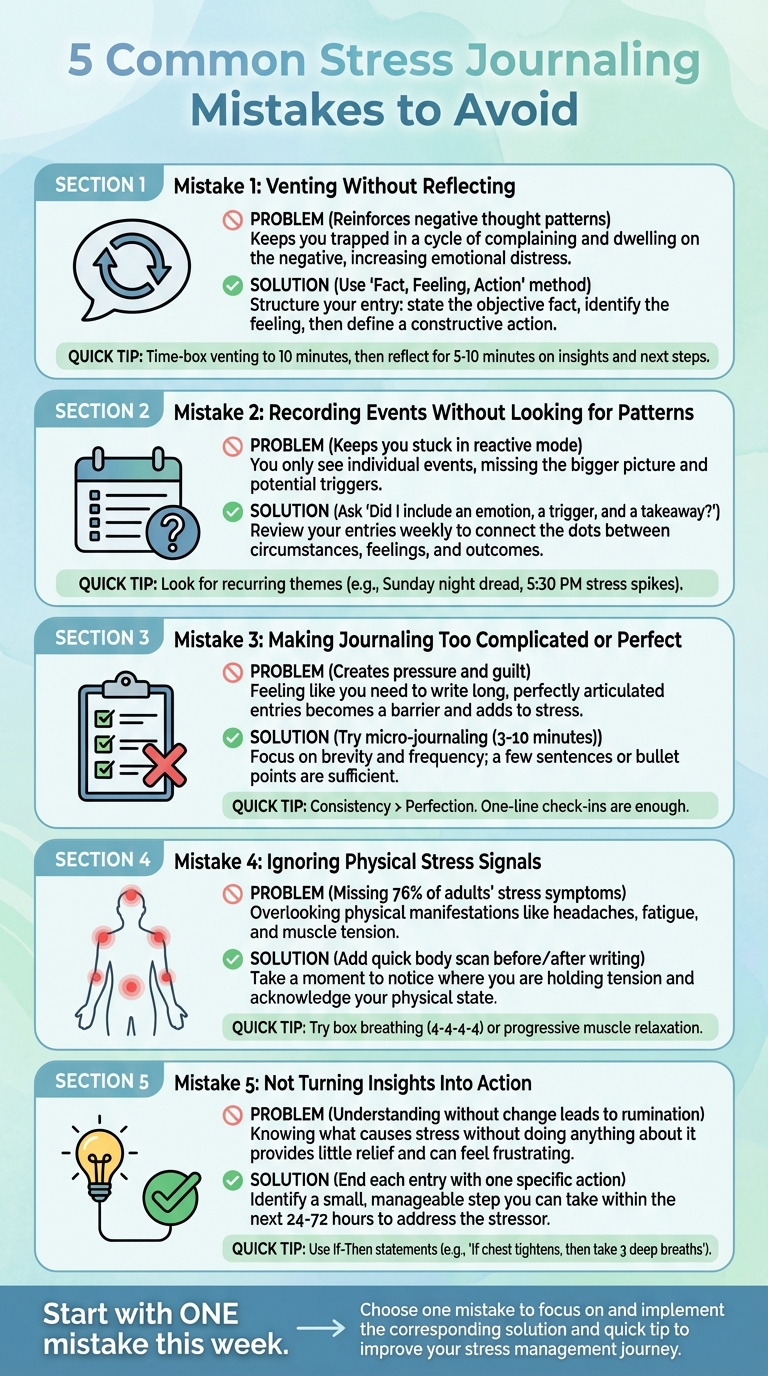
- Venting Without Reflection: Writing only about frustrations without processing emotions can lead to rumination and worsen stress. Instead, use methods like “fact, feeling, action” to gain insight and move forward.
- Recording Events Without Patterns: Logging daily events without linking them to emotions or triggers keeps you stuck. Look for recurring stressors and connect them to your feelings for deeper understanding.
- Overcomplicating the Process: Perfectionism, like obsessing over layouts or rigid schedules, can make journaling stressful. Keep it simple with short, honest entries.
- Ignoring Physical Stress Signals: Stress shows up in the body too. Include physical sensations like tension or fatigue in your entries to address the full picture.
- Not Acting on Insights: Writing about stress without making changes reinforces the same cycles. End each entry with a specific, actionable step to break the pattern.
5 Common Stress Journaling Mistakes and How to Fix Them
Mistake 1: Venting Without Reflecting
Simply writing to vent - repeating frustrations without digging deeper - can actually make stress worse. When you jot down phrases like "my boss is awful" or "nothing ever works out for me" without exploring the underlying issues, you’re reinforcing those same negative thought patterns. Instead of calming your mind, this approach keeps your nervous system in a heightened state of stress, leaving you feeling more anxious or stuck than before.
Why Venting Alone Falls Short
Venting alone keeps you stuck in the narrative of what went wrong, without helping your brain process the situation or find a way forward. Research on expressive writing shows that staying in pure emotion without reflection often leads to rumination and increased distress. On the other hand, writing that evolves to include insight, meaning, and problem-solving brings real improvements in mood and stress management.
Psychologists even use the term "psychological crapper" to describe journaling that serves as an emotional dump without structure or reflection. While venting might feel momentarily relieving, it can feed self-absorption and worry, much like mental rumination.
Eddie Fidler, a Life Note user, shared: "Sometimes the feedback from my mentors has been able to stop a negative thought pattern that had been bothering me the entire day."[1]
Without reflective strategies to interrupt these patterns, you risk spending your journaling time reinforcing the very thoughts you’re trying to escape.
How to Process Emotions Effectively
The key to constructive journaling is to acknowledge your feelings while avoiding getting stuck in them. A simple method called fact, feeling, action can help turn venting into productive emotional processing. Here’s how it works:
- Fact: Start by writing down what happened in neutral, observable terms, as if a video camera recorded it. For example: "My manager moved the deadline up during our meeting."
- Feeling: Identify your emotions and physical sensations: "I felt anxious and resentful; my chest was tight, and my jaw was clenched."
- Action: Decide on one or two practical next steps: "Tomorrow I’ll ask which tasks can be postponed, and tonight I’ll go for a 10-minute walk to release tension."
Another helpful tool is time-boxing your stress journaling. If you tend to overthink, set a timer for 10 minutes to freely write about what’s bothering you. Then, spend 5–10 minutes answering reflective prompts like "What do I need right now?" or "What part of this is in my control?" This structured approach trains your brain to associate journaling with finding calm and clarity rather than staying stuck in stress.
Life Note offers tools to guide this shift from venting to reflection.
Sergio Rodriguez Castillo, a licensed psychotherapist and university professor, said: "Life Note strikes a rare balance - offering support with gentle nudges and thoughtful invitations to reflect. Having the voices of luminaries from different fields comment on my writing has been a major advantage - deepening the experience and helping me gain insights beyond my own words."[1]
With AI mentor prompts like "What value feels threatened here?" Life Note helps transform raw emotion into meaningful, actionable insights.
Mistake 2: Recording Events Without Looking for Patterns
Simply jotting down daily events without deeper reflection can leave you stuck in a cycle of stress. Many people use stress journals as basic logs - like noting timestamps or events - without connecting them to emotions or triggers. While this creates a record of your day, it doesn’t help you understand or manage your stress. Without linking what happened to how you felt and what set those feelings in motion, your mind and body may stay in reactive mode, repeating the same patterns over and over.
Why Event-Only Journaling Falls Short
Focusing solely on events without exploring emotions or triggers keeps you spinning in the same stress loops. If you don’t name your feelings - whether it’s frustration, anxiety, or guilt - or identify recurring triggers, your brain may repeatedly revisit the same situations without resolution. This can reinforce negative thought patterns like "my job is unbearable" or "I’m terrible at handling conflict." Instead of easing your stress, this approach can deepen it. The key to breaking the cycle is identifying patterns, which transforms journaling from a passive activity into a tool for self-awareness and growth.
Research supports this. Psychologist James Pennebaker’s studies on expressive writing reveal that the biggest benefits come when you not only write about upsetting events but also connect the dots between facts, emotions, and meaning. Similarly, organizational psychologist Tasha Eurich emphasizes that unstructured emotional journaling can lead to rumination, while a more thoughtful approach - focused on lessons and perspective - can enhance emotional regulation and self-awareness.
How to Spot Patterns in Your Stress
Shifting from simple event tracking to meaningful reflection doesn’t have to be complicated. After writing about your day, take a moment to ask yourself: "Did I include an emotion, a trigger, and a takeaway?" If your entry is just a list of events, try adding a few lines to explore these questions. For example, a parent might notice their stress spikes every weekday at 5:30 p.m. during daycare pickup and dinner prep, prompting them to adjust their schedule or seek help. Similarly, a remote worker might realize their stress builds around late-night work messages, signaling the need for clearer boundaries.
Life Note's advanced memory takes this a step further by identifying recurring themes in your entries. For example, it might highlight patterns like "Sunday night dread", "post-work arguments", or "waking up at 3:00 a.m." With these insights, you can see how certain situations consistently trigger stress. The AI mentor then provides tailored suggestions, offering alternative perspectives or small behavioral adjustments to help you turn scattered notes into a clear map of your stress triggers.
Tiffany Durham, a journaling enthusiast, shared: "I love how tailored the responses are and also the fact that it 'remembers' what I wrote in the previous entries 🤯 It really feels like my mentor is on this journey with me." [1]
Next, we’ll dive into how perfectionism can complicate journaling and undermine your efforts to manage stress.
Mistake 3: Making Journaling Too Complicated or Perfect
Journaling is supposed to be a tool for stress relief, but it can easily turn into yet another source of pressure when overcomplicated. If you find yourself obsessing over the right pen, perfectly color-coded pages, or intricate layouts, you might be missing the point. Journaling isn’t about presentation - it’s about self-expression and relief, not creating a polished product.[3]
How Perfectionism Adds Stress
When you set rigid rules - like journaling every morning for 30 minutes - you risk creating unrealistic expectations. On busy days, missing a session can lead to feelings of failure, making the practice feel more like a chore than a release.[4][3] For instance, if you’ve decided you can only journal at night, an exhausting day might leave you skipping it altogether. Instead of being a source of comfort, journaling can start to feel like homework.
The truth? Consistency matters more than perfection or length. Research shows that short, regular entries are far more effective in building a sustainable habit than long but sporadic ones.[4] Perfectionism can keep you stuck - thoughts like "I don’t have the energy to do it properly" can stop you from writing anything at all. If you find yourself dreading journaling, feeling guilty about missed days, or editing entries to make them look “better,” it’s a sign your system might be too complicated.[3][5]
How to Simplify and Stay Flexible
The key to making journaling work is simplicity and flexibility. Try micro-journaling - writing for just 3–10 minutes or jotting down a few sentences. Formats like one-line check-ins (e.g., "Right now I feel… because…") or three quick bullet points (what happened, how you felt, and one thing to improve) make it easy to stay consistent without overthinking.[4][2] Allow yourself messy, imperfect entries. Cross things out, skip days guilt-free, and focus on honesty over perfection.[3][5]
Life Note offers a great way to embrace this approach. With it, you can write brief, unpolished entries in just 5–10 minutes. The AI mentors then pull meaningful insights from your words, weaving them into thoughtful weekly reflections. There’s no need for elaborate organization or flawless prose - just jot down your thoughts, however they come, and let the system do the rest.
As writer Jessie Liu puts it: "In a world obsessed with 'success,' this feels like a safe space to express imperfection, regain inner peace, and face life with more ease."[1]
Mistake 4: Ignoring Physical Stress Signals
When most people journal, they focus on their emotions and thoughts, but often overlook what their body is trying to tell them. That’s a big miss. Stress doesn’t just live in your mind - it manifests physically too. Think muscle tension, headaches, shallow breathing, stomach knots, or fatigue. If your journaling only captures mental chatter, you’re leaving out a critical piece of the puzzle, which can keep your nervous system stuck in overdrive.
How Stress Manifests in the Body
According to the American Psychological Association, 76% of adults report experiencing at least one stress-related physical symptom in the past month. The most common ones? Headaches (34%), fatigue (51%), upset stomach (23%), and muscle tension, especially in areas like the neck, shoulders, and jaw. These physical signs are your body’s way of waving a red flag, signaling that your stress response is still in high gear.
When you skip addressing these physical cues in your journaling, you risk reinforcing the stress cycle. Research highlights how unresolved physical tension can feed into negative thought patterns, creating a feedback loop that makes stress harder to shake.
Adding Body Awareness to Your Journaling Practice
Here’s a straightforward fix: incorporate a quick body scan into your journaling routine. Before or after writing, pause and check in with your body. Notice any tension or discomfort - are your shoulders tight, your jaw clenched, or your stomach knotted? Ask yourself questions like, "How is my breathing - shallow, fast, deep, or relaxed?" or "What does my body need right now?" (rest, movement, hydration, or maybe just a break).
Pair this awareness with simple relaxation techniques. For example:
- Box breathing: Inhale for 4 seconds, hold for 4, exhale for 4, and hold again for 4. Repeat for 1–2 minutes to calm your nervous system.
- Progressive muscle relaxation: Tense and release muscle groups like your hands, shoulders, or face for 5–10 seconds, noticing the shift from tension to relaxation.
If you use Life Note, it can help you track these patterns over time. By analyzing past entries, it might reveal links you hadn’t noticed - like how you always mention tight shoulders after back-to-back meetings. Weekly reflection letters can highlight these connections and suggest small, actionable steps, such as doing a 2-minute body scan before stressful situations. This turns journaling into a powerful tool for managing both mental and physical stress.
Mistake 5: Not Turning Insights Into Action
Maybe you’ve noticed how late-night emails spike your anxiety, overcommitting leaves you burned out, or skipping lunch makes you irritable. You’ve written about these patterns in your journal, yet nothing in your day-to-day life has shifted. Your schedule stays packed, your boundaries remain blurry, and your routines are unchanged. Unsurprisingly, the same stressors keep popping up. This is what happens when insights don’t lead to action - when you understand your stress triggers but don’t take practical steps to address them. Without action, those insights become little more than observations.
Why Understanding Alone Isn’t Enough
If you’ve ever flipped through old journal entries and found yourself writing the same phrases over and over - “Work is overwhelming,” “I’m so tired,” “My partner doesn’t listen” - that’s a clear sign of being stuck. Research on expressive writing shows that journaling is most effective when it helps you organize your thoughts and build a narrative that leads to meaning and change. Just venting, without a plan, doesn’t do the trick.
In fact, revisiting the same unresolved issues can make things worse. It can lead to rumination, a mental loop where you dwell on problems without solving them. Studies link rumination to higher levels of anxiety and depression, and over time, it can make you feel powerless. You might start thinking, “I’ll never feel less stressed,” or “I’m just not capable of change.” Instead of being a tool for growth, your journal becomes a frustrating reminder of what isn’t working.
Turning Insights Into Actionable Steps
To break this cycle, end each journal entry with a specific, actionable step you can take in the next 24–72 hours. Ask yourself questions like: “What’s the smallest thing I can change?” or “What’s one thing I can realistically do tomorrow?” Then, make your action measurable. For example, if you’ve written, “I feel most stressed when I check email late at night,” your plan might be: “At 9:00 p.m., I’ll set a reminder to log out of email and leave my phone in the kitchen.”
Replace vague goals with concrete micro-actions. Instead of writing “reduce work stress,” try: “Tomorrow, I’ll block 30 minutes from 9:00–9:30 a.m. to work on my report with Do Not Disturb turned on.” If your goal is to build confidence, don’t just jot down “be more confident.” Be specific: “Today, I’ll speak up once during the 3:00 p.m. team meeting to share my idea.” You can also use an If–Then approach: “If I notice my chest tightening in a meeting, then I’ll take three deep breaths before I respond.” These small, focused steps turn your worries into manageable actions, completing the loop between awareness and change.
Life Note's Aligned Actions feature is designed to help you bridge this very gap. After you journal about a stressful situation, mentors analyze your entry, identify recurring themes - like overwork, people-pleasing, or poor sleep - and suggest practical, science-backed steps you can take. For example, if you repeatedly write about burnout, a mentor might recommend blocking off a 30-minute no-meeting window on your calendar. They’ll then follow up with you to see how it went. Life Note’s ongoing memory tracks your progress, adjusts the difficulty of suggested actions if you’re feeling overwhelmed, and connects your weekly stress levels to the steps you’ve taken - or skipped. This turns journaling into more than just a place to vent; it becomes a personalized, evolving action plan that helps you reduce stress in real, tangible ways.
Related: Explore all the benefits of journaling →
Conclusion: Building a Stress-Relief Journaling Practice That Lasts
Stress journaling works best when you avoid common pitfalls like venting without reflecting, documenting events without identifying patterns, overcomplicating the process, ignoring physical cues, or gaining insights without taking action. These missteps can keep you stuck in cycles of stress.
To begin, focus on addressing just one of these challenges. Choose the one that feels most relevant to you and work on it for the next week. For instance, if you tend to vent without reflecting, try wrapping up each journal entry with questions like: "What did I learn from this?" or "What's one small step I can take tomorrow?" Keep it simple - limit your journaling to five minutes a night, whether after dinner or just before bed, so it naturally integrates into your routine.
If you’re looking for extra support, tools like Life Note can help turn reflections into meaningful actions. Life Note offers prompts to guide your thoughts, highlights recurring themes, and suggests practical, research-backed steps to take. Its memory feature helps you track your progress over time, while weekly reflection letters provide insights into how your stress patterns are evolving. Features like the Wisdom Library and Inner Gallery transform your daily entries into a visual record of your growth, making the process feel rewarding and encouraging.
When journaling feels like a supportive practice rather than another obligation, it becomes easier to stick with it.
"With Life Note, I've built a consistent journaling habit and learned to better embrace my emotions." [1] - Jessie Liu, Writer
FAQs
How can I make my journaling more productive instead of just venting?
To make venting through journaling more constructive, try blending emotional release with reflection and problem-solving. Begin by jotting down your feelings as a way to ease stress. Once you've let it out, shift gears - look for patterns, consider potential solutions, or try to view the situation from a different angle. You might ask yourself things like: What lessons can I take away from this? or What actions could help improve things?
If you're looking for extra guidance, tools like Life Note can be a great help. They offer prompts inspired by timeless wisdom, helping you turn raw emotions into valuable insights. This way, your journaling can transform into a process of self-discovery, clarity, and actionable progress.
How can I spot stress patterns in my journaling?
Identifying stress patterns in your journal might be easier than you expect, and if those patterns point to chronic exhaustion, our burnout journal prompts can help you dig deeper. Start by going through your past entries and spotting recurring themes, emotions, or situations that consistently surface during stressful times. Look for repeated words or phrases like "overwhelmed", "exhausted", or "pressured" - these can act as clues to your underlying stressors.
Another helpful approach is to consider the timing of your entries. Do you notice stress cropping up more often on certain days, at specific times, or after particular events? Pinpointing these trends can give you a clearer picture of what triggers your stress, allowing you to tackle it more effectively. Journaling tools, such as Life Note, can simplify this process by summarizing patterns and providing insights, helping you piece everything together over time.
How can I include physical signs of stress in my journaling?
Paying close attention to how your body reacts to stress can add a powerful dimension to your journaling routine. Notice physical sensations like tight shoulders, a pounding heart, or quick, shallow breaths. Jot down when and where you experience these feelings, and reflect on what might be causing them.
Linking these physical cues to your emotions and experiences can give you deeper insight into your stress patterns. Over time, this awareness can guide you toward more effective ways to manage stress and cultivate healthier responses.
My Journaling Habits Were Stressing Me Out - Until I Fixed These Things
Related Blog Posts
- Journaling Exercises for Behavior Change
- Journaling for Emotional Awareness: Complete Guide
- 25 Therapist-Informed Journaling Prompts for Mental Health
- How to Start Anxiety Journaling in 10 Minutes (with 10 Prompts)
Looking for more? See our complete collection of 100+ journaling prompts for mental health.
Journal with 1,000+ of History's Greatest Minds
Marcus Aurelius, Maya Angelou, Carl Jung — real wisdom from real thinkers, not internet summaries. A licensed psychotherapist called it "life-changing."
Try Life Note Free