
How To Reflect On Past Decisions Through Journaling

Learn journaling methods to analyze past choices, process regret, clarify values, and build a consistent habit that improves future decision-making.

Explore More
Continue your journey:
- How to Start Journaling in 2026 — The complete guide
Explore More
Continue your journey:
- Productivity Journaling: 50+ Prompts — The complete guide
📌 TL;DR — Reflecting on Past Decisions
Reflecting on past decisions improves future ones by learning from patterns. Key prompts: "What did I know/not know then?" "What would I do differently?" "What patterns do I see across decisions?" Avoid hindsight bias—judge decisions by the information you had at the time, not outcomes. The goal is wisdom, not regret.
Journaling is one of the most effective ways to reflect on your past decisions and learn from them. By writing about your choices, you can better understand your emotions, values, and patterns in decision-making. This process helps you identify triggers, reduce biases, and gain clarity for future decisions. Whether you're dealing with regret, uncertainty, or simply seeking self-awareness, journaling offers a structured, judgment-free space to process your thoughts.
Here’s how journaling can help:
- Understand your emotions and motivations: Writing helps you explore the feelings and beliefs behind your decisions.
- Identify patterns: Spot recurring behaviors, triggers, or biases that influence your choices.
- Process regret and uncertainty: Journaling creates emotional distance, making it easier to turn negative feelings into insights.
- Clarify your values: Reflect on whether your actions align with what truly matters to you.
- Improve future decisions: Use lessons from past experiences to make more informed, intentional choices.
Techniques like free writing, analyzing decisions over time, and shifting perspectives can deepen your reflections. Structured methods, such as the Problem-Solution-Action framework, can also help break down decisions into actionable insights. Regular journaling builds self-awareness, sharpens judgment, and creates a feedback loop for personal growth.
Whether you use pen and paper or tools like Life Note, the key is consistency. Dedicate time weekly or monthly, write without judgment, and review your entries to track progress. Over time, you’ll notice clearer thinking, better decision-making, and a stronger connection to your values.
Why Reflecting on Past Decisions Matters
Reviewing past decisions activates metacognition — research shows structured reflection improves future decision quality by up to 25 percent.
Looking back on past choices lays the groundwork for making better decisions in the future. This process offers real psychological and emotional benefits, helping you face challenges with greater clarity. By thoughtfully revisiting your decisions, you gain deeper self-awareness, which is explored further in the sections below.
How Self-Awareness Drives Growth
Reflecting on past decisions encourages deliberate thinking, steering you away from automatic reactions. This approach helps you avoid common pitfalls like cognitive biases and decision fatigue, which often arise when decisions are made on autopilot[7].
By documenting your decision-making processes and reviewing them over time, you create opportunities to learn from your choices and refine your responses to similar situations in the future[4]. For example, journaling can help you identify patterns - like situations that consistently cause anxiety or overconfidence - and recognize triggers such as tight deadlines, external pressures, or unpredictable circumstances[7].
One business leader shared their experience of using a decision journal to evaluate major business calls. They noticed a shift: fewer impulsive reactions, clearer reasoning, and improved outcomes for their team[7]. Journaling helped them think more clearly, explain their choices better, and reflect intentionally on their decisions. Over time, this practice became a tool for building confidence and learning from past decisions[7].
This growing self-awareness leads to more confident decision-making and intentional leadership. It creates a feedback loop where each decision becomes a chance to refine your judgment, helping you avoid repeating unproductive patterns and sharpening your decision-making skills over time[7].
Processing Regret and Finding Emotional Clarity
Regret can feel overwhelming when it lingers in your mind, replaying endlessly. Journaling offers a way to process those emotions by putting them into words. Writing freely can help you tap into your core values, hopes, and fears[8].
By transferring regret and disappointment onto the page, you create some emotional distance, which makes it easier to approach these feelings with compassion rather than letting them fester. This practice allows you to examine the emotional state you were in when making a decision, the external pressures influencing you, and any recurring triggers - like making rushed choices when feeling stressed[7].
"Sometimes the feedback from my mentors has been able to stop a negative thought pattern that had been bothering me the entire day." – Eddie Fidler, Life Note User[1]
"Through Life Note, I've built a consistent journaling habit and, with the support of AI mentors, learned to better understand and accept my different states of mind. In a world obsessed with 'success,' this feels like a safe space to express imperfection, regain inner peace, and face life with more ease." – Jessie Liu, Writer[1]
Journaling also supports introspection, problem solving, planning, and reorganizing your thoughts[4]. Instead of carrying regret indefinitely, you can transform it into insight. By acknowledging where your judgment may have faltered or where short-term comfort overruled long-term values, you develop the self-compassion and humility needed for growth. This emotional clarity helps you move forward with a clearer perspective.
Clarifying Your Values and Making Better Choices
Once you've processed emotions like regret, the next step is to evaluate how your values align with your actions. Often, there’s a gap between what you say you value and the choices you make in real-life situations. Reflecting on past decisions helps highlight these discrepancies, showing you what you actually prioritized when it mattered.
Through journaling, you can explore your thoughts and emotions across different areas of life, uncovering patterns that reveal what truly matters to you[8]. Writing down your decisions helps clarify whether your actions reflect your core values[7].
This process can lead to surprising realizations. For instance, you might say family is your top priority, but your choices may show a consistent focus on work. Or, you may discover that a career path you thought you wanted doesn't align with your deeper goals.
Journaling is one of the most effective ways to uncover your true feelings about life and career choices. Many people find that writing brings unexpected clarity, helping them articulate truths they hadn’t consciously realized until they saw them on the page[9].
With this awareness, you can make more deliberate choices that align with your authentic self and desired path in life[8]. By understanding which values guided your past decisions, you can close the gap between who you aspire to be and how you actually live, ensuring your future choices reflect the life you truly want.
Journaling Techniques for Analyzing Past Decisions
The most effective technique is the decision audit: write the decision, your reasoning at the time, what actually happened, and the specific lesson learned.
Explore into journaling methods that can help you uncover deeper insights about your past decisions. These approaches range from free-flowing emotional exploration to structured analysis, guiding you toward meaningful reflections and actionable takeaways.
Free Writing for Emotional Exploration
Free writing is a simple yet powerful way to tap into your emotions. It involves writing nonstop without worrying about grammar, structure, or judgment [2]. This unfiltered process allows you to uncover feelings - like doubt, regret, or excitement - that may have been buried beneath the surface. The goal isn’t polished writing but rather creating a space where you can freely explore the emotional layers of a decision.
To try this, set a timer for 10–15 minutes and focus on a specific choice you’ve made. For example, think about a career decision and let your thoughts flow. Write about the logic behind your choice, but also dive into the emotions - whether it was anxiety, excitement, or uncertainty - and consider how those feelings have shifted over time. This practice can reveal patterns and help you understand the emotional weight of your decisions.
Analyzing Decisions Across Time
Looking at a decision through the lens of time can provide surprising insights. This technique involves revisiting a choice from three perspectives: how you viewed it at the time, how you see it now, and how you might interpret it in the future [6]. At the time, your decision was likely shaped by limited information and your emotional state. Reflecting on it months or years later can highlight outcomes you didn’t anticipate and show how your priorities or circumstances have evolved [5].
Start by noting your current thoughts about a past decision. Then, think back to when you made the choice - what were your priorities, and what pressures influenced you? Finally, imagine how you might view this decision 5–10 years down the road. Regularly revisiting these reflections can help you spot recurring themes in your decision-making and track how your judgment grows over time.
Shifting Perspectives
Sometimes, stepping outside your own viewpoint can reveal insights you might otherwise miss. This method involves reflecting on a past decision from different perspectives - your own, a loved one’s, or even an imagined mentor’s [2,5]. By doing this, you can uncover factors you may have overlooked and build greater empathy.
For instance, if you’re reflecting on a choice to prioritize work over family, try writing from your spouse’s perspective. You might notice emotional impacts you hadn’t fully considered, like how your absence affected their daily life. Alternatively, imagine how a trusted mentor might evaluate your decision - this can help you identify blind spots and gain fresh insights. This technique is especially helpful when grappling with the consequences of a decision, as it breaks repetitive thought patterns and encourages personal growth.
Tools like Life Note take this concept further by connecting you with mentors from various fields - such as entrepreneurs, writers, or scientists - who offer reflections based on their experiences. Writing about your thoughts and emotions in this way can help you see your choices from entirely new angles.
Problem-Solution-Action Framework
For a more structured approach, the Problem-Solution-Action Framework helps you break down past decisions into three clear steps: the problem you faced, the solution you chose, and the lessons or actions you’ve taken since [3]. This method shifts the focus from emotional processing to practical insights, making it easier to learn from your experiences.
- Define the problem: Write about the challenge you were dealing with, including the context, stakes, and any constraints like time or resources. Be as specific as possible.
- Examine the solution: Reflect on why you chose a particular path. What alternatives did you consider? What expectations did you have, and how did your emotions influence your choice?
- Focus on outcomes and lessons: Analyze what actually happened. How did the results compare to your expectations? What would you do differently if faced with a similar situation?
For example, if you decided to address a conflict with a colleague directly, you might note that open communication helped resolve the issue. Writing down these reflections creates a blueprint for future decisions, reducing impulsive reactions and improving clarity in your reasoning [7]. Leaders who regularly use this framework often find it easier to make thoughtful, well-informed choices.
Step-by-Step Guide to Reflecting on Past Decisions
Start by choosing one meaningful past decision, then write for 15 minutes without editing — honest freewriting bypasses the mind's tendency to rationalize.
Now that you've got the techniques down, it’s time to put them into action. This guide walks you through turning your journaling into a structured way to learn from past decisions.
Step 1: Choose a Decision to Reflect On
Start by picking a decision that still weighs on your mind - something tied to uncertainty, regret, or unexpected results. These moments often hold the greatest potential for personal growth.
Focus on decisions tied to significant areas of life - like career moves, relationship choices, financial investments, or situations that tested your values. Be specific. For instance, reflecting on "leaving my job at a marketing agency to start freelancing" is much clearer than a vague thought like "thinking about my career."
Timing is also crucial. Pick a decision made weeks or months ago, not one from yesterday or years in the past. This balance ensures you have enough emotional distance to reflect objectively, while the details are still fresh in your mind.
Once you’ve chosen, the next step is to document its context.
Step 2: Document the Facts and Context
Write down the basics of your decision without adding personal commentary. Note exactly what you decided, along with the date or timeframe when it happened.
Then, dive into the circumstances surrounding the choice. What was happening in your life at the time? What pressures or opportunities were influencing you? Who else was involved? What information did you have, and what alternatives did you consider before making your choice?
Include key details about your job, relationships, finances, health, or any other factors that played a role in your decision-making process. This factual approach creates a solid foundation for spotting patterns and gaining insights later. By documenting and reviewing your choices over time, you can better prepare for similar situations in the future [4].
Step 3: Explore Your Emotions and Motivations
Shift your focus to the emotional side of the decision. What were you feeling at the time? Were you anxious, excited, confident, conflicted, or something else entirely?
Next, consider what motivated you. Were you driven by fear, ambition, the need for security, or a desire to align with your values? Reflect on the beliefs you held about the situation and your expectations for the outcome. This step helps you understand whether your choice was shaped by your true values or external pressures, emotional reactions, or unconscious habits.
To dig deeper, try prompts like: "What was I afraid of?" "What did I hope would happen?" "What values was I honoring or compromising?" or "What might have happened if I’d chosen differently?" Before you begin, take a few calming breaths to open yourself up to genuine self-discovery. Often, the act of journaling uncovers insights you didn’t realize until you saw them written down [9].
Step 4: Analyze the Outcome and Impact
Now, evaluate what happened as a result of your decision. Start by noting the actual outcome - did things go as expected? Were there any surprises?
Assess the impact across various areas of your life. How did this decision affect your relationships, career, finances, health, personal growth, or emotional well-being? Consider both the positive and negative outcomes, as well as any unintended ripple effects. Writing about these experiences sharpens your ability to observe patterns in your behavior and choices [4].
Reflect on whether the decision aligned with your values. Did it represent who you are and what’s important to you? Did it bring you closer to or further from your goals? Since some outcomes take time to fully unfold, remember to consider both immediate results and longer-term effects.
Avoid labeling the decision as simply "good" or "bad." Instead, focus on understanding its nuances and complexities [4].
With this analysis complete, you’re ready to uncover actionable lessons.
Step 5: Identify Lessons and Insights
Turn your reflections into meaningful takeaways. Ask yourself: What did I learn about myself? Are there patterns in how I make decisions? What would I do differently in a similar situation? What strengths did I display, and where could I improve?
Write down specific lessons, like "I prioritized others’ approval over my needs" or "I make better choices when I gather information from multiple sources." These insights can refine your future decision-making process and build on the self-awareness we discussed earlier.
Translate these lessons into concrete actions. For example, if you notice that anxiety leads to rushed decisions, commit to waiting 24 hours before making high-stakes choices. If you see that skipping advice from trusted people often leads to regret, make a habit of seeking input before big decisions.
Tools like Life Note can take this process further by connecting you with mentors from different fields who share their own reflections. Jessie Liu, a writer, shared her experience:
"Through Life Note, I've built a consistent journaling habit and, with the support of AI mentors, learned to better understand and accept my different states of mind" [1].
The platform’s memory feature helps you identify patterns and link past situations to your present, uncovering insights that might otherwise stay hidden in your journal entries.
Journal Prompts for Decision Reflection
The most revealing prompt is 'What information did I have but chose to ignore, and what fear drove that avoidance?' — avoidance patterns repeat until examined.
Building on earlier techniques, focused journal prompts can help you dive deeper into your past decisions. These prompts turn your reflections into a structured process, helping you explore emotional, logical, and practical aspects to uncover meaningful lessons.
Understanding Your Motivations and Values
Take a moment to explore what drove your decision in the first place. Start with a question like: "What were my main motivations when making this decision?" This helps you document not just the decision itself but also the reasoning behind it, uncovering patterns that reflect your core values.
Next, ask: "How did my values influence this choice?" For instance, if you often prioritize relationships over financial opportunities, this could highlight a guiding principle in your life - or perhaps reveal a gap between your beliefs and actions.
Go further with: "What alternatives did I consider, and why did I dismiss them?" Reflecting on why you passed on certain options - like declining a high-paying job because it required moving away from family - can reveal what truly matters to you.
Another helpful question is: "What factors beyond my control influenced this decision?" Identifying external circumstances can help you separate what you could control from what you couldn’t, minimizing hindsight bias while still learning from the experience.
From here, shift your focus to the emotional elements that played a role in your decision-making.
Exploring Emotional Impact
Emotions often shape our decisions in ways we don’t fully realize until we reflect on them. Try asking: "What emotions did I feel before, during, and after making this decision?" This can help you identify feelings like anxiety, relief, or regret and how they influenced your choices.
Then, consider: "Did my emotions cloud my judgment, or did they guide me in a helpful way?" This question helps you evaluate when to trust your instincts and when to take a more measured approach.
Another prompt to explore is: "What surprised me about my emotional reaction?" Unexpected feelings can highlight hidden values or unmet needs, providing insight into areas where you might need to adjust your perspective.
Once you’ve explored your emotions, turn your attention to actionable takeaways.
Learning from the Past
Reflection becomes most useful when it leads to concrete insights. Start with: "How will I approach similar situations differently in the future?" This encourages you to transform your reflections into a plan for better decision-making.
Another prompt to consider is: "How has this decision influenced my current beliefs or goals?" This helps you see how your choices have shaped your priorities and direction in life.
Ask yourself: "What did I learn about myself through this decision?" and "What factors contributed to either the success or failure of the outcome?" These questions push you beyond surface-level thinking, helping you analyze your patterns and tendencies.
Don’t skip prompts like: "What surprised me about the outcome?" or "What assumptions did I make that turned out to be wrong?" These can help you spot blind spots and challenge any preconceived notions that might have impacted your decision.
Finally, reflect on broader trends by asking: "What patterns do I notice in my decision-making across different situations?" and "Do I tend to repeat the same mistakes or successes in certain types of decisions?" Reviewing your reflections over time can reveal consistent themes in your behavior and thought processes.
Write openly and honestly. By doing so, you create a space for self-awareness and personal growth, helping you make better decisions in the future.
Making Reflection a Regular Practice
Weekly 15-minute decision reviews compound into genuine wisdom — after 90 days, most journalers report noticeably better real-time judgment.
Reflecting every now and then doesn’t quite cut it. The real benefits come when reflection becomes a regular habit - something as routine as checking your calendar or planning your week. By sticking to a consistent journaling practice, you not only deepen your self-awareness but also sharpen your decision-making skills over time. It’s about creating a feedback loop that helps refine your judgment with every cycle.
Building a Journaling Routine
Consistency is what transforms reflection into meaningful growth. A regular journaling habit can improve your ability to make sound decisions and better understand yourself.
Set a regular schedule for reflection. Whether weekly or monthly, the frequency should align with how often you make key decisions. The idea is to choose a pace that feels manageable, not overwhelming.
Dedicate 15–30 minutes per session. This timeframe strikes the right balance - it’s enough to think deeply without feeling like a chore. Business leaders who keep decision journals often report fewer impulsive choices and a clearer thought process after just a few months of consistent practice. Teams led by such individuals also tend to experience better trust and more reliable outcomes in decision-making [7].
Document decisions as they happen to avoid hindsight bias. This is critical because hindsight bias - the tendency to see past events as more predictable than they really were - can distort how you remember your decision-making process [10].
Prioritize free-flowing thoughts over polished writing [9]. Putting your ideas down on paper or a screen creates psychological distance, helping you analyze more objectively than if you just mulled things over in your head [10]. Whether you prefer handwriting or typing, the key is to stick with the method that feels right for you [9].
Keep your journal handy so you can revisit your reasoning if you ever second-guess a past decision [9].
Tracking Growth and Patterns Over Time
The real magic of journaling unfolds when you review your entries over weeks, months, or even years. By looking back, you can uncover patterns in your thinking, behavior, and decision-making style [2]. These insights can highlight areas for improvement and reveal recurring influences on your choices.
Set a regular review schedule - monthly or quarterly works well - to go over past entries and compare your predictions to actual outcomes [7]. Spend 30–60 minutes during these sessions to spot recurring themes, such as emotional triggers or similar responses to specific situations [10].
Compare older entries with recent ones to see how your judgment has evolved. This long-term perspective provides tangible proof of personal growth and shows how reflection helps shape better decisions [2][10].
Be honest in your journaling about the emotions or external pressures that influenced your choices [7]. This transparency makes it easier to identify patterns and improve over time. You might also consider seeking feedback from a trusted mentor or professional to gain fresh perspectives on your reflections [8]. Sometimes, an outside view can reveal blind spots or offer interpretations you hadn’t considered [4].
For those looking to take their journaling to the next level, modern tools can make the process even more insightful.
Using Life Note for Deeper Reflection
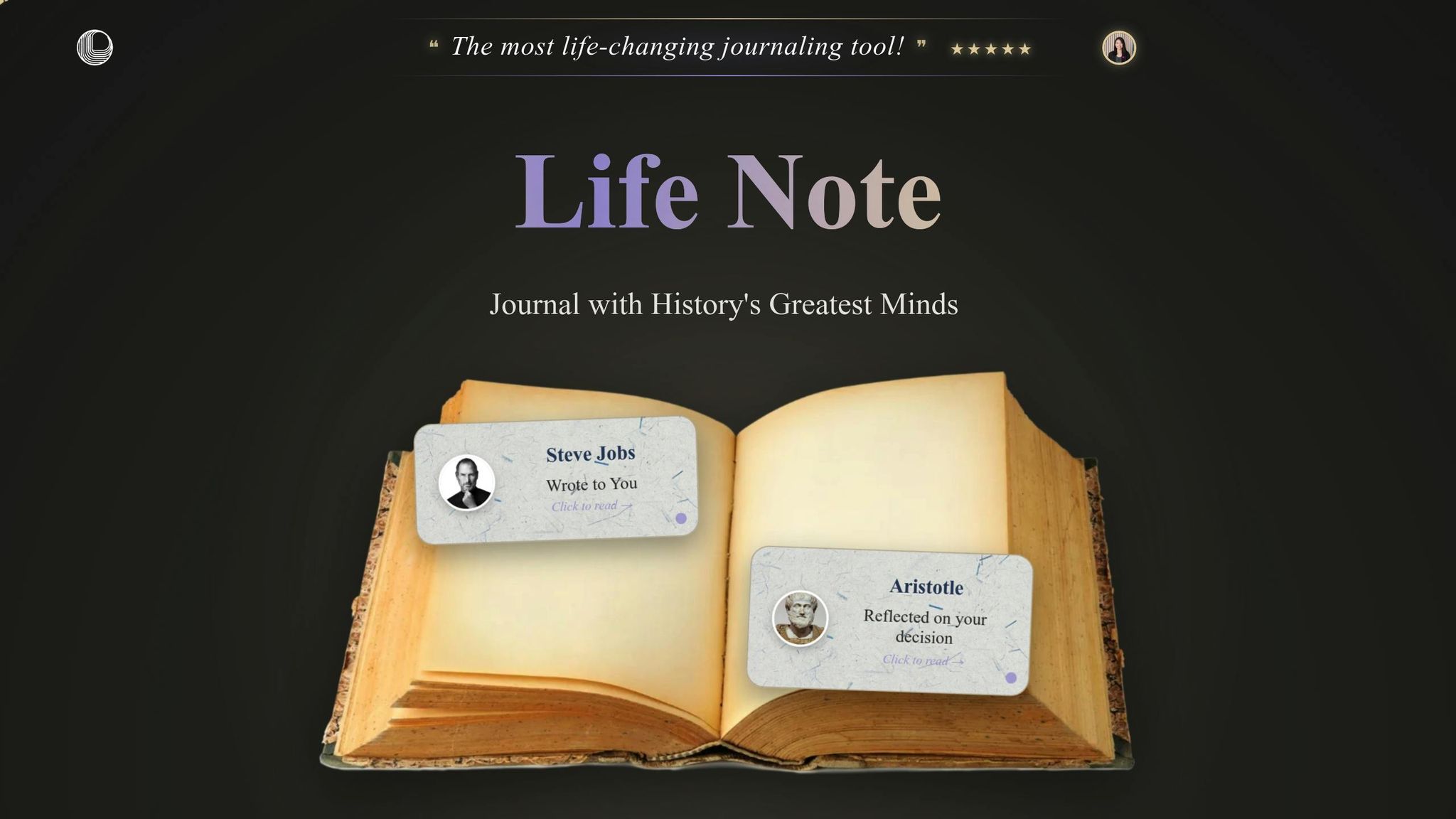
Life Note takes journaling to a whole new level, turning reflection into an interactive experience guided by the wisdom of history’s greatest minds.
Its advanced memory feature connects past reflections with current insights. Unlike basic journaling apps, Life Note remembers everything you’ve written, building a continuous narrative of your decision-making journey. As Tiffany Durham, a dedicated journaling enthusiast, puts it:
"I love how tailored the responses are and also the fact that it 'remembers' what I wrote in the previous entries. It really feels like my mentor is on this journey with me." [1]
Mentors within the platform help you identify patterns and link past experiences to present situations. This makes it easier to uncover insights that might otherwise go unnoticed [1].
Each week, personalized reflection letters summarize your journal’s themes, guide you toward balance, and highlight your progress. This structured review saves you from manually analyzing every entry.
The Wisdom Library acts as your personal archive, where you can save meaningful reflections in an organized, searchable format. This makes it simple to revisit impactful ideas when you’re facing similar challenges in the future.
Faisal Humayun, a Senior Manager, shared his experience:
"Life Note has helped me immensely in overcoming complicated mental and emotional issues. What truly captivates me is its ability to develop into a fully mentored path, allowing my pick of inspiring role models." [1]
Actionable insights bridge reflection with real-world progress. Once patterns emerge in your journaling, Life Note’s mentors suggest practical steps that align your daily actions with your long-term goals.
The platform also provides a supportive environment for decision-making. A licensed therapist and college professor remarked:
"I've encouraged clients and students for decades to keep journals as one of the best tools for self-awareness. When AI journaling apps began appearing, I tried several. Most gave sycophantic responses. That changed when I found Life Note. It strikes a rare balance - offering support with gentle nudges and thoughtful invitations to reflect. Having the voices of luminaries from different fields comment on my writing has been a major advantage - deepening the experience and helping me gain insights beyond my own words."
Privacy is a top priority. Everything you write in Life Note is encrypted and remains entirely yours. This ensures your most personal reflections stay secure, encouraging complete honesty in your entries - the cornerstone of meaningful reflection.
Research Foundation
| Study | Finding | Implication |
|---|---|---|
| Fischhoff (1975) | Landmark study demonstrated hindsight bias: people overestimate how predictable outcomes were after learning results | Decision journals capture pre-decision thinking before hindsight distorts it |
| Arkes & Blumer (1985) | 85% continued investing in a doomed project when prior investment was mentioned vs. 10% without that framing | Writing down rationale exposes sunk-cost reasoning before it wastes resources |
| Kross & Ayduk (2011) | Self-distanced reflection reduces emotional reactivity and promotes adaptive meaning-making from negative experiences | Reviewing past decisions in third person prevents regret spiraling |
| Klein (1998) | Experts make effective decisions by matching situations to experience patterns; premortem analysis surfaces blind spots | Decision journals build the pattern library experts use for accurate judgment |
| Koriat, Goldsmith & Pansky (2000) | Metacognitive monitoring (tracking confidence) improves calibration between perceived and actual accuracy | Recording confidence alongside decisions trains better-calibrated judgment |
| Ericsson, Krampe & Tesch-Romer (1993) | Expertise develops from structured cycles of practice, reflection, and feedback — not raw repetition | Decision journaling is deliberate practice for judgment |
Conclusion
Reflecting on past decisions transforms regret into a systematic learning tool — the goal is not perfection but pattern recognition and continuous improvement.
Journaling has the power to turn past decisions into stepping stones for wiser choices. By recording your decisions, reflecting on your motivations, and identifying recurring patterns, you create a personalized feedback loop that sharpens your judgment over time. This practice transforms quick, impulsive reactions into thoughtful decisions that align with your core values.
With consistent journaling, clarity and intentionality naturally follow. Many business leaders who adopted decision journals noticed fewer impulsive reactions and greater clarity in their reasoning within just a few months. Why? Because journaling encourages you to pause, reflect, and dig deeper into your experiences. It acknowledges the complexity of your decisions while uncovering insights that might otherwise go unnoticed. This reflective process not only enhances decision-making but also integrates seamlessly into a proactive journaling habit.
Reflection becomes transformative when it leads to action. By creating actionable plans based on your discoveries, tracking your progress in future entries, and assessing the outcomes, you can turn insights into measurable improvements.
Tools like Life Note take this a step further. Its AI mentors analyze your journaling history, helping you uncover patterns, connect past experiences to current challenges, and suggest practical steps that align with your long-term goals. It’s not just about reflection - it’s about turning those reflections into meaningful progress.
Whether you prefer pen and paper or digital tools like Life Note, the key is to journal regularly and honestly. Dedicate 15–30 minutes on a consistent basis, write without judgment, and periodically review your entries to track your growth. Over time, you’ll notice a shift: your decisions will become more deliberate, your emotions more balanced, and your choices more aligned with the person you aspire to be.
The journey from impulsive decisions to thoughtful, values-driven choices begins with a single journal entry. Start today and keep going.
FAQs
How can I stay consistent with journaling to reflect on past decisions effectively?
Consistency in journaling begins with creating a routine that’s easy to stick to. Pick a specific time each day - whether it’s first thing in the morning or right before bed - and set aside just 5–10 minutes for writing. Use this time to reflect on your choices, emotions, and any lessons from the day without overcomplicating the process.
Tools like Life Note can make the practice more interactive and meaningful. They help you spot patterns, bring clarity to your thoughts, and tie your reflections to personal growth. This added layer of insight can keep you motivated and make sticking to your journaling habit much simpler.
How can I use journaling to reflect on past decisions and avoid emotional biases?
To thoughtfully evaluate past decisions, begin by detailing the situation with a clear focus on the facts, setting emotions aside for the moment. Once you've outlined the facts, take a step back to identify the emotions you experienced at the time and how they may have shaped your choices. Reflect on key questions such as: What assumptions was I operating under? or What other actions were available to me? This approach can help you spot recurring patterns or biases in your decision-making.
If emotions cloud your judgment, consider strategies like writing about the event from a third-person perspective or imagining how a trusted mentor or a historical figure might interpret the situation. Tools like Life Note can also be valuable, offering insights from well-known thinkers to expand your perspective and support a more balanced reflection process.
How can journaling help me make decisions that reflect my values and goals?
Journaling offers a powerful way to explore into your thoughts and emotions, uncovering patterns that shape your decisions. It helps you align your choices with your core values and long-term goals. By looking back on past decisions, you can gain a clearer understanding of what truly matters and pinpoint areas where you want to grow.
With Life Note, this practice becomes even more impactful. It bridges your reflections with actionable steps, drawing from behavioral science, philosophy, and timeless wisdom. This ensures that your daily actions stay in sync with who you are and the future you envision for yourself.
How Do I Learn From My Past Journal Entries?
Re-read entries with fresh eyes — comparing past predictions to actual outcomes reveals blind spots your present mind still cannot see.
Related Blog Posts
Journal with 1,000+ of History's Greatest Minds
Marcus Aurelius, Maya Angelou, Carl Jung — real wisdom from real thinkers, not internet summaries. A licensed psychotherapist called it "life-changing."
Try Life Note Free