
10 Mindful Writing Practices for Journaling

Ten mindful journaling techniques—gratitude, stream-of-consciousness, breath work, prompts, body-scan and evening reflection—to reduce stress and build self-awareness.

📌 TL;DR — Mindful Writing Practices
Mindful writing combines meditation and journaling for deeper self-awareness. Practices: breath-focused writing (pausing between sentences), sensory description (what you notice right now), non-judgmental observation of thoughts, and slow, deliberate handwriting. The process matters as much as the product.
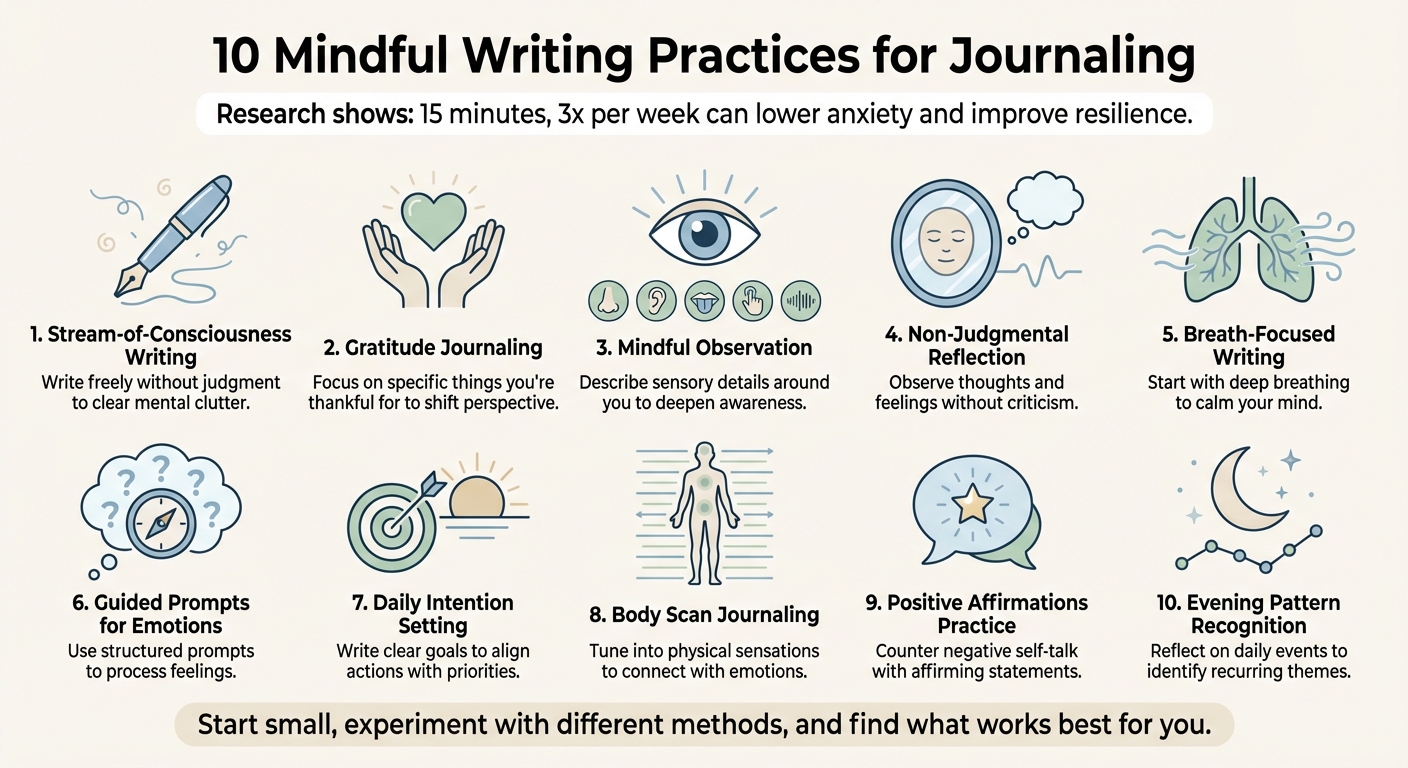
Mindful journaling combines self-reflection with present-moment awareness to help you process emotions, reduce stress, and gain clarity. Research shows that just 15 minutes of reflective writing, three times a week, can lower anxiety and improve resilience. Here’s a quick overview of 10 practices to try:
- Stream-of-Consciousness Writing: Write freely without judgment to clear mental clutter.
- Gratitude Journaling: Focus on specific things you're thankful for to shift your perspective.
- Mindful Observation: Describe sensory details around you to deepen awareness.
- Non-Judgmental Reflection: Observe your thoughts and feelings without criticism.
- Breath-Focused Writing: Start with deep breathing to calm your mind before writing.
- Guided Prompts for Emotions: Use structured prompts to process feelings.
- Daily Intention Setting: Write clear goals to align your actions with your priorities.
- Body Scan Journaling: Tune into physical sensations to connect with your emotions.
- Positive Affirmations Practice: Counter negative self-talk with affirming statements.
- Evening Pattern Recognition: Reflect on daily events to identify recurring themes.
These techniques can transform journaling into a powerful tool for self-awareness and emotional well-being. Start small, experiment with different methods, and find what works best for you.
10 Mindful Writing Practices for Journaling
1. Stream-of-Consciousness Writing
Stream-of-consciousness writing is all about letting your thoughts flow freely onto the page. Think of it as a "word dump" where you set aside judgment and allow your subconscious to take the lead. This technique helps bypass the inner critic, opening the door to fresh ideas and unexpected insights[1][10].
To try it out, set a timer for 5–10 minutes and write nonstop. Don’t worry about grammar, structure, or even making sense. You can even use dashes to separate ideas, a method famously used by Jack Kerouac[9].
Interestingly, neuroimaging studies show that this kind of unfiltered writing activates the brain's default mode network, which is associated with creativity and problem-solving[10]. By putting your inner dialogue on paper, you clear out mental clutter and free up brainpower that might otherwise be tied up in worry or overthinking.
The goal here isn’t polished writing - it’s about quantity, not quality. Once your thoughts are out in the open, they tend to lose their emotional weight, making it easier to reflect on them with curiosity instead of fear.
This simple yet powerful exercise lays the groundwork for more focused and intentional writing practices down the line.
2. Gratitude Journaling
Gratitude journaling is one of the most studied mindfulness techniques, and for good reason. Taking a few minutes to jot down what you're thankful for can help shift your focus toward the positives in life - even when things feel overwhelming. This small change in perspective has been shown to ease stress, reduce anxiety, and alleviate symptoms of depression, all while increasing overall happiness [5][6][3]. It’s a simple practice with a big emotional payoff.
Interestingly, journaling once to three times a week may actually be more effective than doing it daily. Why? Writing every day can lead to something called "hedonic adaptation", where the emotional impact of the exercise starts to wear off [11]. Instead, aim for about 15 minutes per session, and focus on depth rather than quantity. For instance, rather than a broad statement like "I'm grateful for my friends", try something more specific: "I'm grateful that Sarah called me today when she knew I was struggling."
"The goal of the exercise is to remember a good event, experience, person, or thing in your life - then enjoy the good emotions that come with it." - Greater Good Science Center [11]
For a greater emotional boost, center your journaling on people. You can try the subtraction method - imagining life without certain people or outcomes - or reflect on unexpected moments of kindness or joy that made you feel especially grateful [11].
The benefits aren’t just emotional; they’re physical too. Studies have linked gratitude journaling to lower blood pressure, better sleep, and even a stronger immune system [1][4]. Using an AI journaling tool to write down your thoughts can also free up mental energy otherwise consumed by repetitive worries, which may enhance your working memory and bring greater emotional clarity [4][3].
3. Mindful Observation
Mindful observation breathes life into your journal by capturing the sensory details of your surroundings. It’s about using AI journaling tools to notice the world as it is - the hum of traffic outside your window, the cool touch of your coffee mug, or the way the late afternoon light dances across your desk. This practice encourages you to engage all five senses, training your mind to pick up on details that often go unnoticed. Over time, it naturally deepens your sensory awareness.
The key is to describe your environment without adding judgment or interpretation. Focus on recording sensory impressions as they are. As Zindel Segal, Distinguished Professor of Psychology in Mood Disorders at the University of Toronto, puts it: "Make that which is fleeting more vivid and bring a kind curiosity to what is revealed" [1][3]. This mindset keeps your imagination from coloring reality, allowing you to see things as they truly are.
For a structured approach, try the 5-4-3-2-1 grounding exercise in your journal. Write down:
- 5 things you see
- 4 textures you can feel
- 3 sounds you hear
- 2 scents you notice
- 1 thing you can taste [7]
Another idea is to set a timer for 5 to 10 minutes and try a "Beat Word Sketch." This involves jotting down a continuous stream of sensory impressions, separated by dashes. For example: "gray clouds moving fast - car door slam - cold metal chair - coffee smell fading - pressure in lower back." This technique helps link external observations to your inner experience, creating a bridge between the two.
To take this practice further, tune into your internal sensations as well. Before you start writing, pause and notice bodily feelings - warmth, tension, or even the faint brush of a breeze. If your mind starts to wander, simply label it as "thinking" and gently return to what your senses are picking up [9]. Over time, you’ll start noticing details you once overlooked, and your writing will gain depth, dimension, and a stronger connection to your everyday experiences.
4. Non-Judgmental Reflection
Non-judgmental reflection is all about letting your thoughts flow freely, without attaching any judgment to them. For example, when you catch yourself thinking things like "I shouldn’t feel this way" or "This is such a dumb worry," you’re layering judgment on top of your feelings, which can block honest self-expression. Instead, the aim here is to observe your inner world as it is - without grading, labeling, or trying to fix it. This practice mirrors mindful observation, but instead of focusing outward, it invites you to turn inward.
Psychologist Zindel Segal explains it well:
The very act of writing takes information that is often only dimly perceived, such as quick judgments, fears, worries, and concretizes by putting them in written form on paper [1][3].
Writing down your thoughts creates some distance between you and your emotions. It shifts you from feeling the emotion to observing it. This separation can be incredibly freeing.
One of the biggest benefits? It quiets that relentless inner critic. When you stop worrying about perfect grammar, spelling, or polished sentences, you give yourself permission to be raw and unfiltered. A 2018 study even found that people with anxiety who engaged in reflective writing for just 15 minutes a day, three days a week over 12 weeks experienced a noticeable drop in mental distress and a boost in resilience [3]. The magic wasn’t in writing beautifully - it was in writing honestly.
If you’re new to this, start small. Try labeling your emotions. Instead of writing "I’m such a mess," you might say, "I’m feeling anxiety in my chest." This subtle shift moves you from identifying with your emotions to simply noticing them. If self-critical thoughts creep in, label them as "thinking" and let them pass. During particularly stressful moments, try doing a quick, unfiltered "brain dump" to release the tension and reconnect with your present feelings [9].
Studies show that people who regularly accept their mental experiences - rather than battling or judging them - tend to have better psychological health and lower anxiety levels [12]. By making your journal a judgment-free zone, you create a space where all thoughts are welcome. And that kind of acceptance is the first step toward self-compassion.
5. Breath-Focused Writing
Starting your journaling session with a focus on your breath can completely change the experience. Before you even pick up a pen, take a moment to pause and breathe. This simple act helps clear your mind, slow down racing thoughts, and ease physical tension, anchoring you firmly in the present.
Here’s a quick guide: Close your eyes and take a few slow, deep breaths. Pay attention to how the air moves through your chest and abdomen. Is your breathing fast or slow, shallow or deep? Let your breath settle into a natural rhythm. To enhance the calming effect, try lengthening your exhale or even adding a gentle yawn. This activates the vagus nerve, which helps calm your nervous system and shifts your mind from feeling overwhelmed to feeling more grounded [7].
Zindel Segal, a Distinguished Professor of Psychology in Mood Disorders at the University of Toronto, highlights the link between breathing and mindful writing:
Whether it involves writing about pleasant or unpleasant moments... the goals are the same. Make that which is fleeting more vivid, and bring a kind curiosity to what is revealed [1].
By centering yourself through your breath, fleeting worries and fears can be channeled into clear and honest writing. Meditation teacher Amy Spies suggests spending 5 to 10 minutes in breath-focused meditation before journaling to cultivate what she calls “kind-hearted awareness” [3]. This technique isn’t just for starting out - it can also help if you hit a block mid-session. Simply pause, breathe, and reconnect with your authentic voice.
Decades of clinical research back this up: mindful writing practices, often rooted in breathwork, offer a range of mental and physical benefits [4]. By creating calm through your breath, you lay a strong foundation for a meaningful and productive journaling practice.
6. Guided Prompts for Emotions
Sometimes emotions feel overwhelming because they’re hard to pin down or even name. Guided prompts offer a structured way to approach mindful journaling, helping you untangle those elusive feelings and process what’s happening inside.
Experts emphasize that putting emotions into words can soften their intensity, making them easier to handle. When you give shape to subtle or confusing thoughts, they become more concrete and manageable. Research backs this up - one 2018 study found that spending just 15 minutes a day, three times a week, on reflective writing reduced anxiety and boosted resilience within 12 weeks [3].
Here are some techniques you can try:
- The "5 Whys" Technique: Start with an emotion you’re feeling and ask yourself “why?” five times. This simple exercise can help you uncover the deeper root of what’s really bothering you [13].
- Emotional Weather Reports: Use weather metaphors to describe your emotional state. For example, “stormy with sunny breaks” or “a calm, cloudy day” can make complex feelings easier to express [13].
- Dialogue with Anxiety: Imagine your anxiety as a voice. Write down what it might say, then respond to it from a calm, grounded perspective. This can help you externalize and defuse anxious thoughts [13].
- Body-Emotion Connection: Ask yourself, “Where do I feel this emotion in my body?” This practice connects physical sensations to emotional triggers, offering a more holistic understanding of what you’re experiencing [2].
Journaling isn’t just about recounting events - it’s about digging into how and why those events made you feel a certain way. This process helps your brain create a coherent narrative, making sense of complicated experiences [4]. Plus, naming your emotions has a calming effect: it activates the prefrontal cortex, which helps regulate your amygdala, the part of your brain responsible for emotional reactivity [4].
7. Daily Intention Setting
Intention setting takes your journaling beyond simple reflection, turning it into a tool for actionable daily growth. By starting your day with clear intentions, you give yourself direction and focus, ensuring your actions align with what truly matters to you.
Studies reveal that when intentions are tied to personal, intrinsic values, people achieve their goals 30% more often compared to goals driven by external motivations [10]. This approach transforms journaling into a practice that’s not just about looking back but also about moving forward with purpose.
"When writing our intentions or goals, we want to focus on what we wish to see for ourselves and the steps needed to take us there." - Beatriz De La Espriella, Licensed Clinical Social Worker [2]
The trick is to break big goals into smaller, manageable steps. For instance, instead of writing, "I want to be more productive", try something actionable like, "I will take three deep breaths when I feel stuck" [9]. Frame your intentions as affirmations, such as "I am courageous" or "I show myself compassion", to reinforce your core values [1][7].
Kick off this habit with a simple morning prompt: "What am I looking forward to today?" or "What challenges might I face today?" [5][10]. Feeling low on energy? Rate it on a scale of 1 to 10, then jot down one small action to lift your mood [13]. Finally, ask yourself: "What’s one small, easy step I can take right now that my future self will appreciate?" [7]. This keeps your intentions grounded in the present while paving the way for meaningful progress.
8. Body Scan Journaling
Your body often sends signals that reflect your emotions. A clenched jaw, a tight chest, or a knot in your stomach can all be physical signs that something deeper is going on. Body scan journaling is a way to tune into these sensations, giving them a voice and uncovering the emotions behind them.
To begin, spend 5–10 minutes focusing on your breath before you start writing. This helps relax your body and clear your mind of distractions [5][9]. Next, try a "body appreciation tour." Mentally scan your body from your toes all the way to your head, pausing at each part to notice how it feels [13]. Write down the specifics: Is your neck stiff? Are your shoulders tense? Does your stomach feel calm, or is it unsettled?
The key is to give these sensations a voice. Imagine that tension in your chest could talk - what would it say? For example, you might write, "My chest feels like it’s carrying a heavy weight. If it could speak, it would ask me to slow down and take a deep breath." This process can help you identify unexpressed emotions stored in your body, a phenomenon known as somaticized feelings [7]. Studies show that reflective writing, even for just 15 minutes three times a week, can significantly reduce mental distress and foster resilience [3]. This practice ties seamlessly into other mindful journaling techniques by deepening your self-awareness.
For an added layer of insight, try the dual awareness technique. Focus on the part of your body that feels most anxious and the part that feels most grounded. Write about how it feels to shift your attention between the two. This exercise not only helps you track the ebb and flow of your physical and emotional states but also gives you a clearer picture of how they intertwine throughout your day.
9. Positive Affirmations Practice
Positive affirmations are a powerful tool to challenge negative self-talk and boost confidence. By writing affirmations like "I am brave" or "I am kind to myself", you turn vague fears into clear, tangible words on paper, giving them less power over your mind [3][6].
When you write these affirmations by hand, it does more than just put words on a page - it engages your brain. Specifically, it activates the prefrontal cortex (the part of the brain involved in decision-making and self-control) and soothes the amygdala, which is responsible for processing emotions like fear and stress. This creates space between you and emotionally charged thoughts, helping to nurture self-compassion [2][3][4]. Simple "I am" statements like "I am doing my best" or "I am courageous" can be a great starting point. The key is to make them personal and relevant to whatever challenges you’re facing right now [1][7].
For an extra boost, try the "I'm Great Because..." exercise at the end of each week or month. Write down three of your strongest qualities and use them as a counterbalance to any negative thoughts that creep in. For example, if you catch yourself thinking, "I'm not good enough", respond with an affirmation that highlights your strengths. Research backs up this practice - a 2018 study found that participants who engaged in reflective writing for just 15 minutes, three days a week over 12 weeks, experienced lower anxiety levels and greater resilience [3][5][7].
This isn't about perfect grammar or polished sentences. It's about being honest with yourself. Some people also pair affirmations with visualization, imagining the outcomes they’re writing about as if they’re already happening. This combination can make the practice even more impactful. After writing, take a moment to reflect: "Do I feel any different?" or "Has my perspective shifted?" These moments of reflection can deepen your self-awareness and help you notice gradual changes in your mindset [1][9].
10. Evening Pattern Recognition
Take a moment at the end of your day to reflect on the events, emotions, and physical sensations you experienced. This practice helps you uncover patterns that might otherwise go unnoticed in the moment. Writing down these reflections can solidify fleeting thoughts, worries, or judgments, making them easier to understand and address [3].
Start with three simple prompts: "What positive things happened?", "What went wrong?", and "What will I do differently tomorrow?" [5]. These questions provide a straightforward structure for reflecting on your day without feeling overwhelmed. To dive deeper into a specific emotion, try the "why" method - ask yourself "why?" five times to uncover the root cause. This approach builds on earlier mindfulness techniques, steadily enhancing your self-awareness.
Pay attention to significant interactions and consider why they left an impact on you. You might also want to check in on your values: think about moments where you stayed true to your principles and times when you strayed. Reflect on how you can realign your actions with your values moving forward.
One of the most valuable aspects of this practice is revisiting your previous entries. Ask yourself questions like: "What have I learned from my past reflections?" and "How have my perspectives evolved over time?" This process helps you see your life as a continuous story rather than a series of isolated events. In fact, research backs this up - a 2018 study revealed that participants who engaged in reflective writing for just 15 minutes, three times a week over 12 weeks experienced lower anxiety, reduced stress, and increased resilience [3].
For a more guided approach, consider using tools like Life Note. This platform can automatically identify recurring emotional patterns and provide personalized insights through mentors and weekly reflection letters. It’s a great way to connect your thoughts, experiences, and goals, turning your reflections into meaningful growth.
Conclusion
Mindful journaling goes beyond merely jotting down your thoughts - it’s a powerful tool for self-discovery and emotional health. Decades of research back this up, showing that expressive writing can help lower blood pressure, improve sleep, and even strengthen the immune system [1][4]. By putting your inner worries and fears into words, you give them form, making them less overwhelming and freeing up mental energy that might otherwise be consumed by endless overthinking [1][3].
There’s no one-size-fits-all approach to mindful journaling. For some, pouring out thoughts in a stream-of-consciousness style during stressful times brings immediate relief. Others might prefer gratitude journaling ideas for its uplifting tone or using reflective prompts to identify patterns at the end of the day. Start small - just 5–10 minutes a day - and explore different styles to discover what feels right for you [3][8]. As Anaïs Nin beautifully put it:
Writing serves to heighten our own awareness of life…to taste life twice, in the moment, and in retrospection [3].
For those seeking more structure, tools like Life Note can enrich your journaling experience. This platform not only helps you uncover recurring emotional patterns but also offers personalized insights inspired by thinkers like Carl Jung and Brené Brown. Its advanced memory system ties together your thoughts, goals, and experiences, creating a cohesive narrative that evolves with you.
The key is to simply begin. Whether you stick with one approach or experiment with several, dedicating time to write for yourself creates a much-needed pause. It gives you space to step back from your emotions, offering clarity and compassion. Over time, your journal becomes a trusted refuge - a place to process difficult feelings without judgment, fostering resilience and a deeper connection to your authentic self [1][4].
FAQs
How does mindful journaling benefit mental health?
Mindful journaling blends writing with a focus on the present moment, giving you a judgment-free zone to unpack your thoughts and emotions. Techniques such as stream-of-consciousness writing, gratitude lists, and reflective prompts encourage you to slow down, recognize emotional patterns, and cultivate self-compassion - essential ingredients for mental well-being and emotional strength.
Research highlights the benefits of mindful journaling, showing it can improve mood, reduce anxiety, and even help lower blood pressure. It sharpens self-awareness, enhances emotional control, and clears mental clutter, making it easier to handle stress and stay centered. Over time, this practice promotes personal growth, builds confidence, and nurtures a deeper sense of calm and purpose.
Tools like Life Note take journaling to the next level. With guided prompts, AI-driven reflections inspired by historical mentors, and insights into your emotional trends, Life Note helps you develop a consistent journaling habit that supports your mental health and personal transformation.
How can beginners start a mindful journaling practice?
Starting a mindful journaling habit doesn't have to be complicated. The key is to focus on consistency and self-expression. Dedicate 15–20 minutes each morning or evening to write in a distraction-free environment. Forget about grammar or structure - just let your thoughts spill onto the page. If you're unsure where to start, try gentle prompts like “What am I grateful for today?” or “What emotion am I feeling right now?” Let curiosity guide you, not judgment.
Once you've finished writing, take a moment to read over your thoughts. Notice how your perspective or mood might have shifted. Keeping your practice short, regular, and free of self-criticism makes it easier to stick with over time.
If you'd like a little extra help, Life Note - an AI-powered journaling tool - offers personalized prompts and reflective feedback inspired by historic thinkers. It can help you uncover patterns, stay consistent, and experience deeper mindfulness as you journal.
How often should I write in a gratitude journal to experience its benefits?
Writing in a gratitude journal just once a week can make a noticeable difference in your life. Research suggests that this small, consistent effort can lift your mood, strengthen your resilience, and improve your overall sense of well-being.
The trick is to stay consistent. Pick a day that fits seamlessly into your routine and take a few moments to jot down what you’re grateful for. Over time, this straightforward practice can shift your perspective, helping you approach life with greater positivity and mindfulness.
Mindfulness Journaling - improve your self awareness
Related Blog Posts
Journal with 1,000+ of History's Greatest Minds
Marcus Aurelius, Maya Angelou, Carl Jung — real wisdom from real thinkers, not internet summaries. A licensed psychotherapist called it "life-changing."
Try Life Note Free