How Artists Use Visual Journaling for Self-Expression

Learn how visual journaling blends art and writing to reduce stress, process emotions, develop your artistic voice, and spark creative flow with simple techniques.
Explore More
Continue your journey:
- Creative Journaling: 40+ Prompts — The complete guide
One legendary framework comes from choreographer Twyla Tharp — read about her creative journal techniques built over 60 years of artistic practice.
📌 TL;DR — How Artists Use Visual Journaling
Artists use visual journals as creative laboratories — spaces to experiment without pressure, capture fleeting ideas, process emotions through imagery, and develop artistic voice. Famous examples: Frida Kahlo's illustrated diary, Leonardo da Vinci's notebooks. Your visual journal is private — perfection isn't the goal.
Visual journaling blends art and writing to help people express emotions, process thoughts, and discover patterns in their inner world. It’s not about creating perfect art; instead, it focuses on using visuals like sketches, collages, and colors to reflect feelings that words alone can’t capture. Studies show it can reduce anxiety (by 32% in just a month with regular practice) and lower stress levels, while also helping artists refine their personal style over time.
Key takeaways:
- Combines written reflections with visual elements (drawings, collages, etc.).
- Encourages emotional release and stress reduction.
- Activates both sides of the brain for better emotional processing.
- Tools needed: simple supplies like paper, pens, and markers.
- Techniques include using non-dominant hand drawings, symbols, and altered books.
Whether you’re an artist or just looking for a way to process emotions, visual journaling is an accessible and effective method to explore your thoughts and feelings.
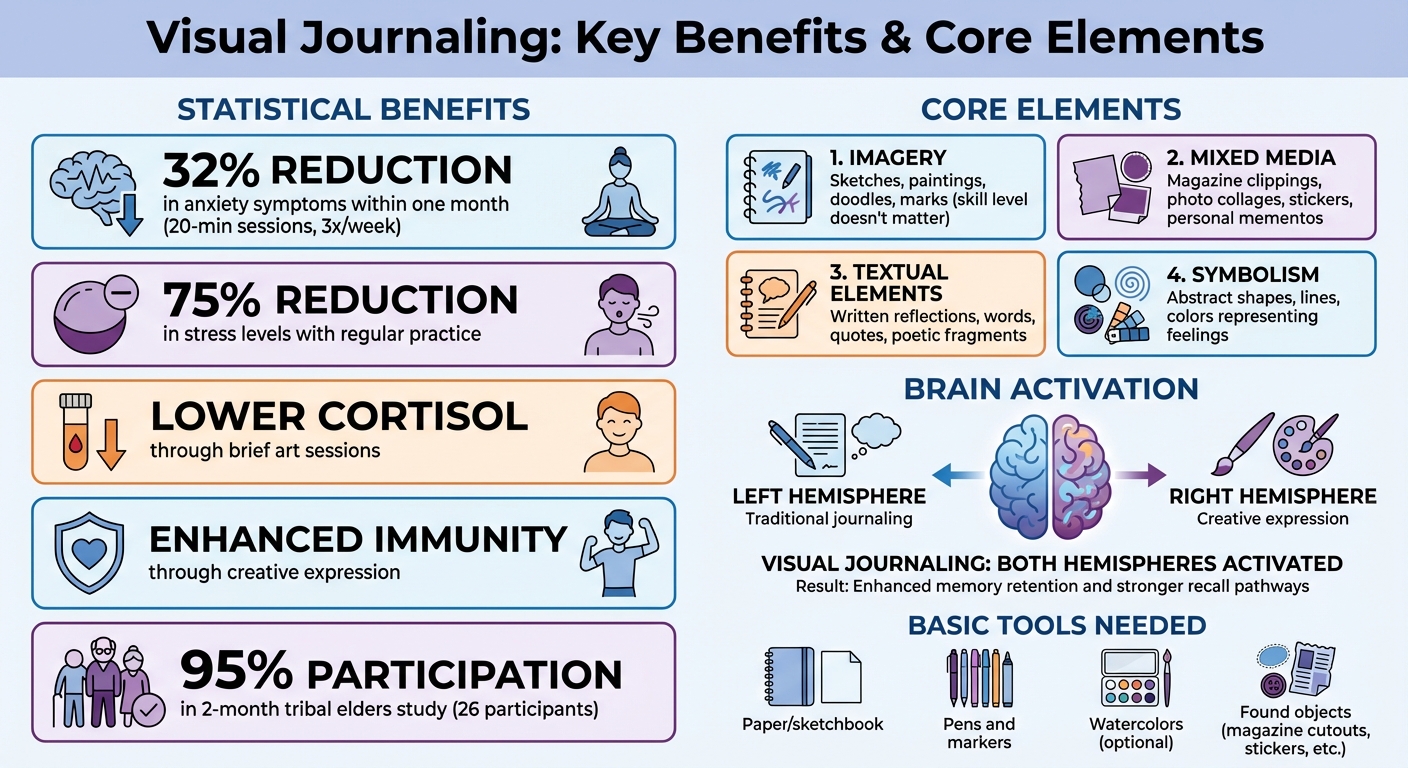
Visual Journaling Benefits: Key Statistics and Core Elements
How to start art Journaling | Intro to Art Journaling for Beginners: A Complete Beginner's Guide
Art journaling begins with covering a blank page using any medium available, because the hardest part is breaking the perfection barrier of an empty white surface.
What Is Visual Journaling?
Visual journaling combines images, color, texture, and text to express emotions and ideas that verbal language alone cannot adequately capture or communicate.
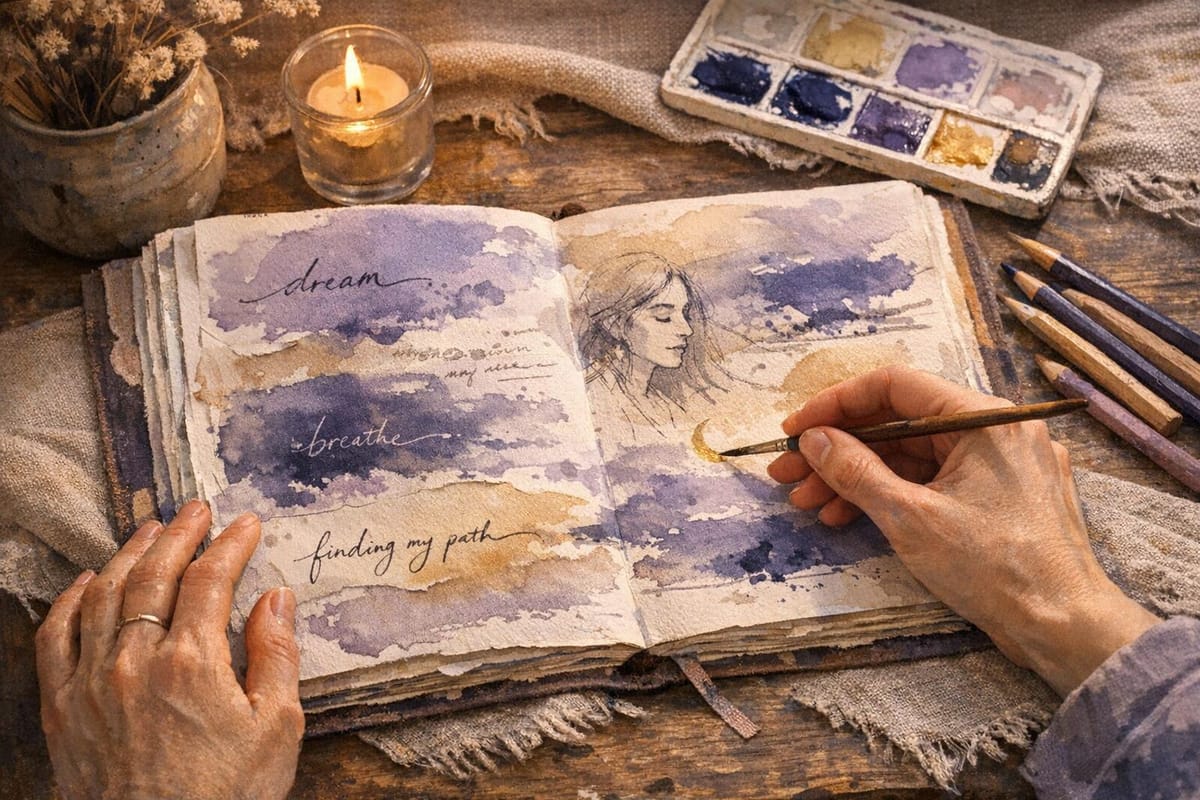
Visual journaling is a creative practice that combines written entries with visual elements like sketches, paintings, collages, and symbols to capture personal experiences and emotions.
Unlike traditional, text-only journals that primarily engage the brain’s logical left hemisphere, visual journaling activates both hemispheres. This dual engagement enhances memory retention and builds stronger recall pathways.
What makes visual journaling so powerful is its ability to express emotions that words might struggle to capture. A splash of vibrant red paint, a torn piece of a magazine, or a simple line drawing can communicate complex feelings - whether it’s joy, pain, or confusion - more directly and honestly than text alone.
These foundational ideas set the stage for understanding the key components that define visual journaling.
Core Elements of Visual Journaling
Visual journaling brings together a mix of creative elements to foster meaningful self-expression:
- Imagery: The backbone of visual journaling. This can include sketches, paintings (using materials like watercolor or acrylic), doodles, or even simple marks. Skill level doesn’t matter - what counts is authentic expression.
- Mixed Media: Magazine clippings, photo collages, stickers, or personal mementos can add richness and layers to your visual story.
- Textual Elements: Written reflections, single words, quotes, or even poetic fragments can complement the visuals, providing context or adding emotional depth.
- Symbolism: Instead of literal representations, abstract shapes, lines, and colors can symbolize feelings or states of being. Over time, these symbols can become a unique visual language that reflects your inner world.
Some popular techniques include repurposing old books as canvases - painting, drawing, or collaging directly on the pages - and using your non-dominant hand for more intuitive and less self-critical creativity.
"Art journaling is about having a visual conversation with yourself." – Cathy Malchiodi, PhD, LPCC, LPAT, ATR-BC, REAT
Why Artists Use Visual Journaling
Artists embrace visual journaling for a variety of interconnected reasons:
- It uncovers subconscious thoughts and emotions that words often fail to articulate. The act of creating - whether through drawing, painting, or collaging - can bring these hidden feelings into sharper focus.
- Over time, it becomes a tool for discovering and refining a personal visual language. As you journal consistently, patterns emerge - recurring symbols, preferred techniques, and stylistic choices - that deepen your understanding of both your inner self and your artistic voice.
- It provides a therapeutic outlet for emotional release and stress reduction. Studies show that even brief periods of making art can lower cortisol levels and ease physical tension. The physical act of creating - mixing colors, tearing paper, or gluing pieces together - can feel meditative and grounding.
Unlike art journaling, which often emphasizes technical skill and aesthetics, visual journaling is all about the process. It’s not about creating something “beautiful” or “perfect” - it’s about making something honest and meaningful to you.
These benefits open the door to exploring practical approaches to visual journaling and the tools you can use to get started.
Benefits of Visual Journaling for Artists
Visual journaling builds creative confidence, breaks artistic blocks, processes emotions through nonverbal channels, and maintains daily practice habits that feed larger professional work.
Visual journaling isn't just a tool for self-expression - it’s a way to process emotions, discover your artistic voice, and keep your creativity alive.
Processing Emotions and Healing
Sometimes words aren't enough to express what you're feeling. That’s where visual journaling steps in. By blending images with written reflections, this practice helps you process emotions in a safe and private way. Cathy Malchiodi, PhD, a psychologist and expressive arts therapist, describes it as:
"Visual journaling can be a simple, yet empowering experience of 'telling without talking' about abuse or assault" [5].
When you combine colors, lines, shapes, and text, you create a bridge between your thoughts and emotions. This process helps untangle intrusive thoughts and place difficult experiences into a more manageable context [5][6].
The benefits aren’t just emotional - they’re physical too. Studies show that even brief art sessions can lower cortisol levels and boost immunity [3]. In one study, participants who journaled visually for 20 minutes, three times a week, saw a 32% drop in anxiety symptoms within a month [1]. As Zindel Segal, a psychology professor at the University of Toronto, explains:
"The very act of writing takes information, that is often only dimly perceived, such as quick judgments, fears, worries, and concretizes by putting them in written form on paper... they may be experienced with less of an emotional charge than when they were only 'in the head'" [11].
This emotional clarity naturally feeds into your artistic growth, allowing your personal style to shine through.
Developing Your Artistic Voice
Visual journaling isn’t about making perfect art - it’s about letting your creativity flow freely. By removing the pressure to produce a masterpiece, you can experiment without fear of judgment. Over time, this low-pressure environment allows your unique artistic voice to emerge [6][7].
Simple techniques, like drawing with your non-dominant hand, can help quiet your inner critic and tap into your intuition [9][10]. Dating your entries and revisiting them later reveals how your visual language evolves. You might notice recurring symbols, shifting styles, or metaphors that reflect your life experiences [7][10]. These patterns build self-awareness and lay the groundwork for an authentic artistic style.
As your voice takes shape, it becomes easier to slip into a creative rhythm.
Building Creative Flow
One of the biggest challenges for any artist is facing a blank page. Visual journaling helps you sidestep that fear by focusing on the process rather than the outcome. This approach quiets perfectionism and encourages experimentation. It also engages both sides of your brain, blending emotional and sensory input into a seamless creative process.
For professional artists, a journal can act as an "idea incubator", a space to explore concepts before developing them into finished pieces. Techniques like diluted watercolor washes or word collages provide quick, inspiring prompts to get started without overthinking.
The benefits extend beyond creativity. Regular visual journaling can reduce stress levels by as much as 75% [1]. The stress relief and dopamine boost create the perfect conditions for creative flow, turning your journal into a personal lab for ideas, materials, and metaphors. Even during hectic times, a quick five- to ten-minute session can keep your creative energy alive.
Techniques and Tools for Visual Journaling
Core techniques include collage layering, paint-over-text, image transfer, intuitive mark-making, and mixed-media assemblage that anyone can learn regardless of formal artistic training.
Practical techniques can guide you from initial ideas to meaningful creative expression, helping you tap into the many benefits of visual journaling.
Getting Started with Basic Techniques
One way to silence your inner critic is by drawing with your non-dominant hand. The results might be messy and imperfect, but this approach can discover deeper intuition and engage both sides of your brain [9][7].
Combining words and images is another effective method. This pairing activates both sensory and narrative pathways, leading to a richer form of self-expression [6][5].
If staring at a blank page feels overwhelming, try using altered books. Instead of starting with an empty sketchbook, repurpose an old hardcover book by painting, drawing, or collaging over its pages. The existing text and images act as a creative springboard, making it easier to get started [7]. Even something as simple as doodling can be transformative. As Malchiodi explains:
"Doodling is not just a way to 'think differently;' it's a way to 'feel differently,' too" [6].
Once you've mastered these basics, you can explore how symbolism adds depth to your visual storytelling.
Using Symbolism and Themes
Incorporating symbols into your journaling can take your practice to another level. Over time, you'll likely notice recurring colors, shapes, or images in your work - these become your personal visual vocabulary for expressing complex emotions [7].
For example, you can create a "Circle of Wellness" by dividing a circle into four sections: physical, emotional, spiritual, and mental. Fill each section with symbols that represent your current state [3]. Another idea is the "Inside vs. Outside" prompt, where you draw what you're feeling internally versus what you present to the world [9].
A 2012 study led by Dr. Elizabeth Warson explored visual journaling among 26 southeastern tribal elders over two months, resulting in a 95% participation rate. Common themes included daily life activities like picking peas, designing quilt patterns, and references to family. This practice helped participants release stress and improve their overall well-being [3].
Malchiodi highlights the intentionality behind symbolism:
"Creating an expression to represent an intention and reinforcing that in regular visual journaling not only serves as a reminder, it is also an imaginal commitment to change" [9].
Materials and Tools to Use
You don’t need expensive supplies to start. A simple composition book or sketchbook, along with felt markers, Sharpie pens, and watercolors, will do the job [9][7][12]. For those looking for more versatility, Tombow dual-brush pens are a great choice. They work like markers, dry quickly, and cover large areas efficiently, helping you maintain your creative flow [4]. A black marker is also essential for outlining, lettering, and adding structure to your pages [4].
Incorporating found objects can add texture and a personal touch to your journal. Items like magazine cutouts, postcards, plane tickets, stickers, dried flowers, or receipts can all contribute to your visual story [2]. Artist Jordan Sondler offers this advice:
"If you draw things you hate in colors you love, it's easier to let them go" [4].
To simplify your process, limit yourself to three or four colors per session. This reduces decision fatigue and allows you to focus on expressing yourself [4].
If you’re working with mixed media or heavy paint, opt for a journal with thicker paper, like a Strathmore visual journal, to prevent bleeding [4][2]. Research suggests that combining art with writing leads to greater stress relief than writing alone [3], so having the right materials to support both practices can make a big difference.
How Life Note Supports Visual Journaling

Traditional visual journaling often relies on manual creativity, but Life Note takes it a step further by blending written reflections with AI-generated art. This digital twist adds a fresh layer of insight, helping you uncover emotional patterns that might otherwise go unnoticed. It’s a unique way to complement physical journaling, offering a deeper understanding of your emotional journey. Let’s dive into how Life Note turns your thoughts into meaningful, visual expressions.
Turning Journal Entries into Art
One of Life Note’s standout features, the Inner Gallery, transforms your written entries into symbolic art each week. This process taps into what psychologist Cathy Malchiodi refers to as "dual coding" - a blend of visual and verbal processing that strengthens memory by creating multiple ways to recall experiences. As Malchiodi puts it:
"Creating an image is a way to tangibly convey what words cannot adequately communicate or explain in a logical, linear way" [5].
The Inner Gallery acts as a reflective space, turning your emotions into visual symbols. For example, you might jot down your feelings about a challenging day, and Life Note will generate imagery that mirrors your inner state. This makes abstract emotions more tangible and accessible, even for those who aren’t naturally artistic. By automating this process, Life Note opens the door to the benefits of visual journaling for everyone.
Identifying Patterns and Themes
Life Note doesn’t just stop at creating art - it also tracks your entries over time to uncover recurring emotional patterns. Its memory system highlights themes like repeated color schemes during stressful periods or specific symbols that reflect your mental state. These insights form a personal visual vocabulary, documenting your emotional evolution. Each week, Life Note’s mentor reflections point out these recurring motifs, guiding you toward a deeper understanding of your inner world. This ability to recognize patterns adds a whole new dimension to your journaling journey.
Using AI Mentorship for Creative Guidance
Life Note takes creative exploration further by connecting you with AI mentors inspired by over 20 professions, including figures like J.K. Rowling and Mark Twain. These mentors provide personalized reflections on your journal entries. As Matt Tommey explains, a mentor offers a seasoned perspective, helping you see beyond your immediate understanding [13].
These AI mentors act as empathetic guides, an essential element for meaningful visual journaling [6][8]. They encourage you to dig deeper into your reflections, uncovering hidden insights and pushing you to step out of your comfort zone. Depending on your creative goals, the AI can suggest themes to explore or help you weave sensory memories into a coherent narrative [14]. This mentorship not only enhances your creative process but also helps you cultivate a genuine artistic voice tailored to your personal journey.
Conclusion
Visual journaling offers a powerful blend of art and self-reflection, allowing you to weave images and words into a personal narrative that helps process emotions and preserve sensory memories. The beauty of this practice lies in its simplicity - no formal training is needed, just a willingness to express yourself. As art therapist Cathy Malchiodi puts it, "The value lies in the process, not the product" [1].
The rewards of visual journaling are both immediate and long-lasting. Short, regular sessions can ease stress and improve well-being, while a consistent practice helps your unique visual language grow and evolve over time [7]. In fact, studies reveal that combining art with writing is more effective at reducing stress than writing alone [3].
Getting started is easy. You can try techniques like color washing to reflect your mood, drawing with your non-dominant hand to silence self-criticism [9], or sketching within a circle to contain and explore emotions [10]. Dating your entries can also help you see how your creative voice develops over time [10].
For those seeking a deeper experience, Life Note offers a unique way to turn written reflections into symbolic art, guided by AI mentorship. This approach bridges creativity and introspection, helping you uncover themes and refine your self-expression.
Whether you prefer traditional pen and paper, digital tools, or a mix of both, the most important step is to begin and stay consistent. Over time, your visual journal will become a meaningful record of your emotional journey - a space to process feelings, nurture your artistic voice, and uncover insights that can inspire growth, both creatively and personally.
FAQs
How can I start visual journaling as a beginner?
Starting a visual journal is both straightforward and fulfilling. All you really need is a blank notebook or sketchbook, a few basic tools like pencils, pens, or markers, and an open mind ready to dive into your creativity. Pick a notebook that’s reserved just for your visual entries - it becomes your personal space for self-expression.
To get started, set a simple intention. Maybe you want to capture your mood, a memory, or even just a color that resonates with you at the moment. Begin with a quick sketch, a doodle, or a small prompt. Don’t stress about making it perfect - this is about expressing yourself, not creating a masterpiece. If you want to add more layers to your entries, jot down a few notes or phrases alongside your drawings to give them extra meaning. Try to make it a habit, whether it’s a few minutes each day or once a week, and let the process unfold naturally over time.
Need a little extra inspiration? A digital tool like Life Note can be a great companion. It helps store your entries, provides prompts, and offers reflective insights - all while keeping the hands-on creative experience intact.
What are the mental health benefits of visual journaling?
Visual journaling, a blend of artistic expression and written reflections, can be a powerful tool for mental well-being. This practice provides a creative outlet for emotions, helping to reduce stress through calming, hands-on activities like drawing or painting. Engaging in visual journaling regularly can not only lower stress but also improve emotional regulation and foster a sense of balance.
But it doesn’t stop at stress relief. Visual journaling can deepen self-awareness by bringing hidden thoughts and feelings to light. The combination of images and words offers a unique way to process emotions, recognize patterns, and reflect on personal growth. It also encourages mindfulness, eases anxiety, and serves as a meaningful method to track progress over time.
For a modern twist, Life Note offers a digital take on visual journaling by incorporating AI-guided insights. This tool helps users transform their creative expressions into deeper reflections, blending the therapeutic benefits of journaling with personalized feedback. It’s a private, organized way to explore emotions while nurturing mindfulness.
What are the best materials to start visual journaling?
To dive into visual journaling, the first thing you’ll need is a reliable journal that can handle a variety of art supplies. Mixed-media journals are a popular pick because their thick, acid-free pages can handle everything from watercolors to acrylics without bleeding or warping. If you’re feeling crafty, you might enjoy using a hand-made or upcycled journal to add a personal touch to your creative process.
When it comes to tools, start with the basics: graphite pencils, fineliner pens, and gel pens for sketching and outlining. To bring your pages to life with color, try watercolors, acrylic paints, gouache, or colored pencils. If collage is your thing, gather materials like magazine clippings, fabric scraps, and stickers, and use acid-free glue or double-sided tape to secure them. Don’t forget essentials like a set of brushes, a palette, and a rubber eraser to help you create dynamic and textured designs. The beauty of visual journaling lies in experimenting with these tools to see what sparks your creativity!
Related Blog Posts
Journal with 1,000+ of History's Greatest Minds
Marcus Aurelius, Maya Angelou, Carl Jung — real wisdom from real thinkers, not internet summaries. A licensed psychotherapist called it "life-changing."
Try Life Note Free