
7 Famous Diaries That Changed Lives

Seven influential diaries—from wartime and exploration to marginalized voices—show how journaling preserves history and sparks personal transformation.

Explore More
Continue your journey:
- How to Start Journaling in 2026 — The complete guide
📌 TL;DR — 7 Famous Diaries That Changed Lives
From Anne Frank's powerful Holocaust testimony to Samuel Pepys' vivid 17th-century chronicles, these seven diaries show how journaling preserves history and transforms lives. Other diarists include polar explorer Robert Falcon Scott, Civil War-era Emilie Davis, and boundary-breaking traveler Isabelle Eberhardt. Their writings prove that documenting life—whether through pen and paper or modern tools like Life Note—remains a powerful way to reflect, grow, and connect with the world.
Curious about what the greatest thinkers gained from writing? Explore how great minds benefited from journaling.
Diaries have long been a tool for self-reflection and historical documentation, offering raw, real-time insights into personal and world events. From Anne Frank’s poignant account of life during the Holocaust to Samuel Pepys’ detailed chronicles of 17th-century England, these writings have shaped how we understand history and humanity. This article explores seven impactful diaries that range from personal struggles to cultural revolutions, showing how journaling can inspire change and preserve the human experience.
These diarists were searching for something beyond daily events — they were seeking meaning. For a philosophical framework on that search, explore what the Buddha taught about life’s true purpose and why it goes beyond the pursuit of happiness.
Quick Highlights:
- Anne Frank: A teenager’s voice amidst the horrors of the Holocaust, her diary is a testament to resilience and hope.
- Samuel Pepys: Captures daily life and significant events like the Great Fire of London with vivid detail.
- Robert Falcon Scott: Chronicles the tragic Antarctic expedition, blending scientific discovery with human perseverance.
- Emilie Davis: A rare window into the life of a free African American woman during the Civil War.
- Isabelle Eberhardt: Defied societal norms, documenting her spiritual and physical journey through North Africa.
- Holocaust Youth Diaries: Other young voices preserved the realities of war, blending personal growth with historical testimony.
- Life Note AI Journaling: A modern journaling app that combines technology with wisdom from great thinkers to deepen self-reflection.
These diaries remind us that writing isn’t just about recording life - it’s about understanding it. Whether through pen and paper or digital tools, journaling remains a powerful way to navigate challenges, reflect on experiences, and connect with the world. These diaries reveal something profound about wisdom's true meaning.
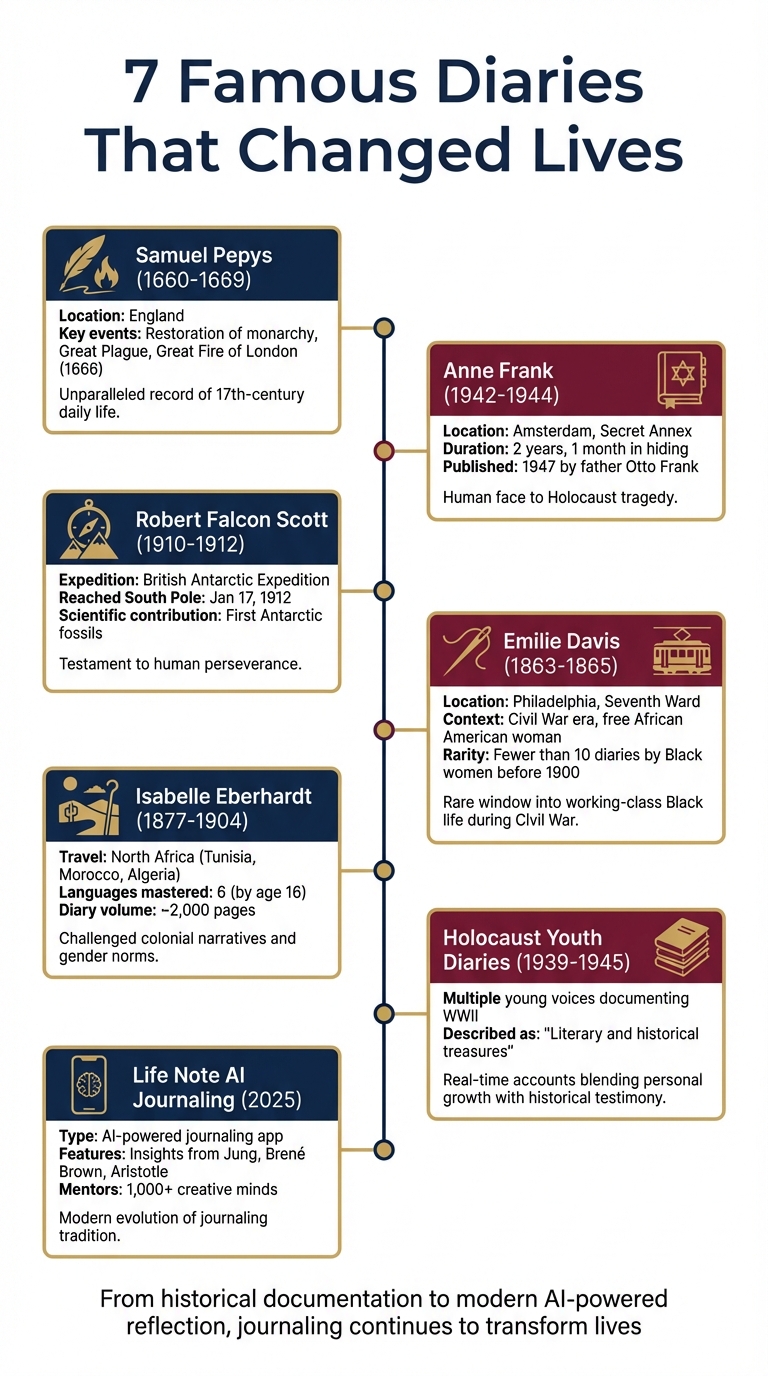
Timeline of 7 Famous Diaries That Changed History
Remarkable Diaries: The World's Greatest Diaries, Journals, Notebooks and Letters
History's greatest diaries transformed private reflection into public revelation, documenting wars, plagues, and personal revolutions that official records deliberately excluded or sanitized.
1. Anne Frank's Diary
Anne Frank's diary, written during two years hiding from Nazi persecution, became the twentieth century's most powerful testimony to human resilience and the cost of hatred.
On June 14, 1942, a 13-year-old girl received a diary as a birthday gift. What began as a personal refuge soon became a powerful historical document. Anne Frank spent two years and one month hidden in a secret annex behind a bookcase at 263 Prinsengracht Street in Amsterdam. During this time, she wrote letters to her imaginary friend "Kitty", while Nazi forces relentlessly hunted Jewish families across Europe [1]. Her writings captured the struggles of growing up under unimaginable circumstances.
Anne's diary explores into the universal challenges of adolescence, even as she faced extraordinary horrors. She wrote about everyday teenage concerns - like arguments with her mother, her budding feelings for Peter van Pels, and her search for identity - all while confined with seven others in the "Secret Annex" [1]. But her entries went far beyond the ordinary. As Anne matured, her reflections revealed deep philosophical thought and a remarkable literary talent. Critics now regard her diary as both a "literary and historical treasure" [1]. Her honest and heartfelt words gave a human face to an overwhelming tragedy, reminding readers of the enduring power of hope and resilience.
One of the most striking aspects of Anne's diary is her enduring optimism. Even while acknowledging the immense suffering around her, she held on to her belief in the goodness of humanity [1]. In one of her most famous passages, she wrote:
(Related: Seneca's writings on Stoicism — and a full primer on what Stoicism actually teaches)
I still believe, in spite of everything, that people are truly good at heart… I somehow feel that everything will change for the better that this cruelty too shall end, that peace and tranquility will return once more [1].
These hopeful words stand in heartbreaking contrast to her fate. Anne died of typhus at the Bergen-Belsen concentration camp in March 1945, just weeks before her 16th birthday [1]. Of the eight people in hiding, only her father, Otto, survived. In 1947, he published Anne's diary, ensuring her voice would be heard by millions and making it impossible for the world to forget the Holocaust.
What makes Anne's diary so impactful isn't just its historical significance - it’s her ability to turn abstract statistics into a deeply personal story. Through her relatable and honest voice, Anne reminds us that self-reflection and storytelling can profoundly shape how we understand both history and humanity.
Related: Explore our guide to the difference between journals and diaries.
2. Samuel Pepys' Diary
Samuel Pepys documented 1660s London with extraordinary sensory detail, creating the definitive eyewitness account of the Great Fire and the devastating Great Plague.
Anne Frank's diary gave the world a poignant glimpse of war through a young girl's perspective, but Samuel Pepys' writings open a very different window - one into the everyday life of 17th-century England during a time of profound change. From 1660 to 1669, Pepys chronicled his life with extraordinary detail, capturing everything from national disasters and political intrigue to household squabbles and deeply personal moments. As Clerk of the Acts to the Navy Board, he was uniquely positioned to witness history unfold, and his meticulous entries provide an unparalleled record of the era.
What makes Pepys' diary so compelling is how seamlessly it weaves together the mundane and the monumental. He jotted down notes on his finances, the weather, and his daily routines while also documenting major historical events like the Restoration of the monarchy, the Great Plague, and the Great Fire of London. This mix of personal and public life offers historians a rare glimpse into how grand events shaped the lives of ordinary people.
One of the most striking parts of his diary is his account of the Great Fire of London in 1666. Pepys’ vivid descriptions bring the chaos and devastation to life. He wrote:
With one's face in the wind you were almost burned with a shower of Firedrops [6].
After nine years of dedicated writing, Pepys stopped keeping his diary in 1669, fearing he might lose his eyesight. Despite its relatively short span, his journal remains an invaluable resource, capturing spontaneous, firsthand observations that stand in stark contrast to later, more polished accounts like Daniel Defoe's A Journal of the Plague Year, which was written long after the events it describes.
Pepys' commitment to honest and consistent self-reflection has inspired countless diarists over the centuries. His work reminds us that documenting the small, everyday details of life can provide profound insights into both personal experiences and the broader sweep of history.
3. Robert Falcon Scott's Diary
Robert Falcon Scott's Antarctic diary recorded his expedition's final days with unflinching honesty, becoming one of exploration history's most haunting accounts of human endurance.
Robert Falcon Scott's diary offers a vivid account of the relentless challenges faced by the British Antarctic Expedition (1910–1912). His team endured unimaginable hardships as they pushed toward the South Pole, only to face a devastating discovery upon their arrival. On January 17, 1912, after months of grueling travel, they found that Roald Amundsen's Norwegian team had beaten them to the pole by over a month [9]. Scott captured his heartbreak in his diary, writing:
Great God! This is an awful place and terrible enough for us to have laboured to it without the reward of priority [9].
This raw expression of despair highlights the emotional weight such records can carry.
The diary recounts the series of misfortunes that plagued the expedition. Motor sledges broke down, the Manchurian ponies were ill-suited to the punishing Antarctic conditions, and leaking fuel cans at supply depots left the team unable to melt ice for water [7]. Temperatures plunged to –40°F during the day and –47°F at night [10], while the men burned around 6,000 calories daily but only had rations providing 4,500 calories [7].
Even in the face of these overwhelming challenges, the team remained committed to their scientific goals. They carried 35 pounds of geological specimens, including the first Antarctic fossils ever discovered, which later revealed that the continent had once been forested [8]. Tragedy struck when Edgar Evans died on February 17, 1912, after a fall. A month later, on March 17, Lawrence Oates, suffering from severe frostbite, walked into a blizzard, uttering the now-famous words:
Oates’ selfless act remains one of the most poignant moments in the history of polar exploration.
Scott’s final diary entry, dated March 29, 1912, reveals the grim reality of their situation. Trapped in their tent by a relentless blizzard and just 11 miles from a life-saving supply depot, Scott wrote:
We shall stick it out to the end, but we are getting weaker, of course, and the end cannot be far. It seems a pity, but I do not think I can write more. For God's sake look after our people [9].
In November 1912, a search party found their frozen bodies along with Scott’s diary. His record of their journey, though filled with tragedy, serves as a powerful testament to the human spirit and the importance of documenting personal experiences. Up next, we’ll explore another diary that offers even deeper reflections on personal transformation.
4. Emilie Davis' Diary
Emilie Davis, a free Black woman in Civil War Philadelphia, kept pocket diaries documenting daily life, Lincoln's assassination, and racial inequality with quiet, powerful precision.
Emilie Davis chronicled her life as a free African American woman living in Philadelphia from 1863 to 1865 in three leather-bound diaries [12][13]. Unlike the extensively documented lives of elite Black women from this period, Davis' writings offer a rare look into the experiences of a working-class dressmaker and domestic worker. With fewer than 10 diaries by Black women from before 1900 available in public records, her entries fill an important gap in understanding everyday life during the Civil War [15]. Her diary seamlessly blends personal anecdotes with reflections on the broader societal context, bringing the era to life.
Davis wrote about personal moments that painted a vivid picture of her daily life - social outings, church concerts, ice cream trips, and even learning to play the guitar at the Institute for Colored Youth [11][13]. Remarkably, she recorded four separate ice cream outings during the war, a luxury in segregated Philadelphia [13]. She also noted how the war disrupted daily routines, writing about the soaring cost of muslin (cotton), which had become "frightfully Dear" due to halted Southern production and increased demand for military uniforms [12][14].
Her diary also reflects her involvement in political and social movements. She attended lectures by prominent figures like Frederick Douglass, Frances Ellen Watkins Harper, and James Sella Martin, and participated in the Ladies' Union Association [11][13]. Davis documented the community’s efforts to desegregate Philadelphia’s streetcars, a fight that culminated in victory in 1867 [12].
Amid these reflections, Davis also recorded her fears. She worried that Confederate forces might capture her father and sell him into slavery [11][12]. Her entries, written from Philadelphia’s Seventh Ward - home to the largest concentration of Black wealth on the East Coast during the 1860s - show how national events shaped the lives of individuals [11].
Davis' diaries have provided historians with invaluable insight into the Civil War era. Karsonya Wise Whitehead’s analysis of Davis' writings, Notes from a Colored Girl, earned prestigious accolades, including the Darlene Clark Hine Book Award from the Organization of American Historians and the Letitia Woods Brown Book Award from the Association of Black Women Historians [12]. Through Davis’ words, we are reminded that history is not just shaped by generals and politicians - it is lived by everyday people, whose stories deserve to be remembered.
5. Isabelle Eberhardt's Diary
Isabelle Eberhardt's journals chronicle her radical life as a European woman who adopted Islam, dressed as a man, and explored the Sahara in the 1900s.
Isabelle Eberhardt was a trailblazer who shattered the societal norms of the late 19th century. Rejecting the constraints of her European heritage, she ventured across North Africa dressed in a burnus - a traditional male garment - and adopted the male alias "Si Mahmoud Essadi." Her journey wasn’t just physical; it was deeply spiritual. She embraced Islam, became a member of the Qadriya Sufi brotherhood (a role usually reserved for men), and traveled independently through Tunisia, Morocco, and Algeria. Her experiences and transformation are captured in her diary, which spans about 2,000 pages of manuscripts [17].
Eberhardt’s writings are a window into her evolving identity and her rejection of societal complacency. She sought a life of questioning and higher ideals, as reflected in this powerful excerpt:
I am no typical Fatma or ordinary Aicha. I am also your brother Mahmoud, a prominent djilani (of the Sufi Order), and a servant of God, far more so than as a servant of my husband [16].
Even after marrying Slimane Ehnni, an Algerian soldier, in 1901, she retained her independence - both spiritually and personally.
Unlike many European travel writers of her time, who often romanticized North Africa, Eberhardt’s diary took a critical stance. She condemned the dehumanizing impact of French colonialism in the Maghreb. Tunisian scholar Hedi Abdel-Jaouad noted her groundbreaking approach:
she was the first to use polyglotism as a device to undermine 'monolange,' one of the principal pillars of the colonial order [17].
By the age of 16, Eberhardt had mastered six languages - Russian, Arabic, French, Latin, and Greek - leveraging her linguistic skills to challenge the colonial dominance of language.
Her fearless critiques and unique perspective left a lasting legacy. Sadly, her life was cut short when she died at just 27 years old in a flash flood in Ain Sefra, Algeria, in 1904 [17]. Despite this tragedy, four of her diaries survived and were published posthumously. The first English translation, Passionate Nomad: The Diary of Isabelle Eberhardt, was released in 1978. In one of her final entries, she wrote:
Vagrancy is deliverance and life on the open road is the essence of freedom. To have the courage to smash the chains with which modern life has weighed us... then to take up the symbolic stick and bundle and get out! [17].
Today, her work continues to inspire. Conde Nast Traveler has hailed her diary as one of the greatest travel books ever written, and her name lives on in the streets of Algiers and Béchar, honoring her extraordinary life and legacy [18].
6. Holocaust Survivors' Youth Diaries
Youth diaries from Holocaust survivors preserve the voices of children facing unimaginable horror, ensuring their experiences remain documented beyond the reach of historical denial.
Anne Frank's diary might be the most well-known, but she wasn’t the only young voice documenting the horrors of the Holocaust. Many other young diarists captured the raw reality of their lives during this dark period, offering deeply personal and historical insights [1]. These diaries are often described as "literary and historical treasures", chronicling the ominous "approaching thunder" of destruction and the unimaginable "suffering of millions" [1]. What makes them so powerful is their immediacy - written in real time, without the benefit (or burden) of hindsight. They blend personal growth with historical testimony, providing a unique lens on the experiences of youth during the Holocaust.
These young writers faced a heartbreaking duality: navigating the typical challenges of adolescence - family conflicts, first loves, and dreams for the future - while enduring unimaginable hardship and the constant specter of death [1]. For some, their diaries became a lifeline, a way to process their emotions, hold onto their identity, and leave a record of their lives for future generations [2][3].
What’s striking about these diaries is how they weave together the ordinary and the extraordinary. Scholars often call this the "memorializing of the mundane" [2]. Pages filled with daily routines, small joys, and personal frustrations sit alongside accounts of monumental historical events. This juxtaposition preserves not just the history but also the humanity of individuals who refused to let their voices be erased.
Even in the face of overwhelming despair, many young diarists held onto hope and ideals. Their writings remain vital today because they capture history with "absolute fidelity to the present" - offering an unvarnished, real-time window into one of humanity’s darkest chapters [2][3].
7. Life Note: The AI Journaling Companion for Self-Discovery and Human Wisdom
Life Note continues the diary tradition digitally, pairing personal reflection with AI mentors trained on writings from history's greatest minds for deeper guided self-discovery.

For centuries, diaries have been a way to turn everyday experiences into lasting insights. Now, that tradition takes a modern twist with Life Note, the first AI-powered journaling app designed to draw from humanity's collective wisdom [19]. This isn't just about recording your life - it's about using those records to guide your personal growth.
Life Note goes beyond traditional journaling by creating an interactive experience. When you write about your day, challenges, or aspirations, the app responds with reflections inspired by some of history's greatest thinkers. Imagine receiving insights from Carl Jung, Brené Brown, Aristotle, or Virginia Woolf, each offering advice rooted in their unique philosophies. It's like having a conversation with the minds that shaped human thought, helping you view your experiences through lenses you may never have considered [19] [20].
The app also incorporates tools inspired by Tolstoy's method of tracking personal growth [4]. It uses smart recognition to identify recurring themes in your entries, uncovering emotional triggers and patterns you might not notice on your own [19].
Licensed psychotherapist Sergio Rodriguez Castillo notes that while many AI journaling tools focus on surface-level positivity, Life Note strikes a balance between empathy and meaningful challenges, encouraging deeper self-reflection [19].
Privacy is a priority, with AES-GCM end-to-end encryption safeguarding your entries. Life Note features insights from over 1,000 creative minds across 20+ disciplines. You can start with a free tier or opt for a subscription at $10.99 per month (or $99.99 annually) for unlimited journaling and full access to its mentor library [19].
What sets Life Note apart is its focus on turning self-reflection into a transformative practice. A 2026 study found that AI-enhanced journaling tools help users "reflect" rather than simply "record", leading to improved emotional regulation and a stronger sense of purpose [19] [20]. Life Note builds on this with features like the Wisdom Library, where you can save key insights, and weekly reflection letters that allow you to track your growth over time. It’s journaling reimagined - blending timeless wisdom with modern technology to deepen self-discovery [19].
Research Foundation
| Study | Finding | Implication |
|---|---|---|
| Pennebaker & Beall (1986) | Students writing about traumatic experiences visited the health center at half the rate of controls over 6 months | Personal diary-keeping measurably reduces illness |
| Smyth (1998) | Meta-analysis found written emotional expression improves physical health, psychological wellbeing, and general functioning (d=.47) | Regular diary writing improves health on multiple dimensions |
| McAdams (2001) | People who construct narratives with redemptive meaning and personal agency enjoy higher mental health and maturity | Famous diarists instinctively used narrative structures that build resilience |
| Fivush (2011) | Individuals who develop detailed, coherent personal narratives show a more differentiated sense of self | Diary-keeping builds identity coherence |
| Burton & King (2004) | Writing about intensely positive experiences for 3 days reduced illness visits through broadened cognitive focus | Diaries capturing peak experiences provide distinct health benefits |
| Baikie & Wilhelm (2005) | Writing about stressful events for 15-20 min on 3-5 occasions improves immune function, reduces anxiety, and improves sleep | Even brief diary-keeping sessions produce clinically meaningful benefits |
Conclusion
These seven diaries prove that private writing holds extraordinary power to document truth, process trauma, and create lasting records that shape how humanity understands itself.
The diaries we've delved into - from Anne Frank's heartfelt wartime writings to Samuel Pepys' vivid chronicles - remind us of a profound truth: journaling is more than documenting life; it's a way of shaping who we are. These historical records highlight how writing brings clarity and purpose during life’s most trying times, whether it’s navigating the chaos of war, uncovering new frontiers, or simply making sense of the ordinary. Their enduring lessons continue to inspire the journaling practices we rely on today.
Studies have shown that journaling enhances memory, helps regulate emotions, and eases anxiety [5]. It’s no surprise that during moments of uncertainty, people often instinctively turn to writing as a way to process their thoughts and find direction.
Much like the diaries that captured resilience and humanity in the face of adversity, modern journaling tools have evolved to deepen personal reflection. While Anne Frank wrote in the solitude of her attic, today’s platforms - like Life Note - merge timeless wisdom with modern technology, offering insights into your thoughts and helping you uncover patterns in your emotions.
Whether you prefer pen and paper or a digital approach, journaling holds the power to change lives. Artist Eugène Delacroix expressed this sentiment beautifully:
By keeping a record of my experiences I live my life twice over. The past returns to me. The future is always with me [3].
In an age brimming with endless distractions, journaling provides a rare opportunity - a quiet space to reflect, grow, and find meaning in the small, everyday moments that ultimately define us.
FAQs
How do diaries help us understand history?
Diaries provide an intimate glimpse into history, offering a personal perspective that official records often miss. They capture the raw thoughts, emotions, and day-to-day experiences of individuals living through significant moments. For example, Anne Frank’s diary offers a deeply human account of life during the Holocaust, while Charles Darwin’s notes from his Beagle voyage laid the groundwork for his groundbreaking theory of evolution.
Written in real time, diaries shed light on social attitudes, everyday concerns, and the cultural norms of their era. They give historians a deeper, more textured view of the past. These personal writings turn individual experiences into shared stories, making history feel vivid and deeply human.
Why is Anne Frank’s diary considered one of the most impactful accounts of the Holocaust?
Anne Frank’s diary stands out as an intimate and profoundly human window into life during one of history’s darkest chapters. Penned by a teenager in hiding, her words weave together heartfelt honesty, literary richness, and an enduring sense of hope, even in the face of overwhelming adversity.
Translated into more than 75 languages, the diary has become one of the most widely read accounts of the Holocaust. Its universal themes - resilience, the essence of humanity, and the yearning for freedom - continue to resonate, reminding us of the power of personal stories in making history feel real and deeply understood.
How does Life Note elevate traditional journaling?
Life Note takes the age-old practice of journaling and elevates it into an interactive and thought-provoking experience. By blending advanced AI with the wisdom of some of history’s most brilliant minds - like Aristotle, Carl Jung, and Brené Brown - it offers a fresh way to reflect and grow through personalized conversations with virtual mentors.
One standout feature is its smart memory, which helps you identify emotional patterns, monitor your progress, and link your thoughts to deeper insights. On top of that, Life Note delivers weekly reflection letters and practical steps to help you align your daily actions with your bigger life goals. It turns journaling into a powerful tool for self-discovery and meaningful change.
Related Blog Posts
- Discover Your Values Through Journaling: 7 Tips
- 10 Journaling Tips to Build Self-Discipline
- Decision Journaling: Lessons from Great Thinkers
- How Travel Journaling Enhances Emotional Awareness
Famous diaries are personal journals written by notable figures throughout history—from Anne Frank to Marcus Aurelius—offering intimate windows into private thoughts, historic events, and the universal human experience of self-reflection.
Journal with 1,000+ of History's Greatest Minds
Marcus Aurelius, Maya Angelou, Carl Jung — real wisdom from real thinkers, not internet summaries. A licensed psychotherapist called it "life-changing."
Try Life Note Free