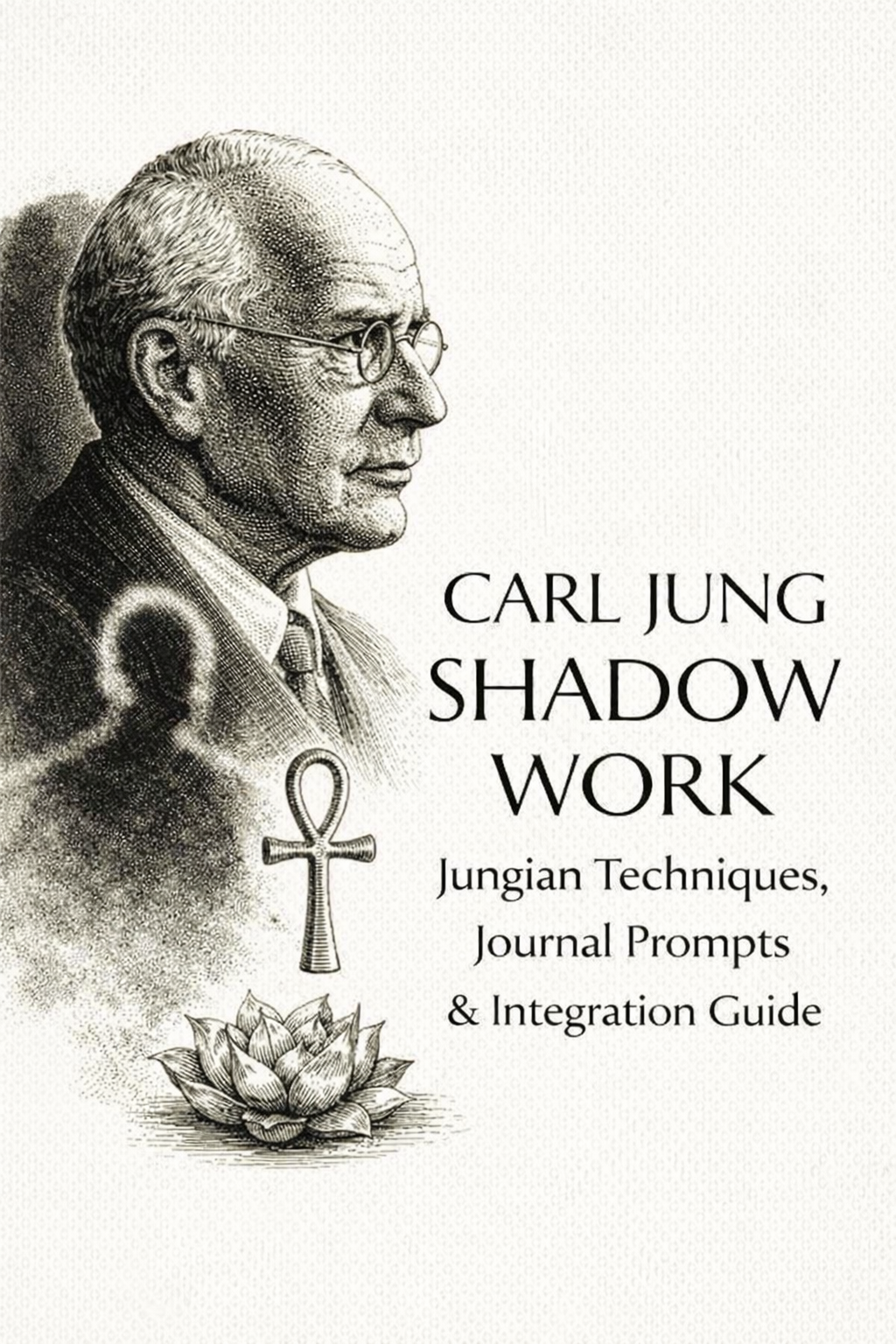
Carl Jung Shadow Work: Jungian Techniques, Journal Prompts & Integration Guide

Master Carl Jung's shadow work techniques. 30 Jungian journal prompts, 5 integration methods, and how to do shadow work using Jung's original framework.
📌 TL;DR — Carl Jung Shadow Work
Carl Jung's shadow is the unconscious part of your personality containing repressed traits, desires, and emotions. Shadow work means bringing these hidden parts into awareness through techniques like active imagination, dream analysis, journaling, and examining your triggers and projections. The goal isn't to eliminate the shadow but to integrate it — accepting all parts of yourself leads to psychological wholeness. Jung believed this integration was essential for individuation (becoming your true self).
Who Was Carl Jung?
Jung broke with Freud over a single conviction: the unconscious is not just a warehouse of repressed pain — it holds your untapped potential.
Carl Gustav Jung (1875-1961) was a Swiss psychiatrist and psychoanalyst who founded analytical psychology. After an early collaboration with Sigmund Freud, Jung developed his own approach to the psyche.
His framework emphasized:
- The importance of the unconscious mind
- Symbolic thinking and archetypes
- The process of individuation (becoming whole)
Jung's ideas have influenced not just psychology but mythology, literature, religious studies, and personal development. Today, every Jungian analyst works with concepts that originated with Jung—the collective unconscious, archetypes, introversion/extroversion, and synchronicity. Jung's concept of synchronicity also applies to angel numbers and their meanings.
But perhaps his most practically useful contribution is the concept of the shadow—and the process of shadow integration that makes us whole.
What Is the Shadow According to Carl Jung?
Your shadow is not your worst self — it is every version of you that someone once made you believe was unacceptable.
According to Carl Jung, the shadow is the unconscious part of the personality that contains every trait, desire, emotion, and impulse that the conscious ego has rejected or never developed. Jung introduced this concept as a cornerstone of his analytical psychology framework in the 1930s, arguing that the shadow forms naturally during childhood as we learn which parts of ourselves are rewarded and which are punished by family, culture, and society. The rejected qualities do not disappear — they are pushed into what Jung called the personal unconscious, where they continue to influence behavior, relationships, and emotional reactions from below the surface of awareness. Research by Gross and John (2003), studying 1,483 participants, confirmed that habitual emotional suppression — the psychological mechanism that creates and maintains the shadow — correlates with lower well-being, poorer social functioning, and reduced life satisfaction. The shadow is not inherently evil or negative. It contains any quality that was deemed unacceptable: for some people, that means aggression; for others, vulnerability or the desire to rest; for high achievers, it may be the longing to slow down; for people-pleasers, authentic anger. Jung wrote that "everyone carries a shadow, and the less it is embodied in the individual's conscious life, the blacker and denser it is." When the shadow remains unacknowledged, it manifests through projection (seeing disowned traits in others), slips of the tongue, recurring dreams, and moments when we act "out of character." Shadow work is the process of making these unconscious patterns conscious, integrating what was split off back into the whole self.
What the shadow might contain:
- For some people: aggression
- For others: vulnerability
- For high achievers: the desire to rest
- For people-pleasers: authentic anger
The shadow is deeply personal—shaped by your specific history of what was rewarded and what was punished.
Jung famously wrote: "Everyone carries a shadow, and the less it is embodied in the individual's conscious life, the blacker and denser it is."
When we refuse to acknowledge our shadow, it doesn't disappear. It gains power. It shows up in:
- Projection (seeing our disowned traits in others)
- Slips of the tongue
- Dreams
- Moments when we act "out of character"
Shadow work is the process of making the unconscious conscious—integrating what was split off back into the whole self.
Jung's Key Shadow Work Concepts
| Concept | Definition | Role in Shadow Work |
|---|---|---|
| The Shadow | Unconscious aspects of personality the ego doesn't identify with | Primary focus of shadow work—what we bring to awareness |
| Projection | Attributing your own traits to others | Key diagnostic tool—what triggers you reveals your shadow |
| Integration | Accepting and incorporating shadow aspects into conscious personality | The goal—becoming whole rather than "perfect" |
| Individuation | Process of becoming your authentic self | Larger journey that shadow work supports |
| Active Imagination | Technique for dialoguing with unconscious content | Method for engaging with shadow figures directly |
| Archetypes | Universal patterns in the collective unconscious | Shadow often appears through archetypal figures |
Why Shadow Integration Matters
Ignoring your shadow does not make it passive — Jung found it grows more powerful the longer it stays unconscious, hijacking decisions you think are rational.
Shadow integration matters because unacknowledged shadow material does not remain dormant — it actively undermines psychological health, relationships, and personal development. Carl Jung considered shadow integration the most critical component of individuation, the lifelong process of becoming a complete, authentic self. Without integration, individuals remain psychologically fragmented, presenting a carefully constructed persona to the world while their genuine complexity stays hidden, even from themselves. Modern research validates Jung's position: Pennebaker and Beall's 1986 study found that writing about suppressed emotions for just 15 minutes per day over four days reduced physician visits by 50% over six months, demonstrating that confronting hidden material produces measurable health benefits. Neff and Vonk (2009), studying 2,187 adults, found that self-compassion — a quality central to shadow integration — predicted greater emotional resilience than self-esteem alone. Integration does not mean acting on every shadow impulse. It means acknowledging those impulses, understanding their origins in childhood conditioning or cultural messaging (our inner child trauma recovery prompts offer a structured approach to this work), and consciously choosing how to respond rather than being driven by unconscious patterns. The practical benefits span every dimension of life: reduced projection onto others, more authentic relationships, access to previously suppressed creativity and energy, and freedom from the repetitive behavioral cycles that mark an unintegrated psyche.
The benefits of shadow integration include:
- Reduced projection — You stop seeing your own disowned traits in others and judging them for it
- More energy — Suppressing parts of yourself is exhausting; integration frees that energy
- Greater authenticity — You stop performing and start being
- Better relationships — When you accept your own complexity, you can accept others'
- Access to creativity — The shadow often contains unexpressed creative energy
- Emotional resilience — You're no longer blindsided by parts of yourself you didn't know existed
Integration doesn't mean acting on every shadow impulse. It means acknowledging those impulses, understanding where they come from, and consciously choosing how to respond. The goal isn't to become your shadow—it's to stop being controlled by it.
5 Jungian Shadow Work Techniques
The technique that works fastest is usually the one you resist most, that resistance itself is the shadow pointing at the door.
Jungian shadow work techniques are structured psychological practices developed by Carl Jung and his successors for encountering, dialoguing with, and ultimately integrating unconscious shadow material into conscious awareness. The five primary techniques — active imagination, dream analysis, projection work, the 3-chair dialogue, and shadow journaling — each target a different pathway to the unconscious and are supported by decades of clinical practice and modern research. Lieberman et al. (2007) demonstrated through fMRI imaging that affect labeling — the act of naming emotions, which is central to all five techniques — directly reduces amygdala reactivity, providing a neurological basis for why shadow work reduces the power of unconscious material. Kaufman (2020) argued in his theoretical review that integrating disowned traits through these Jungian techniques is essential for achieving what Maslow called self-actualization. These techniques range from highly introspective (active imagination, dream analysis) to relationally focused (projection work) to structured and accessible (journaling, 3-chair dialogue), making shadow work available to people at different levels of psychological experience. Most practitioners benefit from combining multiple techniques, as different shadow material responds to different approaches — cognitive patterns may surface through journaling, while body-held trauma may require somatic attention.
Technique 1: Active Imagination
Active imagination is Jung's signature technique—a method for dialoguing with the unconscious. Unlike passive fantasy or daydreaming, active imagination involves consciously engaging with unconscious material. To work with your dreams systematically, try our dream journal guide with 30 prompts.
How to practice:
- Start with an image, feeling, or dream fragment
- Enter a relaxed but alert state
- Allow the image to develop on its own—watch what it does
- Engage with it: ask questions, respond to what emerges
- Maintain the tension between conscious observation and unconscious expression
- Record what happened through writing or drawing
Jung used active imagination with his own patients and in his personal inner work. It requires practice but can produce profound insights into shadow material that resists direct analysis.
Technique 2: Dream Analysis
Jung saw dreams as messages from the unconscious—communications that use symbols and images rather than logical language. Shadow material often appears in dreams as threatening figures, rejected characters, or situations we'd never consciously choose.
Working with dreams for shadow integration:
- Keep a dream journal by your bed; write immediately upon waking
- Note the emotional tone—how did the dream feel?
- Identify figures in the dream—especially those you fear or judge
- Ask: what part of me might this figure represent?
- Consider: what is this dream trying to teach me about my hidden self?
A recurring dream often signals shadow material seeking integration. The dream will repeat until the message is received.
Technique 3: Projection Work
Jung observed that we project our shadow onto others—seeing in them the traits we can't accept in ourselves. The people who trigger us most often carry our projections.
Projection creates a blind spot. We can clearly see the flaw in others while remaining completely unaware of it in ourselves. Until we become consciously aware of this pattern, it controls our relationships and judgments.
The projection shadow work worksheet generator:
- Identify someone who irritates, angers, or disturbs you
- Name specifically what bothers you about them
- Ask honestly: where might this trait exist in me?
- Consider: when have I acted this way, even slightly?
- Reflect: why might I have rejected this trait?
This doesn't mean the other person's behavior is acceptable. It means your strong reaction contains information about your own shadow.
Integration comes from owning that reaction—not from fixing the other person.
Technique 4: The 3-Chair Dialogue
A practical technique inspired by Jung's work with parts of the psyche. You dialogue between three aspects of yourself: the ego (conscious self), the shadow (disowned self), and the Self (integrating center).
How to practice:
- Set up three chairs or three positions in a room
- Start in the ego chair—speak as your everyday self about a conflict or difficulty
- Move to the shadow chair—speak as the rejected part of you. What does it want to say? What has it been denied?
- Move to the Self chair—speak as the wise, integrating part of you. What does this conflict teach? How can both perspectives be honored?
- Continue rotating until insight emerges
This technique externalizes inner conflict, making it easier to see and work with.
Technique 5: Jungian Shadow Journaling
Journal writing provides a structured way to encounter shadow material. Unlike casual journaling, jungian journal prompts are designed to surface what's hidden.
The practice:
- Write regularly, ideally at the same time each day
- Use specific prompts designed to surface shadow material (see below)
- Write without censoring—let whatever emerges come through
- Review past entries for patterns
- Ask the key question: what does this reveal about my disowned self?
AI journaling tools like Life Note can deepen this practice. Life Note offers a Carl Jung mentor who responds to your entries with questions and reflections drawn from Jungian psychology—essentially providing guided shadow work through dialogue.
30 Carl Jung Journal Prompts for Shadow Work
Jungian journal prompts are designed to surface unconscious shadow material by asking questions your ego would normally avoid — making the invisible visible.
These jungian journal prompts are designed to surface shadow material and begin the process of integration.
Awareness Prompts
- What trait do I most hate in others? Where might it exist in me?
- What do I pretend not to want?
- What emotion do I rarely allow myself to feel?
- What would I never admit about myself—even to my closest friend?
- What part of me do I hope no one ever sees?
Childhood Origin Prompts
- What was forbidden in my family? What was I punished for?
- What part of myself did I hide to be loved?
- What did I have to become to survive my childhood?
- What dreams did I abandon because they weren't "practical" or "acceptable"?
- What would my childhood self think of who I've become?
Projection Prompts
- Who irritates me most? What specifically bothers me about them?
- Who do I envy? What does that envy reveal about my unlived life?
- Who have I judged harshly? What judgment might I be avoiding about myself?
- What type of person do I immediately distrust? What shadow might they carry for me?
- What quality do I admire but believe I could never have?
Dream Prompts
- What recurring dream or nightmare do I have? What message might it carry?
- When a threatening figure appears in dreams, what might it represent in me?
- What do my dream settings reveal about my inner landscape?
- What dream have I refused to interpret because it disturbed me?
- If I could ask my dream figures one question, what would it be?
Integration Prompts
- What would change if I accepted this shadow trait instead of fighting it?
- How might my shadow be trying to protect me?
- What gift might be hidden in my most difficult trait?
- What would my shadow say if I gave it a voice right now?
- How can I honor this part of myself without acting destructively?
Deep Exploration Prompts
- What am I most afraid to discover about myself?
- If I met my shadow self, what would they look like? What would they say?
- What have I sacrificed to be the person I present to the world?
- What lies have I told myself so long I forgot they were lies?
- Who would I be if no one was watching?
The Process of Carl Jung Shadow Integration
Integration is not a weekend retreat — Jung spent decades on his own shadow and considered the work unfinishable by design.
Shadow integration isn't a single event—it's an ongoing process. Jung described it as part of individuation, the lifelong journey toward psychological wholeness.
Stage 1: Recognition
First, you must recognize that the shadow exists. This sounds simple but requires overcoming denial. Signs that shadow material is present:
- Strong emotional reactions to others (projection)
- Recurring patterns you can't seem to break
- Feeling like there's "something more" to who you are
- Dreams featuring dark or rejected figures
- Moments when you act "not like yourself"
Stage 2: Encounter
Once recognized, shadow material must be encountered directly. This happens through the techniques described above—active imagination, dream work, projection analysis, journaling. The encounter is often uncomfortable. The shadow contains what was rejected for a reason.
Stage 3: Dialogue
Integration requires dialogue—treating the shadow not as an enemy but as a part of yourself with its own perspective. What does this part want? What is it protecting? What would it say if given a voice? The 3-chair technique and AI-guided journaling with tools like Life Note facilitate this dialogue.
Stage 4: Integration
Integration means accepting the shadow as part of your whole self. This doesn't mean acting on every impulse—it means acknowledging its presence.
When you become consciously aware of a shadow trait:
- It no longer has to be hidden
- It stops being projected onto others
- You can work with it intentionally
- Its energy becomes available to your conscious mind
Jung wrote: "One does not become enlightened by imagining figures of light, but by making the darkness conscious."
Stage 5: Ongoing Work
The shadow isn't integrated once and done. New shadow material forms throughout life. Old integrations may need revisiting. Jungian shadow work techniques become a regular practice, not a one-time fix.
Common Shadow Archetypes
Jung identified recurring shadow archetypes — the Victim, the Tyrant, the Addict, the Martyr, and the Saboteur, that represent universal patterns of repressed psychic energy. The wounded child is one of the most common shadow archetypes — learn more in our guide to inner child work.
Jung identified archetypal patterns that often appear in shadow work. Recognizing these can accelerate your integration process.
The Victim
The disowned sense of powerlessness. Often appears in high-achieving people who can't admit vulnerability. Integration means acknowledging where you feel helpless without collapsing into helplessness.
The Tyrant
The disowned desire for control and power. Often appears in people who see themselves as easygoing or accommodating. Integration means acknowledging your desire for control without becoming controlling.
The Addict
The disowned hunger for pleasure and escape. Often appears in disciplined people who deny themselves joy. Integration means acknowledging your needs without being ruled by them.
The Destroyer
The disowned capacity for anger and destruction. Often appears in people who fear their own rage. Integration means acknowledging anger as a valid emotion without acting destructively.
The Abandoned Child
The disowned vulnerability and need for care. Often appears in self-reliant people who never ask for help. Integration means acknowledging your need for connection without losing your autonomy.
AI-Assisted Jungian Shadow Work
AI journaling tools can facilitate the Socratic dialogue Jung considered essential for shadow work — offering consistent, nonjudgmental prompts that surface unconscious material.
Modern technology offers new tools for the ancient practice of shadow work. AI journaling apps can facilitate the dialogue that Jung considered essential for integration.
Life Note offers a Carl Jung AI mentor specifically designed for shadow work. When you journal about triggers, patterns, or difficult emotions, the Jung mentor responds with questions drawn from Jungian psychology—helping surface shadow material and guide the integration process.
This isn't a replacement for depth therapy, but it provides accessible daily shadow work practice. The AI maintains consistency and remembers your history, noticing patterns across entries that might escape your own awareness.
Key benefits of AI-assisted shadow work:
- Available anytime, removing barriers to regular practice
- Non-judgmental dialogue space
- Pattern recognition across multiple entries
- Consistent application of Jungian frameworks
- Lower stakes than human therapy for initial exploration
Modern Clinical Applications of Shadow Work (2026)
As of March 2026, shadow work has moved from the analyst's couch into mainstream clinical practice — therapists now combine Jung's framework with IFS, EMDR, somatic therapy, and psychedelic-assisted protocols.
Carl Jung developed shadow work in the mid-20th century as a fundamentally introspective practice, but the past decade has seen clinicians integrate his framework with evidence-based modalities that did not exist in his lifetime. The result is a clinical landscape where shadow integration is no longer confined to Jungian analysis — it operates under different names across multiple therapeutic schools, each approaching the same core problem Jung identified: that disowned psychological material, left unconscious, drives suffering.
Internal Family Systems (IFS) and the Shadow
Richard Schwartz's Internal Family Systems model, which has gained significant clinical traction since 2020, maps closely onto Jung's shadow framework. What Jung called "the shadow" corresponds to what IFS calls exiles (wounded parts carrying pain and shame) and protectors (parts that developed defensive strategies to keep exiles out of awareness). Both frameworks recognize that these hidden aspects are not pathological — they carry important history and unmet needs. A 2025 scoping review published in Clinical Psychologist identified IFS as a promising therapeutic approach for PTSD, depression, and chronic pain, noting significant symptom reduction in pilot trials. The convergence of IFS and Jungian work has produced a new generation of clinicians who use parts-based dialogue (similar to Jung's active imagination) to help clients relate to their shadow material with curiosity rather than fear.
EMDR and Shadow Material Processing
Eye Movement Desensitization and Reprocessing (EMDR), originally developed for trauma, is increasingly used to process shadow-adjacent material — the emotionally charged memories and beliefs that form the foundation of disowned traits. When a client's shadow contains, for example, suppressed rage rooted in a childhood experience of being punished for anger, EMDR can target the originating memory directly, reducing its emotional charge and making conscious integration possible. A 2025 editorial in Frontiers in Psychology documented EMDR's expanding applications beyond PTSD into panic disorders, mood disorders, and chronic pain — conditions that often have roots in the kind of emotional suppression Jung described as shadow formation. Clinicians combining EMDR with Jungian frameworks report that processing the somatic and emotional roots of shadow material accelerates integration that might take years through talk therapy alone.
Somatic Approaches to Shadow Integration
Jung intuited what modern somatic psychology has confirmed: the shadow lives in the body as much as the mind. Suppressed emotions produce measurable physiological effects — elevated cortisol, chronic muscle tension, altered heart rate variability. Somatic Experiencing (SE), developed by Peter Levine, and other body-based therapies work with these physical manifestations of shadow material. A 2024 meta-analysis on emotional suppression and physiological stress responses found that chronic suppression elevates cardiovascular reactivity and is associated with increased risk of heart disease, autoimmune disorders, and gastrointestinal problems. This validates what shadow workers have long observed clinically: the body keeps the score of every trait and emotion the conscious mind rejects.
Psychedelic-Assisted Shadow Work
Perhaps the most striking development in shadow work is its convergence with psychedelic-assisted therapy. A 2025 study in Neuroscience of Consciousness by McGovern and colleagues proposed that Jung's archetypes — including shadow figures — can be understood as eigenmodes of deep brain activity: self-organizing neural patterns that surface during altered states of consciousness, including psychedelic experiences. This provides the first neuroscientific framework for understanding why psilocybin and MDMA sessions so frequently produce encounters with shadow material. Clinical trials through 2025 show that 71% of PTSD patients experience lasting relief with MDMA-assisted therapy, and 58% achieve depression remission with psilocybin at twelve months. Integration therapists increasingly use Jungian frameworks to help patients process the shadow encounters that emerge during psychedelic sessions — making Jung's century-old concepts directly relevant to one of the most active frontiers in mental health treatment.
Jung vs. Freud: Understanding the Difference
While Freud saw the unconscious as a repository of repressed pathology, Jung viewed it as a creative wellspring containing both shadow and untapped potential for growth.
The difference between Jung and Freud on the unconscious is fundamental to understanding what makes Jungian shadow work distinct from other psychoanalytic approaches. Sigmund Freud, who mentored Jung early in his career before their famous 1912 split, viewed the unconscious primarily as a repository of repressed desires and traumatic memories — dangerous material that needed to be analyzed, controlled, and subordinated to the rational ego. Freud's goal was essentially to strengthen the ego's dominance over unconscious impulses. Jung disagreed profoundly. He distinguished between the personal unconscious (individual repressed material unique to each person's biography) and the collective unconscious (universal archetypal patterns shared across all human cultures). Both layers contained not just psychological problems but also wisdom, creativity, and untapped potential for growth. For Jung, the unconscious was not merely a problem to be managed — it was a vital resource to be integrated into conscious life. This philosophical difference produces radically different therapeutic orientations. Where Freud sought to make the unconscious controllable, Jung sought to make it relatable, entering into genuine dialogue with shadow figures rather than suppressing them. For a deeper exploration of ancient philosophical approaches to inner work that parallel Jung's integration framework, see our guide on Seneca and Stoic philosophy.
This difference matters for shadow work:
- Freudian approach: Understand why you repressed something, reduce its power over you
- Jungian approach: Understand what the shadow carries, integrate its gifts into conscious life
Jung's framework is ultimately more optimistic. The shadow isn't just damage to be repaired—it's potential to be realized.
Signs Your Shadow Is Running the Show
The strongest clue is a pattern you keep swearing you will break — then recreating in a new relationship, job, or friendship without understanding why.
When shadow material remains unconscious, it doesn't stay quiet. It influences your life in ways you may not recognize:
Repeated Patterns You Can't Break
The same relationship dynamics. The same career frustrations. The same conflicts with authority or intimacy. When patterns repeat despite conscious effort to change, shadow material is often driving the cycle.
Disproportionate Emotional Reactions
When someone's behavior triggers a reaction far larger than the situation warrants, you're likely touching shadow material. The intensity isn't about them—it's about something unresolved in you.
Chronic Self-Sabotage
Undermining yourself just as success becomes possible. Starting projects but never finishing. Creating drama that destroys what you've built. Self-sabotage often serves the shadow's agenda, even when it contradicts conscious goals.
Rigid Judgments of Others
When you can't tolerate certain traits in others—when their behavior fills you with contempt—you're projecting. The intensity of judgment is proportional to how much you've denied that trait in yourself.
Feeling Like a Fraud
Imposter syndrome often signals a split between persona (the mask you present) and shadow (what's hidden beneath). The fraud feeling arises because part of you knows the mask isn't the whole truth.
Chronic Exhaustion
Suppressing shadow material takes enormous energy. If you're perpetually tired despite adequate sleep, part of your energy may be devoted to keeping the shadow down.
Working with the Golden Shadow
If you consistently admire a quality in someone else but insist you could never have it, Jung would say you already do — you just buried it.
The golden shadow is a concept from Jungian psychology referring to the positive qualities, talents, and capacities that a person has repressed or refused to claim as their own. While most people associate the shadow exclusively with "dark" traits like anger or selfishness, Jung and his student Marie-Louise von Franz observed that the shadow equally contains rejected strengths — creativity deemed impractical, ambition that felt shameful, power that seemed dangerous, joy that felt unsafe to express, or intelligence that threatened social belonging. The golden shadow operates through the same mechanism as the dark shadow: projection. Instead of projecting negative traits onto others, we project our unclaimed gifts onto the people we admire, placing them on pedestals and assuming they possess capacities we lack. Jung argued that excessive admiration of another person frequently signals golden shadow material seeking integration. The golden shadow forms in childhood when specific talents or qualities are met with discouragement, jealousy, or punishment from caregivers, peers, or cultural norms. Integrating the golden shadow often feels as threatening as integrating dark shadow material, because owning your full potential requires accepting the responsibility, visibility, and vulnerability that come with it.
The golden shadow contains:
- Talents you were told weren't practical
- Creativity that felt too vulnerable to express
- Ambition that seemed shameful
- Power you were taught to suppress
- Joy that felt unsafe to show
We often project the golden shadow onto admired figures—seeing in them capacities we refuse to claim for ourselves. The person you admire most may carry your unlived potential.
Golden shadow prompts:
- Who do I admire most? What quality do I see in them?
- What talent did I abandon because it wasn't "realistic"?
- What would I do if I knew I couldn't fail?
- What compliment do I deflect or dismiss?
- What dream feels too big to even speak aloud?
Integrating the golden shadow often feels as threatening as integrating the dark shadow—it requires owning your power, which can feel dangerous.
Shadow Work in Relationships
Jung observed that intimate relationships are the most powerful mirrors for shadow material — partners unconsciously become screens onto which we project our unowned traits.
Nowhere does the shadow appear more clearly than in close relationships. Partners, friends, and family members become screens onto which we project our unowned material.
Jung observed that we often attract partners who carry our projected shadow. The very trait that initially attracts us—their boldness, their sensitivity, their spontaneity—becomes the trait that later irritates us. What we can't accept in ourselves, we alternately worship and condemn in others.
Relationship shadow work involves:
- Examining what specifically irritates you about your partner—where might this trait exist in you?
- Noticing what you fell in love with initially—what did that quality represent that you hadn't claimed for yourself?
- Taking back projections instead of trying to change your partner
- Communicating from ownership ("I notice I react strongly when...") rather than blame
This doesn't mean relationship problems are always projections. Some conflicts are real. But many relationship patterns shift dramatically when partners do their own shadow work instead of trying to fix each other.
The Collective Shadow: Jung's Warning for Society
Jung argued that when entire groups refuse to confront their shadow, the suppressed material erupts collectively — through scapegoating, political extremism, and cycles of cultural violence.
Jung's shadow concept extends beyond individuals. He observed that families, organizations, nations, and entire cultures develop collective shadows — shared traits and histories that the group refuses to acknowledge. When a society values productivity above all else, its collective shadow contains rest, grief, and vulnerability. When a culture celebrates independence, its shadow holds the need for dependence and community.
The collective shadow operates through the same mechanisms as the personal shadow:
- Collective projection — Groups project their disowned traits onto other groups, creating "enemies" who carry the shadow for the whole society
- Cultural blind spots — Patterns of injustice or exploitation that the majority cannot see because acknowledging them would threaten the collective identity
- Mass eruptions — When collective shadow material reaches critical mass, it breaks through as social upheaval, populist rage, or cultural reckoning
Jung wrote extensively about how unexamined collective shadow material contributed to the rise of totalitarianism in the 20th century. His warning remains relevant: individual shadow work is not merely personal self-improvement — it is a contribution to the psychological health of the communities and cultures we inhabit. Every person who withdraws their projections removes one thread from the fabric of collective unconsciousness.
In 2026, the collective shadow manifests visibly in polarized political discourse, social media outrage cycles, and the cultural anxiety around artificial intelligence. Each represents a domain where society is grappling with disowned material — fear of the other, suppressed vulnerability, and the shadow side of technological progress. Shadow work, in this context, becomes an act of social responsibility as much as personal growth.
Integrating Shadow Work Into Daily Life
Daily shadow work means treating emotional triggers, dreams, and strong reactions as invitations to explore what unconscious material is seeking your conscious attention.
Shadow work isn't just for therapy sessions or intensive retreats. It can become a daily practice woven into ordinary life. In this sense, Jungian shadow work is one of the most transformative forms of inner work you can undertake, and many of the same resources (journals, apps, books) support both practices.
Daily Trigger Tracking
Notice when you react strongly throughout the day. Note the trigger, the emotion, and ask: what might this reveal about my shadow? This takes 30 seconds per incident and builds awareness over time.
Evening Shadow Review
Before sleep, briefly review the day through a shadow lens:
- When did I judge someone harshly?
- When did I act out of character?
- What did I avoid or suppress?
- What dreams (literal or metaphorical) am I ignoring?
Weekly Journal Practice
Set aside 20-30 minutes weekly for deeper shadow work using the carl jung journal prompts above. Or use an AI journaling tool like Life Note to dialogue with a Jung-based mentor.
Monthly Dream Review
Review your dream journal (you are keeping one, right?) for recurring themes, figures, and emotions. What is your unconscious trying to communicate? What patterns emerge across dreams?
Research: The Psychology Behind Shadow Work
| Study | Sample | Finding | Source |
|---|---|---|---|
| Pennebaker & Beall (1986) | 46 students | Writing about suppressed emotions reduced physician visits by 50% over 6 months | Journal of Abnormal Psychology |
| Gross & John (2003) | 1,483 participants | Emotional suppression (shadow avoidance) linked to lower well-being and poorer social outcomes | Journal of Personality and Social Psychology |
| Neff & Vonk (2009) | 2,187 adults | Self-compassion (key to shadow integration) predicted greater emotional resilience than self-esteem | Self and Identity |
| Lieberman et al. (2007) | 30 participants (fMRI) | Labeling negative emotions (affect labeling) reduced amygdala reactivity — the neural basis of shadow naming | Psychological Science |
| Baumeister et al. (1998) | Meta-analysis | Ego threat (unexamined shadow) is the primary predictor of aggression and destructive behavior | Psychological Review |
| Kaufman (2020) | Theoretical review | Integrating disowned traits (Jung's individuation) is essential for Maslow's self-actualization | Transcend (book) |
| McGovern et al. (2025) | Neuroscience review | Jung's archetypes map onto eigenmodes of deep brain activity — self-organizing neural patterns surfacing in dreams and altered states | Neuroscience of Consciousness |
| IFS Scoping Review (2025) | Systematic review | Parts-based therapy (parallel to Jung's shadow framework) shows promising results for PTSD, depression, and chronic pain | Clinical Psychologist |
| Suppression & Stress Meta-analysis (2024) | Quantitative review | Chronic emotional suppression elevates cardiovascular reactivity to stress and increases long-term disease risk | Psychosomatic Medicine |
Key insight: Research through 2025 continues to validate Jung's core idea — acknowledging and naming your shadow (suppressed emotions, disowned traits) reduces their unconscious power over your behavior. Neuroscience now maps Jungian archetypes onto measurable brain activity patterns, and parts-based therapies confirm that integrating disowned material produces clinical improvement across multiple conditions.
FAQ — Carl Jung Shadow Work
What is the shadow according to Carl Jung?
The shadow is the unconscious part of the personality containing traits that the conscious ego doesn't identify with—everything about yourself you've rejected, denied, or never developed. It's not inherently evil; it's simply what's been pushed out of awareness.
How do I know if I have shadow material to work with?
Everyone has shadow material. Signs include strong emotional reactions to others (projection), recurring patterns you can't break, dreams featuring threatening or rejected figures, and moments when you act "out of character."
What are the best jungian shadow work techniques?
Jung's primary techniques include active imagination (dialoguing with unconscious images), dream analysis, projection work (examining what triggers you in others), and journaling with specific prompts designed to surface shadow material.
What are good carl jung journal prompts for shadow work?
Effective prompts include: "What trait do I most hate in others? Where might it exist in me?", "What part of myself did I hide to be loved?", "Who irritates me most and what specifically bothers me about them?", and "What would I never admit about myself?"
How long does shadow integration take?
Shadow integration isn't a destination—it's an ongoing process. Initial recognition can happen quickly; deep integration takes months or years of regular work. New shadow material forms throughout life, so the practice continues indefinitely.
Can I do shadow work without a therapist?
Yes, though severe trauma may require professional support. Self-directed shadow work through journaling, dream analysis, and tools like AI-guided journaling can be effective for most people. Life Note offers a Carl Jung mentor for guided shadow work.
What's the difference between shadow work and therapy?
Shadow work is a component of many therapeutic approaches, especially Jungian analysis. Therapy provides professional guidance, while self-directed shadow work can be done independently through journaling and reflection. Both can be valuable; they're not mutually exclusive.
How does shadow work relate to IFS (Internal Family Systems) therapy?
IFS and Jungian shadow work share deep structural parallels. What Jung called "the shadow" maps onto IFS concepts of exiles (wounded parts) and protectors (defensive parts). Both frameworks treat hidden psychological material as meaningful rather than pathological, and both use dialogue-based techniques to facilitate integration. Many modern therapists combine the two approaches — using IFS parts language to make Jung's shadow concepts more accessible and clinically actionable.
Can psychedelics help with shadow work?
Emerging research suggests that psychedelic-assisted therapy frequently surfaces shadow material. A 2025 neuroscience study found that Jung's archetypes, including shadow figures, correspond to self-organizing patterns of deep brain activity that become accessible during altered states. Integration therapists increasingly use Jungian frameworks to help patients process shadow encounters from psychedelic sessions. However, psychedelic shadow work should only be undertaken with professional guidance, as unprocessed shadow material can be destabilizing without proper therapeutic support.
What is the collective shadow?
The collective shadow is Jung's extension of the shadow concept to groups, cultures, and societies. Just as individuals repress unacceptable traits, communities collectively deny aspects of their shared identity. This manifests as scapegoating, cultural blind spots, and cycles of social upheaval. Jung believed individual shadow work contributes to collective healing — every person who confronts their projections helps reduce the unconscious forces driving group conflict.
Beginning the Work
Jung wrote that until you make the unconscious conscious, it will direct your life — shadow work is how you reclaim authorship of your own story.
Jung wrote: "Until you make the unconscious conscious, it will direct your life and you will call it fate."
Shadow work changes that equation. Instead of being driven by hidden forces, you develop relationship with all parts of yourself—including the parts that were rejected.
This isn't easy work. The shadow was hidden for reasons. Encountering it can be uncomfortable, even painful. But the alternative—remaining fragmented, projecting onto others, repeating the same patterns—is worse.
Begin with one journal prompt. Notice what arises. Don't judge it—just observe. Tomorrow, try another prompt. Build the practice slowly, with compassion for yourself and the parts you're encountering.
The shadow isn't your enemy. It's the key to your wholeness. Jung knew this. Now you can discover it for yourself.
Want to go deeper? Explore our shadow work journal prompts and exercises for a complete guided practice.
📚 Complete Shadow Work Resource
For a comprehensive collection of shadow work techniques and exercises, see our main guide: 100+ Shadow Work Prompts for Deep Self-Discovery.
For practical methods to integrate your shadow, see our guide to shadow work journal techniques.
Put Jung's shadow theory into practice with our journal prompts that turn emotional triggers into insight.
Journal with 1,000+ of History's Greatest Minds
Marcus Aurelius, Maya Angelou, Carl Jung — real wisdom from real thinkers, not internet summaries. A licensed psychotherapist called it "life-changing."
Try Life Note Free