
Best Shadow Work Journals in 2026: Tested Picks and Who They Fit

Explore the best shadow work journals of 2026, from AI-driven platforms to guided workbooks, and find the perfect fit for your self-discovery journey.

📌 TL;DR — Best Shadow Work Journals 2026
For a focused approach to one of the most common shadow patterns, try our shadow work journal guide for self-sabotage.
Looking for the best shadow work journal? Life Note leads with AI-powered guidance that adapts to your journey. For structured workbooks, The Shadow Work Journal by Keila Shaheen offers 100+ prompts, while Wisdom of Wholeness takes a depth-oriented artistic approach. Choose digital (Life Note, Rosebud) for AI insights and pattern tracking, or physical workbooks for tactile, unplugged reflection. Start gentle — shadow work can surface intense emotions, so consider professional support for trauma.
Shadow work isn’t just introspection — it’s choosing to sit with the parts of yourself you’ve avoided, abandoned, or misunderstood. And the right journal can make that journey feel safer, deeper, and more structured.
In 2026, shadow work journals fall into two major camps: digital tools that adapt to your emotional patterns in real time, and physical workbooks that offer structured shadow work worksheet generators you can hold in your hands.
For additional prompts and exercises, explore our comprehensive shadow work prompts collection.
This guide compares the best shadow work journals in 2026—both digital and physical—so you can choose the one that fits your emotional depth, learning style, and stage of inner work.
Each works — if you choose the one aligned with your mind, lifestyle, and emotional needs.
Below are the top shadow work journals of 2026, tested and compared, with clear guidance on who each one is ideal for.
- Life Note: Life Note brings shadow work into the modern era. Instead of static prompts, you get personalized guidance, emotional pattern recognition, and mentor-style responses by actual AI mentors like Carl Jung, Brené Brown, and Ram Dass, who will be there to journal and chat with you 24/7. Ideal for tech-savvy users seeking a dynamic, interactive experience. Pricing: $10.99/month or $99.99/year.
- The Shadow Work Journal by Keila Shaheen: A structured physical workbook with exercises focused on childhood experiences and self-reflection. Great for beginners who prefer a hands-on approach. Pricing: $20–$31.55.
- Wisdom of Wholeness: Created by two women with 35+ years of combined experience and the minds behind the critically acclaimed Wisdom of the Shadow Oracle, this guided journal blends psychology, embodiment, and creative exploration. Recommended by therapists. It’s perfect for intuitive, depth-focused seekers. Price: $22.
- Mindful Shadow Work by Aletheia Luna: A psychology-based journal with practical exercises and therapeutic techniques. Suitable for those looking for a clinical approach. The journal is direct, clinical, and grounded in psychological theory. Pricing: $11.00.
- Shadow Work Journal by Luna and Sol: A digital workbook with over 60 prompts and inspirational visuals. Perfect for those who enjoy structured yet engaging formats.
Quick Verdict (2026)
- Best overall (digital): Life Note
- Best physical journal for beginners: The Shadow Work Journal (Keila Shaheen)
- Best depth-oriented, embodied journal: Wisdom of Wholeness
- Best psychology-based workbook: Mindful Shadow Work (Aletheia Luna)
Quick Comparison
| Journal | Format | Best For | Price | Depth Level |
|---|---|---|---|---|
| Life Note | Digital (AI app) | Tech-savvy users; pattern tracking; deep shadow work | $10.99/month or $99.99/year | Very Deep |
| The Shadow Work Journal | Physical workbook | Beginners | $20–$31.55 | Intro-Medium |
| Wisdom of Wholeness | Physical journal | Depth-seekers; intuitive and embodied types | Varies | Deep |
| Mindful Shadow Work | Physical workbook | Psychology-focused users | $11.00 | Intro |
| Shadow Work Journal (Luna & Sol) | Digital workbook | Structured journaling fans | Varies | Medium |
How to Choose the Right Shadow Work Journals in 2026:
Choose a shadow work journal based on your experience level: guided prompts for beginners, depth-psychology frameworks for intermediate, and open-ended reflection for advanced practitioners.
Choose based on how your mind works:
- If you are looking for something super personalized → Life Note
- If you want something simple and structured → Keila Shaheen’s journal
- If you want a reflective, embodied journey → Wisdom of Wholeness
- If you want clinical grounding → Aletheia Luna’s workbook
- If you want structure but digital flexibility → Luna & Sol
Choose the format that matches your nervous system — not what you think you “should” use. Shadow work is intimate. The right journal is the one that helps you show up consistently.
1. Life Note: The AI Journaling Companion for Shadow Work & Self-Discovery
Life Note uses AI trained on Carl Jung's actual writings and 1,000 other thinkers to guide shadow work conversations that adapt to your unique psychological patterns.
 Life Note has become one of 2026’s most transformative tools for shadow work — blending AI intelligence, psychological depth, and mentor-style guidance into a journaling experience that feels alive. Where a traditional workbook gives you prompts, Life Note gives you a relationship with your inner world.
A Journaling System That Adapts to Your Psyche
Unlike static journals, Life Note evolves with what you write. As you journal, its AI analyzes emotional patterns, recurring themes, and unconscious wounds — then offers prompts designed to help you explore the places you usually avoid.
If your entries reveal:
- self-doubt
- rejection sensitivity
- shame cycles
- people-pleasing
- unmet childhood needs
Life Note surfaces these patterns gently and guides you deeper, helping you trace them back to their origins.
This adaptiveness is what makes Life Note powerful for shadow work:
you’re not journaling into the void — you’re journaling into a mirror that sees beneath the surface.
Mentors Inspired by Carl Jung, Brené Brown, and More
Life Note’s signature feature is its AI mentor system.
You journal, and mentors respond in their authentic philosophical voice.
- Carl Jung explores your shadow, archetypes, projections, and unconscious patterns.
- Brené Brown helps unpack shame, vulnerability, boundaries, and emotional honesty.
- Ram Dass guides you toward compassion, awareness, and spiritual perspective.
They don’t give generic affirmations.
They respond with psychological insight, wisdom, and meaning-making — the heart of shadow work.
A Memory System That Tracks Your Inner Patterns
Life Note remembers what you’ve written — not to judge you, but to help you see your evolution.
Its memory system identifies:
- recurring emotions
- shadow traits
- attachment wounds
- cycles of self-abandonment
- relationship patterns
- old stories resurfacing
Every week, you receive a personalized reflection letter summarizing your emotional themes — something almost impossible to do manually.
Accessibility Without Compromise
Life Note includes:
- voice-to-text
- high-contrast mode
- mobile + desktop access
Shadow work should be accessible regardless of physical constraints or attention patterns.
Pricing & Availability
Life Note offers:
- Free tier with essential prompts
- Premium: $10.99/month or $99.99/year
- 7-day free trial for the full experience
This includes unlimited entries, deep mentor responses, pattern analysis, and weekly letters.
Privacy You Can Trust
Life Note uses:
- end-to-end encryption
- biometric logins
- zero data-sharing with third parties
Shadow work involves your deepest wounds.
Your privacy is sacred, and Life Note treats it that way.
Who Life Note Is Best For
Life Note is ideal for:
- Tech-savvy users
- People working through shadow patterns, trauma, or emotional habits
- Deep thinkers
- Journalers who want meaning, not just mood tracking
- Anyone who wants an interactive companion, not just a blank page
User Praise & Ratings
With a 4.9/5 rating across major app stores, Life Note is praised for:
- depth
- clarity
- CBT + mindfulness integration
- design
- emotional intelligence
It’s widely regarded as one of the most advanced AI journaling tools available.
Because Life Note is depth-oriented, it may feel more reflective than quick-prompt journals for users seeking ultra-light daily check-ins.
Important Note
Life Note is a powerful tool for reflection, but not a replacement for professional therapy. For complex trauma, it works best as a companion, not the primary container.
2. The Shadow Work Journal: A Guide to Integrate and Transcend Your Shadows
Keila Shaheen's The Shadow Work Journal is the bestselling guided option, with 100 structured prompts progressing from self-awareness to shadow integration over 12 weeks.
If you’re someone who prefers a physical tool over digital prompts, Keila Shaheen’s The Shadow Work Journal: A Guide to Integrate and Transcend Your Shadows might be just what you need. This journal has gained traction on TikTok for its well-organized approach to exploring the deeper, often hidden parts of your psyche.
The journal kicks off with a "Declaration of Intent", encouraging you to commit fully to the process of shadow work. From there, it guides you through exercises designed to uncover and process repressed emotions, fears, and behavioral patterns. A significant focus is placed on how childhood experiences shape adulthood, with techniques like writing letters to your younger self and mirror-gazing to challenge limiting beliefs.
The second edition brings even more to the table, including expanded content, additional exercises, fresh journal prompts, and a redesigned format. It’s crafted to appeal to both beginners and those more experienced in shadow work.
"Through the process of shadow work, you'll gain a deeper understanding of your fears, insecurities, and negative patterns of behavior, and learn how to embrace them in order to become a more integrated and authentic version of yourself." - Keila Shaheen [1]
The journal has received glowing feedback on Amazon, with readers praising its thought-provoking questions and practical exercises. Therapists like Wendy M., a trauma and addictions specialist, also recommend it, noting: "It does a fantastic job of explaining shadow work, and has great exercises to help them get going, journal prompts, and then the blank shadow work journals." [1]
You can find it in various formats: hardcover for $21.24, paperback for $20.00, spiral-bound for $31.55, and even a free Kindle app version. The second edition boasts a 4.6-star rating from 3,211 reviews on Amazon and a 4.02-star score from 866 ratings on Goodreads [1][2].
While some readers mention that the content can be emotionally intense - especially for those dealing with complex trauma - the journal’s structured approach makes it a great starting point for anyone new to shadow work. Its blend of guided exercises and reflective insights offers a solid foundation for self-discovery.
Next, let’s dive into another creative way to approach shadow work journaling.
3. Wisdom of Wholeness: A Depth-Oriented, Embodied, and Artfully Guided Shadow Work Journal
Wisdom of Wholeness combines shadow work with somatic exercises and art therapy, making it the most body-centered and creatively oriented journal on this list.
The Wisdom of Wholeness: Shadow Work Journal is one of the most thoughtfully crafted physical-form shadow work tools available. This journal is designed not just for reflection, but for integration, embodiment, and genuine inner transformation.
Created by Jessica Ricchetti and Jenny Hahn, this journal draws on their 35+ years of combined experience in depth transformation, shadow work, and facilitation. Since 2020, their critically acclaimed Wisdom of the Shadow Oracle has been embraced by therapists, coaches, and healers, many of whom incorporate the Shadow deck directly into client sessions. This journal is therapist-backed and designed for meaningful, depth-oriented inner work.
Where many shadow work journals offer prompts alone, Wisdom of Wholeness functions as a full guided journey. It blends psychological insight, intuitive exploration, somatic practices, and beautifully evocative full-page art to create a container that feels both safe and empowering.
A Journal That Meets You in Both the Beginning and the Depths
Many journals are either beginner-focused or advanced — this one intentionally bridges both. Whether you’re entering shadow work for the first time or are seasoned in introspective practice, the structure guides you with clarity while allowing room for profound depth.
Inside, you’ll find a guided journey blending foundational teachings with deeper practices. It includes teachings on the shadow, along with rituals, contemplations, and actionable steps to cultivate wholeness, exploring topics such as authenticity, boundaries, grief, shame, rage, inner child, power, expectations, and identity.
Rather than pushing you into intensity without support, the journal teaches you how to build a compassionate, grounded relationship with your shadow — making the process feel meaningful, magical, and emotionally safe.
Designed for Real Transformation, Not Quick Reflection
Shadow work can feel intimidating. This journal intentionally reframes the journey: not as “digging through the dark,” but as reclaiming the wholeness that has always been there.
It guides you step-by-step through understanding, witnessing, integrating, and liberating the parts of yourself that have remained hidden or unexpressed. Each section is built to cultivate empowerment, clarity, and embodied awareness — not overwhelm.
Who It’s Best For
Wisdom of Wholeness is ideal for:
- People seeking a depth-focused approach that is practical and approachable
- Seekers who learn through both structure and intuition
- Artists, sensitives, and visual thinkers drawn to symbolic or somatic exploration
- Therapists and coaches wanting a client-friendly tool
- Anyone ready for an immersive inner work journey, not just prompts
It strikes a balance — not too clinical, not too new-age, not too simple, and not overwhelmingly complex — making it accessible while still profound.
If you want a deeply-rooted journal that teaches, guides, and illuminates, and that helps shadow work feel approachable and supportive — this is one of the strongest physical journals available.
4. Mindful Shadow Work by Aletheia Luna
Aletheia Luna's Mindful Shadow Work pairs Jungian shadow concepts with mindfulness meditation techniques, ideal for practitioners who prefer contemplative approaches over analytical ones.
Aletheia Luna is widely known in the psychospiritual community for her work on emotional healing, ego exploration, and the journey toward personal wholeness. Her journal, Mindful Shadow Work: Exercises for Befriending Your Dark Side, Healing Trauma, and Finding Joy, reflects that depth. It combines practical exercises with gentle guidance, offering a structured yet compassionate pathway into your unconscious.
Unlike some shadow work journals that focus heavily on prompts alone, Luna’s approach weaves together mindfulness, self-inquiry, and psychological insight. The journal encourages you to develop a more spacious relationship with your emotions—one where curiosity replaces judgment and self-awareness replaces self-criticism.
The paperback edition is typically available on Amazon for around $11.00, with standard shipping times of about four days [1]. Readers consistently highlight its clarity and approachability. One reviewer noted that the journal is “practical and easy to understand, and yet meticulous, detailed, and thorough,” which aligns with Luna’s signature style: simple language, deep insight.
With early ratings reflecting positive feedback, the journal stands out for its mindfulness-based approach. Rather than pushing you into heavy emotional territory all at once, it helps you slow down, observe, and integrate—ideal for people who want shadow work to feel gentle rather than overwhelming.
This makes Mindful Shadow Work particularly suitable if you:
- appreciate a psychologically grounded approach
- prefer step-by-step exercises over abstract prompts
- want a blend of spirituality and emotional awareness
- value a journal that feels supportive rather than intense
One reviewer highlighted the journal’s clarity and depth, stating:
"practical and easy to understand and yet, like other works I have read from this author, also meticulous, detailed, and thorough" [3].
With 10 ratings so far [1], the journal’s emphasis on embracing and understanding one’s shadow side offers a mindfulness-based approach that could appeal to readers looking for a gentle yet meaningful way to heal and grow.
Next, we’ll dive into a journal that emphasizes community in the shadow work journey.
5. Shadow Work Journal by Luna and Sol
Luna and Sol's Shadow Work Journal offers the most accessible entry point with clear explanations of Jungian concepts and progressively deeper prompts across seven shadow archetypes.
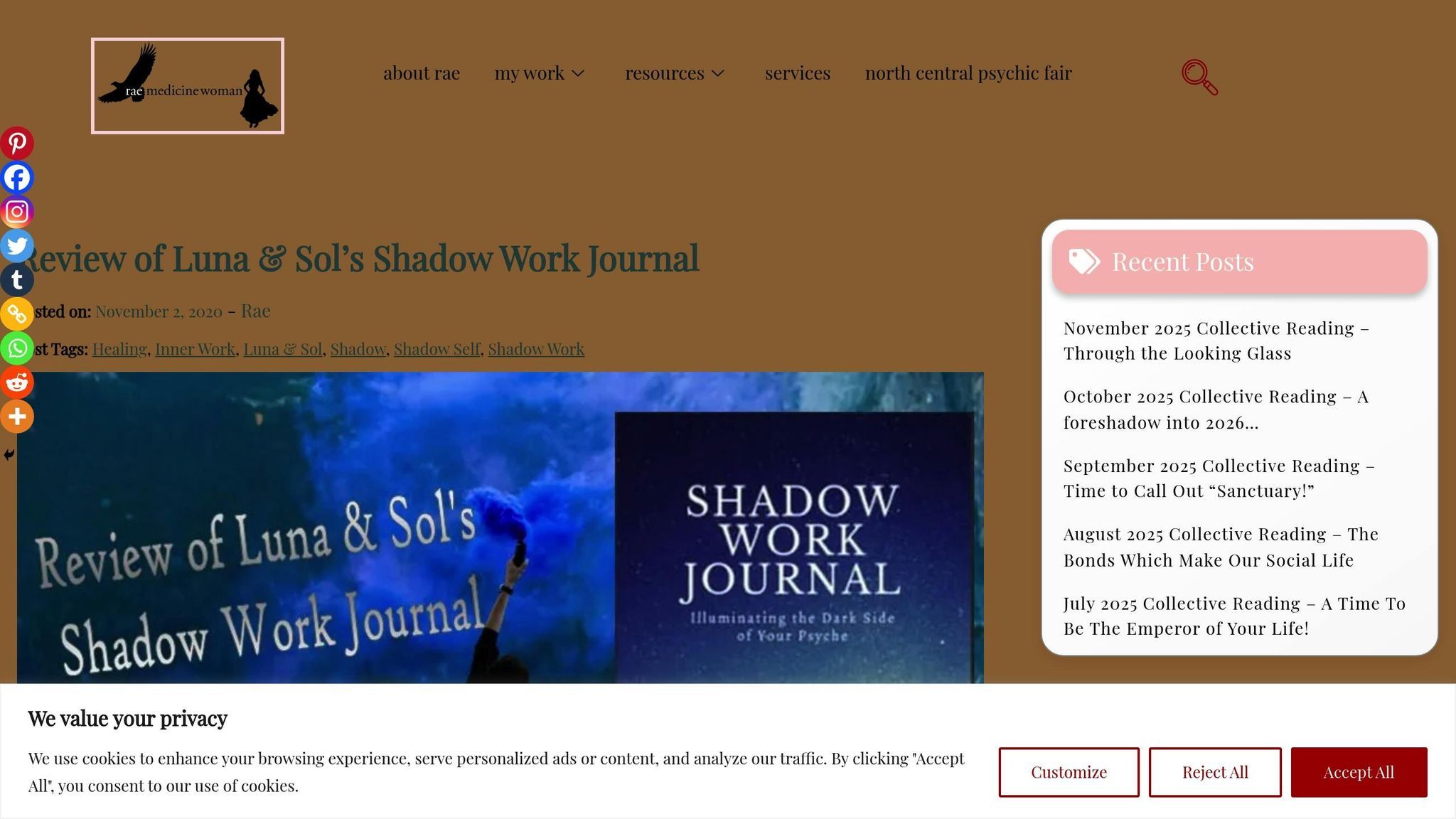
Luna and Sol, the creators behind the popular spiritual development platform LonerWolf, offer a digital shadow work journal that blends structure with creativity. Their approach is rooted in psychospiritual growth, and this journal reflects that balance: part workbook, part introspective guide.
The journal includes more than 60 thoughtfully designed prompts and activities. These aren’t random questions—they’re organized to help you uncover emotional patterns, repressed beliefs, and blindspots step by step. For users who appreciate a clear path into deeper work, this structure can be a major advantage.
A defining feature of the Luna and Sol journal is its visual presentation. Striking imagery, symbolic motifs, and motivational quotes elevate the experience beyond simple text. For many, the design itself becomes an emotional cue—inviting reflection, slowing the mind, and opening space for deeper inquiry[3].
The shadow work community regularly highlights this journal for its balance of depth and accessibility. It has been praised for encouraging users to move past surface-level reflection into more meaningful emotional territory, without feeling overwhelming.
This journal is particularly suited for:
- users who like a structured but artistic approach
- people who prefer a digital workbook over a physical one
- beginners who want clear guidance
- creatives who respond well to visual inspiration
- individuals who enjoy having many prompts to choose from
The only potential downside is that the abundance of prompts may feel like too much for someone who prefers a minimalist approach to shadow work. But for anyone seeking variety, inspiration, and structure in one place, the Luna and Sol journal is a compelling choice.
Next, we’ll explore how these journals compare in strengths and limitations—and which one may be right for your journey.
Pros and Cons: Choosing the Right Shadow Work Journal
Each shadow work journal excels in different areas: AI journals adapt in real time, guided journals provide structure, and open-ended journals develop independent self-inquiry skills.
Shadow work journals aren’t interchangeable.
Each one has its own personality — structure, depth, and emotional “tone.”
Understanding the strengths and limitations of each helps you choose the journal that actually supports your healing rather than derailing it.
Below is a clear, reader-friendly breakdown of how each journal fits into different psychological needs and journaling styles.
Life Note
Strengths:
Life Note is the most adaptive option in this list. Its AI-powered mentorship lets you engage with reflective guidance inspired by figures like Carl Jung and Brené Brown. The platform’s memory system tracks your emotional patterns over time, and weekly reflection letters help you see your progress clearly. It’s ideal for people who want personalized insight, emotional pattern recognition, and a dynamic journaling experience that grows with them.
Challenges:
It’s digital-first.
If handwriting is essential to your process or you prefer a strictly offline practice, Life Note may not feel as tactile or grounding as a physical journal.
The Shadow Work Journal (Keila Shaheen)
Strengths:
This workbook is beginner-friendly, structured, and clear. The step-by-step format provides psychological safety, and the exercises help users move from awareness to integration. It’s great for people who want a straightforward entry into shadow work.
Challenges:
For more advanced users or deep divers, the structure may feel restrictive.
There’s limited room for free exploration.
Wisdom of Wholeness: Shadow Work Journal
Strengths:
Beautifully designed with ample room for open-ended writing and artistic expression. Ideal for visual thinkers, creatives, and those who prefer intuitive exploration while having a rooted structure to be held by.
Challenges:
The physical format may not suit those looking for digital-first tools, and the dynamic structure may not suit those seeking a prompt-only journal.
Mindful Shadow Work (Aletheia Luna)
Strengths:
Grounded in psychospiritual and psychological principles. Exercises are methodical, trauma-informed, and accessible. Luna’s work is known for being clear, compassionate, and intellectually grounded.
Challenges:
The tone can feel clinical or academic for readers who prefer a conversational or more poetic journaling style.
Shadow Work Journal by Luna & Sol
Strengths:
The journal’s structured digital workbook format and 60+ prompts make it one of the most comprehensive options. Visuals and quotes add inspiration and make the practice feel engaging rather than heavy.
Challenges:
The sheer quantity of prompts can overwhelm absolute beginners.
Users who prefer simplicity may find it too dense.
Key Feature Summary
Life Note — Adaptive AI mentorship with emotional pattern tracking
The Shadow Work Journal — Clear, structured exercises for beginners
Wisdom of Wholeness — Depth-oriented for intuitive, embodied exploration
Mindful Shadow Work — Psychology-based, evidence-informed exercises
Luna & Sol — Interactive prompts with strong visual and spiritual design
🛡️ Limitations & Safety: What to Know Before Starting Shadow Work
Shadow work journaling is not a substitute for therapy when processing trauma, active self-harm ideation, or dissociative episodes that require professional clinical support.
Shadow work is powerful—but it’s not neutral.
Working with repressed emotions, old memories, or unconscious patterns can bring intensity, grief, anger, or confusion to the surface. For many people, this is part of healing. But it’s important to approach the process with care, pacing, and self-compassion.
A few things to keep in mind:
-
Shadow work can feel emotionally intense.
Journaling may uncover past wounds, attachment patterns, or self-beliefs you’ve avoided for years. If emotions feel overwhelming, it’s okay to slow down or pause. -
Journals are reflective tools, not therapists.
While guided journals and AI companions can offer insight and structure, they are not a substitute for professional mental health care. If you’re processing trauma, severe anxiety, depression, or intrusive thoughts, working alongside a licensed therapist is strongly recommended. -
Go at the pace your nervous system can handle.
Healing is not a race. Consistency and safety matter more than depth or speed. If you feel dysregulated, grounding practices (movement, breath, rest) are just as important as reflection. -
Choose containment, not intensity.
The best shadow work journal is not the one that pushes you hardest—but the one that helps you stay present, curious, and kind with yourself.
Shadow work is about integration, not excavation.
When done gently and consciously, it can be one of the most transformative practices available.
Conclusion: Choosing the Journal That Meets Your Inner World Where It Is
Selecting a shadow work journal is less about picking the “best” one and more about choosing the one that matches your nervous system, your learning style, and your emotional readiness.
If you want a modern, adaptive approach shaped by your actual entries, Life Note is your strongest companion. It brings psychological insight, emotional pattern tracking, and mentor-style guidance into a single experience. For people who value digital depth and personalization, it’s unmatched.
If you're just beginning your journey, The Shadow Work Journal provides grounding structure without overwhelming you.
If you process emotions visually or creatively, Wisdom of Wholeness offers space for intuitive exploration.
If your healing needs are psychological, methodical, and research-oriented, Aletheia Luna’s journal gives you tools grounded in established therapeutic principles.
If you want a workbook with variety, visuals, and structured depth, Luna & Sol gives you an immersive and comprehensive digital guide.
Ultimately, the best shadow work journal is the one you’ll return to.
The one you trust.
The one that helps you stay with yourself when it’s tempting to turn away.
Choose the journal that resonates, and commit to the practice.
Your shadow becomes less frightening the moment you learn to meet it — gently, consistently, and with curiosity.
FAQs
How does Life Note's AI mentorship make shadow work journaling more effective?
Life Note's AI mentorship takes your shadow work journaling to a deeper level by offering guidance that's tailored to your personal emotional growth and self-discovery. It provides thoughtful prompts, reflective questions, and insights designed to help you explore your subconscious and uncover hidden emotions or patterns.
As you engage with it, the AI learns from your responses, creating an evolving and supportive journaling experience. This approach encourages meaningful self-reflection and emotional healing. Whether you're just starting with shadow work or have been practicing it for years, Life Note's AI mentorship makes the journey easier to navigate and more enriching.
How can beginners decide between a digital or physical shadow work journal?
When choosing between a digital or physical shadow work journal, think about your writing preferences and what suits your lifestyle best. A digital journal might be ideal if you value portability, the convenience of syncing across devices, or features like prompts and progress tracking. Meanwhile, a physical journal offers a more tactile, hands-on experience that many find personal and grounding.
Your decision might also depend on how you spend your time. If you're frequently on the move, a digital journal can keep up with you. But if you cherish unplugging and carving out quiet moments for reflection, a physical journal could feel more aligned. Both options can effectively support your journey of self-discovery - just go with what feels right for you.
What challenges or risks should I be aware of when using shadow work journals for emotional healing?
Using shadow work journals can stir up emotions or past experiences that you might not have fully processed. This can feel overwhelming at times, especially if you're unpacking deeply buried feelings or unresolved issues. It's crucial to approach this practice with care and to respect your emotional boundaries.
If the process becomes too intense or unsettling, reaching out to a mental health professional can make a big difference. They can offer valuable tools and strategies to help you navigate these emotions in a safe and supportive way.
Is shadow work safe to do on your own?
Shadow work can be done independently, especially through guided journals that offer structure and emotional grounding. However, if you’re processing trauma, intense memories, or overwhelming emotions, it’s best to pair journaling with professional support. A journal is a mirror, not a therapist. If entries trigger distress, seek help from a licensed mental health professional.
Is AI journaling safe for shadow work?
AI journaling can be powerful if the platform prioritizes privacy, emotional sensitivity, and accurate pattern recognition. Life Note, for example, uses encrypted data storage and mentorship-style responses grounded in psychological insight. AI is best used as a reflective companion, not a replacement for human support.
Which shadow work journal is best for beginners?
For beginners, the best shadow work journal is one that offers structure, emotional safety, and gentle guidance.
- Physical beginners often benefit from The Shadow Work Journal by Keila Shaheen, which provides clear exercises and a step-by-step format that helps ease people into deeper self-reflection.
- Digital beginners may find Life Note especially supportive, as it adapts to your writing, offers gentle mentor-style prompts, and helps surface patterns without overwhelming you.
If you’re new to shadow work, avoid tools that push intensity too quickly. The right journal should help you feel grounded and curious—not pressured or flooded.
Related Video: How to do Shadow Work Journaling
Explore More
- Shadow Work for High Achievers: The Hidden Psychology Behind Your Drive, Anxiety & Patterns
- Shadow Work: Understand Self-Sabotage and Stop
Related Blog Posts
- AI Journaling: Discover Your Life Purpose in 2024
- Journaling and Shadow Work in Psychology
- Aligned Actions: Journaling for Purposeful Planning
- Shadow Work Prompts That Turn Triggers into Insight
The best shadow work journals are structured workbooks and guided journals designed to help you explore your unconscious patterns, repressed emotions, and hidden aspects of yourself through directed exercises, prompts, and proven frameworks.
Journal with 1,000+ of History's Greatest Minds
Marcus Aurelius, Maya Angelou, Carl Jung — real wisdom from real thinkers, not internet summaries. A licensed psychotherapist called it "life-changing."
Try Life Note Free