
8 Best Shadow Work Apps in 2026 (For Serious Inner Work)

Ready to face your shadow? These 8 apps help you explore repressed emotions, hidden patterns, and unconscious beliefs. Jung-inspired tools for deep self-discovery.

TL;DR — Best Shadow Work Apps 2026
- Best overall: Life Note — journal with AI mentors including Jung himself
- Best for beginners: Reflectly — guided prompts without overwhelming depth
- Best free: Stoic — Jungian questions in daily journaling format
- Best for tracking: Daylio — identify shadow triggers through data
- Shadow work requires consistency over intensity — choose one app and stick with it
- These apps supplement, not replace, working with a therapist for deep trauma
Shadow work apps are digital tools designed to guide users through the psychological practice of exploring their unconscious personality traits, repressed emotions, and hidden behavioral patterns — what Carl Jung (1959) termed "the shadow." Jung believed that the shadow contains not only negative qualities but also undeveloped strengths and creative potential that become accessible through conscious integration. The concept has gained significant mainstream attention since 2020, with search interest in "shadow work" increasing over 400% according to Google Trends data. While traditional shadow work was practiced primarily in Jungian analysis and depth psychology settings, modern apps have made the practice accessible to anyone with a smartphone. Research supports the underlying mechanisms: Pennebaker and Beall (1986) demonstrated that writing about emotionally difficult experiences produces measurable improvements in both psychological and physical health, and Lieberman et al. (2007) showed through fMRI imaging that labeling difficult emotions — a core shadow work activity — reduces amygdala activation by up to 30%. Kristin Neff’s self-compassion research (2003) further established that approaching painful self-knowledge with kindness rather than judgment leads to greater emotional resilience and personal growth. This guide evaluates the 8 best shadow work apps available in 2026, comparing their approaches, depth of psychological frameworks, and suitability for different experience levels.
That's shadow work in a sentence: bringing awareness to the parts of yourself you've hidden, denied, or repressed. The anger you swallowed. The dreams you abandoned. The beliefs about yourself you absorbed before you could question them.
Shadow work isn't comfortable. But the people who do it consistently report transformations — better relationships, clearer decisions, less reactivity, and a deeper sense of authenticity.
The challenge? It's hard to do alone. You need prompts that go deep, frameworks that guide exploration, and ideally, wise perspectives to help you make sense of what you find.
This guide covers the best apps for shadow work in 2026 — tools that can support your journey into the unconscious with structure, depth, and safety.
March 2026 App Updates
Shadow Work Journal & Therapy (VizMystech) released v2.5.0 (April 2025) with a redesigned UI and a new "Visual Shadow Work" section, bringing total guided exercises to 400+. Zenfulnote is a new entrant offering trigger/glimmer tracking (emotional highs and lows over time) and meditations from 2-minute resets to full sessions. The two defining 2026 trends in shadow work apps: AI-powered pattern recognition in journaling and therapist integration for guided support.
📝 Want a printable worksheet?
Use our free Shadow Work Worksheet Generator to create a personalized PDF with prompts for your specific focus area.
What is Shadow Work?
Shadow work is the psychological practice of exploring your unconscious patterns, repressed emotions, and hidden traits — originally developed by Carl Jung.
Shadow work is the practice of systematically exploring the unconscious dimensions of personality — the traits, emotions, desires, and memories that an individual has repressed, denied, or disowned because they were deemed unacceptable by family, culture, or personal standards. Carl Jung introduced the concept of "the shadow" in his 1959 work on the archetypes, describing it as the unknown dark side of the personality that contains everything the conscious ego refuses to acknowledge. Jung argued that the shadow is not inherently negative — it also contains undeveloped positive qualities, creative impulses, and authentic desires that were suppressed during socialization. Modern psychology has validated the core premise: suppressing emotions and self-knowledge carries measurable costs. Gross and John (2003) found that habitual emotional suppression leads to reduced well-being, poorer social functioning, and increased depressive symptoms, while Pennebaker’s four decades of expressive writing research demonstrates that confronting difficult truths through structured writing produces lasting improvements in both mental and physical health. Shadow work brings these hidden aspects into awareness through journaling, meditation, and guided inquiry — not to eliminate them, but to integrate them into a more complete and authentic sense of self.
Your shadow isn't evil. It contains:
- Repressed emotions: Anger, grief, fear, or jealousy you learned to suppress
- Disowned traits: Qualities you rejected to fit in (assertiveness, sensitivity, ambition)
- Childhood wounds: Painful experiences stored below conscious awareness
- Hidden strengths: Gifts you abandoned because they weren't valued
Jung wrote extensively about how the shadow, when unexamined, projects itself onto others and sabotages our lives. The person who triggers you most? They're often mirroring a shadow part of yourself.
Shadow work brings these hidden parts into awareness — not to eliminate them, but to integrate them. When you accept your shadow, it stops controlling you.
Why Shadow Work is Backed by Research
Multiple peer-reviewed studies confirm that structured self-reflection reduces anxiety, improves emotional regulation, and accelerates personal growth measurably.
Shadow work draws its therapeutic legitimacy from multiple evidence-based frameworks that validate its core mechanisms — emotional exploration, structured self-disclosure, and cognitive reappraisal of difficult personal material. While "shadow work" is Jungian terminology, the underlying practices align closely with well-researched therapeutic approaches including expressive writing therapy, cognitive behavioral therapy (CBT), and acceptance and commitment therapy (ACT). Pennebaker and Beall’s foundational 1986 study established that writing about traumatic or emotionally significant experiences for just 15–20 minutes over four days produced improvements in immune function and reduced doctor visits over the following six months. Lieberman et al. (2007) demonstrated through neuroimaging that the simple act of labeling negative emotions — what shadow work practitioners call "naming the shadow" — significantly reduces amygdala reactivity, effectively calming the brain’s threat response system. Hayes, Strosahl, and Wilson’s Acceptance and Commitment Therapy model (2006) provides further theoretical grounding: their research shows that psychological flexibility — the ability to contact difficult thoughts and feelings without avoidance — is a stronger predictor of mental health outcomes than the absence of negative thoughts. The table below maps specific shadow work practices to their evidence-based equivalents.
| Research Area | Finding | Source |
|---|---|---|
| Emotional labeling | Naming emotions reduces amygdala activity by 50% | UCLA (Lieberman, 2007) |
| Expressive writing | Writing about trauma improves immune function and mental health | Pennebaker (1997) |
| Self-compassion | Accepting difficult emotions reduces anxiety and depression | Neff (2011) |
| Parts work (IFS) | Working with "parts" of self reduces PTSD symptoms | Schwartz (2021) |
Shadow work combines these evidence-based elements: naming emotions, writing about difficult experiences, practicing self-compassion, and relating to different "parts" of yourself.
What Makes a Good Shadow Work App?
A good shadow work app offers psychologically grounded prompts, pattern recognition across entries, privacy protection, and guidance beyond generic journaling templates.
Effective shadow work requires specific psychological conditions that not every journaling app provides. Jung himself emphasized that shadow integration demands a balance of safety and confrontation — the individual must feel secure enough to explore uncomfortable material while being prompted deeply enough to move beyond surface-level reflection. Research on therapeutic writing suggests three essential elements for productive self-exploration: structured prompts that target specific emotional themes (Pennebaker, 1997), a framework for making meaning from difficult experiences rather than simply venting (Smyth, 1998), and mechanisms for tracking patterns over time (Baikie & Wilhelm, 2005). Neff’s self-compassion research (2003) adds a fourth requirement: the process must cultivate self-kindness rather than self-judgment, as harsh self-criticism during shadow exploration can reinforce shame rather than facilitate integration. In evaluating shadow work apps, the most important differentiators are depth of psychological framework, quality and specificity of prompts, ability to personalize the exploration to the user’s particular shadow material, and whether the app encourages genuine insight or merely provides generic journaling space. The comparison below highlights what separates effective shadow work tools from generic journaling apps.
| Feature | Why It Matters for Shadow Work |
|---|---|
| Deep prompts | Surface-level gratitude lists won't access shadow material — you need questions that probe childhood, triggers, and repressed emotions |
| Psychological framework | Jungian, IFS, or therapeutic models provide structure for navigating difficult territory |
| Privacy & encryption | You won't be honest about your darkest thoughts if you're worried about data leaks |
| Reflection guidance | The shadow is hard to see alone — AI mentors or guided prompts act as mirrors |
| Pattern tracking | Shadow patterns repeat until recognized — apps that surface themes help you see what's hidden |
| Non-judgmental tone | Shadow work requires accepting dark parts of yourself — the app shouldn't add shame |
The 8 Best Shadow Work Apps
These eight apps were evaluated on psychological depth, AI quality, prompt variety, and user experience — ranked by how effectively they guide shadow exploration.
1. Life Note — Best for Jungian Shadow Work

Price: Free tier | Premium $9.99/month
Platforms: iOS, Android, Web
If Carl Jung had an app, it would be Life Note. This AI journaling app lets you reflect with mentors trained on the actual writings of history's greatest thinkers: including Jung himself.
What sets Life Note apart for shadow work is its depth. The AI doesn't shy away from dark material. When you write about anger, shame, or painful memories, Jung (as an AI mentor) responds with insights drawn from his work on the shadow, archetypes, and the process of individuation.
Key Features:
- Jung-informed AI: Trained on Jung's writings about the shadow, archetypes, and individuation
- Multiple perspectives: Also includes Stoic, Buddhist, and modern therapeutic viewpoints
- Pattern recognition: Identifies recurring shadow themes across your entries over time
- Depth without judgment: The AI meets dark material without flinching or offering hollow positivity
- End-to-end encryption: Your shadow exploration stays completely private
Pros: Deepest Jungian integration of any app; AI responds intelligently to shadow material; excellent privacy.
Cons: More reflective than quick check-in apps; requires engagement to get value.
Best for: Serious shadow workers who want Jungian depth and AI-guided exploration.
2. Stoic — Best Free Jungian Journaling
Price: Free | Premium $59.99/year
Platforms: iOS, Android
The Stoic app combines daily journaling with philosophical depth: including specific shadow work prompts. While the name references Stoicism, the app incorporates Jungian concepts and questions designed to surface unconscious patterns.
The morning/evening structure creates consistency, which is essential for shadow work. You can't do deep psychological exploration sporadically — the shadow reveals itself through repeated observation.
Key Features:
- Morning and evening reflection prompts with psychological depth
- Weekly reviews that help you spot recurring patterns
- Philosophical frameworks for reframing shadow material
- Mood tracking that correlates with your entries over time
- Generous free tier with core features
Pros: Completely free for basic use; structured daily format; philosophical depth.
Cons: No AI responses; less personalized than Life Note.
Best for: People who want structured daily shadow work without paying for an app.
3. Day One — Best for Long-term Shadow Journaling
Price: Free | Premium $34.99/year
Platforms: iOS, macOS, Android, Web
Day One isn't specifically designed for shadow work, but its features make it ideal for deep, long-term inner work. The "On This Day" feature is particularly powerful for shadow work — it surfaces old entries from the same date in previous years, revealing patterns you've been repeating for years without realizing it.
Many shadow patterns operate on cycles: seasonal depression, anniversary reactions, relationship dynamics that replay. Day One's time-based features help you see these cycles clearly.
Key Features:
- Unlimited entries with photos, audio, and location tagging
- End-to-end encryption (critical for honest shadow material)
- Powerful search across years of entries — find every time you wrote about a specific trigger
- Multiple journals — keep a dedicated shadow work journal separate from daily logging
- "On This Day" surfaces patterns across years
Pros: Best for multi-year journaling; excellent search; strong privacy.
Cons: No shadow-specific prompts; no AI guidance; DIY approach.
Best for: People committed to long-term shadow journaling who want robust, privacy-focused features.
4. Reflectly — Best for Shadow Work Beginners
Price: Free trial | Premium $59.99/year
Platforms: iOS, Android
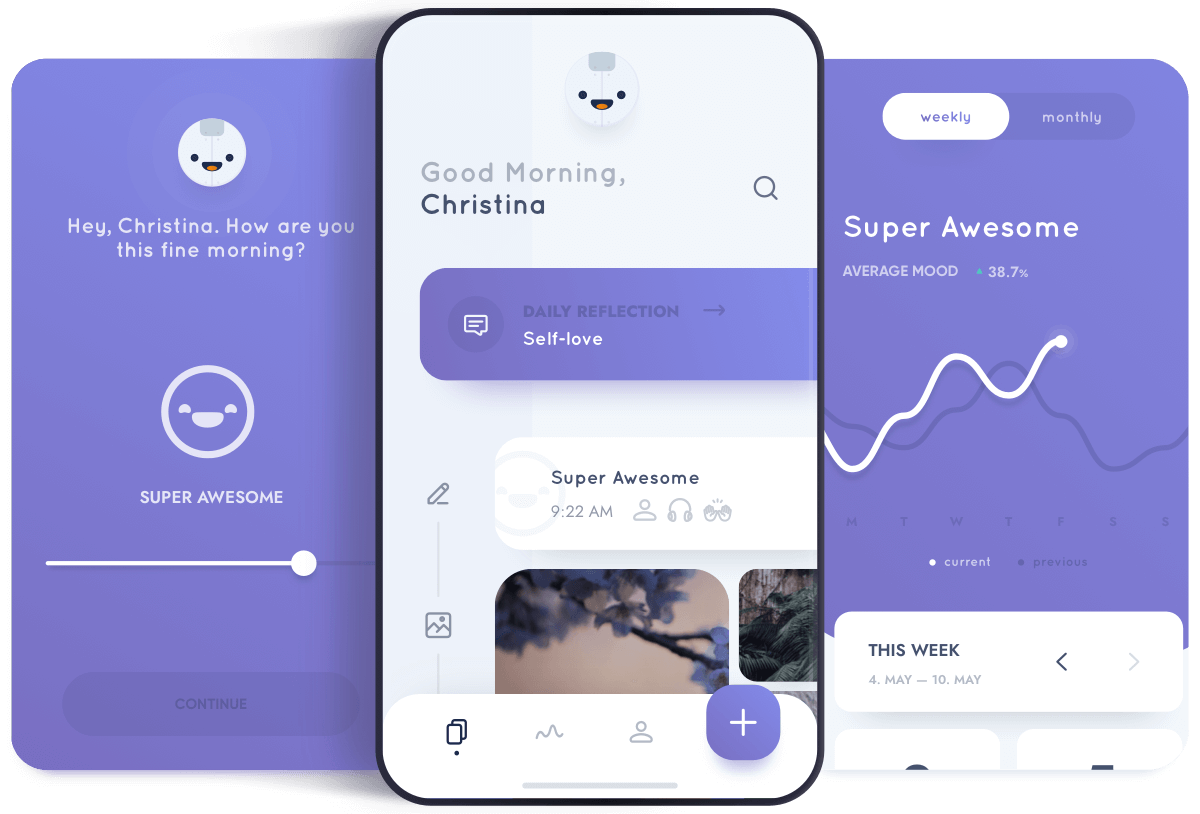
Shadow work can be overwhelming for beginners. Reflectly's AI-guided journaling provides gentle structure that can ease you into deeper exploration without throwing you into the deep end immediately.
The app's cheerful design might seem at odds with shadow work, but that's actually useful. The shadow doesn't respond well to grim, heavy approaches — sometimes a lighter container makes dark material easier to face.
Shadow-relevant prompts include:
- What triggered your strongest reaction today?
- What did you avoid feeling?
- What story are you telling yourself about this situation?
- When did you feel most unlike yourself?
Pros: Gentle introduction to introspection; AI guidance; mood tracking.
Cons: Insights stay surface-level; not designed for deep trauma work.
Best for: People new to introspection who want to build a journaling habit before going deeper.
5. Rosebud — Best for Structured Prompts
Price: Free | Premium $59.99/year
Platforms: iOS, Android
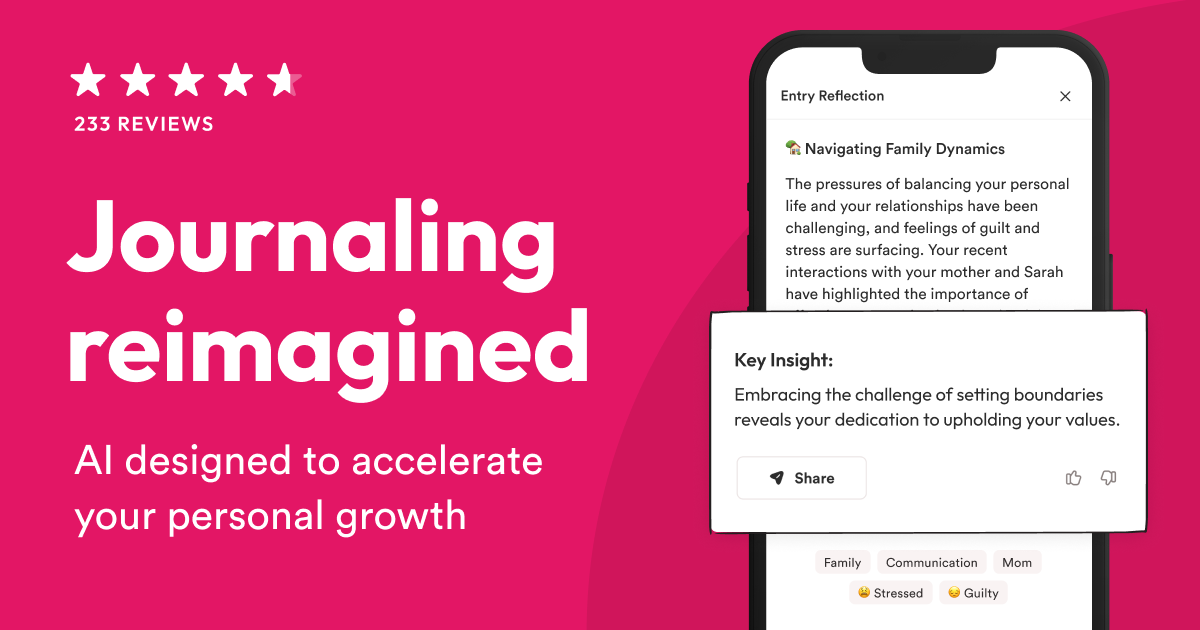
Rosebud offers structured journaling prompts designed by therapists. While not explicitly Jungian, the self-discovery and emotional processing prompts work well for shadow exploration.
The therapist-designed prompts go deeper than most journaling apps. Rather than asking "What are you grateful for?" Rosebud asks questions like "What emotion have you been avoiding this week?" and "What would your younger self think of how you handled that situation?"
Key Features:
- Therapist-designed prompt library covering emotions, relationships, and self-discovery
- AI-generated insights that identify patterns in your entries
- Mood tracking with analysis of what correlates with emotional states
- Voice journaling option for when typing feels like too much effort
- Weekly summaries that synthesize your reflections
Pros: High-quality prompts; AI pattern recognition; voice option.
Cons: Less philosophical depth than Life Note or Stoic; subscription required for full features.
Best for: People who want therapist-quality prompts and AI insights without seeing a therapist.
6. Jour — Best for Guided Audio Sessions

Price: Free | Premium $99.99/year
Platforms: iOS, Android
Jour combines journaling with guided audio sessions — think meditation meets therapy meets writing. The audio guides you through reflection exercises, then prompts you to write while the insights are fresh.
This format works well for shadow work because the audio creates a container. When facing difficult emotions, having a calm voice guide you through the process can prevent overwhelm.
Why audio helps shadow work:
- Audio creates a safe container for difficult emotions
- Guided visualizations can access shadow material that pure journaling misses
- Writing immediately after captures insights before the conscious mind filters them
- The pacing prevents rushing through discomfort
Pros: Unique audio-guided format; good for people who struggle with blank page anxiety.
Cons: Higher price point; less flexibility than pure journaling apps.
Best for: People who prefer audio guidance or find silent journaling difficult.
7. Perspective — Best for Cognitive Reframing
Price: Free | Premium $49.99/year
Platforms: iOS
Perspective helps you examine and reframe thoughts using CBT (Cognitive Behavioral Therapy) techniques. This is particularly useful when shadow work surfaces limiting beliefs.
When you discover a shadow belief — "I'm not worthy of love" or "I have to be perfect to be acceptable" — Perspective guides you through questioning it systematically.
The reframing process:
- What evidence supports this belief?
- What evidence contradicts it?
- What would you tell a friend with this belief?
- What's a more balanced perspective?
- How does holding this belief affect your life?
Pros: Practical tools for working with shadow beliefs; evidence-based CBT approach.
Cons: iOS only; less focused on exploration, more on reframing.
Best for: People who want practical cognitive tools for working with the limiting beliefs shadow work reveals.
8. Daylio — Best for Tracking Shadow Patterns
Price: Free | Premium $47.99/lifetime
Platforms: iOS, Android
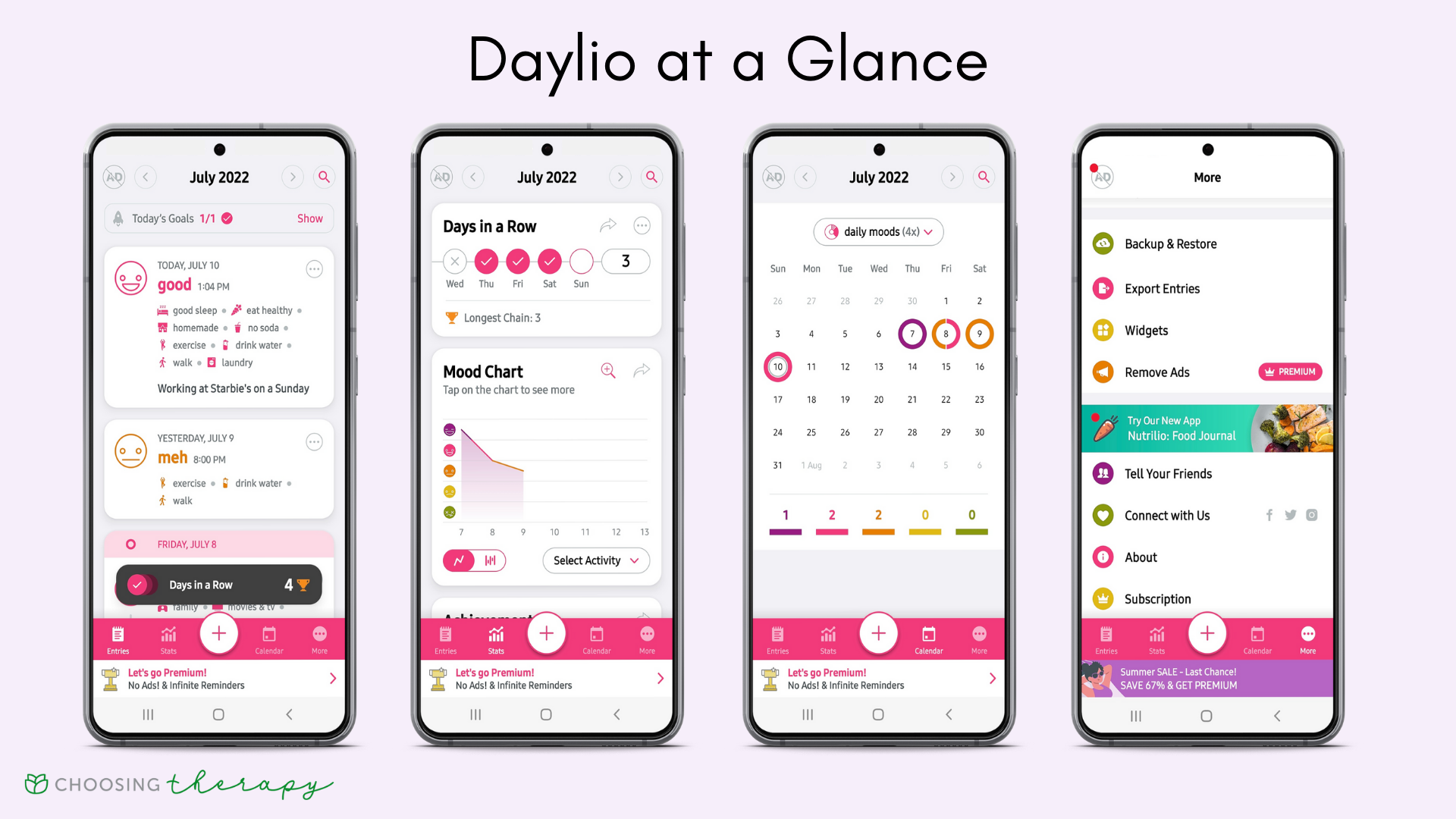
Daylio isn't a journaling app in the traditional sense — it's a mood and activity tracker. But shadow patterns often correlate with specific people, situations, or environments, and Daylio excels at revealing these connections.
Maybe your shadow emerges every time you talk to your mother. Maybe certain work situations trigger shame. Maybe your mood drops every Sunday evening. Daylio's data visualization shows these patterns that pure reflection might miss.
Key Features:
- Track mood correlations with activities, people, locations, and times
- Visual charts reveal patterns over weeks and months
- Custom activities let you track shadow-specific triggers
- Statistics show what consistently affects your emotional state
- One-time payment instead of subscription
Pros: Data illuminates patterns that reflection alone misses; affordable lifetime purchase.
Cons: Not designed for deep journaling; no AI or prompts.
Best for: Data-minded people who want to identify shadow triggers and patterns through tracking.
Quick Comparison Table
This side-by-side comparison highlights each app's strengths, pricing, and ideal user type — so you can find your best match at a glance.
| App | Best For | Price | Jungian? | AI? |
|---|---|---|---|---|
| Life Note | Deep Jungian work | Free / $9.99/mo | ✓ Yes | ✓ Yes |
| Stoic | Free structured journaling | Free / $59.99/yr | Partial | ✗ No |
| Day One | Long-term journaling | Free / $34.99/yr | ✗ No | ✗ No |
| Reflectly | Beginners | $59.99/yr | ✗ No | ✓ Yes |
| Rosebud | Therapist-quality prompts | Free / $59.99/yr | ✗ No | ✓ Yes |
| Jour | Audio-guided sessions | Free / $99.99/yr | ✗ No | ✗ No |
| Perspective | Cognitive reframing | Free / $49.99/yr | ✗ No | ✗ No |
| Daylio | Pattern tracking | Free / $47.99 lifetime | ✗ No | ✗ No |
How to Start Shadow Work With an App
Start with just five minutes of shadow work journaling each morning — consistency matters far more than session length for meaningful self-discovery.
Shadow work isn't something you "complete" — it's an ongoing practice of self-awareness. Here's a structured approach for your first 8 weeks:
Weeks 1-2: Awareness Building
Use your chosen app to simply notice patterns without trying to change anything:
- When do you feel triggered? What situations, people, or topics activate strong reactions?
- What emotions do you suppress or avoid? Notice when you change the subject or distract yourself.
- What judgments do you have about others? These often reflect your shadow — the traits you reject in yourself.
- When do you feel "not yourself"? Those moments often reveal shadow activation.
Weeks 3-4: Deeper Exploration
Once you've built awareness, go deeper with prompts like:
- What did I learn about myself before age 10 that I never questioned?
- What parts of myself have I disowned to fit in or be loved?
- What traits do I hate in others? What might that reflect about me?
- What am I most afraid others will discover about me?
- What dreams or desires did I abandon? Why?
Weeks 5-6: Working with Triggers
Choose a recurring trigger and explore it systematically:
- What exactly triggers this reaction?
- When did I first start having this reaction?
- What does this trigger remind me of from childhood?
- What is this reaction trying to protect me from?
- What would happen if I didn't react this way?
Weeks 7-8: Integration
Shadow work isn't about eliminating shadow parts — it's about integrating them:
- What gift or strength hides within this shadow aspect?
- How has this shadow part protected me?
- How can I honor this part of myself instead of fighting it?
- What would it look like to express this trait consciously rather than unconsciously?
For a comprehensive prompt library, see our 100+ Shadow Work Prompts.
Common Shadow Work Mistakes to Avoid
The most common shadow work mistakes include going too deep too fast, intellectualizing emotions instead of feeling them, and skipping integration after insights.
Even with a good app, you can fall into traps that limit your progress:
1. Trying to eliminate the shadow
The goal isn't to "get rid of" shadow parts. They contain valuable energy and information. Integration means accepting and channeling them consciously.
2. Intellectualizing instead of feeling
It's easy to analyze your shadow without actually feeling the emotions involved. If you're writing about anger without feeling any heat in your body, you're probably avoiding the real work.
3. Going too deep too fast
Shadow work can destabilize you if you rush. Pace yourself. You don't need to process every trauma in your first week.
4. Doing it sporadically
The shadow reveals itself through consistent observation. Journaling once a month won't surface patterns. Aim for daily or at least weekly practice.
5. Doing it entirely alone
Apps are tools, not replacements for human support. For deep trauma or overwhelming material, work with a therapist.
When to Seek Professional Help
Shadow work apps are supplements, not replacements, for professional support.
Seek a therapist trained in depth psychology, IFS, or somatic approaches if:
- Shadow work surfaces overwhelming emotions you can't regulate
- You have a history of trauma, especially childhood trauma
- You experience dissociation, flashbacks, or panic during journaling
- Your daily functioning is affected by what emerges
- You feel stuck in the same patterns despite consistent practice
- You're using shadow work to avoid other forms of healing
A good therapist can help you navigate shadow material safely and integrate insights in ways that self-guided work cannot.
Related Resources
These curated resources — articles, books, and guides — deepen your shadow work practice beyond what any single app can offer.
- IFS Journal Prompts — Parts work journaling guide
- 24 Journaling Prompts for Self-Reflection
- 8 Best AI Journaling Apps
- Spiritual Journaling Guide
Frequently Asked Questions
These answers address the most common shadow work questions, from safety concerns and time commitment to choosing between apps and professional therapy.
What is the best app for shadow work?
Life Note is the best app for shadow work because it includes AI mentors trained on Carl Jung's actual writings about the shadow, archetypes, and individuation. You can journal with "Jung" and receive responses informed by his psychological framework.
Is there a free shadow work app?
The Stoic app offers free Jungian-inspired journaling with daily prompts suitable for shadow work. Daylio and Rosebud also have generous free tiers that work for shadow exploration.
Can I do shadow work with a journaling app?
Yes, journaling is one of the most effective methods for shadow work. Writing bypasses the ego's defenses and surfaces unconscious material. The key is using prompts that go beyond surface-level reflection.
Is shadow work safe to do alone?
Gentle shadow work — noticing triggers, exploring patterns, journaling about emotions — is generally safe to do alone with app support. However, if you have trauma history or shadow work surfaces overwhelming emotions, work with a therapist trained in depth psychology.
How long does shadow work take?
Shadow work is an ongoing practice, not a one-time fix. You'll likely notice shifts within 4-8 weeks of consistent journaling, but deep integration happens over months and years. The shadow doesn't "disappear" — you develop a more conscious relationship with it.
What's the difference between shadow work and therapy?
Shadow work is a practice of self-exploration that can be done independently or with support. Therapy provides professional guidance, safety, and techniques for processing difficult material. Many people do both — using apps for daily practice and therapy for deeper work.
Journal with 1,000+ of History's Greatest Minds
Marcus Aurelius, Maya Angelou, Carl Jung — real wisdom from real thinkers, not internet summaries. A licensed psychotherapist called it "life-changing."
Try Life Note Free