
How to Find Your Best Self Journal for Intentional Growth

Discover the best self journal for your growth. We compare analog vs. digital tools and share proven strategies for building a transformative habit.

📌 TL;DR — Best Self Journals
Best Self journals are guided journals designed for goal achievement. Key features: 13-week sprints, daily intention and reflection pages, weekly review structure, and space for gratitude. They work by providing consistent structure rather than blank pages. Good for: people who thrive with structure and want accountability built into their journal.
A "best self" journal isn't just a place to vent or list what you did today. It’s a tool built for one thing: intentional personal growth. Think of it less like a diary and more like a strategic partner for becoming the person you want to be.
This guide will show you how to find the right journal—whether analog or digital—that aligns with your goals. We'll break down the key features that matter, compare different formats, and explain how to build a consistent habit that sticks. By the end, you'll have a clear framework for turning simple reflection into a powerful engine for personal development.
Decoding The Best Self Journal: From Passive Log to Active Tool

A best self journal operates on a simple but powerful principle: self-awareness is the launchpad for any real change. By giving you a framework for consistent, focused reflection, it helps you spot hidden patterns, get crystal clear on your values, and make sure your daily actions actually line up with your long-term vision.
This structured approach is what turns journaling from a simple habit into a powerful tool for self-creation. The self-improvement market is booming—valued at USD 64.61 billion in 2026 and projected to hit USD 90.94 billion by 2029, according to ResearchAndMarkets.com. People are actively looking for tools that support intentional living, and journaling is often cited among the most effective therapeutic activities for mental health.
The Philosophy of Active Self-Creation
At its heart, a best self journal pushes back against passive life-logging. It’s all about creating an active, forward-looking conversation with yourself.
A standard diary asks, "What happened today?" A best self journal asks, "What did I learn today, and how will it shape who I become tomorrow?"
That small shift in questioning is everything. It’s the difference between merely documenting the past and deliberately building a better future.
Key Pillars of a Best Self Journal
To really get what makes this practice unique, you have to look at its core components. These pillars are what separate it from any old notebook.
| Pillar | Description | Primary Goal |
|---|---|---|
| Guided Reflection | Uses specific prompts to steer your thoughts toward growth, values, and goals. | To move beyond surface-level thoughts and uncover deeper personal insights. |
| Intentional Goal-Setting | Provides a structured space to define, track, and review short-term and long-term objectives. | To translate aspirations into actionable steps and maintain focus. |
| Habit Architecture | Includes trackers and systems to help build positive habits and break negative ones. | To create consistent daily actions that align with your desired identity. |
| Future Self Focus | Encourages you to visualize and connect with the person you want to become. | To make decisions in the present that serve your future self. |
When these pillars come together, the journal becomes an incredible tool. It provides the structure needed to close the gap between who you are now and who you want to be, turning personal growth from a vague idea into a deliberate, achievable process.
What Makes a Great "Best Self" Journal?
Finding the right journal isn't about fancy covers or a million different templates. It’s about finding a tool that actually works for you. A great journal should feel less like a chore and more like a partner in your personal growth. Whether you’re a pen-and-paper traditionalist or a digital native, a few key features separate the good from the great.
Guided Prompts: The Cure for the Blank Page
Ever opened a notebook and just… stared at it? A blank page is intimidating. That's why structured and thoughtful prompts are the single most important feature. They're the gentle nudge that gets you thinking beyond the surface-level “what I did today.” Good prompts are open-ended questions that spark genuine curiosity about yourself. They challenge you to look at your values, question your beliefs, and get clear on what you really want.
Look for a journal that mixes it up with prompts covering different parts of your life, like:
- Self-Awareness: "What qualities do I miss about my younger self?"
- Goal Alignment: "What is one small step I can take today toward a major goal?"
- Emotional Intelligence: "When did I feel most energized today, and why?"
With the right guidance, every entry becomes an opportunity to learn something new, not just record old news.
Goal and Habit Tracking: Where Reflection Meets Action
Reflection is only half the battle. A true "best self" journal must connect your insights to your actions. This is where integrated goal-setting and habit-tracking systems come in. It’s one thing to write about your ambitions; it’s another to have a system that holds you accountable. The best journals have dedicated spaces to define your big goals and, more importantly, track the small, daily habits that will get you there. This creates a feedback loop that shows you how your daily efforts are adding up to your long-term vision.
The Feel Factor: Quality Materials and Clean Interfaces
Let’s be honest: if your journal is a pain to use, you won't use it. For a physical journal, this comes down to high-quality materials. You want a durable cover, thick paper that doesn’t bleed through, and a binding that lays flat. A beautifully made journal is a joy to use, which is all the motivation you need to keep coming back.
The digital equivalent is a clean, intuitive user interface (UI). An app should feel effortless—free of clutter, easy to navigate, and designed to get out of your way so you can write. A clunky, confusing app creates friction, and friction is the enemy of a consistent habit.
Privacy and Security: Protecting Your Inner World
Your journal holds your deepest thoughts, private fears, and biggest dreams. Uncompromising privacy and security aren't just a feature; they're a fundamental requirement, especially for digital apps. Before you type a single word, read the privacy policy. The best journaling apps offer end-to-end encryption, which means your entries are scrambled in a way that no one—not even the company that made the app—can read them.
Look for these security must-haves:
- End-to-End Encryption: Your data is locked on your device, and only you have the key.
- Biometric Lock: The option to use Face ID or a fingerprint adds another layer of protection.
- Clear Data Ownership: The company should state plainly that your data is yours, and they won't ever sell it.
Your journal should be a true sanctuary, completely safe from prying eyes.
Analog vs. Digital Journals: Which Is Right for You?
Choosing between a classic paper journal and a modern digital app is a deeply personal decision. The best tool depends entirely on your lifestyle, your goals, and what you'll actually stick with.
The move toward digital tools is impossible to ignore. The market for journaling apps hit USD 5.1 billion in 2024 and is on track to reach USD 13.58 billion by 2033, according to Straits Research. This isn't just a fad; it's a reflection of a real need for smarter, more accessible tools for self-reflection.
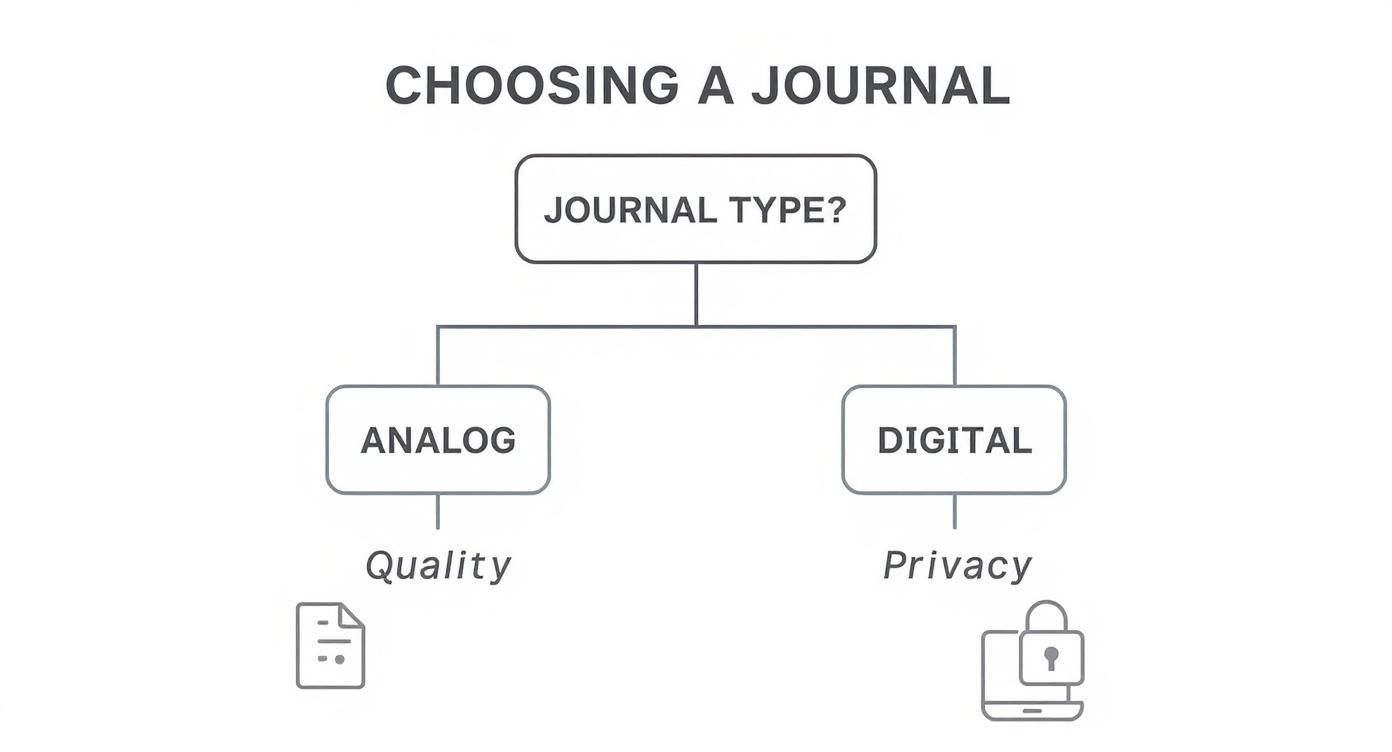
For The Tactile Thinker: The Power of Pen and Paper
Do you find clarity in the physical act of writing? Does the feeling of a good pen gliding across high-quality paper help your thoughts flow? If so, an analog journal is probably your best bet. The tactile experience of a paper journal creates a powerful, screen-free ritual. It forces you to slow down, encouraging a more deliberate and mindful connection with your thoughts. For many people, this physical process is almost meditative.
For The Data-Driven Achiever: The Analytics of an App
Are you motivated by tracking progress, spotting trends, and seeing patterns emerge over time? If that sounds like you, then a digital journal is your strongest ally. Digital platforms offer features impossible to replicate with pen and paper, like searchable entries, mood-tracking analytics, and automated reminders. This transforms your journal from a simple logbook into a dynamic database of your personal growth.
The greatest strength of a digital journal is its ability to help you connect the dots over time. It can highlight recurring emotional triggers or show you how far you've come, providing data-backed motivation to keep going.
For The Minimalist On The Go: The Convenience of Digital
Do you value convenience and accessibility above all else? For the person who travels light, a digital journal offers unmatched practicality. Your journal lives on the devices you already carry—your phone, tablet, and computer. This means you can jot down an insight on the train or reflect during your lunch break. This convenience makes a real difference for building a consistent habit. Plus, apps like Life Note make it easy to highlight and collect wisdom on your mobile device, turning fleeting thoughts into a structured library of personal insights.
Situational Showdown: Analog vs. Digital Journaling
To make the choice even clearer, let's pit these two formats against each other in a few common scenarios.
| Scenario / Priority | Analog Journal (Paper) | Digital Journal (App) | Recommended For |
|---|---|---|---|
| Evening Wind-Down | Winner. Creates a screen-free ritual that promotes relaxation and better sleep. No blue light or notifications. | Less ideal. The blue light from screens can interfere with sleep. Risk of distraction is high. | Anyone looking to build a calming, mindful end-of-day routine. |
| On-the-Go Capturing | Cumbersome. Requires carrying a notebook and pen. Not ideal for quick, fleeting thoughts. | Winner. Always accessible on your phone. Perfect for capturing ideas or insights in the moment. | Commuters, busy professionals, and anyone who has ideas at inconvenient times. |
| Long-Term Trend Analysis | Difficult and manual. Requires flipping through pages and making notes to find patterns. | Winner. Search, tags, and analytics make it effortless to track moods, habits, and recurring themes over years. | Individuals focused on data-driven self-improvement and habit tracking. |
| Absolute Privacy | Winner (with a catch). Its security depends entirely on its physical hiding spot. No risk of data breaches. | Requires trust in the company's security (look for end-to-end encryption). Vulnerable to hacks if not secured. | Those who are highly private and comfortable with physical security over digital. |
| Creative Expression | Winner. Allows for sketching, doodling, and a free-form layout. The physical act can feel more creative. | More structured. While some apps allow images, they can't match the freedom of a blank page. | Visual thinkers, artists, and anyone who wants to blend writing with other creative forms. |
Ultimately, the best tool is the one you use consistently.
How AI Is Reshaping Self-Journaling
Artificial intelligence is elevating journaling from a one-way monologue into an interactive conversation with yourself, helping you see your own thoughts in a completely new light. The personal development market hit USD 48.4 billion in 2024 and is expected to climb to USD 67.21 billion by 2030, a growth driven by demand for the personalized insights AI makes possible, as reported by Grand View Research.
From Static Entries to Dynamic Insights
A traditional journal is a static record of your thoughts. An AI-powered journal, on the other hand, becomes a dynamic partner in your reflection. It doesn't just store your words; it analyzes your writing to offer feedback and highlight connections you might have missed.
Powerful AI features include:
- Sentiment Analysis: This technology reads the emotional undercurrent of your writing, helping you connect the dots between your feelings and what’s happening in your life.
- Intelligent Prompt Generation: AI can generate prompts tailored specifically to your recent entries, asking sharp questions designed to get to the heart of your values and fears.
- Thematic Pattern Recognition: Algorithms can scan months of entries to find recurring themes you’d never spot on your own—like a nagging feeling of imposter syndrome or a consistent sense of gratitude on weekends.
Connecting the Dots in Your Personal Narrative
The true power of AI in journaling is its ability to act as your objective memory. By connecting past goals and anxieties with present actions, it helps you see your life not as a series of random events, but as a continuous, evolving story.
An AI journal doesn't just store your memories; it helps you make sense of them. It reveals the underlying narrative of your growth, showing you how past challenges connect to present strengths.
Life Note: A Privacy-First AI Journaling Companion
Of course, the idea of sharing your deepest thoughts with an AI brings up valid privacy concerns. A privacy-first approach is non-negotiable. Life Note was designed with this principle at its core. It uses AI not to harvest your data, but to deepen your self-awareness within a completely private, encrypted space. The AI works locally on your behalf, providing insights without ever compromising your security. Using an AI journaling tool like this, you can safely explore ways to discover your life purpose and understand your own story.
Building a Consistent Journaling Habit

Choosing the right journal is the easy part. The real growth begins when you show up to the page day after day. Building a habit that sticks isn't about willpower; it's about strategy. Here are actionable steps to make journaling an automatic part of your routine.
Step 1: Start Ridiculously Small
Most people fail because they aim too high. Vowing to write three pages every day is a recipe for burnout. Instead, commit to something that feels almost too easy, like writing for just five minutes or even a single sentence. The goal right now isn't volume; it’s consistency.
Step 2: Use Habit Stacking
Anchor your new journaling habit to something you already do on autopilot. This technique is called habit stacking.
A few examples:
- Morning Routine: After I pour my coffee, I will open my journal.
- Evening Routine: Before I turn off the lights, I will write down one thing I’m grateful for.
By linking journaling to an established routine, you eliminate the mental friction of deciding when to do it.
Step 3: Overcome Common Roadblocks
Motivation comes and goes. Have a plan for when the blank page feels intimidating.
- Use Prompts When You're Stuck: If you don't know where to start, fall back on a simple prompt. Questions like, "What was the high point of my day?" or "What's one small thing I can do tomorrow to move forward?" provide instant direction. For more ideas, check out this excellent guide on how to start journaling for self-discovery.
- Default to Gratitude: If you’re feeling uninspired, listing three things you’re thankful for can shift your emotional state and get the words flowing.
Step 4: Create a Ritual You Crave
To make your habit stick, the experience has to feel good. Transform it from a chore into a self-care ritual. This could mean creating a cozy corner just for writing, lighting a candle, or putting on calming music. The more positive associations you build around the act of journaling, the more your brain will look forward to it. Our guide with 10 journaling tips to build self-discipline dives deeper into making your practice both rewarding and effective.
Conclusion: Turning Reflection into Action
Finding the "best self" journal isn't really about the journal at all. It's about finding a companion for your own growth—a tool that feels less like a chore and more like a conversation with yourself. The best choice is whatever you'll actually use, day in and day out.
What matters most is building a practice that connects the dots between what you think and what you do. A great journal doesn't just hold your thoughts; it helps you see the patterns, challenge your assumptions, and turn those quiet insights into real, tangible change. This is where a modern approach can make all the difference.
If you're looking for structured reflection combined with the power of intelligent insights, Life Note offers a different path. It was designed to meet every criterion we've discussed: guided prompts, actionable insights, and total privacy with end-to-end encryption. If you’re ready to stop just recording your life and start actively shaping it, this is where the real work begins.
Frequently Asked Questions (FAQ)
Here are quick, no-fluff answers to the most common questions people ask when they're new to journaling for self-improvement.
How Much Time Should I Actually Spend Journaling?
Aim for 5 to 10 minutes a day when you're just starting. Quality beats quantity. This is just enough time to build the habit without it feeling like a chore. Once it feels automatic, you can go longer if you want to dig deeper.
What if I Miss a Day?
Missing a day isn't a failure—it's just life. Don't waste energy on guilt. The only mistake is letting one missed day spiral into a missed week. Just pick up your journal tomorrow and start again. This practice is about progress, not perfection.
Isn't This Just a Gratitude Journal?
No. While gratitude is an important component, a best self journal is a comprehensive toolkit for intentional growth. It also helps you tackle goal setting, habit formation, future-self visualization, and deep reflection on your values and fears. Gratitude is one essential ingredient; a best self journal is the entire recipe.
Can This Really Help Me Hit My Long-Term Goals?
Absolutely. It's one of the most powerful tools for making big goals a reality. By consistently writing down your goals, breaking them into manageable steps, and tracking your progress, you keep them front and center. This ensures your daily actions are aligned with your long-term vision, turning distant dreams into a concrete plan you're executing every day.
Ready to turn your thoughts into a clear plan of action? Life Note is the AI journaling companion built for real self-discovery.
Start your journey with Life Note today.
Journal with 1,000+ of History's Greatest Minds
Marcus Aurelius, Maya Angelou, Carl Jung — real wisdom from real thinkers, not internet summaries. A licensed psychotherapist called it "life-changing."
Try Life Note Free