
Anxious Attachment Style: Signs, Causes, and How to Heal

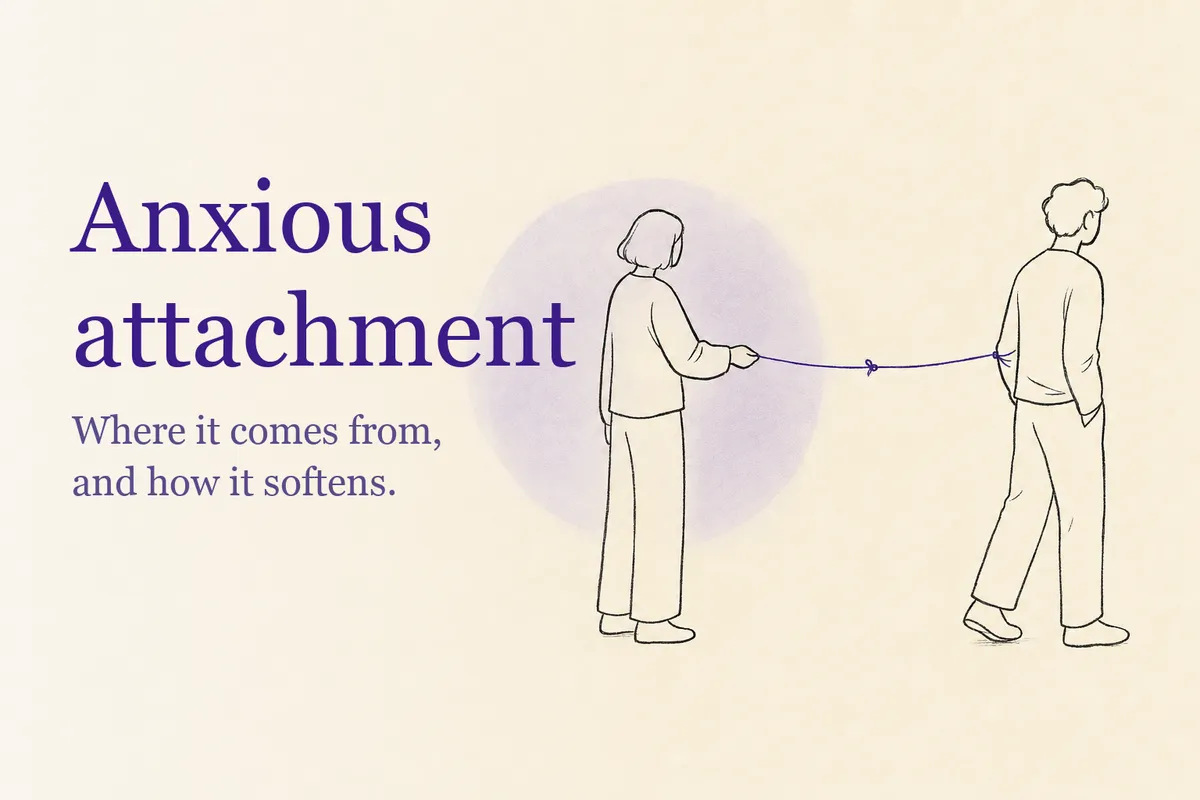
📌 TL;DR: Anxious Attachment Style
Anxious attachment style is a pattern of craving closeness while fearing abandonment, first described by Bowlby and Ainsworth. It shows up as reassurance-seeking, overanalyzing texts, and reading rejection into neutral behavior from a partner. It is not fixed. Mikulincer and Shaver's research found attachment patterns can shift toward security over time.
What Is Anxious Attachment Style?
Anxious attachment style is a pattern of craving closeness while fearing abandonment, rooted in inconsistent early caregiving, first mapped by Bowlby and Ainsworth.
Anxious attachment style describes a relationship pattern built around one core question: will this person stay? People with this style want closeness, notice their partner's moods and availability closely, and feel destabilized when a relationship feels uncertain. The term comes from attachment theory, a framework the psychiatrist John Bowlby laid out in his 1969 book Attachment and Loss. Bowlby argued that infants are wired to seek proximity to a caregiver because closeness once meant survival. How a caregiver responds to that need, consistently or unpredictably, shapes a working model the child carries into every close relationship that follows.
Mary Ainsworth turned Bowlby's theory into something researchers could observe directly. Her Strange Situation experiments (Ainsworth et al., 1978, Patterns of Attachment) watched toddlers separate from and reunite with a caregiver in a lab setting, then sorted their reactions into patterns: secure, avoidant, and anxious (originally called anxious-resistant or ambivalent). Anxious infants in her studies were hard to soothe on reunion. They wanted contact and pushed it away at the same time, a mix of clinging and anger that mirrors what many adults with this style describe feeling in their own relationships.
The adult version of this research came from Cindy Hazan and Phillip Shaver's 1987 study 'Romantic love conceptualized as an attachment process,' published in the Journal of Personality and Social Psychology. They asked adults to read short descriptions of relationship styles and pick the one that fit them best. Roughly 56% chose the secure description, 25% chose avoidant, and 19% chose the anxious or ambivalent description. That study is the bridge between Bowlby and Ainsworth's work on infants and the language we now use for adult attachment styles.
In adulthood, anxious attachment usually means you feel most settled when a relationship feels certain, and least settled when it doesn't. A vague text, a canceled plan, or a quiet mood in your partner can trigger a search for evidence that something is wrong. This is not a diagnosis or a personality flaw. It is a pattern, and patterns can be worked with.
What the research actually says
Infants show distinct patterns (secure, anxious, avoidant) based on how they respond to a caregiver's return after separation.
Ainsworth et al. (1978), Patterns of Attachment
Anxious attachment has an observable behavioral basis, not just a self-reported feeling.
Infant attachment behavior toward a caregiver functions as a survival-oriented bonding system.
Bowlby (1969), Attachment and Loss, Vol. 1
Attachment is a built-in system, not a character trait or a personal failing.
Adults self-classified into attachment styles at roughly 56% secure, 25% avoidant, and 19% anxious/ambivalent.
Hazan & Shaver (1987), Journal of Personality and Social Psychology, 52(3):511-524
Anxious attachment is a well-documented minority pattern in adult romantic relationships, not a rare condition.
Adult attachment splits into four categories (secure, preoccupied, dismissing, fearful) based on views of self and others.
Bartholomew & Horowitz (1991), Journal of Personality and Social Psychology, 61(2):226-244
Anxious (preoccupied) attachment specifically pairs self-doubt with a positive view of others, which explains the reassurance-seeking.
Signs of Anxious Attachment
Common signs include frequent reassurance-seeking, fear of abandonment, overanalyzing texts, discomfort with being alone, and reading rejection into neutral, everyday behavior.
Anxious attachment tends to look similar across different relationships, jobs, and even friendships, because it is a pattern in how you relate, not a reaction to one specific person. If several of these sound familiar, an anxious attachment style is worth exploring.
- You need frequent reassurance that your partner still loves you or isn't upset with you.
- You reread texts and conversations, looking for a hidden sign that something is wrong.
- A slow reply can feel like proof that someone is pulling away.
- You feel calmest when you're in close, constant contact with a partner.
- Being physically or emotionally distant from a partner triggers real anxiety, not mild discomfort.
- You've tested a partner, on purpose or not, to see if they'll stay.
- Conflict feels like a threat to the entire relationship rather than a disagreement to work through.
- You give more than you receive in relationships, hoping that effort will secure the bond.
- Your mood tracks closely with the state of your relationship.
- You notice a pull toward partners who are less consistently available.
- You apologize quickly, even when you're unsure you did anything wrong, to keep things calm.
- You have a hard time fully believing things are fine, even when a partner says they are.
None of these signs on their own means much. Everyone checks a phone or wants reassurance sometimes. The pattern matters more than any single moment. If you want a structured read on where you land, our attachment style quiz walks through this in about five minutes.
Where Anxious Attachment Comes From
Anxious attachment often develops from inconsistent early caregiving, where comfort was unpredictable rather than absent, according to Ainsworth's original research.
Ainsworth's Strange Situation research pointed to inconsistency, not absence, as the driver behind anxious attachment. A caregiver who is warm and attentive one day and distracted or overwhelmed the next teaches a child that connection is available but unreliable. The child learns to stay alert to the caregiver's mood and availability, because that vigilance is what got their needs met often enough. That vigilance can carry straight into adult relationships as a heightened sensitivity to a partner's tone, timing, and mood.
Early caregiving is one input, not the only one. Mikulincer and Shaver's 2007 book Attachment in Adulthood reviewed decades of research and concluded that attachment patterns are not fixed for life. A stable, responsive adult relationship can move someone toward security. A betrayal, an unpredictable partner, or a hard breakup can move someone the other way, even if their childhood attachment was secure. If you didn't have an anxious childhood but still recognize this pattern in your adult relationships, that is consistent with the research, not a contradiction of it.
Culture and family messaging play a role too, even though they fall outside the five studies cited here. Growing up in a household where love was tied to performance, where conflict meant withdrawal, or where a parent leaned on a child for their own emotional needs can all reinforce the same underlying pattern: closeness feels good and also feels like it could disappear.
Anxious vs. Avoidant vs. Disorganized Attachment
Anxious attachment craves closeness, avoidant attachment craves distance, and disorganized attachment wants both at once, per Bartholomew and Horowitz's four-category model.
Kim Bartholomew and Leonard Horowitz's 1991 paper in the Journal of Personality and Social Psychology reorganized attachment into four adult categories: secure, preoccupied (the clinical term for anxious), dismissing (avoidant), and fearful. Their model is useful because it splits attachment along two questions: how you view yourself, and how you view others. Anxious or preoccupied attachment pairs a negative view of self with a positive view of others, which is part of why reassurance from a partner matters so much. The table below lays out how the three insecure styles tend to differ in practice.
| Pattern | Core fear | Response to distance | Response to conflict |
|---|---|---|---|
| Anxious (preoccupied) | Being abandoned or unloved | Pursues, seeks contact and reassurance | Escalates, needs quick resolution |
| Avoidant (dismissing) | Being engulfed or controlled | Withdraws, self-soothes alone | Shuts down, needs space before talking |
| Disorganized (fearful) | Both closeness and distance | Alternates between pursuing and withdrawing | Unpredictable, can escalate then shut down |
Disorganized attachment (also called fearful-avoidant) combines features of anxious and avoidant attachment in the same person. It tends to develop when the same person who could offer comfort was also a source of fear or unpredictability, so the nervous system never settles on one strategy. If this describes you, the patterns below still apply, but the pursue-and-withdraw cycle can run in both directions inside your own reactions, not just between you and a partner.
How Anxious Attachment Shows Up in Relationships
Anxious attachment shows up as constant texting checks, reassurance-seeking, and what Bowlby called protest behavior when a partner feels distant.
Bowlby used the term protest behavior to describe what infants do when a caregiver leaves: crying, reaching, following. Adults with anxious attachment show a version of the same instinct. When a partner feels distant, the nervous system reads it as a threat and pushes toward action, not patience.
In practice, this looks like specific, repeatable habits. Texting is a common flashpoint: sending a follow-up message before getting a reply to the first one, reading punctuation or response speed as a mood indicator, or feeling real relief when a read receipt turns into a reply. Reassurance-seeking is another: asking a partner directly if they're upset, or asking indirectly through hints, silence, or a change in tone, hoping they'll notice and respond. Protest behavior can also look like picking a fight right before a partner leaves for a trip, or withdrawing affection to see if a partner chases it back.
None of this is manipulation in the way it's sometimes framed online. It's a nervous system trying to restore a sense of safety using the only strategies that have worked before. Recognizing the pattern in the moment, rather than judging it after, is the first step toward changing it. For a closer look at how your style interacts with a specific partner's style, our attachment style compatibility tool maps the two side by side.
The Anxious-Avoidant Trap
Anxious and avoidant partners often attract each other, then reinforce each other's fears through a pursue-withdraw cycle that neither one started.
Anxious and avoidant partners end up together often enough that the pairing has its own shorthand. Early on, it can feel like a fit: the avoidant partner's independence reads as confidence, and the anxious partner's attentiveness reads as devotion. Over time, the same traits collide. The anxious partner reaches for more closeness right when the avoidant partner needs space, and the avoidant partner pulls back right when the anxious partner needs reassurance.
Each response confirms the other person's fear. The anxious partner's pursuit feels like pressure to the avoidant partner, so they withdraw further. The avoidant partner's withdrawal feels like confirmation of abandonment to the anxious partner, so they pursue harder. Neither partner is doing this on purpose. Both are running an old survival strategy against a partner whose survival strategy is the opposite shape.
Breaking the cycle usually takes both people naming the pattern out loud, ideally before the argument that triggers it starts. If you recognize this dynamic and your partner leans avoidant, our avoidant attachment journal prompts can help them build language for what their withdrawal is actually about, which is often the missing piece.
Is Anxious Attachment Bad?
Anxious attachment isn't a flaw. It carries real costs, like chronic worry, alongside real strengths, like empathy and deep relational commitment.
Anxious attachment carries genuine costs. It can produce chronic low-grade anxiety inside relationships that are actually going fine. It can push a partner away through the very behaviors meant to hold them close. It can make it hard to enjoy good moments because part of your attention is always scanning for the next bad one. Over years, that vigilance is exhausting, both for you and for a partner trying to reassure a fear that reassurance never fully resolves.
The same wiring produces real strengths. People with anxious attachment tend to be attentive partners who notice small shifts in mood, tone, and need. They tend to invest early and fully, rather than holding back to protect themselves. They're often the first to name a problem in a relationship instead of letting it sit unaddressed, because tolerating uncertainty is harder for them than having the uncomfortable conversation. Those are qualities plenty of partners value, once the anxiety underneath them is managed rather than running the relationship.
A label describes a pattern. It doesn't set a ceiling on the relationships you're capable of having.
How to Heal Anxious Attachment
Healing anxious attachment means building self-soothing skills and choosing consistent partners, moving toward what Mikulincer and Shaver call earned security.
Mikulincer and Shaver's Attachment in Adulthood (2007) introduced the idea of earned security: adults who did not have secure early attachment can still develop a secure pattern later, usually through a combination of self-reflection and stable relational experience. That finding is the basis for everything below. Healing is not about becoming a different person. It's about building new evidence, one experience at a time, that closeness can be steady.
- Build a self-soothing habit before you reach for reassurance. A short walk, a few slow breaths, or writing down the fear before sending a text creates a pause between the trigger and the reaction.
- Separate the story from the fact. 'They haven't replied in three hours' is a fact. 'They're losing interest' is a story. Naming the difference, even on paper, weakens the story's grip.
- Practice tolerating small gaps. Sit with an unanswered text for ten minutes before acting on it. Notice that the anxiety peaks and then drops, even without a reply.
- Choose consistency over intensity. A partner who is calm and dependable will feel less exciting at first than one who is unpredictable. Consistency is what earned security is actually built on.
- Say the need directly instead of testing for it. 'I'd feel better with a quick check-in when you land' works better than picking a fight to see if they care.
- Work with a therapist if the pattern feels bigger than daily habits can shift. Attachment-focused therapy, including approaches like Emotionally Focused Therapy, is built specifically around this work.
Shadow work, the practice of looking directly at the parts of a pattern you'd rather not examine, pairs well with this process. Our shadow work guide for anxious attachment goes deeper into the underlying beliefs that keep the pattern running.
Most of the healing practices above start with noticing the pull before you act on it, and that is easier in writing than in your head at 11pm. Life Note pairs your journal with mentors built on the actual writings of thinkers like Rilke and Seneca, who will ask what the silence actually means before you decide it means leaving. Open Life Note and write down the last time you waited for a text.
How to Explain Your Anxious Attachment Style to a Partner
Explain anxious attachment as a pattern with a history, name a specific trigger, and ask for one concrete, repeatable thing that helps.
Explaining attachment style to a partner works best when it's specific rather than a label dropped into a conversation with no context. 'I'm anxiously attached' tells a partner very little about what to actually do. A short script that names the pattern, gives it context, and asks for something concrete tends to land better.
Something like: 'I noticed I get anxious when I don't hear from you for a while, and I've realized it's an old pattern, not really about you. It would help me if you could send a quick text when your plans change, even just a line. I'm working on managing the anxious part myself too.' That structure does three things: it takes ownership of the pattern instead of framing it as the partner's fault, it gives one specific, doable ask instead of a vague request for more reassurance, and it signals that you're actively working on it, not asking the partner to manage it for you indefinitely.
Timing matters as much as wording. This conversation lands better outside of a triggered moment, when neither person is already anxious or defensive.
Journaling for Anxious Attachment
Journaling helps by slowing the gap between a trigger and a reaction, turning a vague fear into a specific, examinable thought.
Journaling is useful for anxious attachment specifically because the pattern runs on speed. A trigger happens, a story forms, and a reaction follows, often within seconds. Writing forces a pause into that sequence and gives you something to look back at, so you can start noticing the pattern instead of just living inside it. These six prompts are a starting point.
- What actually happened, in one factual sentence, versus what story I told myself about it?
- What am I afraid this moment means about whether I'm loved?
- What did I do in response, and did it get me closer to what I actually wanted?
- What would I need to feel calm right now that I haven't asked for directly?
- Where else in my life, outside this relationship, have I felt this exact fear before?
- What's one thing that's actually going well in this relationship that the anxiety is drowning out right now?
For a longer, structured set built specifically around this pattern, our full anxious attachment journal prompts collection has more depth than fits here.
When to Get Professional Help
Get professional support if anxious attachment causes panic, repeatedly ends relationships, or comes from past trauma that self-guided work isn't resolving.
Journaling and self-guided practice help most people shift an anxious attachment pattern over time, but some situations call for a therapist rather than, or alongside, that work. If the anxiety in relationships reaches panic-level intensity, if the pattern has ended multiple relationships in similar ways, if it's tangled up with a history of trauma or a past abusive relationship, or if it's paired with symptoms of an anxiety disorder or depression, professional support is the right next step, not a last resort.
Attachment-focused approaches, including Emotionally Focused Therapy and psychodynamic therapy oriented around early relationships, are built directly around this material. This article is educational and is not a diagnosis or a substitute for care from a licensed therapist.
The Limits of Attachment Labels
Attachment categories are useful shorthand, but self-report labels are rough, most people are mixed, and a label can turn into an excuse.
Attachment styles are a helpful map, not a precise diagnosis. Hazan and Shaver's original 1987 study relied on adults picking one of three short descriptions to describe themselves, a self-report method that's useful for research but rough at the level of one individual life. Most people don't fit neatly into a single category. You might lean anxious with a romantic partner and secure with close friends, or your pattern might shift depending on how safe a specific relationship feels.
A label is most useful as a starting point for noticing a pattern, not as a fixed identity or an excuse. 'I'm anxiously attached' can become a reason to skip the harder work of communicating a need directly, or a way to explain away a partner's legitimate frustration. The goal of naming the pattern is to loosen its grip, not to give it a permanent home in how you describe yourself.
Attachment research relies on categories, and real people rarely fit one category cleanly. Most self-report tools, including the ones behind the studies cited here, ask people to pick the closest description rather than measuring attachment directly, so results are a rough sketch, not a precise reading. Attachment can also vary by relationship: a pattern that shows up with a romantic partner may not show up with a parent or a friend. Mikulincer and Shaver's research found that patterns can shift over time with new relational experience, so a label that fits today may not fit in five years. Finally, a label is a tool for understanding a pattern, not a diagnosis and not an excuse to avoid the harder work of communicating directly with a partner.
Frequently Asked Questions
What are signs of anxious attachment?
Common signs include needing frequent reassurance, overanalyzing texts or a partner's tone, feeling anxious when a partner is unavailable, testing a partner to see if they'll stay, and reading rejection into neutral or ambiguous behavior.
What is the hardest attachment style to live with?
There's no single answer, since it depends on the pairing, but disorganized (fearful) attachment is often described as the hardest to navigate because it combines the pursuit of anxious attachment with the withdrawal of avoidant attachment in the same person, which can feel unpredictable to a partner and confusing from the inside.
How can I explain my anxious attachment style to my partner?
Name the pattern as a history, not a fault: explain that a specific trigger (like a slow reply) sets off an old fear of abandonment, then ask for one concrete, repeatable thing that helps, such as a quick check-in text, rather than asking generally for more reassurance.
Is anxious attachment bad?
No. It carries real costs, like chronic relationship anxiety, but also real strengths, like attentiveness and deep commitment. It's a pattern that can be worked with and shifted over time, not a permanent flaw.
What is anxious preoccupied attachment style?
Anxious preoccupied is the clinical term Bartholomew and Horowitz used for what's commonly called anxious attachment: a pattern combining a negative view of self with a positive view of others, which drives a strong need for closeness and reassurance in relationships.
Can anxious attachment change to secure?
Yes. Mikulincer and Shaver's research on adult attachment describes 'earned security,' where consistent, stable relational experience combined with self-reflection can shift someone from an anxious pattern toward a secure one over time.
What triggers anxious attachment in relationships?
Common triggers include a delayed reply, a partner seeming distant or distracted, unresolved conflict, physical distance like travel, or any change that feels like reduced availability, even when nothing about the relationship has actually changed.
Keep Exploring

Journal with 1,000+ of History's Greatest Minds
Carl Jung, Marcus Aurelius, Lao Tzu: replies grounded in their original works, each citing its source. Co-developed with a licensed psychotherapist.
Try Life Note Free