
How to Use AI for Self-Compassion Journaling

Learn how AI-guided journaling fosters self-compassion with emotional labeling, mentor-style feedback, pattern tracking, prompts, and weekly summaries.

Explore More
Continue your journey:
- AI Journaling: The Complete Guide — The complete guide
📌 TL;DR — AI for Self-Compassion Journaling
AI journaling apps like Life Note can guide you through self-compassion practices when you're being self-critical. The AI asks non-judgmental questions, helps reframe harsh self-talk, and offers perspective you might miss when stuck in negative thought patterns. It's like having a compassionate friend available 24/7.
AI-powered journaling transforms self-reflection into a guided, interactive process that helps you better understand and manage your emotions. Combining writing with AI tools like Life Note allows you to process feelings, identify patterns, and receive personalized feedback to approach challenges with kindness and clarity.
Key Takeaways:
- What It Is: Self-compassion journaling helps you treat yourself with kindness, understand shared struggles, and acknowledge emotions without judgment.
- How AI Helps: Platforms like Life Note provide real-time emotional feedback, track patterns over time, and connect you with insights from historical figures like Carl Jung and Marcus Aurelius.
- Benefits: AI journaling reduces stress, improves emotional awareness, and offers tailored advice to help you grow emotionally.
Why it matters: Journaling with AI is not just about writing - it’s about turning self-criticism into understanding and creating a path toward emotional resilience. For $10.99/month or $99.99/year, Life Note offers tools like mentor guidance, weekly summaries, and emotional pattern tracking to make this practice accessible and effective.
My Surprisingly Positive Experience with an AI Chatbot
Benefits of Using AI for Self-Compassion
AI-powered journaling takes the often lonely process of writing and transforms it into an interactive experience that helps you navigate your emotions with greater understanding and kindness. Instead of staring at a blank page, unsure if you're "doing it right", AI offers real-time feedback that helps you untangle complex feelings and view yourself with more compassion. Here's how this support translates into tangible benefits.
Personalized Emotional Feedback
When you use platforms like Life Note, the AI doesn't just parrot back your thoughts - it reflects on them, providing new angles and reframing your insights. By analyzing patterns in your language, such as recurring words or themes, it uncovers emotional undertones you might not even notice.
One standout feature is emotional labeling. For example, when you write, "I feel angry because...", the AI helps you label and process those emotions, which can calm your fear response and engage your rational mind [1]. This isn't just feel-good advice - it's backed by research. A two-week study with 55 participants showed that AI-assisted journaling significantly lowered depression scores (measured by PHQ8) and increased daily positive emotions [4].
Guidance from Historical Figures and Thought Leaders
Life Note connects you with over 1,000 historical mentors spanning more than 20 disciplines, including Carl Jung, Marcus Aurelius, Steve Jobs, and Brené Brown [1][3]. These aren't generic chatbot replies. Each mentor's guidance is rooted in their actual writings, philosophies, and lived experiences, offering you perspectives you might not arrive at on your own.
For instance, if you're grappling with a career setback, you might receive advice from Viktor Frankl on finding meaning in adversity. This dialogue with wisdom turns personal challenges into opportunities to learn from people who faced similar struggles and emerged with valuable insights. The AI carefully matches you with the mentor best suited to your situation, making self-compassion feel less like a solitary exercise and more like a supportive conversation.
Tracking Patterns and Progress Over Time
Traditional journaling often leaves you flipping through pages in search of patterns - a task most people avoid. AI eliminates this hurdle by automatically identifying and organizing recurring themes, emotional triggers, and shifts in your mindset [2]. Life Note’s memory system tracks these changes over weeks, months, and even years, giving you a clear picture of your growth.
In a 91-day study conducted in December 2024, participants using structured self-compassion journals reported notable improvements in self-compassion (p < 0.001) and psychological well-being (p = 0.015) compared to a control group. Many participants highlighted positive effects on self-kindness and mindfulness [5]. With AI, you receive weekly reflection summaries that highlight your progress, identify growth areas, and showcase measurable changes, such as shorter recovery times after setbacks and a shift from self-criticism to curiosity [1].
Instead of wondering, "Am I improving?", you get clear evidence: your emotional vocabulary becomes richer, you catch negative thought patterns more quickly, and you start approaching challenges with better questions. It's the difference between hoping you're growing and knowing you are.
How to Use Life Note for Self-Compassion Journaling
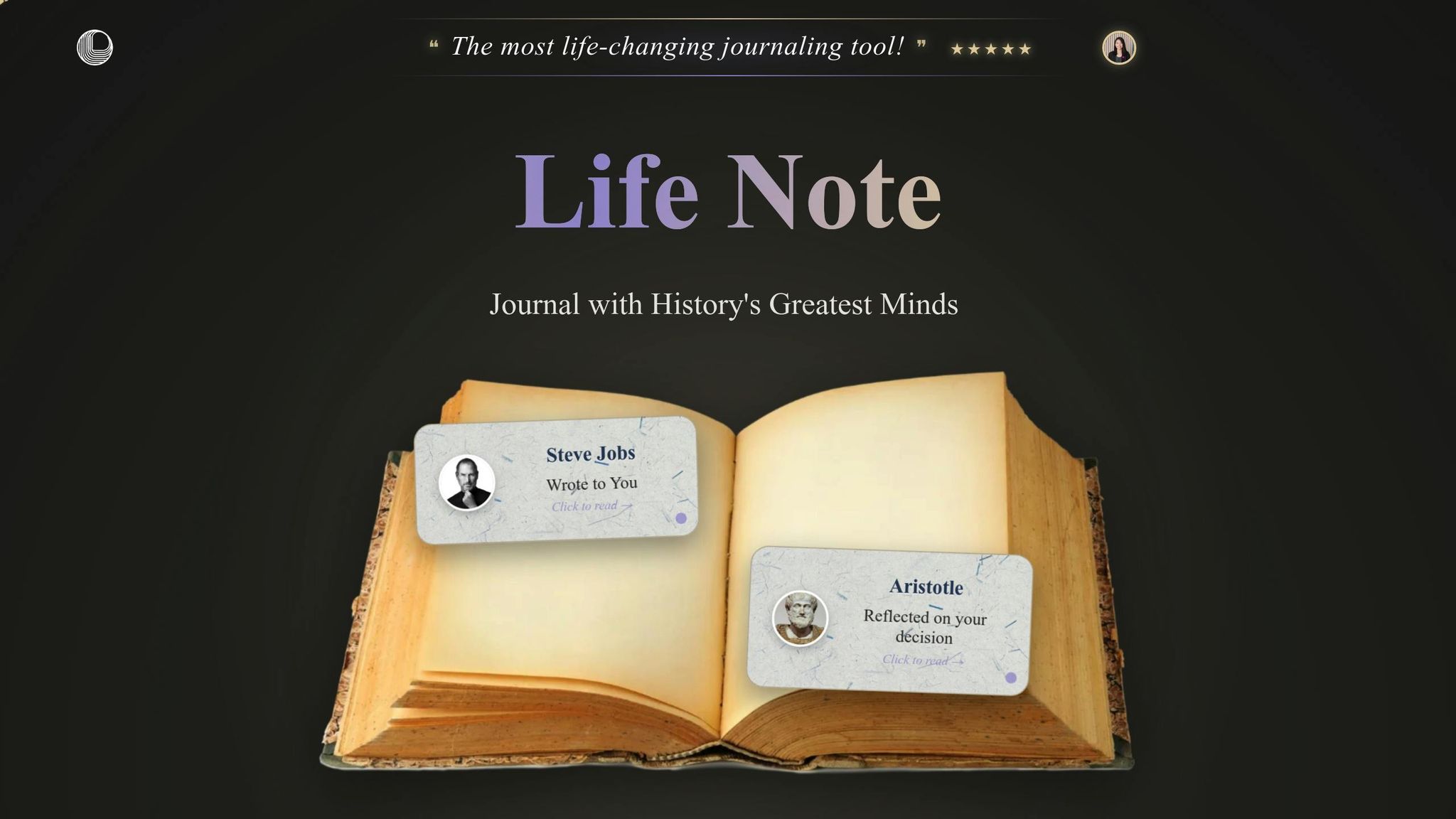
Building on the earlier discussion of personalized feedback and pattern tracking, Let's get started.to how you can make the most of Life Note for self-compassion journaling. These five steps will help you establish a meaningful practice, setting the stage for deeper self-awareness and emotional growth.
Step 1: Set Up Your Life Note Account
Start by visiting mylifenote.ai and signing up with your email. You can choose between a monthly subscription for $10.99 or an annual plan for $99.99. Once you're in, define your journaling goals - whether it's processing emotions, fostering personal growth, or something else entirely.
Life Note places a strong emphasis on privacy. Everything you write is encrypted, and you retain full ownership of your data [1].
Step 2: Choose Mentors for Guidance
Next, select mentors who can guide you through your journaling journey. Life Note offers access to over 1,000 historical figures across more than 20 fields, including Carl Jung, Marcus Aurelius, and Buddha [3]. These mentors provide insights drawn directly from historical texts, offering timeless wisdom.
Pick mentors that align with your current needs. For example:
- Buddha can help with mindfulness and navigating emotions.
- Marcus Aurelius or Viktor Frankl may offer perspective on shared human struggles.
- Carl Jung’s insights could support deeper self-reflection.
You can switch mentors as your needs evolve. While Life Note suggests mentors based on your entries, you’re always free to make your own choice.
Step 3: Journal and Receive Mentor Feedback
Once your mentor is selected, begin writing about your day, emotions, or any challenges you're facing. Life Note uses the CLAIR Template to guide your reflections:
- Check-in: Identify your current emotion.
- Label the story: What narrative is your mind creating about the situation?
- Ask a better question: What’s the deeper issue at play?
- Intent: What truly matters to you today?
- Response: What’s one small action you can take?
As you write, the AI analyzes your language patterns to help with emotional labeling, which can reduce emotional overwhelm and encourage clearer thinking. After submitting your entry, your mentor provides a thoughtful response to help reframe your perspective and inspire fresh insights.
"Your journal is where your life stops being a reaction - and starts becoming a design." - Life Note [2]
Step 4: Reflect on Weekly Summary Letters
Each week, Life Note sends you a personalized reflection letter from your mentor. These letters highlight emotional themes, uncover patterns you may not have noticed, and offer tailored advice for moving forward. For instance, if you’ve been journaling about work-related stress, the letter might reveal recurring anxiety patterns and suggest areas for deeper exploration.
Set aside 60–120 minutes each week to review these reflections. Use this time to pinpoint what drained your energy and identify any tendencies to shy away from difficult emotions [2].
Step 5: Explore the Wisdom Library and Inner Gallery
Over time, your journaling will generate valuable insights worth revisiting. Life Note’s Wisdom Library allows you to save and search for transformative ideas that have shaped your growth. Meanwhile, the Inner Gallery transforms your weekly entries into symbolic artwork, offering a meditative way to visualize your emotional journey and uncover recurring patterns.
These tools create a lasting archive of your insights and a visual representation of your personal growth, making it easier to reflect and stay motivated.
Self-Compassion Prompts to Try in Life Note
These prompts are crafted to help you connect more deeply with yourself while using Life Note. By encouraging self-reflection, they can guide you from a place of self-criticism to one of understanding and kindness. While Life Note's AI mentors provide thoughtful feedback, the questions you ask yourself are just as important. Below, you'll find prompts to help you navigate tough emotions, release burdens, and nurture self-compassion.
Prompts for Processing Difficult Emotions
When you're dealing with tough emotions, it’s tempting to push them aside or judge yourself harshly. Instead, these prompts can help you shift your perspective. Start with "What if nothing is wrong with me right now?" - a question that challenges self-criticism and opens the door to curiosity. Follow it with "If my anxiety wasn’t proof that I’m broken, what else could it mean?" to uncover what your emotions might be signaling.
Take a moment to notice where you feel these emotions in your body by asking, "Where do I feel this right now?" Studies show that labeling emotions can help calm the amygdala [1]. Once you’ve identified the sensation, try asking, "If that body part had a sentence, what would it say?" This approach deepens your awareness of the mind-body connection.
Other helpful prompts include "If my anxiety could talk, what would it say?" or "I (the emotion) show up when…" - these let you view your feelings as parts of your experience, not as your entire identity. To explore underlying fears, ask yourself, "What am I truly afraid of?" or "If this goes badly, what is the story I tell myself about who I am?"
"The real problem starts when we become afraid of our own anxiety and treat it as a disease to eliminate instead of a signal to understand." - Dr. David H. Rosmarin, Associate Professor, Harvard Medical School [6]
Once you’ve worked through these emotions, you can move on to prompts that focus on forgiveness and letting go.
Prompts for Forgiveness and Letting Go
Letting go of self-criticism can feel overwhelming, but these prompts can help lighten the load. Start with "What am I holding onto that no longer serves me?" to identify emotional baggage. Then ask, "What would it look like to forgive myself?" to visualize a way forward.
The "Thoughts vs. Facts" exercise can also be a major advantage. Divide your journal page into two columns - one for self-critical thoughts and another for objective facts. This helps separate negative narratives from reality. Another powerful question to ask is "What compassionate advice would I offer a friend?" - a reminder to treat yourself with the same kindness you’d extend to someone else.
For deeper exploration, Life Note’s mentors can guide you in having a dialogue with parts of yourself, like your inner critic or perfectionist. Instead of judging these parts, approach them with curiosity about their intentions.
After processing and releasing negative emotions, you can focus on cultivating gratitude.
Prompts for Practicing Gratitude
Gratitude journaling can help you notice the positive moments in your life. Begin with "What am I thankful for today?" and let Life Note’s mentors help you uncover the deeper meaning behind your answers. Follow this with "How has compassion shown up in my life recently?" to reflect on acts of kindness you’ve experienced or shared.
A "1–9 Scale Check-In" is another useful tool. Rate your emotions on a scale from 1 to 9 (1-3 low, 4-6 medium, 7-9 high) to determine whether you need simple self-care, deeper reflection, or even professional support. Wrap up your journaling session with the "One Kind Thing, One Brave Thing" practice: identify one small act of self-kindness (like taking a relaxing walk) and one courageous step for your future self (like tackling a challenging task).
"Your journal is not just a record of what happened. It's a mirror of who you're becoming." - Life Note [6]
Traditional Journaling vs. AI-Powered Self-Compassion Journaling
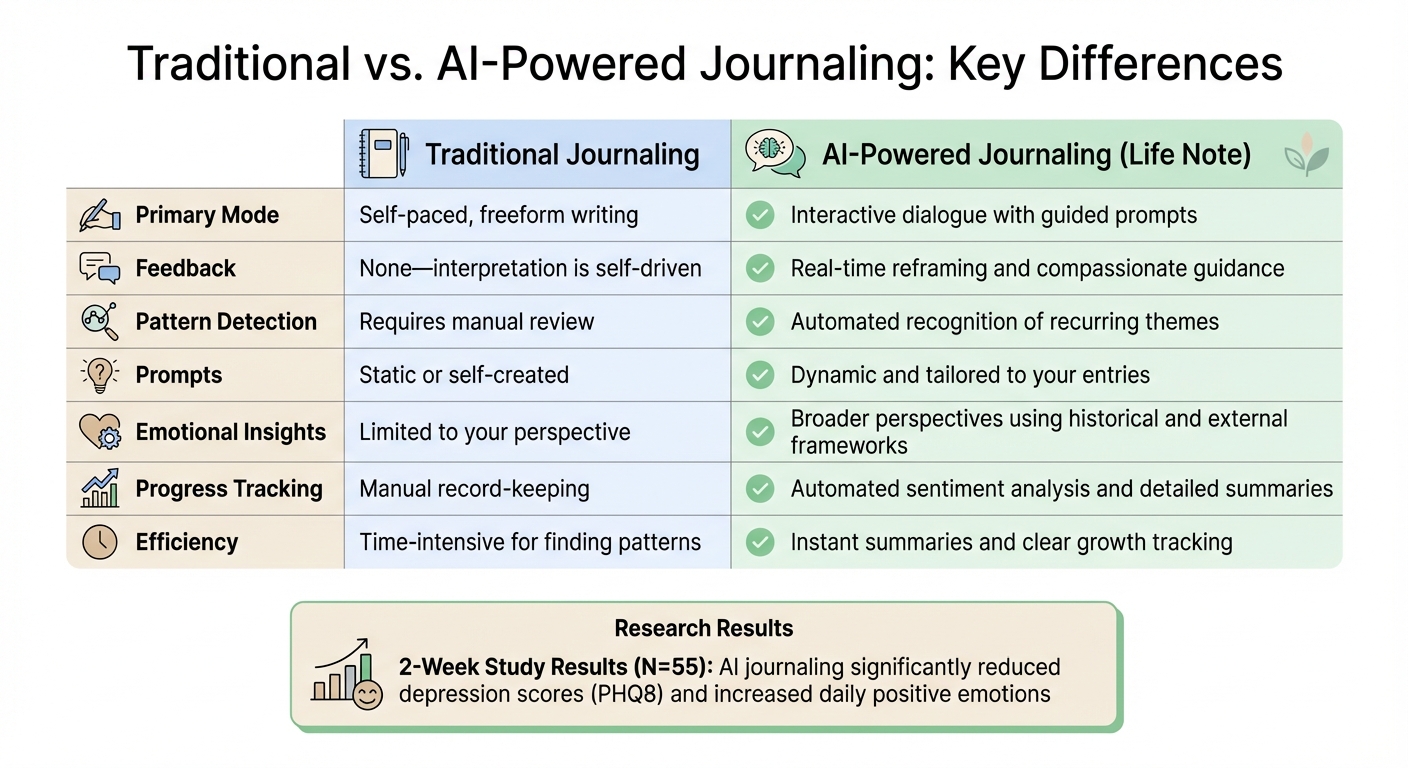
Traditional vs AI-Powered Journaling: Key Differences and Benefits
Traditional journaling has long been a trusted tool for self-reflection. It’s a private space where you can process emotions, track experiences, and make sense of your thoughts. However, it’s entirely self-directed - there’s no feedback or guidance. You’re left to interpret your own patterns, which can be both empowering and challenging.
AI-powered journaling, like using Life Note, takes this practice to a new level by offering real-time feedback and personalized prompts. Instead of staring at a blank page, unsure where to begin, AI provides tailored suggestions based on your emotional state and past entries. If you’re grappling with difficult emotions, the AI helps you untangle facts from interpretations, turning self-critical thoughts into constructive insights. This interactive approach blends your personal reflections with external wisdom, creating a space for deeper self-compassion.
One key advantage of AI-powered journaling is its ability to instantly detect recurring patterns, such as tendencies toward perfectionism or fears of abandonment - something that traditional journaling often requires significant time and effort to uncover. For example, a study conducted in March 2026 found that an AI journaling tool called "Resonance" reduced depression scores (PHQ8) and boosted daily positivity in just two weeks among 55 participants [4]. Tools like Life Note go a step further by combining personal challenges with timeless wisdom, offering perspectives that extend beyond your internal narrative.
"A thought in your head feels like reality. A thought on paper looks like… a sentence. And once it's a sentence, you can interrogate it." - Daniel W. Chen, Life Note [2]
While traditional journaling offers a tactile, immediate connection to your thoughts, pairing it with AI can amplify your growth. AI acts as a reflective partner, uncovering insights that might otherwise go unnoticed. A hybrid approach - using AI for daily reflections and pattern recognition while occasionally writing by hand - has proven to be a powerful method for fostering self-compassion. The guiding principle here is simple: You lead, AI follows. Start with your raw, emotionally rich thoughts, and then let AI help you identify patterns and reframe ideas without taking over the meaning-making process.
Comparison Table: Traditional vs. AI-Powered Journaling
Here’s a quick look at how Life Note enhances journaling by integrating AI-driven insights into your self-reflection journey:
| Feature | Traditional Journaling | AI-Powered Journaling (Life Note) |
|---|---|---|
| Primary Mode | Self-paced, freeform writing | Interactive dialogue with guided prompts |
| Feedback | None - interpretation is self-driven | Real-time reframing and compassionate guidance |
| Pattern Detection | Requires manual review | Automated recognition of recurring themes |
| Prompts | Static or self-created | Dynamic and tailored to your entries |
| Emotional Insights | Limited to your perspective | Broader perspectives using historical and external frameworks |
| Progress Tracking | Manual record-keeping | Automated sentiment analysis and detailed summaries |
| Efficiency | Time-intensive for finding patterns | Instant summaries and clear growth tracking |
Conclusion
AI-powered journaling combines the age-old practice of self-reflection with modern tools to make the process more accessible and enriching. By approaching journaling with self-compassion, you can transform negative self-talk into understanding and growth. Tools like Life Note act as a thoughtful companion, helping you sort through emotions, recognize patterns, and turn self-criticism into actionable insights.
Life Note takes journaling beyond a solitary activity, creating a dynamic conversation infused with timeless wisdom. It challenges your assumptions, prompts deeper questions, and introduces evidence-based practices to guide your journey. Research backs the benefits of AI-assisted journaling: for instance, a study on the AI tool "Resonance" found that participants (N=55) experienced lower depression scores and an increase in daily positive emotions [4].
Start with your unfiltered thoughts, and let AI help you uncover patterns and suggest small, actionable steps to drive meaningful change [1][2]. This ensures that your reflections lead to progress, not just understanding.
If you're ready to take your self-compassion practice to the next level, Life Note offers a supportive and flexible platform to get started. Features like voice-to-text journaling, weekly reflection letters, and the Wisdom Library are designed to fit seamlessly into your routine. Just a few mindful moments each day can help you build the clarity, kindness, and courage you’ll thank yourself for in the future.
FAQs
How does AI enhance emotional feedback in journaling?
AI-powered journaling tools take your personal entries to a whole new level by turning them into engaging, supportive dialogues. When you jot down your thoughts or emotions, the AI dives into your text, picking up on emotional patterns, recurring themes, and moments of self-reflection. From there, it introduces you to a virtual mentor - crafted in the likeness of historical figures or experts - who offers thoughtful insights, helps reframe negative self-talk, and provides perspectives tailored to your unique experiences.
What’s more, the AI doesn’t just stop at single entries. It builds on your past journals, spotting recurring triggers or milestones in your progress. At the end of each week, it creates reflection summaries that highlight your emotional growth. These summaries often include practical steps, drawn from behavioral science and timeless wisdom, to encourage self-compassion and guide your personal development. This transforms journaling into a dynamic, deeply fulfilling practice that promotes greater self-awareness and meaningful change.
How do historical mentors enhance AI journaling?
Historical mentors add a fascinating dimension to AI journaling by offering guidance inspired by enduring wisdom. When you jot down a journal entry, the AI pairs you with a mentor - be it a philosopher, psychologist, writer, or scientist - whose life experiences and perspectives resonate with your thoughts. These mentors provide responses shaped by their unique worldview, helping you see challenges from new angles, build emotional awareness, and transform self-criticism into opportunities for growth.
For example, the AI might draw from Aristotle’s virtue ethics or Brené Brown’s work on vulnerability to offer feedback that is both empathetic and thought-provoking. Over time, the AI identifies recurring themes in your entries, tracking emotional patterns to help mentors deliver advice that feels more personalized. They might suggest practical steps or even summarize your progress in thoughtful weekly reflection letters. This interactive process turns journaling into a creative and deeply enriching path toward self-discovery.
How does Life Note help me track my emotional growth?
Life Note makes understanding your emotional journey both simple and meaningful. Each time you journal, the AI pairs you with a mentor that remembers your previous entries, tracks recurring emotions, and uncovers patterns over time. This helps you observe how feelings like anxiety, joy, or self-compassion shift and develop, giving you a clearer view of your emotional growth.
At the end of every week, you'll receive a personalized reflection letter. This letter highlights key themes, emotional changes, and progress you've made. It also includes Aligned Actions - practical tips to help you align your daily habits with your bigger goals. Beyond that, Life Note turns your journal entries into visual art in the Inner Gallery and stores important insights in your Wisdom Library. These tools allow you to revisit your journey, celebrate milestones, and deepen your self-awareness as time goes on.
Related Blog Posts
- AI Journaling for Self-Awareness: How AI Mentors Mirror the Mind
- Best Journaling Apps for Mental Health (2026 Edition)
- How Travel Journaling Enhances Emotional Awareness
- How Successful People Use Journaling
Self-compassion is essential for inner child healing. For the full framework, explore our inner child work guide.
Journal with 1,000+ of History's Greatest Minds
Marcus Aurelius, Maya Angelou, Carl Jung — real wisdom from real thinkers, not internet summaries. A licensed psychotherapist called it "life-changing."
Try Life Note Free