
How Successful People Use Journaling

Learn how top performers use journaling to solve problems, boost productivity, build resilience, and turn reflection into action with AI tools.

Explore More
Continue your journey:
- How to Start Journaling in 2026 — The complete guide
📌 TL;DR — How Successful People Journal
Top performers like Elon Musk, Oprah Winfrey, and Tim Ferriss use journaling as a strategic tool for success. Oprah kept a gratitude journal for 10 years straight, crediting it with maintaining her perspective during rapid growth. Research shows journaling can boost performance by 25% and writing goals increases success rates by 42%. Even one sentence a day can make a difference.
Journaling isn’t just writing down your thoughts - it’s a tool that top performers like Elon Musk, Oprah Winfrey, and Tim Ferriss use to solve problems, stay focused, and improve decision-making. Research shows it can boost performance by 25%, reduce stress, and improve emotional resilience. Here’s how:
- Elon Musk: Breaks down problems into simple parts, mirroring journaling’s ability to clarify complex issues.
- Oprah Winfrey: Kept a gratitude journal for 10 years, which shifted her mindset and reduced stress.
- Tim Ferriss: Uses journaling to calm his mind, track decisions, and refine judgment over time.
Studies also highlight that writing goals increases success rates by 42% and improves mental clarity. Tools like Life Note take journaling further by using AI to provide feedback, track patterns, and suggest actions for personal growth. Start small - one sentence a day can make a difference.
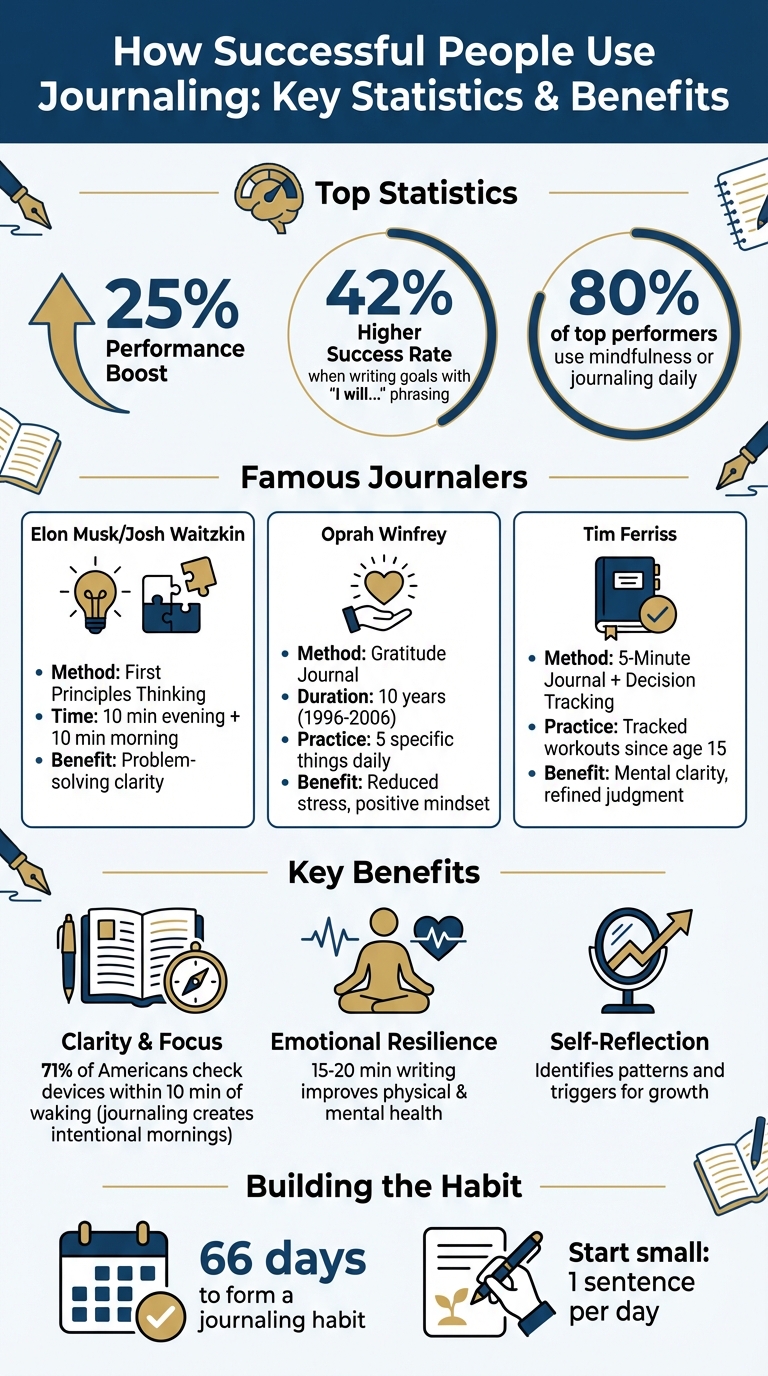
Journaling Benefits and Success Statistics for High Achievers
Why Successful People Use A Journal
How Successful People Use Journaling
High achievers don't just jot down their feelings - they turn journaling into a strategic tool for tackling challenges, gaining perspective, and sharpening their decision-making skills. Let’s take a closer look at how three well-known figures have used this practice to their advantage.
Elon Musk: Solving Problems with First Principles
While Elon Musk doesn’t follow a traditional journaling routine, his approach to problem-solving through first principles thinking is echoed in the journaling habits of Josh Waitzkin, a former chess prodigy and martial arts champion. Waitzkin dedicates 10 minutes before bed to break down complex issues into their simplest components and follows it up with a 10-minute morning session to capture fresh insights from overnight reflections [1][5]. This mirrors Musk’s engineering mindset: stripping away assumptions and focusing on core truths to tackle seemingly impossible challenges. It’s a powerful reminder of how journaling can help dissect and solve intricate problems.
Oprah Winfrey: Gratitude and Reflection
Between 1996 and 2006, Oprah Winfrey kept a daily gratitude journal without skipping a single day. Each morning, she would list five specific things she was grateful for - a habit she credits with helping her maintain happiness and perspective during a period of immense professional growth [2][1]. This practice wasn’t just about feeling good; it fundamentally shifted her outlook. Oprah observed that she went through each day actively looking for things to appreciate, and something always surfaced [2]. Science backs her up - gratitude journaling has been shown to reduce stress and improve decision-making by fostering a mindset of abundance over scarcity [1]. Oprah’s gratitude ritual became her anchor, helping her navigate the pressures of her career.
Tim Ferriss: Decision Journaling for Clarity
Tim Ferriss uses journaling as a way to quiet his "monkey mind" each morning. His tool of choice? The "5-Minute Journal," which prompts him to express gratitude and set daily priorities [5]. But Ferriss doesn’t stop there. He’s meticulously tracked every workout he’s done since age 15 in a dedicated journal to monitor progress and fine-tune his fitness approach [5]. As he bluntly explains:
"I don't journal to 'be productive.' ... I'm just caging my monkey mind on paper so I can get on with my fucking day." [5]
Beyond calming his mind, Ferriss uses journaling for decision tracking - recording the reasoning behind major choices and later reviewing the outcomes. This method, also supported by Nobel Prize winner Danny Kahneman, allows him to refine his judgment over time [5]. Through these practices, Ferriss demonstrates how journaling can serve as a tool for clearing mental clutter, improving focus, and fostering continuous growth.
Benefits of Journaling for Productivity and Emotional Growth
Clarity and Focus
Journaling provides a space to turn thoughts into tangible actions. Writing down clear, actionable goals - using phrases like "I will..." instead of "I hope to..." - can increase your chances of success by 42% [4][6][8]. It’s a simple yet powerful way to align your daily efforts with what truly matters.
Morning journaling, in particular, is a great way to cut through distractions before the day begins. Considering that 71% of Americans check their devices within 10 minutes of waking [1], taking even a few minutes to journal can help you set a focused and intentional tone for the day ahead.
But journaling isn’t just about productivity; it also plays a key role in building emotional resilience.
Emotional Resilience
Think of journaling as a mental release valve. Julia Cameron describes it as "spiritual windshield wipers", clearing away mental clutter so you can face challenges with clarity [5][9].
Spending just 15–20 minutes writing about stressful experiences has been shown to improve both physical and mental health [5]. It helps reduce intrusive thoughts about negative events and strengthens your ability to handle stress [5]. Even a quick session of writing down worries before bed can ease your mind and help you fall asleep faster by reducing overthinking [5].
Self-Reflection and Growth
Once focus and resilience are in place, journaling becomes a tool for self-discovery and growth.
Your journal serves as a personal archive, capturing your thoughts and experiences over time. This allows you to uncover patterns, recognize triggers, and identify areas for improvement [2][5]. As Anne Frank wisely observed, "paper has more patience than people" [5]. Your journal offers a judgment-free space where you can reflect, learn, and evolve at your own pace.
Using AI-Enhanced Journaling with Life Note
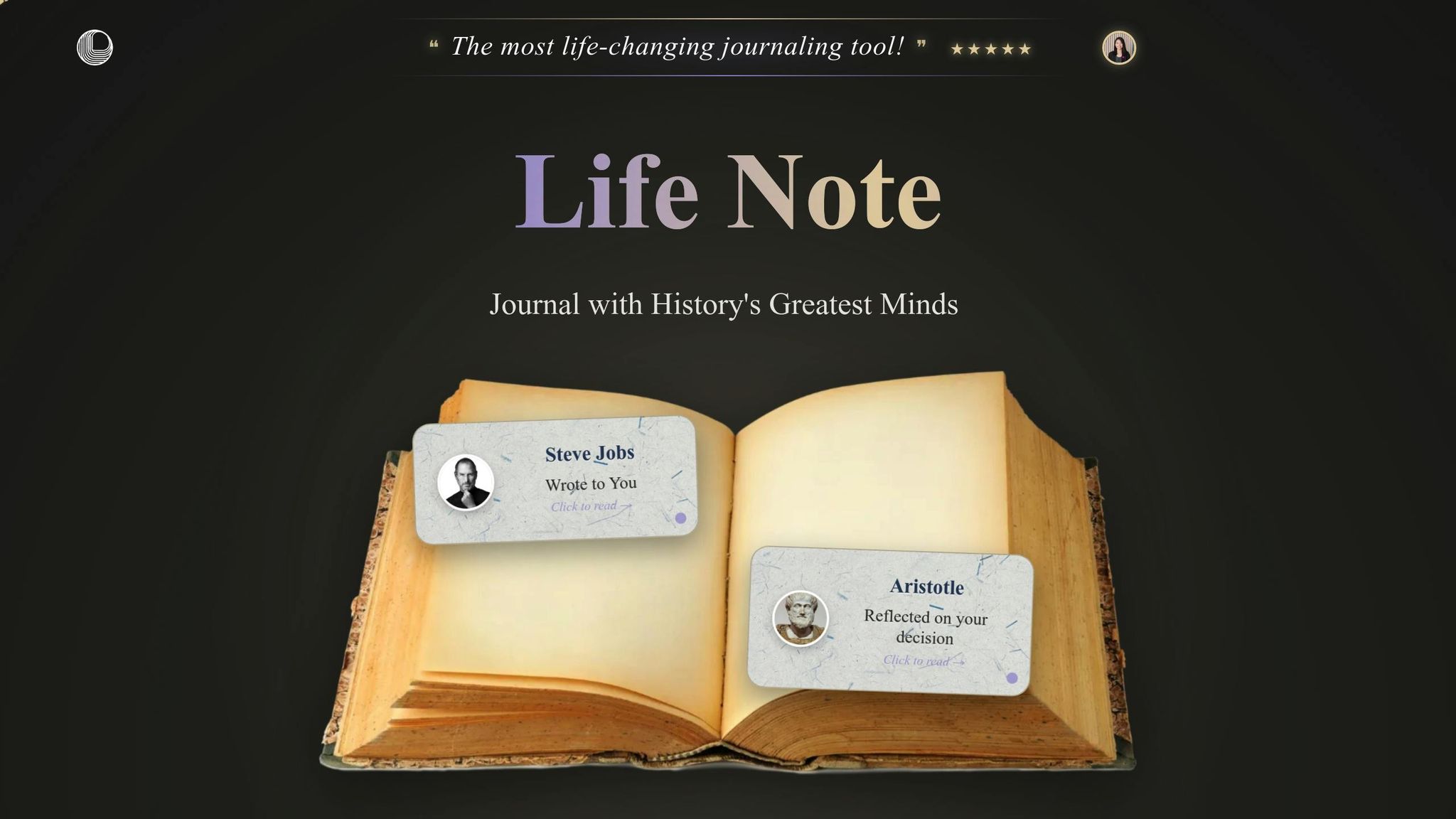
Elevate your journaling experience with Life Note, a platform that blends the benefits of traditional journaling with cutting-edge AI. By offering personalized mentorship, uncovering patterns, and delivering actionable insights, Life Note transforms your daily reflections into a powerful tool for personal growth. It’s like having a guide on your journey toward self-improvement.
Mentorship from History's Greatest Minds
Life Note connects you with over 1,000 iconic figures across 20+ fields - think Steve Jobs, Aristotle, Carl Jung, and Lao Tzu. All you have to do is share your thoughts, challenges, or goals, and the system pairs you with the mentor best suited to your needs.
Each mentor provides feedback rooted in their unique perspective and philosophy. Licensed psychotherapist Sergio Rodriguez Castillo shared his experience:
"Having the voices of luminaries from different fields comment on my writing has been a major advantage - enhancing insight and helping me gain insights beyond my own words" [10].
These interactions broaden your understanding and uncover solutions you might not have considered. It’s a fresh take on the reflective benefits journaling has always offered, now enriched with wisdom from history’s greatest thinkers.
Smart Memory and Pattern Recognition
Life Note doesn’t just listen - it remembers. Its AI tracks recurring themes and emotional patterns, helping you identify tendencies like catastrophic thinking or other cognitive distortions. This "Connect the Dots" feature links your past reflections to your present, creating a clearer picture of your personal growth.
One user, Tiffany Durham, explained:
"I love how tailored the responses are and also the fact that it 'remembers' what I wrote in the previous entries. It really feels like my mentor is on this journey with me" [10].
Every week, Life Note generates a personalized reflection letter, summarizing your key themes and offering guidance drawn from psychological principles. This weekly insight helps you stay grounded and build emotional resilience.
From Reflection to Action
Life Note bridges the gap between self-reflection and meaningful action. Its Aligned Actions feature translates your insights into practical, achievable steps that connect your daily habits to your long-term aspirations.
Your reflections are stored in a personal Wisdom Library, complete with weekly visual summaries to track your progress. And with military-grade encryption, your privacy is always protected [10].
Conclusion
Journaling is more than just a daily routine - it’s a practice that can profoundly impact your life. From Elon Musk’s analytical problem-solving to Oprah’s gratitude exercises and Tim Ferriss’s use of journaling for clarity, many high achievers turn to this habit to stay grounded, focused, and aligned with their goals. Studies show that setting goals through journaling significantly improves achievement rates [6], and nearly 80% of top performers incorporate mindfulness or journaling into their daily lives [3].
What makes journaling so powerful is its ability to bring mental clarity before taking action. As Napoleon Hill famously said:
"The subconscious mind will translate into its physical equivalent, by the most direct and practical method available" [4].
By writing regularly - especially in the morning when your mind is most creative - you can train your subconscious to work toward your aspirations, even when you’re not actively thinking about them.
In today’s world of constant digital noise, journaling offers a much-needed shift from passive scrolling to intentional reflection. Research suggests it takes about 66 days to build a journaling habit [7]. The rewards? Improved decision-making, emotional resilience, sharper pattern recognition, and a stronger sense of purpose.
Modern tools can take this practice even further. Platforms like Life Note combine your reflections with AI-guided mentorship, turning blank pages into insightful dialogues with the wisdom of history’s greatest thinkers. Over time, your journal becomes a personal library of growth and understanding.
Journaling is the habit that bridges your thoughts and actions. Start small - one meaningful sentence can set the tone for your entire day [2]. Make it a daily ritual, and you’ll not only see improvements in productivity but also in how you approach life as a whole.
FAQs
How does journaling help with making better decisions?
Journaling can be a major advantage for decision-making. It gives you a dedicated space to organize your thoughts, weigh your options, and spot patterns that might otherwise slip by unnoticed. When you write down your choices, list the pros and cons, and explore the emotions tied to each possibility, it helps cut through the mental noise, making it easier to evaluate your options with clarity.
Making journaling a regular habit also brings unexpected benefits. It holds you accountable and sharpens your problem-solving abilities. By reflecting on what went well, what didn’t, and the reasons behind those outcomes, you create a personal roadmap for better judgment over time. Plus, the act of journaling can ease stress, improve memory, and free up mental energy, all of which contribute to making clearer, more confident decisions.
If you’re looking for a structured way to journal, Life Note might be worth exploring. This AI-powered journaling tool offers thoughtful prompts, connects you with insights inspired by historical mentors, and helps you turn your reflections into actionable plans. It’s a modern twist on journaling, turning it into a practical tool for personal growth and smarter choices.
How can I start journaling in a simple and effective way?
Starting a journaling habit can be both simple and rewarding if you approach it with a plan. Pick a consistent time and place - maybe in the morning with your coffee or at night before bed - to make it a natural part of your daily routine. There’s no need to overthink it; even a single sentence or a quick list of thoughts is enough to get started.
Not sure what to write? Try using prompts like “What went well today?” or “What am I grateful for?” These can help you stay focused without feeling overwhelmed. Dedicate just five minutes a day to your journal, and by the end of the week, take a moment to read through your entries. You might notice patterns, progress, or small victories you hadn’t realized. Remember, journaling isn’t about perfection - it’s about giving yourself a space to reflect and grow.
What makes AI-enhanced journaling different from traditional journaling?
AI-powered journaling takes the classic practice of journaling and supercharges it with technology, offering both convenience and deeper insights. With AI, you can analyze your entries in real-time, uncover emotional trends, and get tailored prompts or reflections to guide your writing. Tools like auto-tagging, voice input, and weekly summaries make it easier to stay organized, save time, and align your journaling with specific goals.
On the other hand, traditional pen-and-paper journaling provides a hands-on, distraction-free experience that many find grounding and introspective. Writing by hand not only boosts memory but also encourages a deeper emotional connection to your thoughts. However, it doesn’t offer the same level of analysis or personalized guidance that AI journaling brings to the table.
In essence, AI journaling focuses on efficiency, structure, and actionable feedback, while traditional journaling leans into mindfulness and a more intimate, uninterrupted connection with your inner self.
Related Blog Posts
Journal with 1,000+ of History's Greatest Minds
Marcus Aurelius, Maya Angelou, Carl Jung — real wisdom from real thinkers, not internet summaries. A licensed psychotherapist called it "life-changing."
Try Life Note Free