
7 Best Rosebud Journal Alternatives in 2026 (Honest Comparison)

Looking beyond Rosebud for AI journaling? Compare 7 alternatives — from mentor-guided reflection to privacy-first options. Real pros, cons, and pricing.
📌 TL;DR — Rosebud Alternatives
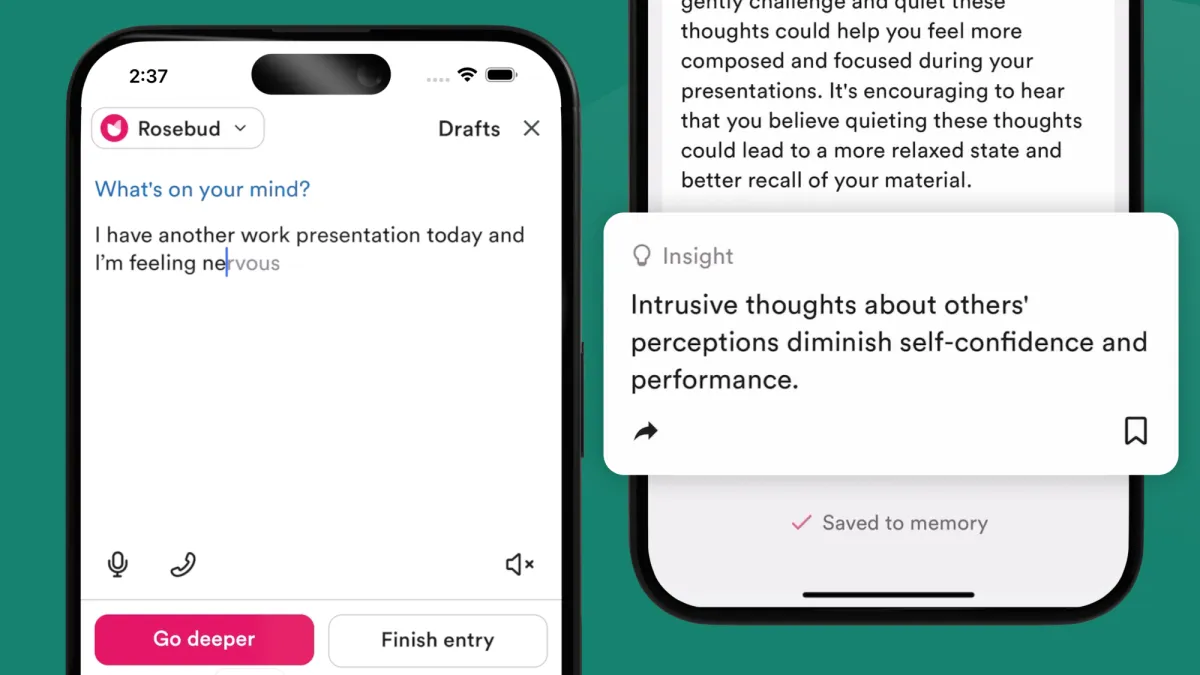
Rosebud is the leading conversational AI journaling app, backed by $6M from Bessemer Venture Partners. Its memory system and therapist-designed workbooks set a high bar. But daily usage caps, $12.99/month pricing, and data training policies drive some users to look elsewhere. Here are the strongest alternatives.

Rosebud — the benchmark for conversational AI journaling
Rosebud has defined what AI journaling looks like in 2026. Its conversational interface, long-term memory system, and pattern recognition across entries set the standard that newer apps are measured against. With $6M in seed funding from Bessemer Venture Partners and investors including Alexis Ohanian and Tim Ferriss, it's the most well-funded dedicated AI journaling startup.
But every app makes tradeoffs. Rosebud's conversational format isn't for everyone, its pricing puts the best features behind a steep paywall, and some users have legitimate concerns about data practices. This guide covers the strongest alternatives for different journaling needs.
Methodology: Each app was evaluated on AI capability, journaling flexibility, pricing, privacy, and platform coverage. This article is published on Life Note's blog — Life Note is one of the apps listed. We've applied identical evaluation standards to every option, including our own.
Why People Look for Rosebud Alternatives
Rosebud is a strong product. But several specific issues drive users to explore alternatives.
- Daily usage cap. Rosebud limits AI interactions per day. Users mid-session get a popup telling them to come back tomorrow — interrupting journaling momentum at the worst possible moment. For an app positioned as a "safe space for self-reflection," a hard stop mid-thought feels contradictory.
- Pricing. At $12.99/month ($107.99/year) for Bloom, Rosebud is one of the most expensive journaling apps. The free plan locks away long-term memory — arguably Rosebud's most valuable and differentiating feature.
- Data practices. Rosebud's Terms of Service explicitly permit use of anonymized and de-identified journal data for AI training and third-party licensing. There is no opt-out. For users sharing deeply personal content about relationships, trauma, and mental health, this is a meaningful concern.
- Structured format only. Rosebud is chat-based by design. Users who want free-form, blank-page journaling — or the ability to write a long, uninterrupted reflection — can't do that here.
- Memory imperfections. The AI occasionally forgets previously discussed topics, asks repetitive questions, and has weak chronological awareness — frustrating for users who've shared deeply personal context over months.
- Desktop parity. Some features available on mobile don't work on the web version, creating a second-class experience for desktop users.
7 Best Rosebud Alternatives in 2026
1. Life Note — Best for Mentor-Guided Deep Reflection
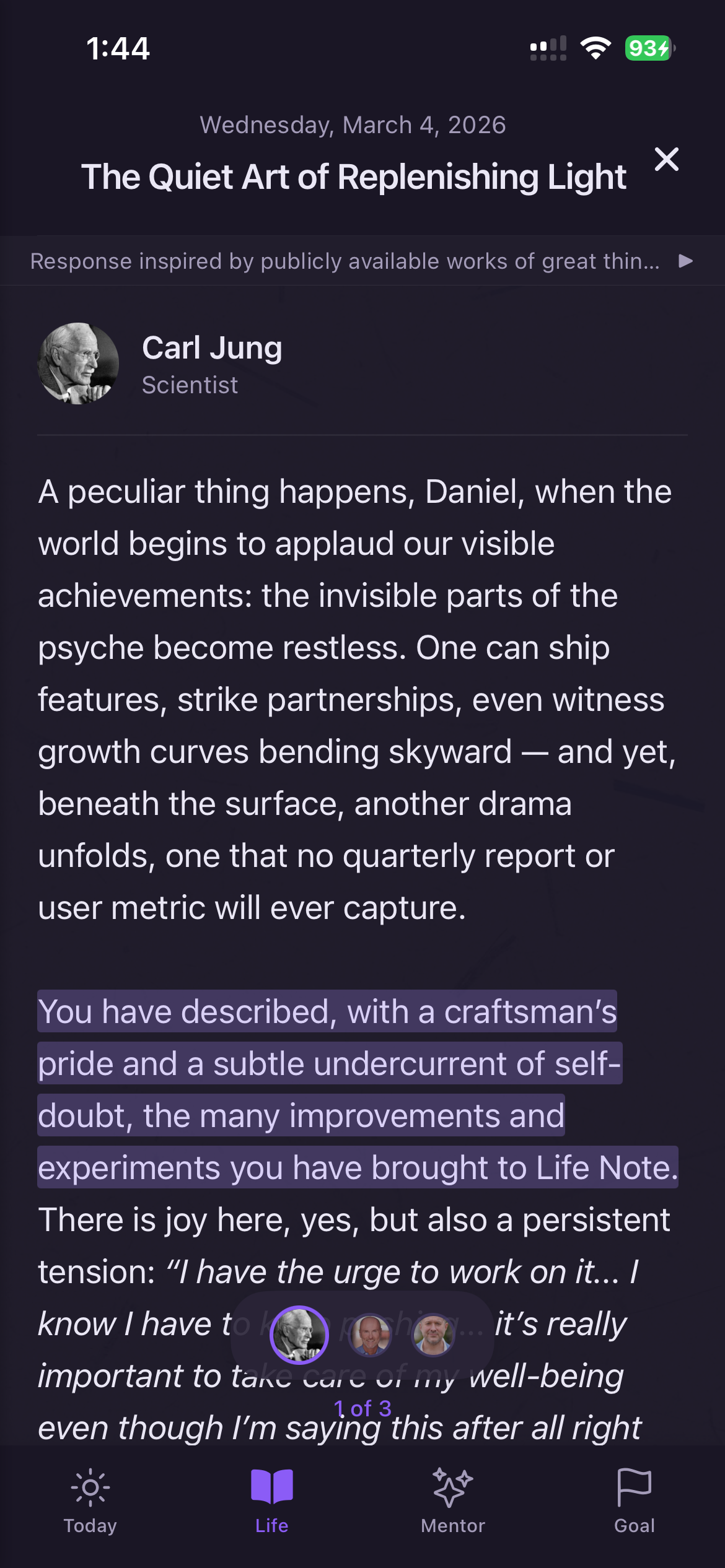
Life Note takes a fundamentally different approach to AI journaling. Instead of a single conversational AI, it offers 1,000+ AI mentors — historical thinkers like Carl Jung, Marcus Aurelius, Virginia Woolf, and modern therapeutic frameworks. Each mentor applies a distinct lens to your writing.
Where Rosebud asks "how does that make you feel?", Life Note's Jung mentor might ask "what shadow aspect of yourself does this situation reveal?" — and its Stoic mentor would ask "what in this situation is within your control, and what isn't?" The result is a different kind of depth — guided by frameworks rather than generic follow-ups.
The philosophical approach won't suit everyone. Some users prefer Rosebud's single-AI simplicity. But for those who find Rosebud's responses becoming repetitive or generic after months of use, Life Note's variety of perspectives can reignite the journaling practice.
Strengths:
- 1,000+ AI mentors spanning psychology, philosophy, spirituality, and creativity
- Each mentor provides a distinct analytical framework — not just personality variation
- Free-form writing mode alongside guided conversations
- iOS, Android, and web with full feature parity (unlike Rosebud's desktop gap)
- 350+ guided journaling articles for context and learning
Limitations:
- Mentor-based approach requires choosing a framework (vs. Rosebud's single-AI simplicity)
- Smaller user community than Rosebud — less social proof
- No therapist-designed workbook library comparable to Rosebud's guided programs
- Pattern recognition is framework-dependent, not automatic across all entries
Pricing: Free plan available. Premium: $99.99/year (no monthly option).
2. Mindsera — Best for Cognitive Analysis

Mindsera — cognitive frameworks and mental model analysis for your journal
Mindsera serves users who want AI to analyze their thinking patterns rather than their emotions. It applies mental models, cognitive frameworks, and decision analysis to your journal entries — journaling for systems thinkers and analytical minds.
Where Rosebud focuses on emotional support and therapeutic dialogue, Mindsera focuses on cognitive quality. It identifies thinking biases, evaluates decision-making patterns, and applies frameworks from psychology and business strategy. The experience is less warm but more rigorous.
Strengths:
- Cognitive analysis identifies thinking patterns, biases, and decision quality
- Mental model library with applicable frameworks from psychology and strategy
- Academic precision in emotional and cognitive analysis
- AI-generated art based on your entries — a creative touch
- Web-based, works on any device with consistent experience
Limitations:
- Analytical tone can feel clinical for emotional processing or grief work
- Less conversational than Rosebud — more like receiving a cognitive report card
- Smaller team and user base — less proven at scale
- Mobile experience is less polished than the web version
Pricing: Free plan. Pro: $9.99/month or $69.99/year.
3. Reflection — Best for Privacy-Conscious AI Journaling

Reflection — AI journaling with end-to-end encryption and no data training
Reflection positions itself as the privacy-first AI journaling app. It offers conversational AI similar to Rosebud's approach but with a fundamentally stronger commitment to data protection — entries are end-to-end encrypted and explicitly never used for AI training.
This matters because of Rosebud's data policies. When users share their deepest thoughts about relationships, trauma, and mental health, the knowledge that anonymized versions of those entries may be used to train AI models gives some people genuine pause. Reflection addresses this concern directly.
Strengths:
- End-to-end encryption for all journal entries — not just optional
- Explicit no-training policy: your entries never train AI models, period
- Conversational AI with contextual follow-up questions
- Clean, minimalist interface with thoughtful UX
- iOS, Android, and web with consistent feature parity
Limitations:
- AI depth may not match Rosebud's sophisticated pattern recognition and memory system
- No workbooks, guided programs, or structured therapeutic content
- Newer app with less track record — long-term viability less proven
- Community and content ecosystem still in early stages
Pricing: Free plan. Premium: $9.99/month or $79.99/year.
4. Day One — Best for Traditional Journaling with Light AI

Day One — 10+ years of polished traditional journaling with multimedia support
Day One is the veteran — 10+ years of development, Automattic-backed, and the only mainstream journaling app with physical book printing. Its AI features are limited to Labs (prompts, summaries, image generation), but for users who want a journal, not a chatbot, it delivers a polished, reliable experience.
Day One and Rosebud serve fundamentally different purposes. Rosebud is an AI tool that happens to involve journaling. Day One is a journal that happens to have some AI. If you're leaving Rosebud because you want less AI and more personal writing space, Day One is the answer.
Strengths:
- Physical book printing from journal entries — genuinely unique in the market
- Automatic weather, location, and health metadata on every entry
- End-to-end encryption with per-journal control
- Map view, calendar view, multiple journals, and shared journals
- Full Apple ecosystem integration (Watch, Shortcuts, Health, Siri)
Limitations:
- AI is minimal — no conversation, no memory, no pattern analysis. Just prompts and summaries.
- $49.99/year with no monthly option
- Android experience significantly lags behind iOS (fewer features, more bugs)
- Documented sync reliability issues — journals occasionally disappearing
Pricing: Free plan. Premium: $49.99/year.
5. Reflectly — Best for Guided Mood Tracking
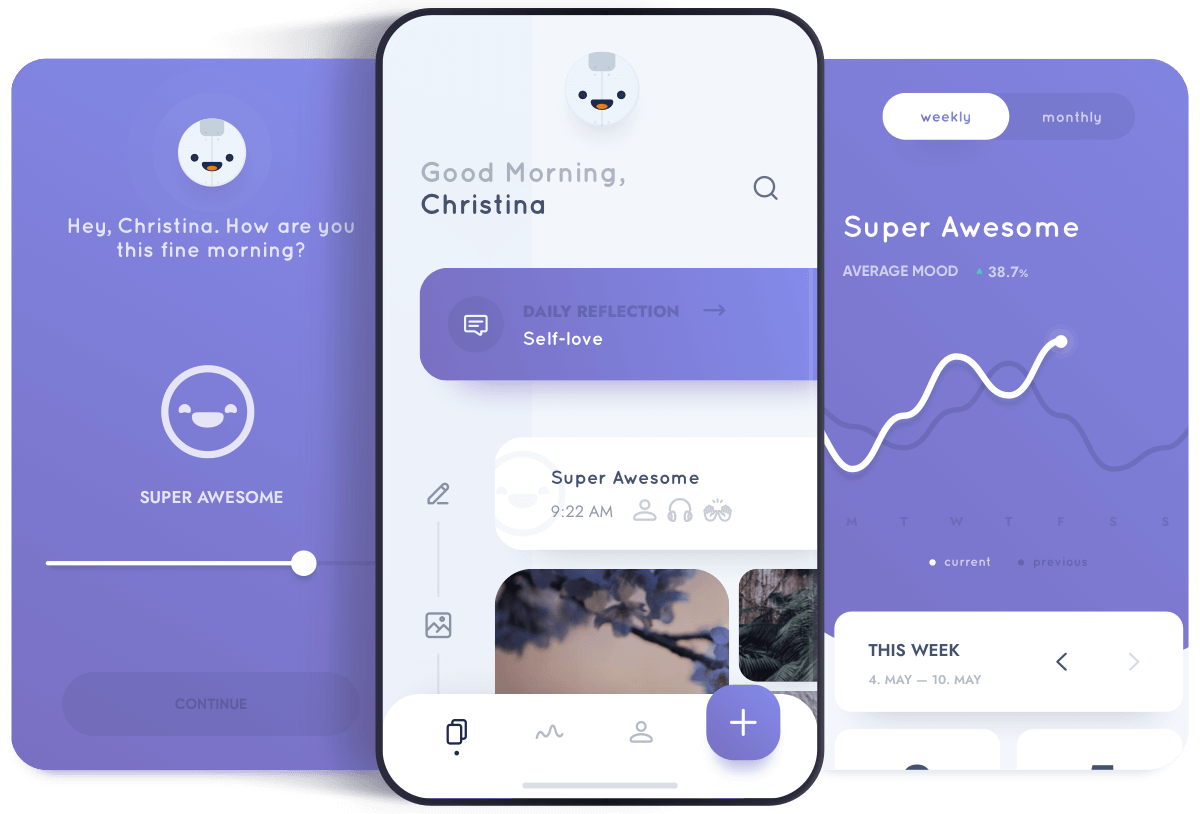
Reflectly — structured daily check-ins for mood tracking
Reflectly is a structured mood-tracking journal with 10M+ downloads. Its 3-part daily check-in lowers the barrier to entry for people who find conversational AI overwhelming or prefer a quick, guided format over open-ended dialogue.
If Rosebud feels like too much — too many questions, too deep too fast, too expensive — Reflectly offers a simpler, cheaper alternative that still builds a journaling habit. The tradeoff is significant depth: Reflectly's AI is pre-LLM (2017 era), so there's no real conversation happening.
Strengths:
- Structured daily check-in takes under 2 minutes — lowest friction option
- Mood-activity correlation tracking with visualized trends
- Polished design and animations (Google's Flutter showcase app)
- 10M+ downloads — the largest user base of any guided journaling app
- Growth Bundle includes 6 companion apps
Limitations:
- AI is pre-LLM (2017-era pattern matching, not conversational) — a major downgrade from Rosebud
- No free-form writing mode — structure is both the draw and the ceiling
- Core analytics paywalled with minimal perceived free-to-premium difference
- Mobile only — no web or desktop app
Pricing: Free plan. Premium: $59.99/year (iOS).
6. Notion AI — Best for DIY AI Journaling

Notion — build your own AI-powered journaling system
Notion with AI is for users who want full control over their journaling system. Build databases for mood tracking, templates for daily check-ins, and use Notion AI to summarize, analyze, and generate prompts — all in one workspace that also handles your tasks, notes, and projects.
The appeal over Rosebud is ownership and flexibility. Rosebud dictates the format (chat). Notion lets you design any journaling workflow you want — and its AI can analyze your entries, though not with the therapeutic depth of a purpose-built journaling AI.
Strengths:
- Infinitely customizable journaling databases, templates, and views
- Notion AI for summarization, analysis, and prompt generation
- Available on all platforms with consistent experience
- Free for personal use — no journaling paywall
- Integrates journaling with your entire productivity system
Limitations:
- Significant setup required — not a journaling app out of the box
- AI is general-purpose, not trained for therapeutic or reflective contexts
- No end-to-end encryption — Notion has access to your content
- No guided programs, workbooks, or structured emotional intelligence features
Pricing: Free for personal use. Plus: $10/month. AI add-on: $10/month.
7. Stoic — Best for Structured Self-Improvement

Stoic — daily journaling with Stoic philosophy exercises and habit tracking
Stoic combines journaling with habit tracking, mood logging, and Stoic philosophy exercises. It's more structured than Rosebud but with a specific philosophical framework — morning reflections and evening reviews inspired by Marcus Aurelius and Epictetus — rather than open-ended conversation.
For users who find Rosebud's open-ended AI conversation unfocused or who want a more structured self-improvement practice with philosophical grounding, Stoic provides clear daily rituals without the complexity of AI chat.
Strengths:
- Combines journaling, habit tracking, and mood logging in one unified practice
- Stoic philosophy exercises (morning reflection, evening review) with historical context
- Beautiful UI with health data integration (Apple Health, Google Fit)
- Breathing exercises and mindfulness tools built directly into the daily flow
- Clear daily structure that builds consistency without AI dependency
Limitations:
- Philosophy-specific approach isn't universal — you need to be interested in Stoicism
- AI features are limited compared to Rosebud, Life Note, or Mindsera
- Structured format — less flexible than free-form journaling
- Smaller development team with slower feature releases
Pricing: Free plan. Premium: $59.99/year.
Side-by-Side Comparison
| App | AI Approach | Memory | Privacy | Price/Year |
|---|---|---|---|---|
| Life Note | 1,000+ mentors | Per-mentor | Standard | $99.99 |
| Mindsera | Cognitive analysis | Entry-based | Standard | $69.99 |
| Reflection | Conversational | Yes | E2E encrypted | $79.99 |
| Day One | Basic (Labs) | No | E2E encrypted | $49.99 |
| Reflectly | Pre-LLM prompts | Limited | Standard | $59.99 |
| Notion AI | General-purpose | Workspace-wide | No E2E | Free/$120 |
| Stoic | Philosophy-guided | No | Standard | $59.99 |
What Research Says About Digital Journaling
The journaling apps in this comparison use different approaches — guided prompts, conversational AI, mood tracking, and free-form writing. Research supports all of these methods, with important nuances:
| Study | Finding | Implication | Limitation |
|---|---|---|---|
| Pennebaker & Beall (1986) | Expressive writing reduced physician visits by 43% over 6 months | Free-form emotional writing has measurable health benefits | Lab setting; participants wrote about trauma specifically |
| Smyth et al. (2018), JAMA | Online expressive writing reduced PTSD symptoms in 1,497 participants | Digital journaling can be as effective as pen-and-paper | Self-selected population; 6-week follow-up only |
| Ullrich & Lutgendorf (2002) | Cognitive processing (not venting) drove health improvements in journaling | AI prompts that encourage analysis outperform simple mood logging | Small sample (122 students); short intervention period |
| Baikie & Wilhelm (2005), Advances in Psychiatric Treatment | Meta-review: expressive writing improved immune function, mood, and well-being across 200+ studies | Consistent evidence that regular journaling benefits mental health | Effect sizes vary; not all populations benefit equally |
| Krpan et al. (2013), British Journal of Health Psychology | Expressive writing reduced depressive symptoms and rumination in clinically depressed adults | Guided reflection may help with depression when paired with professional treatment | 40 participants; 3-day writing protocol only |
Key takeaway: The research consistently shows that how you journal matters more than where you journal. Cognitive processing — making meaning from experiences, not just describing them — produces the strongest outcomes. Apps with AI prompts that encourage deeper reflection may have an advantage over simple mood trackers, though direct comparative studies between journaling apps are still limited.
What to Look for in a Rosebud Alternative
The right alternative depends on what specifically isn't working with Rosebud:
- If the usage cap is your issue: Life Note and Mindsera don't impose daily AI interaction limits. Notion is unlimited within your AI subscription.
- If privacy concerns drive you: Reflection is the clear choice — E2E encryption and explicit no-training policy. Day One also offers E2E encryption. Both are fundamentally different from Rosebud's data practices.
- If you want a different kind of depth: Life Note's mentor frameworks offer variety that Rosebud's single AI can't match. Mindsera's cognitive analysis offers analytical rigor that Rosebud's emotional support model doesn't attempt.
- If price is the issue: Mindsera ($69.99/year), Stoic ($59.99/year), and Reflectly ($59.99/year) all cost significantly less than Rosebud. Day One is $49.99/year. Notion is free for personal use.
- If you want free-form writing: Day One, Notion, and Life Note all support blank-page journaling. Rosebud and Reflectly are structured-only.
How to Choose the Right Rosebud Alternative
- Want AI depth with a different approach? Life Note's mentor system offers guided reflection through 1,000+ philosophical and psychological frameworks — a different kind of depth than Rosebud's single-AI conversation.
- Want analytical rigor? Mindsera applies cognitive frameworks and mental models to your writing — more like a thinking coach than an emotional support system.
- Want privacy-first AI journaling? Reflection offers conversational AI with end-to-end encryption and a no-training data policy.
- Want a traditional journal? Day One is the gold standard for multimedia life archival — no AI conversation, but unmatched for preserving memories.
- Want simplicity? Reflectly's 2-minute daily check-in and Stoic's philosophy exercises both offer structure without the complexity of open-ended AI chat.
What Rosebud Still Does Best
Rosebud's core advantage is the combination of conversational AI with long-term memory and therapist-designed content. No other app currently matches the depth of its pattern recognition system — the ability to surface a behavioral pattern from three months ago that connects to what you're writing about today.
The guided workbooks (ACT, nervous system rebalancing, relationship dynamics) are clinically grounded in ways that generic AI prompts are not. And Rosebud's voice journaling with call mode — essentially talking to an AI therapist — is a genuinely novel interaction model that no competitor has fully replicated.
If conversational AI journaling with long-term memory is your top priority and you're willing to pay $12.99/month for it, Rosebud remains the strongest option in that specific category.
Limitations of This Comparison
- Bias disclosure: This article is published on Life Note's blog. Life Note is one of the alternatives listed. We've applied identical criteria to every app.
- Rosebud funding: Rosebud's $6M seed was led by Bessemer Venture Partners, not a16z as some sources incorrectly report. Other investors include 776 (Alexis Ohanian), Initialized Capital, and Tim Ferriss.
- Self-reported wellness data: Rosebud reports depression -64%, anxiety -60% after one week of use. These are self-reported user metrics, not clinical trial results. Treat them as directional signals, not definitive evidence.
- AI evolves fast: All AI capability assessments reflect March 2026. Every app on this list will have meaningfully different capabilities within months.
- No app replaces therapy: AI journaling apps are reflective tools, not treatments. If you're in crisis, contact a licensed professional or call 988 (Suicide & Crisis Lifeline).
Frequently Asked Questions
Does Rosebud use my journal entries to train AI?
Rosebud's Terms of Service allow use of anonymized and de-identified data for AI model training and third-party licensing. They do not sell raw journal entries, but aggregated data is permitted. There is currently no opt-out option for this data use.
Which Rosebud alternative is cheapest?
Notion is free for personal use (AI costs $10/month extra). Day One is $49.99/year. Reflectly and Stoic are $59.99/year. Mindsera is $69.99/year. Reflection is $79.99/year. Life Note is $99.99/year. All offer free tiers with varying limitations.
Can I move my Rosebud journal to another app?
Rosebud offers data export, but the conversational format (AI questions + your responses) doesn't translate cleanly into other apps' entry formats. You'll retain the content text, but the context of the AI interaction — which question prompted which response — is lost during migration.
Which alternative has the best long-term memory?
Rosebud's long-term memory remains the strongest in the category. Reflection offers entry-to-entry contextual memory. Life Note's mentors build context within their framework. Mindsera analyzes cognitive patterns across entries. No alternative fully matches Rosebud's cross-session memory system yet.
Is Rosebud safe for sensitive personal content?
Rosebud encrypts data in transit and at rest. However, the data training clause in their Terms of Service means anonymized versions of your content may be used to improve AI models. For stronger privacy guarantees, consider Reflection (E2E encryption, explicit no-training policy) or Day One (optional E2E encryption with per-journal control).
Last updated: March 2026. Have a correction or suggestion? Contact us.
For a broader comparison of all AI journaling apps, see our comprehensive AI journaling app comparison.
Journal with 1,000+ of History's Greatest Minds
Marcus Aurelius, Maya Angelou, Carl Jung — real wisdom from real thinkers, not internet summaries. A licensed psychotherapist called it "life-changing."
Try Life Note Free