
10 Journaling Prompts for Personal Branding

Ten focused journaling prompts to clarify your values, strengths, and goals so you can build an authentic personal brand and take small, practical actions.

📌 TL;DR — Journaling for Personal Branding
Your personal brand is how others perceive your unique value. Use journaling to clarify: What am I known for? What do I want to be known for? What are my signature strengths? What stories define my journey? Authentic personal branding starts with deep self-knowledge.
Journaling can help you clarify your personal brand by reflecting on your values, strengths, and goals. It’s a simple yet effective way to align your actions with what matters most and create a brand that feels real to you. Here’s how journaling can guide your self-discovery:
- Understand Your Values: Reflect on decisions that made you proud or times when your actions felt aligned with your inner self.
- Identify Strengths: Look at your achievements, reframe weaknesses as strengths, and recall moments when you felt in your element.
- Set Goals: Define where you want your brand to be in the next 3–5 years and identify obstacles holding you back.
- Stay Honest: Use prompts to uncover truths about your current direction and ensure your brand reflects who you are.
Writing for just 5–10 minutes a day can help you uncover patterns, refine your priorities, and take actionable steps toward building a brand that resonates.
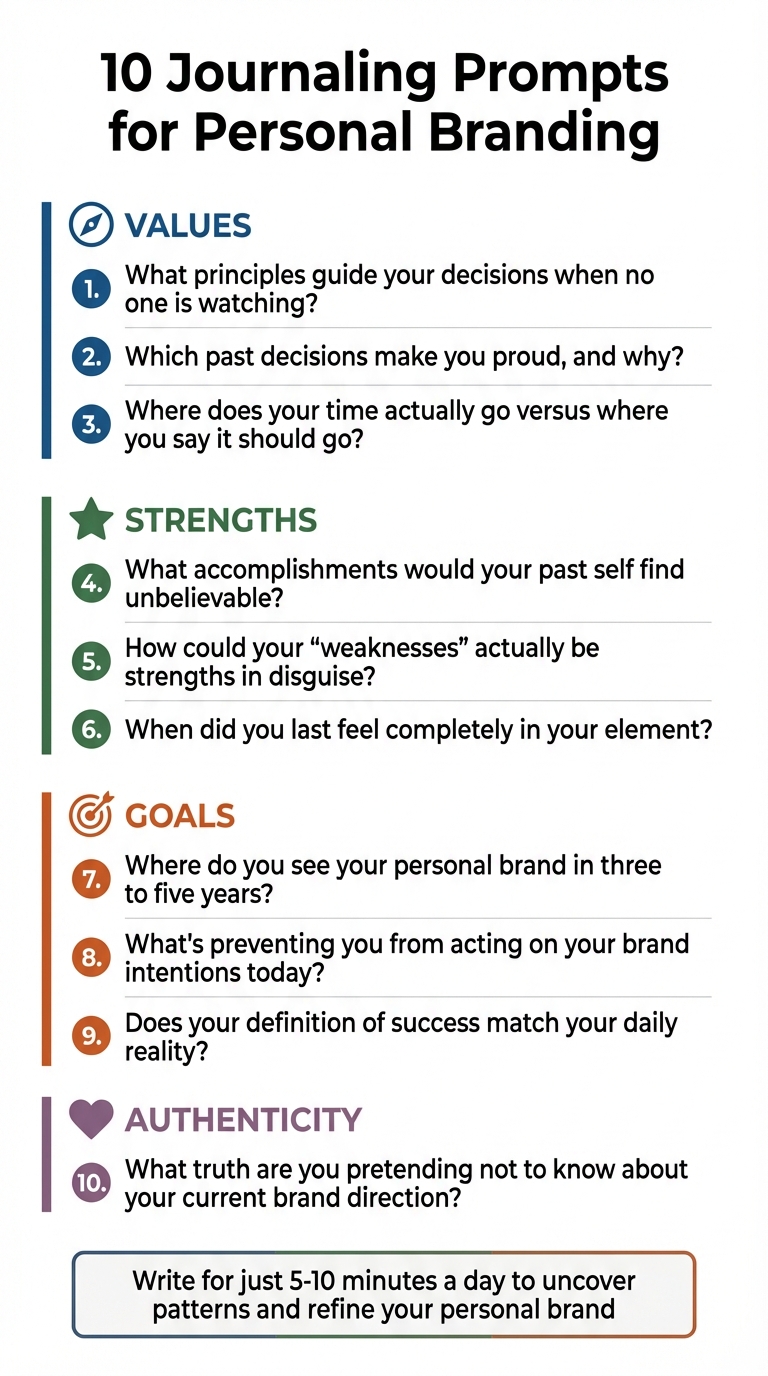
10 Journaling Prompts for Personal Branding Self-Discovery
1. Values
What principles guide your decisions when no one is watching?
Your values act as a personal compass, helping you make choices that feel true to who you are. Think about the times when your actions felt completely in sync with your inner self. What principles were you following in those moments? Reflecting on these experiences can help you uncover what genuinely drives you, cutting through the noise of what you think you should value and revealing what truly matters to you.
Which past decisions make you proud, and why?
Take a moment to identify three to five decisions that fill you with pride, and explore why they stand out. Maybe you declined a high-paying job because it clashed with your creative goals, or you voiced a difficult truth in a meeting because honesty outweighed the fear of conflict [3][5]. These aren't just isolated incidents - they’re clues pointing to your core values. Recognizing these patterns can help you align your values with your daily actions and shape how others perceive your personal brand.
Where does your time actually go versus where you say it should go?
Conduct a time-value audit by tracking how you allocate your time, money, and energy over a week [2]. Then, compare this with the values you claim are most important. Are they in sync, or is there a disconnect? For example, if you say family is your top priority but notice most of your time is consumed by work, that misalignment can blur the clarity of your personal brand. Bridging these gaps not only strengthens your brand but also makes living it feel more natural and less draining [2].
2. Strengths
Defining your strengths goes hand-in-hand with understanding your values, creating a personal brand that feels authentic and distinctive.
What accomplishments would your past self find unbelievable?
Take a moment to reflect on achievements that would have seemed impossible to your younger self. This Achievement Audit helps you uncover the skills you've developed over time [3]. Maybe you successfully negotiated a high-stakes deal, built a thriving community from the ground up, or mastered coding to launch your own app. Each of these milestones highlights specific abilities - whether it’s persuasion, community building, or technical expertise - that contribute to your unique personal brand. Write down three to five major accomplishments and identify the skills behind each one.
How could your "weaknesses" actually be strengths in disguise?
Sometimes, what feels like a flaw can actually set you apart. For example, being "too detail-oriented" might make you exceptional at spotting errors or managing risks. Or, being "overly sensitive" could mean you have the empathy necessary for leadership or client-facing roles. Use the Weakness Reframe to turn one perceived limitation into a strength [4]. This exercise can help you see how what makes you different can also make you stand out in a competitive space [6]. Focus on times when this "weakness" actually helped you shine.
When did you last feel completely in your element?
Think back to a moment when everything just clicked - when work felt effortless, and you were at your best. This Confidence Check can pinpoint your core strengths [3][6]. Recall the situation: what you were doing, who was involved, and why it felt so natural. Maybe you were leading a tough negotiation, creating a compelling presentation, or solving a tricky problem under pressure. The skills you used in that moment are likely your strongest assets - the ones that energize you and align perfectly with your personal brand.
3. Goals
Your personal brand needs a clear sense of direction. Without well-defined goals, even your strongest skills and values can feel scattered. The following prompts are designed to help you map out where you’re headed and give clarity to what success looks like for you. By working through these exercises, you’ll create a roadmap to turn your aspirations into actionable steps.
Where do you see your personal brand in three to five years?
Take a moment to picture your future brand in specific, vivid detail. Imagine it as if it’s already a reality. Are you speaking at conferences? Leading a team? Collaborating with global clients? Think about the day-to-day: What does a typical Tuesday look like? Who are you working with? What kinds of problems are you solving? The more detailed your vision, the more it can act as your guiding light, helping you assess whether your current goals align with your long-term ambitions [1].
What's preventing you from acting on your brand intentions today?
Identify one specific brand intention you have, then pinpoint what’s holding you back. Is it fear of judgment? A gap in skills? Or maybe you’re unsure where to begin? Once you’ve named the obstacle, ask yourself: What’s one small step you can take in the next 24 hours to move forward? For instance, instead of aiming to "establish an online presence", you could start with something manageable, like spending 15 minutes researching three industry podcasts [2][5].
Does your definition of success match your daily reality?
Take a closer look at how you spend your time and see if it aligns with your brand goals. Write down your top three goals and compare them to your recent schedule. For example, if one of your priorities is building meaningful connections but you haven’t dedicated time to networking or engaging with others, there’s a disconnect. This kind of audit can help you identify whether you’re pursuing goals that genuinely matter to you or simply chasing external expectations. Adjust your schedule or goals to ensure your daily actions reflect your vision. When your efforts align with your values, progress tends to follow naturally [1][4].
4. Authenticity
Your personal brand starts to lose its impact the moment it stops reflecting who you truly are. Authenticity isn’t about being flawless - it’s about aligning your core values with how you present yourself to the world. Journaling can be a powerful tool here, offering a safe space to be completely honest with yourself. It helps you sort through which values are genuinely yours and which ones you might have taken on due to societal pressure [2]. Here’s a thought-provoking question to dig deeper:
What truth are you pretending not to know about your current brand direction?
This question gets straight to the heart of the matter. Write down your first, raw response - no filters. Are you chasing a niche that leaves you feeling drained? Are you imitating someone else’s style instead of embracing your own voice? That uneasy feeling you get might be pointing to something important. Once you’ve identified the truth, ask yourself: what’s one small step you can take to move closer to alignment?
As you continue reflecting, pay attention to recurring patterns - what activities energize you, who you’re spending time with, and the obstacles you’ve overcome. This kind of self-awareness doesn’t just refine your brand; it also helps you build deeper, more meaningful connections with others. These insights become the foundation of your personal brand, turning networking into something real and impactful [1]. As Socrates famously said:
"The unexamined life is not worth living" [2].
Conclusion
Building a personal brand goes beyond crafting a polished image - it’s about discovering who you truly are and sharing that authentically. By using these prompts, you can tap into your core values and create connections that matter. Writing for just 5–10 minutes a day can work wonders; brand strategist Hilary Hartling describes it as creating "magic" [1]. These prompts act as snapshots of your evolving mindset, helping you track how your thoughts and perspectives shift over time, ensuring your brand stays true to who you are.
But reflection alone isn’t enough - it’s the actions you take afterward that make the difference. After each journaling session, identify one concrete step you can take. Maybe it’s refining your core message, saying no to opportunities that don’t align with your values, or reaching out to people who share your vision. Aligning your reflections with purposeful actions is what brings your personal brand to life.
For those looking to dig deeper, tools like Life Note can guide your self-discovery journey with AI-driven prompts inspired by historical mentors. These tools help you uncover patterns, challenge your assumptions, and find new angles to tackle your branding challenges. As Kristen Webb Wright points out:
"Exploring our emotions through journaling can deepen our emotional smarts, improve our relationships, and help us connect better with ourselves and others" [2].
Every insight you gain through journaling is a step toward a clearer, more authentic brand. Keep writing, reflecting, and acting - it’s the key to building connections that truly resonate.
FAQs
How does journaling help build a personal brand?
Journaling is an excellent way to refine and strengthen your personal brand. It helps you dig deep into your values, uncover your strengths, and shape the unique story you want to share. By reflecting regularly, you can craft a clear and consistent narrative that shines through in your LinkedIn profile, bios, or even during networking conversations.
Beyond storytelling, journaling enhances self-awareness. It helps you spot habits and patterns - both those that align with your desired image and those that don’t. With this clarity, you can make intentional changes to ensure your actions consistently support the personal brand you’re building. On top of that, the process sharpens emotional intelligence, giving you the confidence to connect with others in a genuine way and leave a memorable impression.
For a more structured approach, tools like Life Note offer tailored prompts, securely store your reflections, and even provide insights inspired by historical figures to help your brand evolve thoughtfully. Journaling with purpose turns self-reflection into actionable steps, allowing you to confidently present your best self to the world.
How can I align my actions with my core values?
If your actions don’t line up with what you truly believe in, it might be time to take a closer look at your core values. Start by figuring out what really matters to you. Write down your top priorities and ask yourself questions like, “What kind of life do I want to lead?” or “What are the non-negotiables in my life?” This reflection can give you the clarity you need to guide your decisions moving forward.
Once you’ve identified your values, take a moment to review your recent actions. Are they in sync with what you care about most? If not, think about the situations where your behavior didn’t match your beliefs. Use those moments as a starting point to make intentional changes. Setting small, realistic goals can help. For instance, if family is one of your top priorities, make it a point to schedule quality time with them regularly.
Journaling can be a powerful tool to keep yourself on track. Write about the choices you made each day, how they made you feel, and what you might want to adjust. Apps like Life Note can offer helpful prompts and reflections to keep you focused on staying true to your values. Over time, these small efforts can help bridge the gap between what you believe in and how you live, giving you a sense of balance and authenticity.
How can I identify what’s holding me back from achieving my personal branding goals?
To figure out what might be holding you back from reaching your personal branding goals, start with some honest self-reflection. Take a close look at your habits, beliefs, and any outside challenges that might be in your way. Journaling can be an incredibly helpful tool for this process. Consider asking yourself questions like:
- What fears or self-doubts come up when I think about promoting my personal brand?
- Are there any daily habits or distractions that are keeping me from focusing on my branding efforts?
- What skills or resources am I missing that are stopping me from delivering on my brand’s promise?
By revisiting these questions regularly, you’ll start to see patterns or roadblocks that need addressing. To make this process even more impactful, you might try using an AI journaling tool like Life Note. This app doesn’t just help you capture your thoughts - it connects your reflections with advice from mentors, such as business leaders or psychologists. They can help you spot blind spots, challenge limiting beliefs, and offer practical steps to overcome obstacles.
When done consistently, journaling can turn vague frustrations into clear, actionable insights, helping you move closer to your personal branding goals, one thoughtful step at a time.
How to Start Journaling + 25 journal prompts for personal growth
Related Blog Posts
Journal with 1,000+ of History's Greatest Minds
Marcus Aurelius, Maya Angelou, Carl Jung — real wisdom from real thinkers, not internet summaries. A licensed psychotherapist called it "life-changing."
Try Life Note Free