
How to Understand Yourself: A Practical Guide for 2026


📌 TL;DR — How to Understand Yourself
Self-understanding requires looking at yourself objectively—hard because we have blind spots and self-protective biases. Key practices: journaling (externalizes thoughts for analysis), seeking feedback, examining patterns in relationships, and noticing what triggers strong emotions. The goal isn't self-judgment but curious self-observation.
To truly understand yourself, you must quiet the noise of the outside world and listen to what’s happening inside. It's a journey, not a destination. This process is about connecting your actions to your core values, observing your emotional patterns without judgment, and getting genuinely curious about your own story. This guide provides a clear, actionable framework for this deep and rewarding work, helping you build the self-awareness needed for a fulfilling life.
Why Understanding Yourself Is Your Greatest Superpower
In a world buzzing with notifications and opinions, the journey inward isn't just a nice-to-have; it's essential. The quest to understand who you are isn't a quiet, philosophical hobby. It's a practical skill for building a life that actually feels like your own.
Without a strong internal compass, it’s far too easy to be pulled in dozens of directions by others' expectations. This is a fast track to feeling disconnected and dissatisfied.
Deep self-awareness is the foundation for almost everything that matters. It sharpens your decision-making, strengthens your relationships, and builds the emotional grit to handle whatever life throws your way. When you know who you are, you can navigate challenges with a sense of calm and purpose.
The Modern Need for Inner Clarity
The need for self-knowledge is more urgent than ever. As life grows more complex, so do our internal worlds. According to Gallup’s latest data, a staggering number of adults worldwide report daily feelings of worry, stress, and sadness. You can explore the findings on global emotional health to see the full picture, but the takeaway is clear: self-awareness is no longer just a personal goal—it's a critical tool for wellbeing.
Knowing yourself is the anchor in this storm. It helps you identify your triggers, understand what you truly need, and manage your reactions before they start managing you.
"If you don’t know yourself, it is very difficult to love yourself. Self-discovery is the process of truly comprehending yourself in each and every way, regardless of the presence of others."
A Practical Path Forward
This guide gets straight to the point. We're moving beyond vague advice and into an actionable framework you can start using today. By blending timeless introspective practices with modern tools, we'll help you map your inner world. Forget being told to "be more mindful." We're giving you structured methods to uncover what actually drives you.
Here's what this guide promises:
- Structured Journaling: Specific prompts designed to unearth your core values, hidden beliefs, and the assumptions running your life.
- Psychological Models: Simple but powerful frameworks to finally make sense of your emotional patterns and triggers.
- Reflective Practices: Exercises that help you understand your own story and rewrite the parts that no longer serve you.
- Aligned Action: Crucially, we'll show you how to turn these insights into real, tangible changes in your daily life.
By the end of this guide, you won’t just understand yourself on a deeper level. You’ll have a practical toolkit to build a life that is a true reflection of who you are. Let's begin.
Step 1: Lay the Foundation with Reflective Rituals
So, you want to understand yourself better. It’s a great goal, but a fuzzy one. "Getting to know myself" often feels like trying to grab smoke—where do you even begin? It’s easy to get stuck in good intentions without a real plan.
True self-discovery isn't a grand, mystical quest. It’s about building a practical toolkit for turning inward and making sense of what you find. It starts with small, consistent acts of introspection. The first real step is creating a personal ritual for reflection, a dedicated space to finally listen to what’s going on inside.
It All Starts with Compassionate Curiosity
Before you pick up a pen or open an app, let’s get the mindset right. You need to approach your inner world with compassionate curiosity.
This just means looking at your thoughts, feelings, and memories without slapping a label on them. Instead of immediately judging an emotion as "bad" or a thought as "silly," just get curious.
Ask yourself things like:
- Where is this feeling actually coming from?
- What past experience does this whole situation remind me of?
- What need is this thought trying to get me to pay attention to?
This one shift changes everything. Self-reflection stops being an exercise in self-criticism and becomes a gentle process of discovery. You’re not a judge; you're an explorer mapping your own mind. This creates the psychological safety you need to be truly honest with yourself.
It’s a skill most of us were never taught. Research often suggests that only a small percentage of people are genuinely self-aware. For example, TalentSmartEQ's 2026 State of EQ Report found that while 41% of people scored high in self-awareness, there's still a massive opportunity for growth. You can dive deeper into their emotional intelligence findings to see why building this muscle gives you such a clear advantage in life.
Find a Journaling Style That Actually Clicks
Journaling is one of the most powerful tools for this work because it gets thoughts out of your head and onto a page where you can actually look at them. But "journaling" isn't one-size-fits-all. The secret is finding a method that feels right for you.
Think of it like choosing who to talk to. Some days you need a structured conversation, other days you just need to vent. Your journal can be just as flexible.
The point isn't to create a perfect record of your life. It's to create a space for an honest conversation with yourself. The best journal is the one you actually use.
Let’s look at a few common techniques. This table can help you pick the right tool for the job, depending on what you’re trying to achieve.
Choosing Your Reflective Journaling Technique
This table helps you choose the best journaling method for your self-discovery goals by comparing their focus, benefits, and best-use scenarios.
| Technique | Primary Focus | Key Benefit | Best For |
|---|---|---|---|
| Free-Form Writing | Unfiltered thought processing; capturing the stream of consciousness. | Reduces mental clutter and can reveal surprising connections. | People who feel overwhelmed and need to "dump" their thoughts without structure. |
| Guided Prompts | Exploring specific themes like values, fears, or aspirations. | Provides direction and helps uncover insights you might not reach on your own. | Beginners or anyone feeling stuck and unsure what to write about. |
| Bullet Journaling | Tracking habits, moods, and daily events in a concise format. | Identifies patterns over time and connects actions to outcomes. | Individuals who are goal-oriented and prefer data-driven self-reflection. |
| Gratitude Journaling | Focusing on positive experiences and cultivating appreciation. | Shifts mindset toward positivity and resilience. | Anyone looking to build a more optimistic outlook and notice the good in their daily life. |
Picking a method that aligns with your personality and current needs makes it far more likely you'll stick with it. Don't be afraid to experiment!
Prompts That Go Deeper Than the Surface
Generic prompts like "What are you grateful for?" are fine, but they rarely lead to breakthroughs. To really understand what makes you tick, you need questions that cut through the noise.
Here are a few that I've found incredibly useful for getting to the good stuff:
- When did you last feel completely, unapologetically you? Describe the place, the people, what you were doing. This points directly to the environments and activities that align with your core self.
- What’s a belief you hold that you’ve never really questioned? Where did it come from? Digging into the origins of our assumptions can reveal if they still actually serve us.
- If fear wasn't in the picture, what one decision would you make right now? This question sidesteps all the practical excuses and goes straight for your deepest desires.
- Describe a time you felt deeply misunderstood. What crucial thing did the other person miss about you? This often uncovers what you most need to feel seen and valued.
Ready to start? Just pick one journaling style and one of these prompts. Give it five minutes. That’s it. Consistency is way more important than duration. This is how you start building the foundation, one honest reflection at a time.
Step 2: Map Your Inner World with Proven Frameworks
Once you’ve got a steady rhythm with your reflective practice, it’s time to go deeper. We’re going to start drawing a map of your inner world. To really know yourself, you have to move beyond just noticing thoughts and feelings as they float by. You need to give them some structure.
This isn't about boxing yourself into rigid categories. It’s about using simple, proven psychological frameworks to finally see your own patterns with stunning clarity. Think of these models as a compass and a map for the often-confusing territory of your own mind. They help turn vague emotions and knee-jerk reactions into something tangible you can actually work with.
Instead of feeling lost in an emotional fog, you'll start to see the roads, landmarks, and recurring weather patterns that make you you.
This diagram lays out the core components of the 'Self' we're about to map: your foundational values, guiding beliefs, and reactive triggers.
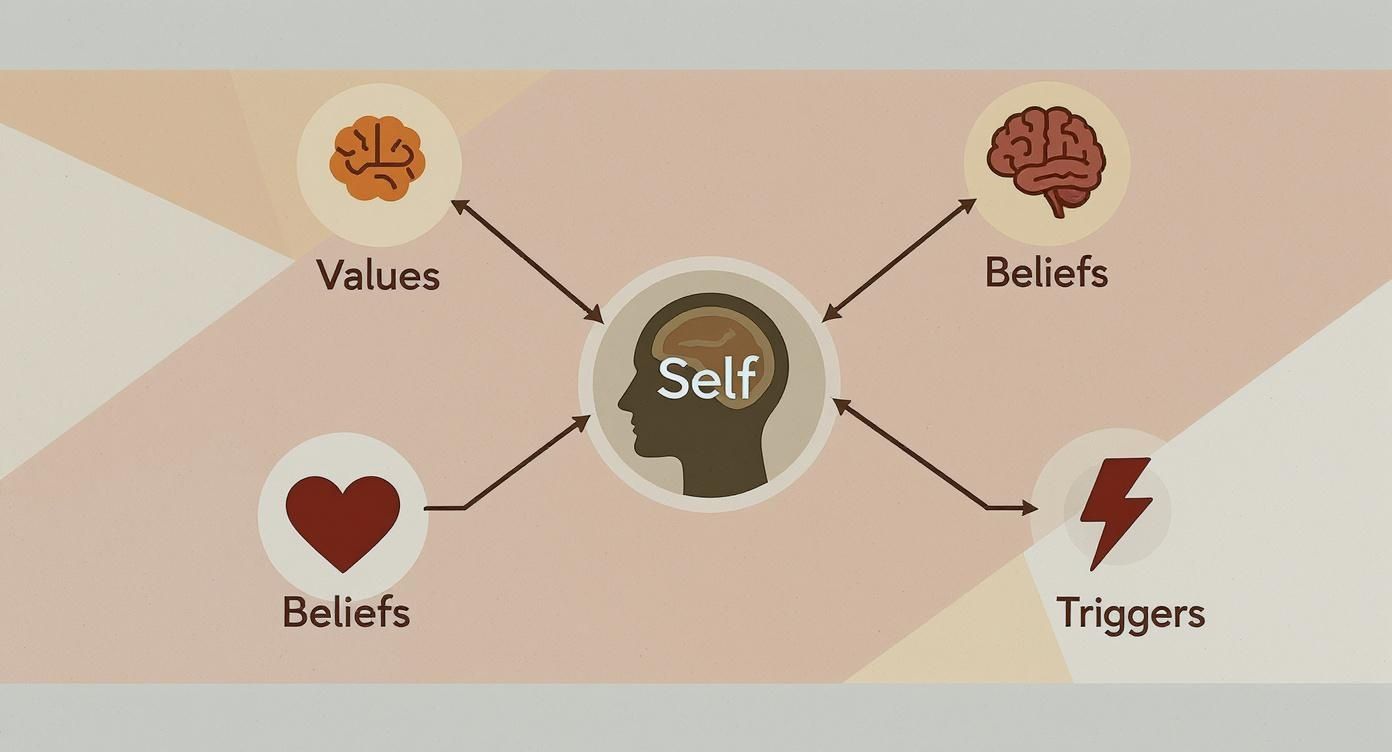
Get a handle on how these pieces connect, and you’ll start to understand the why behind everything you do.
Conduct a Personal Values Audit
Your values are the invisible script guiding your choices, actions, and judgments. They’re your personal definition of a life well-lived. Here’s the catch: most of us have never actually sat down to define them. This creates a frustrating gap between what we say is important and how we actually live.
A personal values audit is a simple exercise to close that gap. It’s a gut check to see if your daily actions align with your deepest principles. When they’re in sync, you feel authentic and purposeful. When they’re not, you feel drained, resentful, or just… off.
Ready to start? First, pick your top five core values. If you're stuck, here are a few to get you thinking:
- Connection: Do you thrive on deep, meaningful relationships?
- Growth: Is continuous learning and self-improvement your jam?
- Creativity: Do you need to express yourself and make new things?
- Stability: Is a sense of security, order, and predictability vital?
- Freedom: How much do you need independence, autonomy, and choice?
Got your list? Great. Now, for one week, track where your time and energy go. At the end of each day, ask yourself: “How much of my day was spent honoring these values?”
The answer might surprise you. You might find that while you cherish 'Connection', you only dedicated 1% of your week to nurturing it. This isn't a moment for guilt—it's a moment of clarity. It's powerful data you can use to make a change.
Create a Trigger Inventory with the ABC Model
We all have them. Emotional triggers are those specific situations, words, or even people that set off a surprisingly big emotional reaction. Understanding what pulls your strings is the first step toward moving from unconscious reacting to conscious responding.
A brilliant tool for this is the Antecedent-Behavior-Consequence (ABC) model, a cornerstone of cognitive behavioral therapy. It gives you a simple, three-part structure to break down any reaction.
- A - Antecedent: What happened right before the emotion hit? Get specific. (e.g., "My manager sent a one-word email: 'Urgent.'")
- B - Behavior: What did you do? This includes your thoughts, feelings, and actions. (e.g., "Felt a wave of anxiety, my stomach clenched, and I immediately started scrolling Instagram instead.")
- C - Consequence: What was the immediate result of that behavior? (e.g., "I avoided the task, which gave me a short-term hit of relief, but made my stress way worse an hour later.")
By jotting these down whenever you notice a strong reaction, you’re creating a "trigger inventory." It usually only takes a few entries before the patterns jump right off the page.
Here's how it plays out: Someone who always procrastinates might use the ABC model and find a pattern. The Antecedent is usually getting critical feedback. The Behavior is avoiding the project. The Consequence is a quick dose of relief, followed by a mountain of anxiety. Suddenly, they see it’s not about laziness at all—it’s an emotional defense against a fear of not being good enough.
If you want to dig even deeper into this, working through a good list of powerful self-reflection prompts and questions can help you investigate those antecedents and behaviors with more structure.
Exploring Other Frameworks
The ABC model makes a real difference for understanding your reactions, but there are plenty of other tools that offer different windows into the self. The key is to find what clicks for you. Don't force a system that doesn't feel right.
For instance, many people get a lot out of personality models like the Enneagram or Myers-Briggs. They offer a shared language and framework for understanding your natural tendencies.
Others find that diving into more symbolic systems can be just as insightful. For those who connect with astrology, learning to gain insights from your birth chart can feel like getting a unique cheat sheet to your innate gifts and challenges.
Remember, the goal isn't to put yourself in a box. It’s to use these systems as mirrors. They reflect parts of yourself you might not have had words for, giving you another powerful lens to view your own inner map.
Step 3: Use Technology as a Mirror for Self-Awareness
https://www.youtube.com/embed/7eocIacA0n0
While introspection is a deeply human act, the right technology can be a surprisingly powerful ally. The key is to see these tools not as a replacement for your intuition, but as a mirror—one that reflects your own patterns back to you with startling clarity.
Used with intention, an ethical, AI-powered tool can help you spot connections you might otherwise miss. It’s not about outsourcing your thinking; it’s about speeding up the discovery process. Instead of manually sifting through months of journal entries to find a pattern, these systems show you the links between your moods, activities, and energy levels.
It’s about empowerment through your own data, finally giving you proof for the gut feelings you've always had.
Decoding Your Digital Footprint
Think about the sheer amount of data you generate every single day. Mood logs, journal entries, sleep trackers, and even your calendar hold clues to your inner world. An intelligent journaling tool basically acts as your personal data scientist, helping you make sense of it all without getting buried in spreadsheets.
For example, maybe you get a recurring wave of anxiety every Sunday evening. A digital tool could analyze your entries and highlight a consistent theme: you almost always write about a difficult meeting scheduled for Monday morning.
Suddenly, a vague, nameless feeling has a clear source.
This shift toward data-driven self-awareness is becoming more common. By 2026, AI-driven self-awareness apps are increasingly used to analyze behavioral patterns and offer personalized recommendations for emotional intelligence. Even the World Health Organization has put a spotlight on self-care interventions, encouraging people to take a more active role in their own mental health. You can read more about how self-awareness drives personal growth at ogslearning.com.
A Practical Walkthrough with AI Journaling
Let's make this real. Imagine you’ve been using an AI journaling companion like Life Note for a few weeks, writing about your daily life, work frustrations, and personal goals. Here’s how the technology can act as your mirror:
- Pattern Recognition: The tool might notice you use words like "drained" or "uninspired" every time you mention a specific project at work. It can highlight this for you, prompting a deeper look into whether that project truly aligns with your core values.
- Mood-Activity Correlation: You've been tracking your mood and noting your daily activities. The system could generate a simple, powerful insight: "We've noticed that on days you go for a morning walk, your reported mood is 30% higher on average." This isn't a command; it's a reflection of your own experience, giving you clear evidence of what actually works for you.
- Connecting Past to Present: An advanced tool with memory can link a current challenge to something similar you wrote about six months ago. It might say, "This situation feels a lot like the one you faced in January. Back then, you found that talking it through with a friend was helpful. Is that an option now?"
This is what it looks like when an AI mentor provides structured feedback on your entries, helping you see the themes hidden in your own writing.
The real magic here is turning your unstructured thoughts into structured insights. It just makes your self-reflection process more efficient and, honestly, more profound. If you want to dive deeper, we have a whole collection of articles on the benefits of AI journaling.
"The greatest discovery of my generation is that a human being can alter his life by altering his attitudes of mind." - William James
Keeping a Healthy Balance
Look, the goal is to use technology to sharpen your self-awareness, not to become dependent on it. It’s a tool, not an oracle. Here are a few ground rules for keeping a healthy relationship with these digital mirrors:
- You Are the Authority: Always treat AI insights as suggestions for reflection, not as definitive truths. Your lived experience is the final word.
- Use It for Clues, Not Conclusions: Let the tech point you in the right direction. Use its observations as a starting point for your own journaling and contemplation.
- Schedule Digital Downtime: Make sure you still have time for unguided reflection—a quiet walk, meditation, or just sitting with your thoughts without any screen. This prevents the tool from shaping your thoughts before you've even had a chance to feel them.
Ultimately, these tools are at their best when they help you build a stronger connection with yourself. They should clarify your inner voice, not quiet it.
Step 4: Turn Insight Into Aligned Action

Discovering a deep truth about yourself is a powerful moment. But self-awareness without action is like drawing a detailed map and then leaving it folded in your pocket. The real journey begins when you use that map to actually navigate your life.
This is where so many of us get stuck. The gap between knowing something and doing something about it can feel immense. The key is to build a bridge between your inner world and your outer reality, one small, intentional step at a time.
True change happens when your daily choices—from the career you pursue to how you spend your Saturday—start to reflect the person you now understand yourself to be. It’s about creating a life that feels less like a performance and more like a genuine expression of your core self.
From Core Values to Daily Habits
The most direct way to put insight into practice is to connect your core values to your daily habits. Your values are your "why"; your habits are your "how." When these two are aligned, you create a powerful engine for a meaningful life.
Let’s say through reflection, you’ve realized that ‘creativity’ is one of your top five values, but your daily routine is filled with administrative tasks that leave you feeling totally drained. The insight is clear, but what’s the action?
It doesn't have to be some dramatic life overhaul. It can start small.
- Schedule a "Creativity Block." Dedicate just 20 minutes, three times a week, to a creative activity—sketching, writing, playing an instrument. Put it on your calendar like any other important appointment.
- Reframe an existing task. Can you bring creativity into your current work? Maybe it’s by designing a more elegant spreadsheet or finding an inventive solution to a recurring problem.
- Consume creative content. Spend your lunch break watching a documentary about an artist you admire or reading a chapter of a beautifully written book.
These aren't just small tasks; they are acts of integrity. You are honoring what you’ve learned about yourself, which builds self-trust and powerful momentum.
Setting Goals That Actually Resonate
Once you know what really matters to you, your whole approach to goal-setting changes. You stop chasing goals you think you should want and start creating goals that are genuinely aligned with your inner compass.
An aligned goal feels energizing, not draining. It pulls you forward with a sense of purpose.
Here’s how to frame goals that connect directly to your self-knowledge:
| Goal Type | Traditional Goal Example | Aligned Goal Example (Value Connection) |
|---|---|---|
| Career | "Get a promotion." | "Find a role where I can use my strategic thinking (Value: Growth) to lead a team (Value: Connection)." |
| Health | "Lose 15 pounds." | "Build a consistent fitness routine that makes me feel strong and energized (Value: Vitality)." |
| Social | "Go to more networking events." | "Schedule one meaningful conversation each week with someone who inspires me (Value: Connection)." |
See the shift? The aligned goals are rooted in a feeling and a value, not just an external outcome. This makes them far more sustainable and fulfilling. Suddenly, the journey to achieve them becomes just as rewarding as the destination.
By grounding your ambitions in your newfound self-awareness, you're not just working toward a different future—you're living differently in the present. Every step feels more authentic.
Navigating the Discomfort of Change
As you begin to act on your insights, get ready for some friction. This change might feel uncomfortable for you, and it might feel confusing to others who are used to the "old" you.
Imagine someone who discovers their trigger for people-pleasing is a deep-seated fear of conflict. Their aligned action is to start saying "no" to requests that drain their energy. The first few times they do this, it will likely feel terrifying. Their friend or colleague might be surprised, or even a little annoyed.
This is a normal—and necessary—part of the process.
Here's how to handle it:
- Start with low-stakes scenarios. Practice setting a new boundary with a supportive friend before trying it with your boss.
- Communicate your 'why' (if it feels right). You don't owe anyone an explanation, but sometimes sharing a little context helps. A simple, "I'm working on managing my energy better so I can be more present for the important things," is often enough.
- Embrace imperfection. You will stumble. You might revert to an old pattern under stress. That's okay. The goal is progress, not perfection.
Once you have this clarity, effective strategies for getting things done become crucial for turning your intentions into reality. Building a clear plan helps you stay on track when the initial motivation fades. For a deeper dive, our guide on how to turn your wisdom into action offers a complete framework.
Conclusion: The Lifelong Practice of Self-Understanding
The journey to understand yourself is not a one-time project but a lifelong practice. It's a continuous process of checking in, getting curious, and courageously aligning your life with what you find. Each insight, no matter how small, is a step toward a more authentic and fulfilling existence.
The tools and frameworks in this guide—from compassionate journaling to the ABC model—are your map and compass. Use them to navigate your inner world with confidence, turning self-awareness into meaningful action. By committing to this practice, you build the most important relationship you will ever have: the one with yourself.
Frequently Asked Questions (FAQ)
How long does it take to understand yourself truly?
Self-understanding is a lifelong practice, not a destination. However, with consistent effort (e.g., 15 minutes of daily reflection), you can gain significant clarity and notice meaningful patterns within a few months. The goal is continuous learning, not a final answer.
What if I discover things I don't like about myself?
This is a sign of progress. The key is to approach these discoveries with self-compassion, not judgment. View these traits as old protective mechanisms that may no longer be useful. Get curious about their origins and decide on one small, different action you can take next time, turning a moment of discomfort into an opportunity for growth.
Do I need a special tool or app to understand myself?
Depends. Tools like journals and apps like Life Note are excellent for providing structure and spotting patterns, but the core practice is simply creating consistent time and space for reflection. This can also be achieved through mindfulness, deep conversations with a trusted friend or therapist, or spending quiet time in nature. The best method is the one you will stick with.
How do I know if I'm actually making progress?
Progress in self-awareness is often subtle. You'll notice it in small shifts: you become less reactive to triggers, you can name your emotions more precisely, your decisions feel more aligned with your values, and you experience a greater sense of inner calm, even when life is challenging.
Ready to turn your reflections into a structured journey of growth? Life Note is the world’s first AI life companion designed to help you access your inner clarity. Journal with mentors like Carl Jung and Brené Brown, uncover hidden patterns, and transform your insights into aligned actions. Start your journey to deeper self-understanding today at https://www.mylifenote.ai.
Explore More
 Daniel W. Chen
 Daniel W. Chen
Journal with 1,000+ of History's Greatest Minds
Marcus Aurelius, Maya Angelou, Carl Jung — real wisdom from real thinkers, not internet summaries. A licensed psychotherapist called it "life-changing."
Try Life Note Free