
How to Make Better Decisions: Wisdom from Great Minds

Explore More
Continue your journey:
- How to Start Journaling in 2026 — The complete guide
Explore More
Continue your journey:
- Productivity Journaling: 50+ Prompts — The complete guide
📌 TL;DR — Making Better Decisions
Better decisions come from understanding how your brain makes decisions—and compensating for biases. Key practices: define the decision clearly (half the battle), consider what you'd advise a friend, sleep on big decisions, imagine you've already decided (notice relief or dread), and separate emotion from analysis. Journaling creates space between impulse and action.
It's easy to assume great decisions come from a flash of genius. But if you study historical figures like Leonardo da Vinci or Marcus Aurelius, you discover their secret wasn't intellect alone—it was a structured process.
Their methods for cutting through the noise are more relevant than ever in our world of information overload. We face "analysis paralysis," bombarded by data and opinions until the path forward fogs over. This guide moves beyond theory to give you the exact mental frameworks these great thinkers used to find clarity.

Uncovering Timeless Mental Models
Instead of relying on gut feelings—which we now know are swayed by emotion and hidden biases—history's sharpest minds built repeatable systems. These mental models gave them a reliable way to deconstruct problems, weigh potential futures, and act with conviction.
Nobel laureate Daniel Kahneman explained the core problem with our modern approach in his book Noise: A Flaw in Human Judgment:
"Wherever there is judgment, there is noise, and more of it than you think."
The frameworks we're about to explore are designed to reduce that "noise" and inject objectivity into your process.
Here’s what we’ll walk through:
- Building a solid foundation by getting clear on your core values, like the Stoics did.
- Applying powerful decision frameworks used by visionaries from Benjamin Franklin to modern strategists.
- Turning these strategies into a daily practice using tools like a decision journal to learn from your own experience.
By adopting these methods, you’ll learn how to make better decisions consistently. It’s about building a life of greater purpose, one clear choice at a time.
To make consistently great decisions, you have to understand the lens through which you see the world. Before you evaluate options, you need a solid foundation built on self-awareness.
This is where First Principles Thinking comes in. Championed by thinkers from Aristotle to modern innovators, it’s the art of breaking a problem down to its most fundamental truths. Instead of reasoning by analogy—doing something because others do—you question every assumption until you're left with only what you know for sure. This practice stops you from inheriting flawed logic, letting you build choices on a bedrock of clarity.
Think of it like building a house. You wouldn’t start on a swampy plot. That ground represents your personal values and awareness of your own mental shortcuts. A strong foundation ensures whatever you build on top—your decisions, goals, and actions—is solid.
Uncover Your Core Operating System
Your core values are your personal operating system. They run quietly in the background, shaping every choice you make. When your decisions clash with these values, you feel conflict and regret. When they align, you feel authentic and confident.
Figuring out these values isn't a fuzzy philosophical exercise. It's a practical step toward clarity. Without this internal compass, you navigate life based on external noise—what society expects, what your friends are doing, or what feels easy.
Here are a few prompts to get you started:
- Recall a peak moment. Think of a time you felt genuinely proud or fulfilled. What were you doing? What values were you living out? Maybe it was creativity, connection, or courage.
- Identify a moment of anger. When did you feel frustrated? What core value was being trampled on? Our strongest negative reactions often point directly to our most sacred principles.
- Define your non-negotiables. What are the lines you absolutely will not cross? These are the pillars of your value system.
Journaling is one of the best tools for this kind of deep introspection. This isn’t a one-and-done task; it’s an ongoing conversation with yourself.
Diagnose Your Hidden Biases
Once you clarify your values, you must face the invisible forces that warp your thinking: cognitive biases. These are the brain's automatic shortcuts, mental glitches that affect everyone. They help us process information quickly but often lead to serious errors in judgment.
One of the most common is confirmation bias. This is our natural tendency to seek out, interpret, and remember information that confirms what we already believe, while ignoring anything that contradicts it. If you’re convinced a certain path is right, you'll subconsciously hunt for evidence that agrees with you and dismiss anything that doesn't.
"When people are coming close to a decision, it becomes difficult to raise doubts. Anyone slowing things down becomes the enemy." - Daniel Kahneman
Our minds resist being challenged once we've picked a path. Recognizing this tendency is the first, crucial step to overcoming it. To make better decisions, you have to actively fight your brain's default settings.
Challenge Your Assumptions Actively
Building a solid foundation means making a habit of questioning your own thoughts. You need to cultivate an internal skeptic who doesn’t just accept your first impressions.
So, when facing a choice, pause. Create distance from your initial gut feeling and ask yourself:
- Stripped of all jargon and assumptions, what is the real problem I’m trying to solve here?
- What do I believe about this situation, and what hard evidence do I have to back that up?
- What would someone I respect, who thinks completely differently, say about this?
This deconstruction is the heart of First Principles Thinking. It shifts you from being reactive to proactive. By combining a clear grasp of your values with a vigilant awareness of your mental shortcuts, you create the unshakeable foundation needed for a lifetime of better decisions.
Master the Mental Models of Visionaries
Once you have a solid handle on self-awareness, it's time to build your toolkit of mental models. These aren't just academic theories. They're practical frameworks that great thinkers have used for centuries to cut through the noise and make better choices.
Think of a mental model as a blueprint for your thinking. An architect uses different plans for a skyscraper than for a house; you should use different models for different decisions. They give you structure, expose hidden assumptions, and steer you toward a more logical, less biased conclusion.
Decision-Making Frameworks of Great Thinkers
Let's look at a few powerful models from history's greatest minds. Each one offers a unique lens for tackling a specific kind of problem.
| Mental Model | Originator/Proponent | Best For | Key Action |
|---|---|---|---|
| Pros & Cons with Weighting | Benjamin Franklin | Clear, defined choices with multiple factors (e.g., job offers, large purchases). | List positives and negatives, but assign a numerical "weight" to each based on its true importance. |
| Pre-Mortem (Premeditatio Malorum) | The Stoics | High-stakes projects or decisions where failure would be costly. | Imagine the project has already failed spectacularly. Work backward to identify all possible causes. |
| OODA Loop | John Boyd (USAF Colonel) | Fast-paced, competitive environments requiring quick, adaptive decisions. | Rapidly cycle through Observe, Orient, Decide, and Act to outmaneuver competitors. |
These frameworks aren't just for historical figures; they are immediately applicable tools. By understanding when and how to use each one, you can bring clarity and structure to even the most chaotic decisions.
Franklin’s Method for Balanced Analysis
Benjamin Franklin had a beautifully simple approach for tough choices. He wouldn't just trust his gut. He'd grab a sheet of paper, draw a line down the middle, and make what we now know as a pros and cons list.
But here's the part most people miss: he assigned a "weight" to each one. A small pro might be a 1, while a massive con could be a 5. This forces you to think about the magnitude of each point, not just the quantity. It's a brilliant way to inject objectivity into an emotional decision.
This infographic captures that very first step of any good decision: pausing to evaluate a new idea with self-awareness instead of just accepting it.
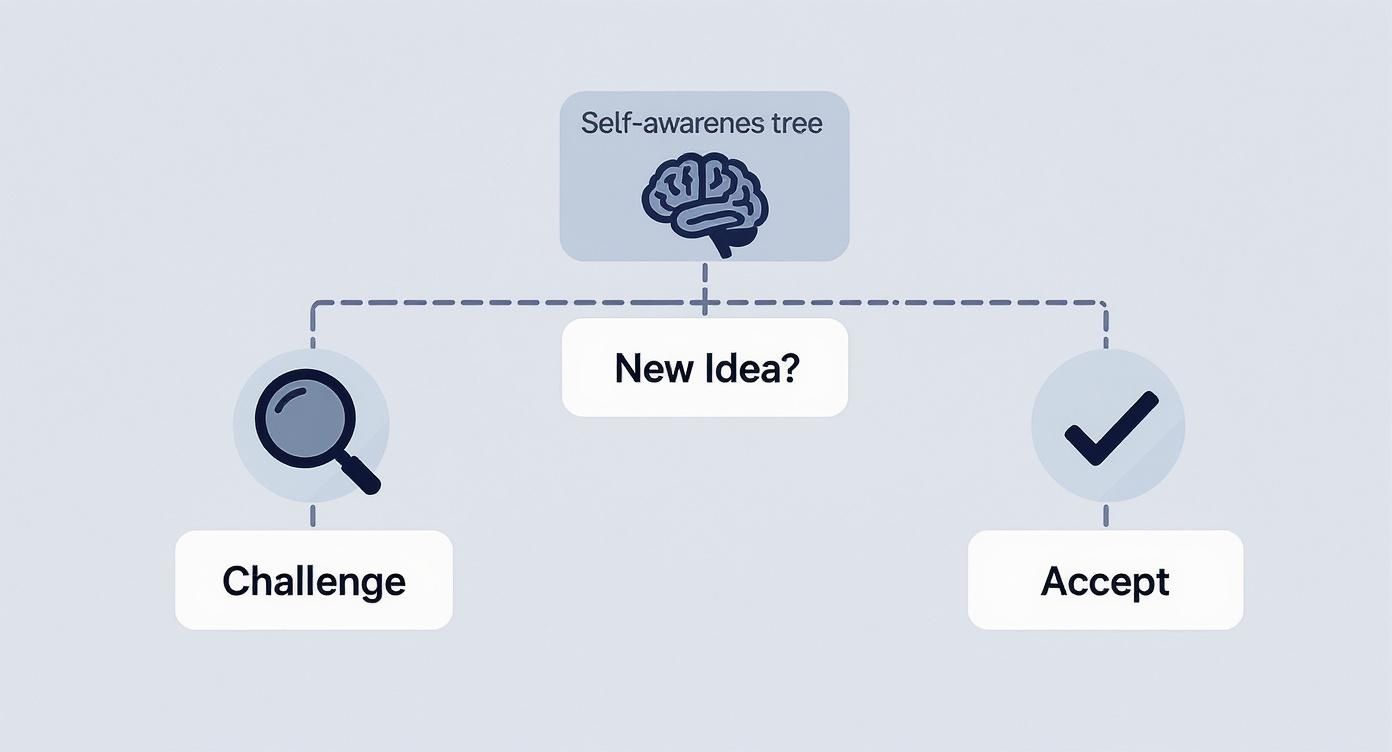
As the visual shows, every decision begins with a choice: do you passively accept an idea, or do you actively challenge its assumptions?
The Stoic Practice of Premeditatio Malorum
While Franklin's model helps you weigh the present, the ancient Stoics had a tool for stress-testing the future. They called it Premeditatio Malorum, or "the pre-meditation of evils." Today, we call it a pre-mortem.
The concept is simple and profound. Before you commit, you imagine the decision has already been made and has failed completely. Then, you work backward to figure out every possible reason why it went wrong. This makes it psychologically safe to voice concerns and spot weaknesses without being labeled a naysayer. By mapping out risks ahead of time, you can build smarter contingency plans and strengthen your strategy.
To really dig into these concepts, you can explore a whole range of structured approaches. This guide on 10 Powerful Decision Making Frameworks is a great place to start.
The OODA Loop for Decisions Under Pressure
Not all decisions happen in a quiet room with a spreadsheet. That’s where the OODA Loop, developed by military strategist John Boyd, comes in. It’s a four-stage cycle for making smart choices in fast-moving, competitive situations.
- Observe: Gather the raw data. What’s happening right now?
- Orient: This is the most important step. You filter the data through your experience, culture, and biases to make sense of it.
- Decide: Based on your orientation, you pick the best path forward.
- Act: You execute your decision.
Then the loop starts again. By cycling through Observe, Orient, Decide, and Act faster than your competitors, you gain a massive strategic edge. It’s a framework used by everyone from fighter pilots to CEOs to stay agile.
Integrating Modern Tools with Timeless Wisdom
These models are powerful on their own, but they become even more potent when combined with modern tools. In a tool like Life Note, you can embed these frameworks directly into your journaling. Imagine having a guided conversation with a mentor like Marcus Aurelius about a pre-mortem you just ran, or workshopping a pros-and-cons list with a virtual Ben Franklin. This turns abstract models into living wisdom you can apply to your real-world challenges.
By mastering just a few of these mental models, you're not just learning tricks—you're building a versatile intellectual toolkit. You learn to match the right framework to the right problem, turning confusion into clarity and doubt into decisive action.
Don't Drown in Data—Learn to Swim
We have more information at our fingertips than any leader in history ever did. But instead of making us all-knowing, this firehose of data often leads to “analysis paralysis”—the frustrating state of overthinking that freezes us from making any decision at all.
The secret isn’t to find more data. It’s to find the right data.
Florence Nightingale figured this out in the 1850s. She didn't just collect dry statistics on soldier mortality; she turned them into striking visual charts. The data became so clear and impossible to ignore that it forced radical reforms in military healthcare. That’s our goal: to turn raw information into a clear, compelling story that demands action.
The 80/20 Rule for Information
One of the best mental models for cutting through the noise is the Pareto Principle, better known as the 80/20 rule. It states that roughly 80% of results come from just 20% of the effort or causes.
When applied to decision-making, it means a tiny fraction of the available information will give you most of the insight you need. Your job is to stop trying to know everything and start hunting for that vital 20%.
- Considering a career change? Don't read a hundred job descriptions. Zero in on the 20% of roles that genuinely match your core values. A few deep conversations with people in those fields are more valuable than skimming dozens of corporate websites.
- Making a business decision? Don't get lost in metrics. Pinpoint the few key performance indicators (KPIs) that truly drive success—like customer lifetime value or churn rate—and track them relentlessly.
This mindset frees you from the pressure of exhaustive research. It’s about being effective, not just busy.
A Simple Framework for Data-Driven Choices
You don’t need a Ph.D. in statistics to make smart, data-informed choices. All it takes is a simple, repeatable process.
Gather Intelligently: Start with a specific question. What are you trying to figure out? This keeps you from falling down a rabbit hole of pointless data collection. And as you gather, be brutally honest—are you looking for the truth, or just for information that confirms what you already believe? That’s confirmation bias, and it’s a decision-killer.
Interpret with Context: Numbers without context are noise. A 5% jump in sales might feel great, but it’s a disaster if your competitor grew by 25%. Always look for trends, benchmarks, and comparisons. Visualizing data can often reveal a pattern that a dense spreadsheet hides.
Act and Iterate: A good decision is one you can act on. Treat your choice as an experiment, not a final verdict. Set a date to review the outcome. This turns every decision, good or bad, into a valuable lesson that sharpens your judgment for next time.
It's a feedback loop, not a search for a single, perfect answer. It's about learning and adapting on the fly.
Making Data Work For You
The struggle to manage information is real. Unstructured data now makes up 80–90% of all new information. Leaders recognize the challenge; 80% say better data access improves their decision-making, and 70% feel real-time data is critical for staying agile.
The goal is not to have the most data, but to have the clearest understanding. Information should serve your decision, not become the decision itself.
To keep from getting buried, tools that help you make sense of this flood are becoming essential. Exploring things like automated reporting tools can be a major advantage. They do the heavy lifting of gathering and organizing data, freeing you to do the human part: thinking, interpreting, and deciding.
Ultimately, you want to build a healthy relationship with data, where it informs your intuition instead of overpowering it. By using mental models like the 80/20 rule and sticking to a simple framework, you can turn information from a source of stress into your greatest asset.
Use the Power of Diverse Perspectives
Making decisions alone is a recipe for disaster. We all have blind spots. Even the sharpest leaders know their own perspective is limited.
Abraham Lincoln famously built a "team of rivals"—a cabinet filled with his political opponents. He did it to stress-test every decision from all angles and avoid the fatal flaws that grow in echo chambers.
Truly great decision-making is a collaborative sport. It means intentionally seeking out people who will challenge your assumptions, not just agree with you. When you only ask people who think like you, you’re not getting advice; you’re getting validation. That's where confirmation bias takes over.
Build Your Personal Board of Advisors
You don’t have to be a president to use this strategy. You can create your own personal "board of advisors"—a small, trusted group of people who see the world differently. This isn't just your friend group; it's a team you deliberately assemble.
Think about putting together a crew with different skills:
- The Optimist: Sees the potential and upside you might miss.
- The Pragmatist: Pokes holes in your plan, asking the tough "how" questions.
- The Industry Veteran: Knows the landscape and can warn you about common pitfalls.
- The Complete Outsider: A person from a totally different field whose "naive" questions can expose your biggest blind spots.
Finding these people is a huge part of your growth. If you want to dive deeper, check out our piece on why you need a mentor and how to build those relationships. A great mentor is often the first and most important member of your advisory board.
Master the Art of Asking for Feedback
Just asking, "What do you think?" is too vague. To get real, constructive feedback, you have to be specific and frame your questions to encourage honest disagreement.
Instead of open-ended questions, try a more structured approach:
- "I'm leaning toward Option A for these three reasons. What am I missing? What are the biggest risks you see?"
- "Imagine this project completely failed a year from now. What would have been the most likely causes?"
- "If you were in my shoes, what is the one thing you would absolutely do differently?"
This changes the dynamic. It’s not an opinion poll; it's a collaborative problem-solving session. You’re not asking for approval—you’re asking for intelligence.

This isn’t just a personal growth hack; it's a core business strategy. The World Economic Forum notes that inclusive decision-making and workforce diversity are now critical for success. Bringing in different perspectives isn't a "soft skill" anymore—it's a competitive necessity.
A decision is only as strong as the weakest argument it has considered. Seeking out dissent isn't a sign of weakness; it's the ultimate sign of intellectual confidence.
By intentionally inviting different viewpoints into your process, you make your decisions more resilient. You learn to spot the valuable signals in the noise, anticipate what's coming next, and ultimately, move forward with far greater clarity and conviction.
Turn Insight Into a Lifelong Habit
We’ve journeyed from uncovering your core values to mastering the mental frameworks of great minds. Now for the most important piece: turning knowledge into instinct.
Making better decisions isn't a one-time upgrade. It’s a skill built through consistent, deliberate practice. The goal is to make clarity and confidence your default settings. This transformation starts with small, repeatable actions that build momentum.
Create a Weekly Reflection Ritual
Find just 15 minutes once a week to look back on the choices you made. This isn’t about beating yourself up over bad outcomes; it’s about calmly analyzing your process. This simple commitment creates a powerful feedback loop that fuels continuous improvement.
The real challenge in making good decisions is not in the moment of choice, but in the practice of reflection that precedes and follows it.
A dedicated journal is the perfect tool for this. By using a decision journal template, you can document your reasoning, track the actual results, and start to spot the hidden biases that creep in over time.
This one habit is what transforms abstract concepts into a practical, lifelong skill.
Frequently Asked Questions
How can I make good decisions when I'm emotional?
High emotion is the enemy of clear thinking. The key is to create psychological distance. Instead of reacting instantly, try the 10-10-10 rule: How will I feel about this in 10 minutes? 10 months? 10 years? This trick forces you to zoom out from your immediate feelings and see the long-term consequences.
What's the biggest mistake people make when deciding?
Hands down, it's confirmation bias. We all do it. It's our brain's sneaky habit of hunting for information that proves we're right while conveniently ignoring anything that suggests we might be wrong. To fight this, you have to deliberately seek out dissenting opinions and actively look for reasons why your preferred choice is a bad idea before you commit.
How do I know if I made the "right" decision?
This is the wrong question to ask. You can run a brilliant process and still get a bad outcome due to pure luck. Conversely, you can make a terrible, impulsive choice that somehow works out.
The quality of a decision should be judged by the process used to make it, not solely by its outcome.
Instead of agonizing over the result, audit your method. Did you get clear on your values? Did you challenge your own biases? If you followed a sound process, you made a “right” decision—no matter how things turned out. This is how you build real judgment over time.
Are these frameworks overkill for small, everyday choices?
Not at all. While you don't need a full pre-mortem for what to eat for dinner, the core principles are scalable. You can turn them into micro-habits. For small daily choices, use a mini-version. Deciding how to spend your evening? Do a quick mental pros-and-cons list. Facing a minor task at work? Briefly ask, "What's one thing that could go wrong here?" Doing this regularly turns structured thinking into a reflex.
Ready to turn reflection into your superpower? Life Note is an AI journaling companion that helps you have conversations with history's greatest minds, uncover your own hidden patterns, and build a lifelong habit of wise decision-making. Start your journey toward clarity today.
Discover the Future of Self-Discovery
Journal with 1,000+ of History's Greatest Minds
Marcus Aurelius, Maya Angelou, Carl Jung — real wisdom from real thinkers, not internet summaries. A licensed psychotherapist called it "life-changing."
Try Life Note Free