
How to Effectively Use a Wellness Journal Planner for Mindfulness

Pick and use a wellness journal planner with prompts, habit and mood trackers, and quick mindfulness practices to build a consistent self-care routine.

📌 TL;DR — Wellness Journal Planner
A wellness journal planner combines habit tracking, mood monitoring, and reflective writing into one system. The most effective approach tracks 3-5 wellness metrics daily (sleep, mood, exercise, nutrition, stress) and pairs them with brief journaling to identify patterns over time.
A wellness journal planner is a practical tool to help you manage your mental and physical well-being. It combines the structure of a planner with the reflective space of a journal, offering sections to track habits, emotions, and health metrics like sleep, nutrition, and exercise. By using it regularly, you can improve mindfulness, reduce stress, and gain clarity about your goals and emotions.
Related: wellness journal guide
Key Takeaways:
- What it is: A mix of a planner and journal with prompts and trackers for habits, mood, and health.
- Why it works: Writing boosts focus, helps process emotions, and supports mindfulness. Research shows journaling can improve sleep and reduce stress.
- How to choose: Pick one based on your goals - anxiety relief, fitness tracking, or gratitude practice.
- Daily use tips: Start small, tie it to a routine, and use prompts or trackers for consistency.
Whether you prefer a traditional journal or an AI-powered tool like Life Note, the key is to start small and stay consistent. Even a few minutes a day can make a meaningful difference in your well-being.
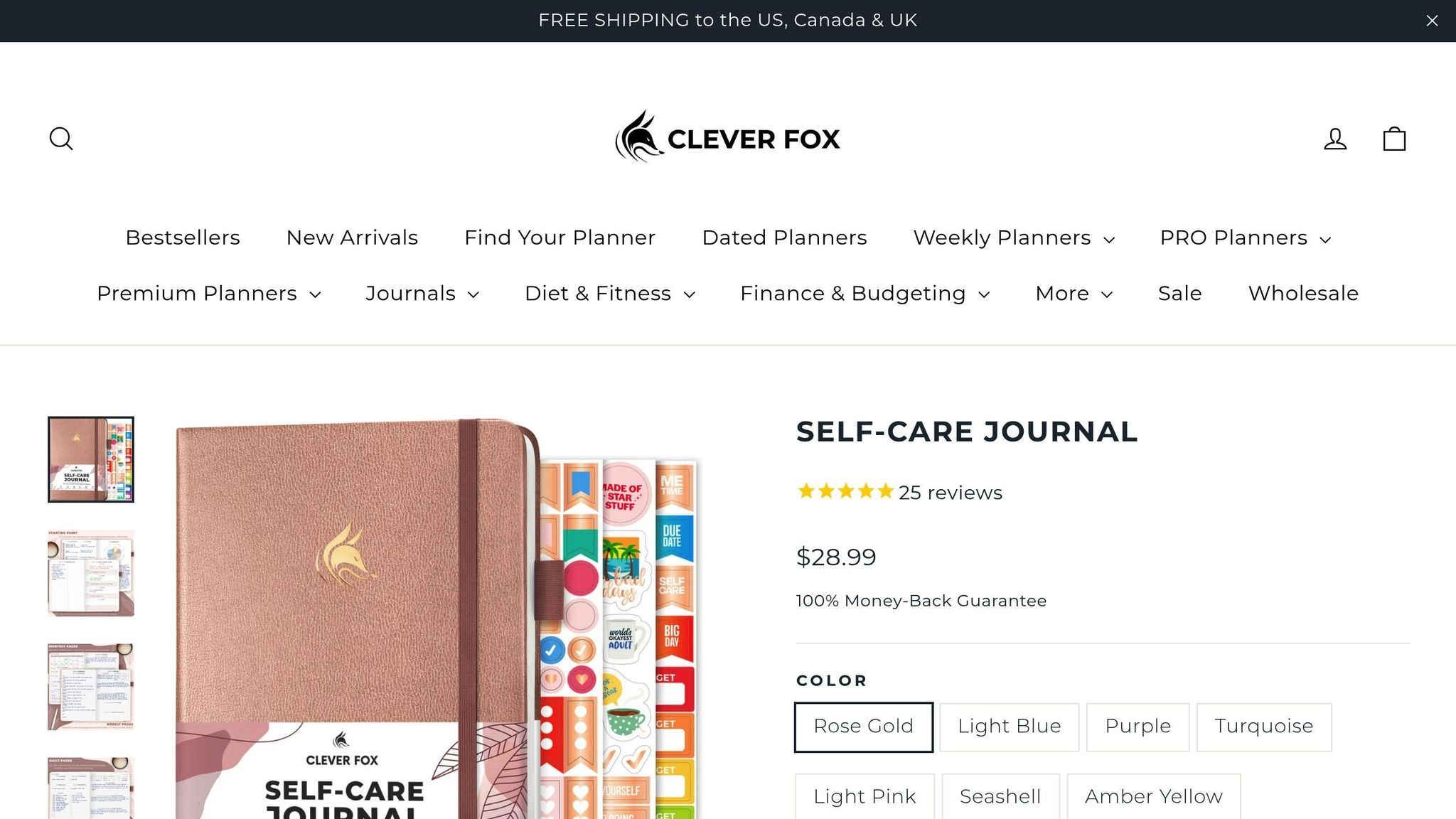
Plan with Me - Mindful Planning ft. Clever Fox Self-Care Journal
Embedded iFrame
Choosing the Right Wellness Journal Planner
The best wellness journal planner matches your specific goals — look for guided prompts, mood trackers, habit sections, and enough blank space for free reflection.
Picking the right wellness journal planner can make all the difference in maintaining a structured self-care routine. Start by identifying your main goal. Are you looking to manage anxiety, track fitness progress, or focus on gratitude? For anxiety, you might need a simple format with prompts that help reframe negative thoughts. If fitness is your priority, look for layouts that include workout and meal-tracking sections. Defining your purpose ensures you’ll pick a journal that supports mindfulness instead of gathering dust on a shelf.
Once you’ve nailed down your goal, it’s time to focus on features that can enhance your mindfulness journey.
Key Features to Look For
A good planner should include tools that encourage consistent reflection. Look for features like daily prompts, weekly check-ins, and tools such as "360 life wheels" to assess different areas of your life. Comprehensive tracking sections for mood, sleep, energy levels, and habits are also incredibly useful. Planners with spaces for setting monthly intentions and outlining actionable steps can help you stay focused.
Mindfulness-specific features, such as gratitude lists, daily affirmations, or sections for a “brain dump,” can reduce stress and promote a sense of well-being [6].
Practical details matter too. High-quality paper (80 lb. or 100 gsm) can prevent ink from bleeding through. Spiral-bound designs make it easier to lay the planner flat, and undated pages offer flexibility to start whenever it suits you. If you’re a visual thinker, color-coded sections might help you spot emotional patterns at a glance.
How AI-Powered Tools Like Life Note Can Help

While traditional planners provide a solid foundation, AI-powered tools like Life Note take personalization to the next level. Unlike static paper planners, Life Note adapts to your entries, creating a more interactive and dynamic journaling experience. It pulls insights from various disciplines and pairs you with a mentor who aligns with your reflections, transforming your journaling into an engaging, two-way conversation.
Life Note’s advanced memory tracks emotional patterns and recurring themes, helping you uncover connections between your thoughts, experiences, and goals that might otherwise go unnoticed. Plus, its personalized weekly reflection letters summarize your entries, offering guidance and balance. This turns your journaling practice into an ever-evolving journey, blending modern technology with timeless insights.
Adding Mindfulness Practices to Your Journal
Integrate mindfulness by writing three sensory observations before journaling — this 60-second grounding exercise shifts your brain from doing mode to awareness mode.
Mindfulness journaling is most effective when you take the time to slow down and genuinely tune into your inner world. The goal here is to create a space where you can reflect intentionally, instead of rushing through your entries. Below are some practical techniques to help you integrate mindfulness into your journaling routine.
Techniques for Mindful Journaling
Start with sensory grounding to anchor yourself in the present moment. Before you even pick up your pen, take a moment to notice your five senses - what you see, hear, touch, smell, and taste. This simple practice can quiet intrusive thoughts and help clear your mind [4][7]. A helpful tool is the 5-4-3-2-1 technique: list five things you see, four you can touch, three you hear, two you smell, and one you taste [7]. This exercise quickly shifts your focus from anxious thoughts to a state of awareness.
Pairing sensory grounding with expressive writing can deepen your mindfulness practice. For expressive writing, set a timer for 15 minutes and write continuously about a troubling issue, without worrying about grammar or structure. While early studies recommended doing this for four consecutive days, even shorter sessions can make a difference [5]. Writing about difficult emotions allows you to process them and view challenges with less intensity. To balance this, incorporate gratitude journaling - list three positive moments from your day and reflect on your role in creating them. This combination can reduce overthinking and strengthen your ability to handle stress [5].
If words alone feel limiting, try visual journaling. Add sketches or doodles alongside your writing. Research shows that blending art with text can be more effective for emotional processing than using either method by itself [5]. Also, consider handwriting instead of typing. The physical act of writing with pen and paper creates a calming rhythm and improves memory recall [4].
"By handwriting in a journal, we can make a mindful moment more memorable and last a little bit longer."
– Misa Terral, Cofounder of Pockitudes [4]
Using Prompts for Deeper Reflection
Once you're grounded through sensory techniques, prompts can guide you into deeper self-reflection. They help you move beyond surface-level thoughts and uncover meaningful insights. For example, if you're feeling stuck, consider asking yourself: "What untrue stories do I tell myself?" or "What am I avoiding, and why?" [5]. Acknowledging areas of avoidance can shift your mindset from dwelling on challenges to taking actionable steps.
Another powerful exercise is to envision your "best possible future self". Write in detail about where you'd like to be in 5 to 10 years regarding your career, health, and relationships [5][7]. This practice helps clarify your values and motivations. You might also write a gratitude letter to someone who has positively influenced your life (whether or not you send it), or recount a moment when you felt genuinely proud of yourself [5][7]. These prompts not only enhance emotional awareness but also reconnect you with what truly matters.
sbb-itb-96f8ddb
Structuring Your Wellness Journal Planner
Structure your planner with daily mood ratings, weekly habit trackers, and monthly reflection pages — this three-tier system captures both patterns and progress over time.
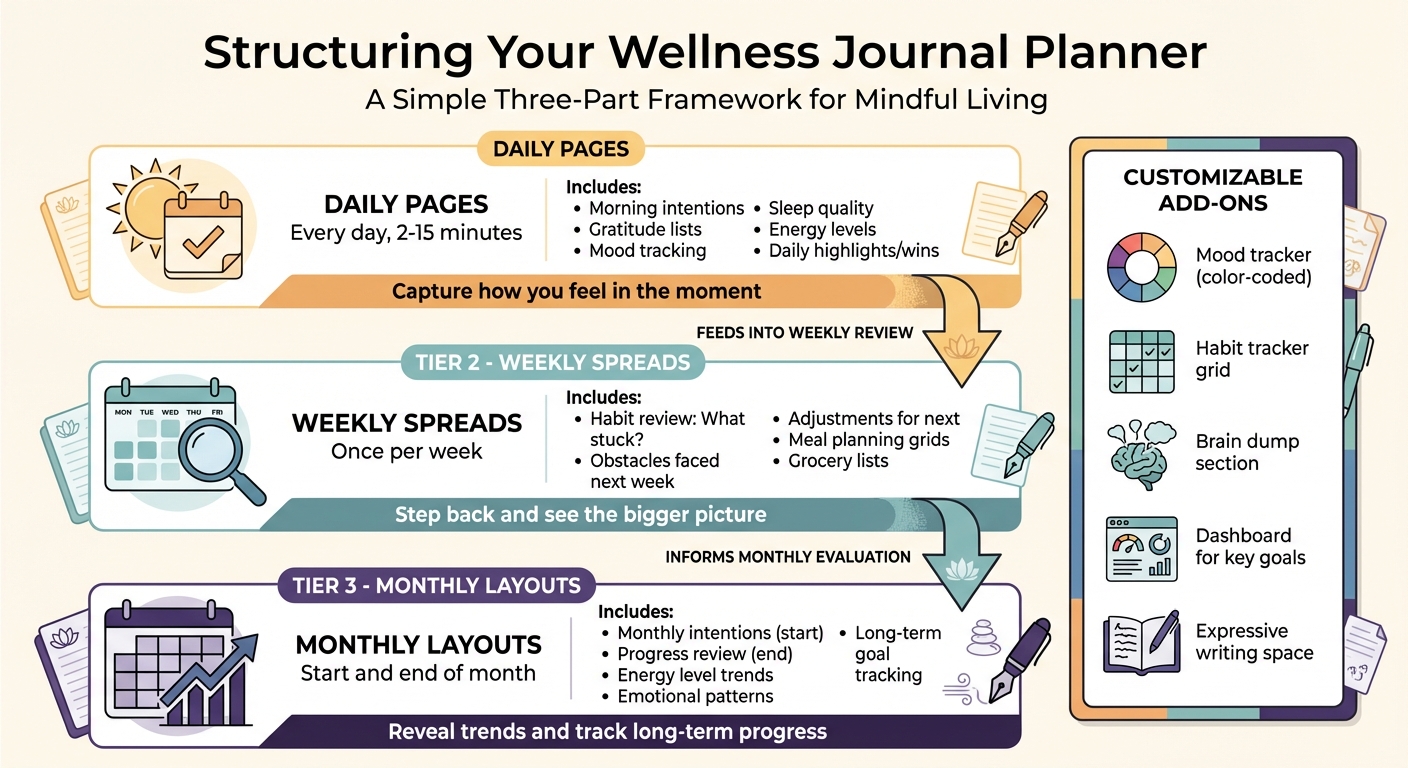
Creating a wellness journal planner that works for you means balancing short-term reflections with long-term tracking. A simple three-part structure - daily pages for immediate mindfulness, weekly spreads for reviewing patterns, and monthly layouts for setting and evaluating goals - provides a solid framework for staying connected to your progress over time [1][3].
Daily, Weekly, and Monthly Layout Options
Daily pages form the core of your wellness journal. These pages often include sections for morning intentions, gratitude lists, mood tracking, sleep quality, energy levels, and daily highlights or "wins" [1][8]. The idea is to capture how you feel in the moment without overthinking it. Whether you spend two minutes jotting down quick thoughts or dedicate 15 minutes to more detailed writing, this habit can offer surprising insights [4][8]. These daily notes naturally feed into your weekly reviews, making it easier to spot recurring themes or habits.
Weekly spreads are where you step back and look at the bigger picture. Use this space to reflect on the past seven days: What habits stuck? What obstacles did you face? What adjustments will you make for the week ahead? [1][3] Many people also incorporate practical tools like meal planning grids or grocery lists, blending reflection with actionable planning [1][3]. These weekly overviews lay the groundwork for monthly evaluations.
Monthly layouts shift the focus to long-term progress and goal setting. At the start of each month, outline your intentions. At the end, take time to review: Have your energy levels changed? Are you noticing any emotional patterns? This higher-level tracking reveals trends that might not be obvious in your daily entries [1][3].
Customizable Sections for Growth
The beauty of a wellness journal planner lies in its flexibility. Tailor it to your needs by including sections that support your goals. For example, a mood tracker with color-coding can help you identify emotional triggers over time [2]. A habit tracker, often designed as a grid or enhanced with stickers, lets you monitor behaviors like hydration, meditation, or exercise at a glance [3][9]. For mental clarity, consider adding a "brain dump" section where you can jot down spontaneous thoughts or ideas [1][8][9].
You might also include a "dashboard" or snap-in tracker to keep your most important goals visible without cluttering your daily pages [8][3]. If stress or anxiety is a focus, dedicate space for expressive writing to process your thoughts unfiltered [5]. The key to designing your journal is understanding your purpose. Are you tracking fitness, managing stress, or cultivating gratitude? Let your "why" guide the sections and tools you include [4].
Staying Consistent with Your Journaling Practice
Consistency beats perfection: journal at the same time daily, start with just one sentence on low-energy days, and pair writing with an existing habit like morning coffee.
Creating a habit of using a wellness journal planner doesn’t have to take up hours of your day or require perfectly crafted sentences. The real challenge lies in showing up consistently, even when life gets hectic or your motivation dips. The strategies below can help you stick with it while keeping journaling stress-free.
Tips for Building a Routine
Start by clarifying why you want to journal, how you’ll hold yourself accountable, and when you’ll make time for it. Your "why" might be to practice gratitude, manage stress, or reflect on your thoughts. Whatever your reason, write it down and revisit it whenever your motivation wanes.
Tie your journaling habit to an activity you already do daily. For instance, you could write after your morning coffee, right after dinner, or just before bed. This method, known as habit stacking, makes journaling feel like a natural part of your day instead of something extra to remember. Keeping your journal in a visible spot - like on your nightstand or desk - also serves as a helpful visual cue.
Start small. Commit to just 2–5 minutes a day and use a timer to keep it manageable. Over time, you can gradually increase your writing sessions as it becomes more comfortable.
Use tools to stay accountable. Smartphone reminders, a journaling partner, or even joining an online journaling community can help keep you on track. Some people find predated journals or habit trackers useful for marking off each completed day, creating a visual streak they’ll want to maintain.
"Journaling is not about being a good writer, or even a prolific one... It's also a mental compost bin, processing your experiences without judgment, obligation, or expectation."Misa Terral, Cofounder of Pockitudes
These strategies make it easier to build a sustainable journaling routine and tackle common hurdles along the way.
Overcoming Common Challenges
Feeling stuck? Writer's block doesn’t mean you’re doing it wrong. If you’re unsure what to write, try a "brain dump" - jot down whatever comes to mind without worrying about structure. Even repeating the same sentence until a new thought surfaces can help break through mental roadblocks.
When perfectionism sneaks in, remind yourself that your journal isn’t a performance. It’s a private space where messy handwriting, fragmented thoughts, and stream-of-consciousness ramblings are all welcome. If a page feels off, simply turn it and start fresh.
If you notice recurring themes like stress or frustration, shift your focus. Instead of writing, "I feel stressed", explore the thoughts behind it: "What am I thinking that’s making me feel this way?" This small adjustment can help turn repetitive venting into productive reflection.
When journaling feels heavy, lighten the mood. Switch gears by listing things you’re grateful for, noting three small wins from your day, or even doodling. The goal is to keep the habit alive, even if the style or content changes, so you can avoid burnout.
"Shame is not a good motivator for me, so I removed it from my wellness journal equation."Elle, Community Manager, Writers.com
Even short sessions can make a difference. Research shows that writing for just 15 minutes a day over four consecutive days can lead to measurable improvements in mental and physical health [5]. You don’t need to write pages to see the benefits - small, consistent efforts add up over time into meaningful change.
Start Your Mindfulness Journey Today
A wellness journal planner can help you clear your mind, ease anxiety, and better process emotions [5]. Studies reveal that writing for just 15 minutes a day over four consecutive days can lead to noticeable improvements in both mental and physical health. These benefits range from strengthening your immune system to lowering stress levels [5][4]. Regular journaling has even been associated with a stronger immune response, a calmer heart rate, and quicker physical recovery [5][4]. Taking time to write allows you to cultivate self-awareness, manage emotions, and gain personal insight - a rare opportunity in today’s fast-paced world [4]. It also helps you recognize emotional patterns, set purposeful goals, and monitor habits that truly make a difference.
Getting started is simple. Dedicate just a few minutes each day to your wellness journal. Forget about grammar or structure - just write freely and honestly. Whether it’s during your morning coffee or right before bed, pick a time that fits seamlessly into your routine. Keep your journal in a visible spot to gently nudge you into making it a daily habit.
If you’re looking for extra guidance, Life Note offers a unique blend of reflective journaling and AI-powered prompts, tailored to your journey. By connecting your past experiences with current challenges, it transforms your daily reflections into meaningful insights that can spark personal growth.
FAQs
How do I choose the best wellness journal planner for my goals?
To choose the right wellness journal planner, start by defining what you want to achieve. If your focus is on fitness or nutrition, look for planners with tools like habit trackers, meal logs, and sections for workouts. If mindfulness or mental health is your priority, go for options that include guided prompts, gratitude exercises, and mood trackers to help maintain balance.
Next, think about how you like to organize your day. Daily layouts are ideal for regular reflections and detailed planning, while weekly or monthly spreads are better suited for keeping an eye on long-term goals. If flexibility is important to you, consider planners with customizable formats or removable pages that can adjust to your changing needs.
Lastly, don’t overlook practical features. A planner should be portable yet spacious, durable with a sturdy cover or binding, and might even include fun extras like stickers or built-in prompts. Matching these details to your goals will make it easier to stay motivated and committed to your wellness journey.
What are some simple mindfulness techniques I can use in my wellness journal?
Adding mindfulness to your journaling routine doesn’t have to be complicated, and it can bring a lot of value to your day. Start with a simple mindful breathing exercise: close your eyes, inhale deeply for a count of four, pause briefly, and then exhale slowly. Repeat this for a minute or two to help settle your thoughts before you begin writing. Afterward, try a quick body scan - pay attention to areas of tension or relaxation in your body, and jot down what you notice. This can help anchor you in the present moment.
Incorporate mindful prompts to shape your journaling. For instance, write down three things you’re grateful for, describe a recent experience in detail using all five senses, or note a positive affirmation that resonates with you. Another helpful practice is to track your mood with a simple color-coded system. Over time, this can reveal patterns and triggers that might otherwise go unnoticed. Wrap up your session by reflecting on one small win or meaningful insight from your day. This approach not only enhances mindfulness but also turns your journal into a tool for self-awareness and growth.
How can I keep up with journaling even when I'm busy?
Sticking to your wellness journal doesn’t have to feel like a chore, even when life gets chaotic. The key is to make it an easy, purposeful part of your routine - something that feels more like a quick recharge than another task on your to-do list.
- Start small: Spend just 3–5 minutes jotting down your thoughts. It could be after your morning coffee or right before you wind down for bed.
- Pair it with a habit: Combine journaling with something you already do every day, like brushing your teeth or taking a lunch break, so it becomes second nature.
- Keep it within reach: Place your journal somewhere you can grab it easily - on your nightstand, desk, or in your bag - so you’re more likely to use it.
- Use simple prompts: Questions like “What made me smile today?” or “What’s one thing I’m grateful for?” keep the process quick and focused.
By weaving journaling into your existing habits and keeping it straightforward, you’ll find it easier to stick with - even on your busiest days.
📚 Related: Looking for more ways to support your mental wellness through journaling? Check out our complete guide to journaling prompts for mental health.
Frequently Asked Questions
What is a wellness journal planner?
A wellness journal planner is a structured tool that combines daily planning with health and well-being tracking. It typically includes sections for mood, sleep, exercise, nutrition, gratitude, and reflective writing.
How do I use a wellness journal effectively?
Track 3-5 key metrics daily (sleep quality, mood, exercise, stress level), write 1-2 sentences about your day, and review weekly to identify patterns. The insight comes from consistency over time, not individual entries.
What should I track in a wellness journal?
Start with sleep (hours and quality), mood (1-10 scale), exercise (type and duration), water intake, and one thing you're grateful for. Add or remove categories based on what's most relevant to your health goals.
Is a wellness journal the same as a bullet journal?
Not exactly. A bullet journal is a productivity system for organizing tasks and events. A wellness journal specifically tracks health and well-being metrics. However, many people incorporate wellness tracking into their bullet journal.
How long should I keep a wellness journal to see patterns?
Most patterns become visible after 2-4 weeks of consistent tracking. For seasonal or hormonal patterns, 2-3 months of data provides more reliable insights. The longer you track, the more useful your data becomes.
Journal with 1,000+ of History's Greatest Minds
Marcus Aurelius, Maya Angelou, Carl Jung — real wisdom from real thinkers, not internet summaries. A licensed psychotherapist called it "life-changing."
Try Life Note Free