
10 Mental Health Journal Prompts to Break the Anxiety Rumination Loop

Explore 10 effective journaling prompts designed to help manage anxiety, break the rumination cycle, and gain emotional clarity.

Mindfulness is a core technique for breaking the rumination cycle. For a dedicated practice, explore our 50 mindfulness journal prompts with worked examples.
📌 TL;DR — Break the Rumination Loop
Rumination is anxious thoughts looping endlessly. Journaling breaks the loop by externalizing thoughts—what's on paper can't loop in your head. Key AI journal prompt generators: "What am I actually worried about?" "What evidence contradicts this?" "What's one action I can take?" Move from circling to clarity to action.
Anxiety doesn’t always roar. Sometimes it whispers.
Sometimes it loops the same thought so many times that it feels like truth.
If you’ve ever been trapped replaying a moment, rewriting a conversation, or predicting a future disaster that hasn’t happened (and probably won’t), you’re not alone. Anxiety thrives in repetition. It feeds on rumination, uncertainty, and the part of your mind that’s trying—desperately—to keep you safe.
Journaling is one of the rare tools that interrupts the loop.
Not because writing magically removes fear,
but because it turns vague discomfort into something you can see,
something you can name,
something you can work with.
This guide offers 10 research-backed journaling prompts designed to help you break anxious cycles, slow down spiraling thoughts, and return to yourself. Each prompt is crafted to help you:
If anxiety stems from past experiences, our guide to journaling for trauma recovery offers deeper therapeutic techniques.
- decode what your mind is really trying to say
- soothe your nervous system
- separate imagined fears from real concerns
- reclaim clarity, agency, and emotional balance
Anxiety often shows up in the body before we recognize it in our thoughts—tight chest, shallow breathing, clenched jaw. Developing somatic awareness can help you catch these physical signals early, before the rumination loop takes hold.
Anxiety thrives in silence.
Journaling gives it a place to speak—and, often, a place to soften.
If your anxiety specifically targets social situations — the dread before parties, the replaying after meetings — our social anxiety journal prompts are organized around that before-during-after cycle.
10 Research-backed Journaing Prompts At Glance:
Each of these prompts is designed to interrupt rumination in a different way—by naming, organizing, softening, or reframing your anxious thoughts.
- Facing the Elephant in the Room – Name the biggest source of your anxiety and describe it honestly, without minimizing or sugarcoating.
- Mapping Your Fears – Break one big fear into smaller, concrete worries and evaluate how likely each actually is.
- Emotional Check-In – Pause to identify what you feel, where you feel it in your body, and what triggered it.
- Letting Go of Control – Sort your worries into “within my control” and “outside my control,” then act only on the first group.
- Self-Compassion Dialogue – Rewrite harsh self-talk as kind, accurate, and supportive inner dialogue.
- Best-Case Scenario Visualization – Give your brain a new “what if” by vividly imagining the best realistic outcome.
- Body Scan Reflection – Track where anxiety lives in your body and describe those sensations with neutral language.
- Reframing Past Experiences – Revisit a difficult memory and retell it with context, growth, and self-empathy.
- Advice to Self – Write a letter to yourself from the perspective of someone who loves you and believes in you.
- Daily Wins and Insights – Capture three small wins and one lesson each day to train your brain to notice progress.
These structured prompts help redirect anxious thoughts, offering practical ways to process emotions and regain a sense of control. Whether you’re tackling a specific worry or seeking daily balance, these exercises provide a clear path forward.
Try the tool: Cognitive distortions worksheet: free CBT exercises
All 15 distortions with examples, plus a generator that builds a printable challenge worksheet for the pattern you are stuck in.
How Journaling Prompts Stop Anxious Thinking Patterns
Expressive writing externalizes anxious thoughts, reducing their emotional charge; research shows twenty minutes of structured journaling lowers cortisol and rumination.
For anxiety specifically triggered by technology and artificial intelligence — a growing concern in 2026 — we've created dedicated prompts for processing AI anxiety.
Journaling prompts break anxiety's rumination loop by externalizing circular thoughts onto paper For an even more direct linguistic intervention — switching to third-person language about yourself — see self-distancing journaling (the Kross method, with the important 2019 depression caveat)., forcing your brain to organize them linearly rather than letting them spiral. When emotions take over completely — a state known as emotional hijacking — structured prompts are especially powerful. This process activates reflective thinking over reactive thinking, giving you distance from anxious thoughts and making them feel more manageable.
When anxiety takes the form of unwanted thoughts — harm thoughts, relationship doubts, contamination fears — rumination becomes obsession. Our intrusive thoughts journal prompts are organized by type (harm, sexual, ROCD, postpartum) and practice cognitive defusion rather than analysis.
Anxiety loves open loops.
No clear question. No clear end. Just “What if…?” on repeat.
A well-designed journaling prompt gives your mind something better to do than spiral. It turns vague dread into a specific task: answer this question, explore this feeling, examine this story. That tiny shift—from looping to looking—is often enough to create relief.
Here’s what’s happening under the hood:
-
You move from chaos to structure.
Instead of thoughts bouncing everywhere, the prompt narrows your focus: “What am I actually afraid of?” “What can I control?” “What evidence supports this fear?” Structure calms the nervous system. -
You move from emotion-only to emotion + observation.
Writing slows thinking just enough for you to see the pattern: “Oh, this is the same ‘I’ll mess everything up’ story again.” Once you see the story, you’re no longer fully inside it. -
You separate reality from imagination.
On paper, you can compare: What has actually happened vs. what my anxious brain is predicting. That gap is where rationality and self-compassion can enter. -
You turn anxiety from an enemy into a signal.
Instead of “Something is wrong with me,” the message becomes “Something in me is asking for attention.” Prompts help you decode that signal—control, uncertainty, perfectionism, shame, fear of judgment, fear of loss, and so on.
Over time, this practice rewires how you relate to anxious thoughts.
They stop being absolute truths and become what they really are: mental weather.
You can notice them, write them down, and let them pass—without building a house inside the storm.
1. Facing the Elephant in the Room
Name the specific worry you have been avoiding; writing it down shrinks its psychological size and transforms vague dread into a concrete, addressable problem.
Sometimes, the root of your anxiety is the very thought you’ve been avoiding. This exercise invites you to confront what your mind has been trying to bury.
The "elephant in the room" represents the major issue fueling your anxious thoughts, even when smaller worries seem to dominate your attention. Counseling psychologist Nonie Carr puts it this way:
"The elephant in the room… it's that thing everyone knows is there but is ignoring. As we ignore the elephant it becomes more and more obvious. It starts to take up more room than you'd like it to." [1]
Acknowledging this underlying issue is the first step toward reclaiming control over your thoughts and emotions.
The Prompt:
Take a moment to write down what’s troubling you the most right now. Be specific. Where did this issue start? How does it affect you physically and emotionally? If you had complete control, what steps would you take to address it?
You don’t need to solve it right away. The purpose is to identify the elephant and take a closer look. Often, the problems we avoid seem far less intimidating once we bring them into the open.
This process is powerful because acknowledgment itself can reduce the weight of the issue. As Carr explains:
"If we notice the elephant in the room, notice and acknowledge the anxiety we feel, the elephant might begin to shrink." [1]
By naming your biggest concern, you can start to see what aspects are within your control. From there, you can begin to ease your anxiety, step by step.
Be brutally honest in this exercise. Don’t downplay or sugarcoat what’s bothering you. The goal is to confront the full scope of the problem - because naming it is the first step to taking away its power.
2. Mapping Your Fears
List every fear connected to your anxiety and rate each from one to ten; this separates rational concerns from catastrophic thinking patterns.
Fear often feels like a shapeless cloud, filling your mind with worst-case scenarios because it lacks clear boundaries.
Fear mapping is a way to untangle that cloud by creating a visual breakdown of what’s truly bothering you. It separates genuine concerns from imagined disasters and gives you a structured way to understand your anxiety. Think of it like building a house - you wouldn’t start without a blueprint, and tackling your fears works the same way. Breaking them into smaller, actionable pieces makes them much easier to handle.
Start by drawing a diagram or making a list. Place your main fear in the center and branch out to explore these key points:
- What could actually go wrong? Be specific. Instead of vague feelings like "everything will fall apart", focus on concrete possibilities that worry you.
- How likely is each scenario? Rate each potential outcome on a scale from 1 to 10, where 1 means "very unlikely" and 10 means "almost certain."
- What evidence supports or challenges these fears? Write down facts, past experiences, or observations that either back up your concerns or suggest they might be exaggerated.
- What can you control? Highlight the areas where you have influence and separate them from the things entirely out of your hands.
This exercise works because it shifts your brain from emotional overdrive to logical thinking. When you’re stuck in a loop of worry, fear mapping helps you step back and approach the situation with a problem-solving mindset.
You might find that your worst fear isn’t as likely as you thought. Or, even if it is, you’ll see there are more solutions available than you initially realized. Often, what feels overwhelming is actually a pile of smaller worries lumped together into one giant, unmanageable problem. A brain dump journal can help — by writing every worry down without filtering, you separate the signal from the noise.
The key is getting specific. For example, instead of writing, "I’m scared about my job", break it down: "I’m worried my boss might cut my role during the next budget review because our team’s revenue dropped 15% this quarter." This level of detail helps you pinpoint exactly what’s troubling you and brainstorm practical steps to address it.
Writing your fears down on paper also takes away much of their power. Once they’re contained within clear boundaries, they stop feeling so overwhelming. Now, instead of a vague sense of dread, you have a plan to tackle each piece one step at a time.
3. Emotional Check-In
Pause and label exactly what you feel right now using specific emotion words; research shows naming emotions reduces amygdala activation within seconds.
Anxiety often operates quietly in the background, gradually draining your energy without you even realizing it.
An emotional check-in is a simple yet effective way to stay in touch with your feelings throughout the day. Think of it as a quick system scan for your emotions. You're not trying to solve every issue at once - just taking a moment to understand what's happening inside your mind and body. This practice helps you catch anxiety before it spirals into overthinking or rumination.
What makes this technique so helpful is its straightforwardness and immediacy. You don’t need to dive into deep introspection. Instead, you’re pausing briefly to observe your current state, breaking the autopilot mode that often fuels anxious thoughts. To get started, focus on these four essential questions:
1. What am I feeling right now?
Pinpoint your emotions as specifically as possible. Instead of general terms like "bad" or "stressed", try identifying whether you're feeling frustrated, overwhelmed, disappointed, or worried. Naming emotions with precision can help you untangle and understand them better.
2. Where do I feel this in my body?
Anxiety often manifests physically before it takes over mentally. Notice if your shoulders are tense, your stomach feels tight, or your jaw is clenched. Recognizing these physical sensations can ground you in the present and create a clearer connection between your mind and body.
3. What triggered this feeling?
Identify the immediate cause of your emotions. Was it a message, a looming deadline, or something you saw online? You don’t need to dig deep into psychological roots - just pinpointing the trigger can help you understand patterns and decide where to focus your energy.
4. What do I need right now?
Ask yourself what small, actionable step could help in this moment. Maybe it’s taking a short walk, drinking a glass of water, or simply allowing yourself to feel the emotion briefly before moving on. Sometimes, acknowledging your feelings is all that’s needed.
The goal here is consistency, not depth. A quick, daily check-in is far more effective than occasional, lengthy journaling sessions. To make it a habit, set a reminder on your phone - perhaps during lunch or just before dinner.
These regular check-ins also serve as a circuit breaker during anxiety spirals. Instead of getting lost in endless "what if" scenarios, this process redirects your focus to tangible, present-moment observations. It’s much harder for your mind to run wild when you’re paying attention to specific details about your current state.
Over time, these check-ins can uncover patterns in your anxiety. For instance, you might notice that your stress spikes after reading emails first thing in the morning or that you feel more anxious mid-afternoon when your energy dips. These insights give you actionable information, helping you make adjustments that reduce anxiety rather than simply enduring it.
4. Letting Go of Control
Write down everything you cannot control about your situation, then list what you can; this Stoic exercise redirects mental energy toward actionable steps.
Anxiety often isn’t just “fear of what might happen.”
It’s fear of not being able to control what happens.
Your mind keeps rehearsing conversations, predicting outcomes, and scanning for danger because it believes: If I worry enough, I can prevent pain. The problem is, worry burns energy without changing reality. This exercise helps you separate where your effort matters from where it doesn’t.
The Prompt
On a clean page, draw two columns:
- Left side: Within My Control
- Right side: Outside My Control
-
Dump your worries.
At the top of the page, list everything you’re anxious about right now—big and small. Don’t edit. Don’t rank. Just get it out. -
Sort each worry into a column.
- “How I show up in the meeting” → Within My Control
- “How my manager reacts” → Outside My Control
- “Whether I apply for the role” → Within My Control
- “Whether they say yes” → Outside My Control
-
Add one line of action to each item in the “Within My Control” column.
- “Prepare a clear outline and practice once.”
- “Ask one honest question instead of trying to impress.”
-
Add one line of release to each item in the “Outside My Control” column.
- “I cannot control their opinion, only my effort.”
- “I am allowed to not be liked by everyone.”
If it helps, complete this sentence at the bottom of the page:
“Today, I choose to give my energy to ______________,
and let life handle ______________.”
You’re not renouncing responsibility. You’re practicing precision—using your limited energy on levers that actually move.
Letting go isn’t a spiritual slogan. It’s a cognitive skill:
see clearly what is yours to do, and consciously return everything else. For a structured approach, try these CBT journaling techniques designed to break the cycle.
5. Self-Compassion Dialogue
Write to yourself as you would to a struggling friend; self-compassion research shows this shift reduces anxiety more effectively than positive self-talk.
When anxiety takes hold, your inner critic often gets louder, feeding fear and self-doubt. This journaling prompt helps you rewrite that inner story and develop a gentler, more supportive inner voice. Like earlier exercises that interrupt anxious thought patterns, this one encourages you to turn inward with kindness.
Self-compassion doesn’t mean dodging accountability or making excuses. It’s about treating yourself with the same understanding and care you’d offer a close friend in a similar situation. Shifting your perspective in this way can ease the weight of anxious thoughts and help you move forward with greater ease.
Start by jotting down your anxious thoughts without judgment. Next, reframe those thoughts with compassionate and honest statements. Use affirmations like:
- "It’s okay to feel this way."
- "I’m doing the best I can."
- "I am not my thoughts."
- "Everyone struggles sometimes."
- "I’ll grow through this."
- "This is really hard, and that’s okay."
- "My emotions don’t define me."
These affirmations can help transform your inner critic into a more understanding voice.
To wrap up, imagine a close friend coming to you with the same worries you’ve written down. What would you say to reassure them? Write a few lines as if you were comforting that friend. You might be surprised at how much gentler and wiser your words become when you step outside your own perspective.
This practice not only quiets your inner critic but also lays the groundwork for deeper self-reflection in the exercises to come.
6. Best-Case Scenario Visualization
Counter catastrophizing by writing the best realistic outcome in vivid detail; this trains your brain to generate balanced predictions instead of worst-case spirals.
Anxiety has a way of turning your imagination into its playground, spinning vivid stories of failure, humiliation, and worst-case outcomes. But if your mind can conjure up these negative scenarios, it’s just as capable of crafting positive ones.
This exercise builds on earlier reframing techniques, shifting your focus from fear to hope. The idea is simple: instead of letting anxiety dominate your thoughts, you train your brain to explore what success and relief might look like. This isn’t about ignoring problems or pretending challenges don’t exist. It’s about giving hope and optimism a fair shot, balancing the scales between fear and possibility.
Start by identifying the situation that’s triggering your anxiety. Write it down at the top of a page. Now, instead of listing everything that could go wrong, ask yourself: “What’s the absolute best thing that could happen in this situation?”
Take a moment to vividly imagine that positive outcome. For example, if you're worried about an upcoming job interview, don’t just picture yourself getting the job - imagine thriving in the role. See yourself excelling, contributing meaningfully, and feeling genuinely fulfilled. If you’re anxious about a tough conversation, envision it leading to a deeper connection, mutual understanding, and a stronger bond.
The trick here is to be specific and detailed. Don’t settle for vague ideas like “everything works out.” Instead, describe what success looks like, sounds like, and feels like. What are the tangible signs that things have gone well? What emotions are you experiencing in this ideal outcome?
This practice works because it breaks the cycle of rumination. By feeding your brain a hopeful narrative, it becomes harder for anxious “what if” thoughts to dominate. You’ve already answered the “what if” question - just with a brighter, more empowering perspective.
Spend five uninterrupted minutes writing about this best-case scenario. You might be surprised to find that these positive outcomes feel more realistic than your anxiety would have you believe. By contrasting your fears with vivid, hopeful possibilities, you can loosen anxiety’s grip and regain a sense of mental balance.
7. Body Scan Reflection
Write where you feel tension right now — jaw, shoulders, chest, stomach — because anxiety stores physically and naming body sensations releases their grip.
Anxiety doesn’t just linger in your thoughts - it settles into your body too. Think about that knot in your stomach before a big presentation, the tension crawling up your shoulders during a hectic day, or the shallow breaths that accompany racing thoughts. If racing thoughts specifically keep you awake at night, see our guide to sleep journaling for evening practices that quiet the mind. Your body often carries stress in ways you might not even notice. This exercise shifts your focus from racing thoughts to the physical sensations that come with them.
A body scan reflection is a mindfulness technique where you gently bring attention to different parts of your body, from head to toe, noticing how each area feels [2][3][4]. When anxiety takes over, this practice helps you reconnect with your physical self and locate where tension has built up - whether it’s in your muscles, joints, or even your breathing.
The goal here isn’t to fix or change anything. Instead, it’s about observing. Simply noticing these sensations creates a pause in your anxious thoughts, giving your mind something concrete to focus on instead of spiraling worries.
To begin, find a comfortable position and take three deep, slow breaths. Starting at the top of your head, gradually move your attention down through your body. As you focus on each area, write down what you observe. Is your forehead tight? Are your jaw muscles clenched? Do your shoulders feel heavy or stiff?
Continue this process slowly, focusing on each body part: your neck, arms, chest, stomach, back, hips, legs, and feet. Don’t rush - spend about 30 seconds on each area. Some parts of your body might feel completely neutral, while others might surprise you with how much tension they’re holding.
As you write, stick to neutral descriptions. For instance, instead of saying, “My shoulders feel awful,” you might write, “I notice tension in my shoulders, as if they’re being pulled upward.” This neutral tone helps you observe without layering emotions onto your discoveries.
Once you’ve completed the scan, take a moment to reflect on your notes. Are there patterns or surprises? Maybe certain areas felt more tense than you expected, or perhaps some spots were surprisingly relaxed. This reflection builds awareness of how your body signals stress, helping you catch tension early - before anxiety spirals out of control.
Over time, regular body scans can act as an early warning system, alerting you to stress before it becomes overwhelming. By tuning into your body, you’re reinforcing the habit of breaking anxious cycles with focused, intentional awareness.
8. Reframing Past Experiences
Rewrite a past anxious event from your current perspective; studies show narrative reappraisal reduces the emotional intensity of difficult memories by forty percent.
After addressing strategies to manage anxiety in the present, it’s worth taking a closer look at the past events that still weigh on your mind.
Our brains love to replay moments that didn’t go as planned - maybe it’s a conversation that went sideways last week, a mistake at work from months ago, or the messy end of a relationship. These memories stick around, often amplifying anxiety.
The issue isn’t just that these events happened; it’s how your mind tends to replay them. Often, it zeroes in on what went wrong, ignoring the bigger picture - context, growth, or lessons learned. This kind of selective memory fuels regret and keeps you stuck in a loop of “what ifs” and “if onlys.”
Reframing doesn’t mean pretending everything was fine or dismissing your feelings. It’s about shifting your perspective to see the full picture - both the challenges and the growth. Think of it like adjusting the focus on a camera lens: suddenly, details you missed before come into view.
Start by choosing a specific memory that’s been bothering you and write it down objectively. Include what happened, when it happened, and who was involved. Then, take a closer look at the assumptions you’ve made about that event. What conclusions have you drawn about yourself, others, or the situation? Often, you’ll find that your mind has filled in the gaps with worst-case scenarios or harsh self-judgments that don’t align with reality.
Now, it’s time to reframe. Ask yourself: If a close friend were in this situation, what would I say to them? How might someone else who was there remember the event differently? Were there factors beyond your control? What did you learn from this experience that you might not have learned otherwise?
Context is key. Reflect on the circumstances surrounding the event. Were you under stress, sleep-deprived, or dealing with other challenges that influenced your actions? Was this a completely new situation for you? Recognizing these factors can help you view your past self with more empathy.
Next, challenge the negative narrative by looking for evidence that contradicts it. If you’re convinced you “completely failed,” write down anything that went right or any positive feedback you received. If you’re certain someone thinks poorly of you because of what happened, consider any interactions since then that suggest otherwise.
Focus on growth as much as the challenges. How has this experience shaped you? Did it teach you something about boundaries, communication, or resilience? Even painful moments often leave behind valuable lessons that help you move forward.
Finally, rewrite the story of that event. Include both the difficulties and the personal growth that came from it. This isn’t about sugarcoating or making excuses - it’s about crafting a narrative that’s honest and balanced, acknowledging both the tough parts and the ways you’ve grown.
9. Advice to Self
Write advice to yourself from the perspective of your wisest, calmest self; this cognitive distancing technique interrupts the anxious inner monologue.
Building on the self-compassion techniques we’ve discussed, this exercise encourages you to step outside your own headspace. While self-compassion dialogue helps soften harsh inner criticism, this activity takes it a step further by putting that compassion into words - through a letter to yourself.
When you’re caught in a cycle of anxiety, your inner voice often turns harsh and unforgiving. You might hear thoughts like, "You're overreacting again," or "Why can’t you handle this like everyone else?" But think about it - would you ever say that to a close friend? Probably not. So why do it to yourself?
This exercise flips that narrative. Imagine someone you deeply care about - your best friend, sibling, or partner - came to you with the exact worry you’re struggling with right now. What would you say to comfort and guide them? That’s the tone you’ll use when writing this letter to yourself.
Start by naming your worry. Whether it’s an upcoming presentation, a tough conversation, or uncertainty about a big decision, get it all down on paper. Be specific - this is your chance to lay it all out without judgment.
Next, shift gears. Write a letter to yourself as if it’s coming from someone who loves and believes in you unconditionally. Use your name to create a sense of separation, beginning with something like, "Dear [Your Name]." Let this compassionate, supportive voice take over.
What would this wise, caring friend say about your strengths? Maybe they’d remind you of past challenges you’ve overcome: "You’ve faced hard situations before, and you always find a way through." Or they might point out patterns you can’t see in the moment: "Remember when you started that new job last year? You doubted yourself, but look how far you’ve come."
This voice might also offer practical advice you’ve overlooked. Perhaps they’d suggest breaking your worry into smaller, manageable steps or remind you of strategies that have worked in the past. They might even give you permission to feel anxious while still moving forward: "It’s okay to feel nervous - it means you care. But don’t let that stop you from trying."
The focus here is on what this supportive voice would want you to remember about your worth and abilities. They might remind you that mistakes don’t define you, that uncertainty is part of life, or that it’s okay not to have all the answers right now.
Close the letter with encouragement. Write the kind of reassurance you’d give to someone you love: "You’ve got this, even if it doesn’t feel like it right now," or "I believe in you, no matter what happens."
The goal isn’t to dismiss your concerns or pretend everything’s fine. Instead, it’s about tapping into the part of yourself that can see beyond the anxiety - the part that remembers your resilience, acknowledges your growth, and offers meaningful support.
Once you’ve written the letter, take a moment to read it back to yourself. Notice how it feels compared to your usual inner dialogue. This compassionate voice can become a touchstone whenever anxiety starts to spiral, guiding you through tough moments and deepening your self-reflection as you continue your journaling practice.
10. Daily Wins and Insights
End each day by recording three small wins and one insight; this gratitude-adjacent practice rewires the negativity bias that fuels chronic anxiety.
Anxiety often pulls you into a spiral of "what ifs", making it easy to miss the good things happening right in front of you. This practice shifts your focus to the small victories and insights that make each day worthwhile.
Every evening, take a moment to ask yourself two simple questions: "What went well today?" and "What did I learn?" No need for overthinking - just let your thoughts flow.
Your daily wins don’t have to be grand. Maybe you finally remembered to drink enough water, shared a genuine laugh with a coworker, or brewed the perfect cup of jasmine tea. Perhaps you navigated a tough conversation without losing your cool. These small moments are proof of your resilience and progress.
Even on difficult days, there’s room for reflection. You might discover something new about how you handle challenges or uncover a hidden strength. These insights can remind you of your ability to grow, even when things feel overwhelming.
Jot down your thoughts in a way that feels natural to you - whether that’s a quick list of bullet points or a few sentences. The key is to make it a daily habit. Over time, you’ll build a collection of positive reminders that can help quiet anxious thoughts and reinforce your growth.
Using Life Note for Calmer, Deeper Reflection
Life Note's AI mentors guide you through anxiety prompts with personalized follow-up questions drawn from CBT, Stoicism, and mindfulness traditions.
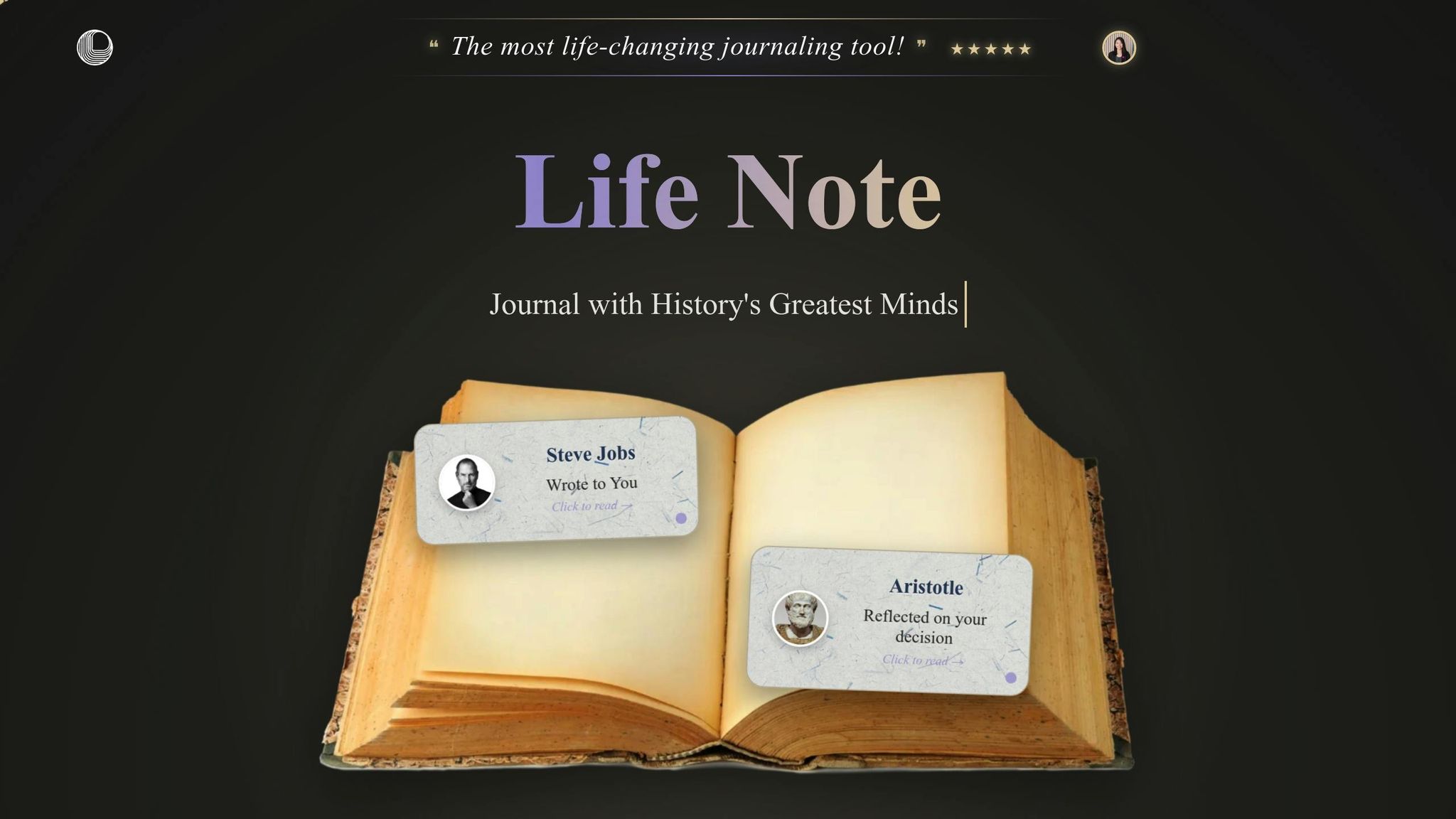
You can do all of these prompts with pen and paper.
But the right tool can multiply their impact—especially when anxiety is loud and focus is low.
Life Note is designed for that moment: when your mind is racing, you want to journal, but you don’t want yet another noisy app. Two things matter most here: privacy and perspective.
Privacy That Lets You Tell the Truth
You can’t be honest on the page if you’re secretly wondering who might read it.
Life Note encrypts your entries with AES-256-GCM before they are stored, with a separate key for your account. Your journals stay locked—no manual log-reading, no hidden reviewers, no “training on your data” surprise. You can export everything or delete everything. You stay in control.
Your anxiety is already loud enough. You shouldn’t have to worry about your journaling app, too.
Weekly Reflection Letters When You Can’t See the Big Picture
Anxiety collapses your attention into today’s problem.
Life Note’s weekly reflection letters zoom you back out. They surface:
- recurring themes in your writing
- emotional patterns across the week
- moments of growth you might have missed
Instead of scrolling through dozens of entries trying to make sense of it all, you receive a gentle, structured summary—like a mentor saying, “Here’s what I’m noticing in you this week.”
It doesn’t replace therapy or human support. It simply makes your inner work more visible, so your progress isn’t swallowed by your latest anxious day.
Comparison Table: Structured vs. Unstructured Journaling
Structured prompts outperform freewriting for anxiety because they direct attention toward specific cognitive reframes rather than letting rumination continue on paper.
When anxiety is loud, how you journal matters almost as much as whether you journal.
- Unstructured journaling gives you freedom, but can accidentally feed rumination.
- Structured journaling gives you focus, but you still have to interpret patterns alone.
- AI-guided journaling (like Life Note) adds a reflective partner that helps you see what you can’t see yet.
Here’s a clear side-by-side view:
| Aspect | Structured Journaling | Unstructured Journaling | Life Note’s AI-Guided Journaling |
|---|---|---|---|
| Clarity | High – prompts focus your thoughts on specific themes and actionable insights | Low to Medium – thoughts can wander, lack direction | Very High – AI mentors ask targeted questions and summarize key takeaways |
| Emotional Insight | Medium to High – helps notice patterns if you review regularly | Medium – depends entirely on your own self-awareness | Very High – mentors highlight emotional patterns, blind spots, and recurring themes |
| Actionability | High – many prompts naturally point toward next steps | Low – insights can stay abstract or vague | Very High – mentors suggest concrete, realistic actions based on your entries |
| Time Investment | Medium – focused, but still requires mental setup | High – easy to overthink and wander without boundaries | Medium – guidance accelerates clarity so you reach insight faster |
| Long-Term Growth | Medium – progress depends on your own consistency and review | Low – hard to track patterns across entries | Very High – AI tracks themes over time and offers weekly summaries and reflections |
| Emotional Support | Low – structure, but no response | Low – fully self-directed, no external perspective | High – responses feel like a compassionate mentor: validating, honest, and growth-oriented |
Structured journaling gives you a clear starting point. Prompts like “Mapping Your Fears” or “Facing the Elephant in the Room” guide your attention toward the real source of your anxiety, instead of letting your mind spin in every direction at once. It’s a practical way to move from vague dread to specific, workable concerns.
Unstructured journaling, while powerful for creativity and catharsis, can backfire when you’re already anxious. Without a frame, it’s easy to keep replaying the same story, strengthening the very neural pathways you’re trying to soften—like having a conversation where both people only repeat the problem, and no one asks a better question.
This is where AI-guided journaling shines.
With Life Note, you’re not just dropping words into a void; you’re in ongoing dialogue with mentors modeled after great minds. If you’re overwhelmed at work, a Jung-inspired mentor might help you explore deeper patterns around identity and shadow; a Brené-like mentor might gently pull you toward self-compassion and boundaries.
One key advantage is pattern detection over time. Instead of you manually rereading dozens of entries, Life Note can surface themes—like anxiety spiking every Sunday night (see our Sunday Scaries journal prompts for that specific pattern), or recurring fears around failure, rejection, or not being “enough.” Those patterns become levers: once you see them, you can work with them. If nighttime anxiety leads you to sacrifice sleep for late-night scrolling, that pattern is especially worth exploring.
And unlike traditional journaling, you’re not left alone with your hardest sentences. AI mentors respond with thoughtful, grounded reflections—validating your experience, offering new angles, and suggesting specific next steps—so journaling becomes less like shouting into a cave and more like sitting with a very patient, very wise friend.
Related: Browse our complete journal prompts collection →
Conclusion
Breaking free from the relentless cycle of anxiety doesn’t mean eliminating difficult thoughts - it’s about changing how you approach them. The ten journaling prompts we've discussed offer practical ways to disrupt those spiraling patterns and channel your mental energy into something more constructive.
By working through these prompts, you’re doing more than just venting emotions. You’re learning to analyze your worries with curiosity and structure, often realizing they’re not as overwhelming as they seemed at first.
Structured journaling has a way of turning chaos into clarity. Each prompt acts as a guide, gently steering you from a state of endless worry to one of purposeful reflection. These exercises not only help clear your mind but also create a bridge between anxious thoughts and actionable insights.
Building on these strategies, Life Note amplifies the benefits by offering tailored guidance that makes self-reflection a more dynamic and supportive process. With mentors who understand the nuances of emotional triggers and how to navigate them, the platform helps you identify patterns before they escalate.
"I've encouraged clients and students for decades to keep journals as one of the best tools for self-awareness. When AI journaling apps began appearing, I tried several. Most gave sycophantic responses. That changed when I found Life Note. It strikes a rare balance - offering support with gentle nudges and thoughtful invitations to reflect. Having the voices of luminaries from different fields comment on my writing has been a major advantage - deepening the experience and helping me gain insights beyond my own words. I'm genuinely excited about the future of Life Note, and I see AI journaling not as a replacement for therapy, but as a powerful tool to complement it." - Sergio Rodriguez Castillo, Licensed Therapist & College Professor
Life Note’s weekly reflection letters take this a step further, providing personalized insights that help you catch patterns you might otherwise miss. Maybe you’ll notice your anxiety peaks on Sunday evenings, or that certain self-talk habits fuel unproductive rumination. These insights act as a guide, reminding you that building emotional resilience is an ongoing process.
Some days, the prompts might feel like a breakthrough; other days, you may struggle to get started. Both experiences are part of the journey. The key is to keep showing up, trusting the process, and allowing these tools to gradually reshape your relationship with anxiety.
It all begins with a single journal entry. Choose the prompt that speaks to you most today and start the dialogue that your anxious mind has been avoiding. The clarity you’re looking for is already within you - these prompts are just the key to unlocking it.
Want an app for this? See our comparison of the best journaling apps for anxiety.
FAQs
How does journaling help manage anxiety and break the cycle of overthinking?
Journaling can be a powerful tool for managing anxiety. It offers a private space to unpack your thoughts and emotions, making it easier to spot triggers or recurring patterns. Simply putting your feelings into words can take the edge off their intensity, helping you feel more grounded and in control.
Beyond that, journaling promotes self-reflection and emotional clarity. Writing out your worries can break the cycle of negative thinking, making those concerns seem less daunting. It shifts your focus toward finding solutions, helping you regain a sense of calm and balance.
How can I make journaling a part of my daily routine to help manage anxiety?
Incorporating journaling into your daily life can be a straightforward yet powerful way to manage anxiety. Set aside a specific time each day - whether it’s in the morning to set the tone for your day or at night to unwind (try these nighttime journaling prompts for bedtime reflection) - and treat it like an appointment you can’t skip. Choose a journal and pen that feel inviting to use, and settle into a quiet, comfortable spot where you can write without interruptions.
If you’re not sure where to start, prompts can help spark your thoughts. Even a few minutes of writing each day can make a difference by helping you process your emotions, interrupt negative thought cycles, and deepen your self-awareness. Stick with it - over time, journaling can evolve into a soothing routine that nurtures your mental health. If you prefer guided digital support, explore apps that support anxiety journaling.
How do guided journaling prompts compare to freewriting for managing anxiety?
Guided journaling prompts offer a structured way to dive into self-reflection, making them particularly useful for managing anxiety. By focusing on specific thoughts or feelings, these prompts can help bring clarity to overwhelming emotions and provide a clear starting point when you're unsure where to begin.
In contrast, freewriting takes a more open-ended approach, allowing you to express your thoughts freely without any guidelines. This method lets you explore your emotions in an unfiltered way. Both approaches can help ease anxiety and process feelings - it really depends on what resonates with you in the moment or what feels most helpful.
What if journaling makes my anxiety feel worse at first?
It’s normal. When you finally slow down enough to listen to your inner world, buried emotions can rise to the surface. This doesn’t mean journaling is “not working”—it means you’re accessing material your mind has been trying to outrun.
Psychologist James Pennebaker’s research shows that expressive writing can temporarily increase emotional intensity before it produces long-term relief. The key is pacing.
If journaling feels overwhelming:
- Set a 5-minute timer and stop when it rings.
- Stick to structured prompts (they contain the emotion instead of letting it spill everywhere).
- End each session with grounding: slow breaths, a short walk, or writing 1 sentence about what you need right now.
Over time, the overwhelm fades and clarity increases. Think of it as emotional weightlifting—your capacity expands gradually. If your anxiety has shifted into chronic exhaustion, our burnout journal prompts offer a staged recovery path.
How often should I journal to see real improvement in my anxiety?
The science is clear: frequency beats duration.
You don’t need 30-minute sessions. You don’t need perfection.
Research from UC Davis and Stanford shows that 3–5 short entries per week is enough to reduce anxiety, improve emotional regulation techniques like DBT journaling, and lower physiological stress markers.
Here’s an optimal rhythm:
-
Daily micro-journaling (2–5 minutes):
Great for breaking rumination loops before they spiral. -
3 structured sessions per week (5–10 minutes):
Use targeted prompts like fear-mapping or best-case scenario reframing. -
1 longer reflection per week:
This is where Life Note’s Weekly Reflection Letters shine, helping you integrate patterns you didn’t see.
Think of journaling like brushing your mind. Short and consistent wins every time.
Related Video: 5 Journaling Prompts for Anxiety & Gaining Inner Peace
If you prefer guided app-based support alongside journaling, see our review of the best apps for anxiety and best apps for overthinking.
Explore More- Journaling Prompts for Anxiety: A Science-Backed Guide to Calming Your Nervous System
- Vomit Journaling for Anxiety: 9 Transformative Techniques Inspired by Campbell Walker’s Method
Related Blog Posts
- Journaling Exercises for Behavior Change
- 12 Journal Prompts for Emotional Clarity & Well-Being
- Journaling for Emotional Awareness: Complete Guide
- 25 Therapist-Informed Journaling Prompts for Mental Health
Anxiety journaling prompts are guided writing questions specifically designed to interrupt the rumination loop—helping you externalize anxious thoughts, identify triggers, and process worry through structured self-reflection.
🧠 Go deeper: Explore our complete collection of journaling prompts for mental health for more ways to support your wellbeing.

Journal with 1,000+ of History's Greatest Minds
Carl Jung, Marcus Aurelius, Lao Tzu: replies grounded in their original works, each citing its source. Co-developed with a licensed psychotherapist.
Try Life Note Free