
Best Apps for Art Therapy Journaling

Compare four top apps that combine visual tools, guided prompts, and AI insights for art therapy journaling to process emotions and track patterns.

📌 TL;DR — Best Apps for Art Therapy Journaling
Art therapy journaling combines writing with visual elements like sketches and photos to process emotions and reduce stress. Top apps include Life Note (AI-generated artwork from entries, $10.99/month), Lifelight (visual timeline with multimedia), Reflection (AI-guided emotional journaling, free basic), and DeepJournal (drawing exercises and art tests). No artistic skill required—choose the app that matches your journaling style.
Art therapy journaling combines writing with visual elements like sketches or photos to help process emotions and reduce stress. Digital apps make this practice easier and more accessible by providing guided prompts, multimedia tools, and AI-driven insights. Here's a quick look at four apps that stand out:
- Life Note: Turns journal entries into AI-generated artwork and offers guidance from historical figures. ($10.99/month or $99.99/year)
- Lifelight: Combines photos, videos, and voice notes into a visual timeline. (Premium subscription required)
- Reflection: Uses AI to guide emotional journaling with tailored prompts. (Free basic version)
- DeepJournal: Focuses on drawing exercises and psychology-based art tests. ($7.99/week or $39.99 one-time fee for premium)
Each app offers unique features to help you better understand your emotions and track patterns over time. Choose the one that matches your journaling style and goals.
What is Art Therapy Journaling?
Art therapy journaling combines visual expression with reflective writing, using drawing, color, and imagery to process emotions that words alone cannot fully capture or release.
Art therapy journaling is a creative way to connect with your emotions by combining traditional journaling with visual elements like sketches, drawings, photos, or even decorative stickers. Think of it as a "mirror for the mind" - a practice that blends creativity and self-reflection to uncover the deeper "why" behind your feelings [4][5]. Unlike traditional journaling, which relies solely on words, this approach engages both the analytical and creative sides of your brain, offering a fuller picture of your emotional landscape.
This method provides a safe outlet for emotions that might be hard to put into words [1]. For example, pairing a quick doodle with a short note can activate different neural pathways, helping you spot emotional patterns you might not have noticed otherwise. Some digital apps even take this a step further by analyzing your text and drawings to identify recurring themes and triggers [1][6].
And here's the best part: you don’t need to be an artist to benefit. Many apps offer guided, science-backed activities, templates, and fun tools like stickers to make the process easy and approachable for everyone [2][5]. The goal isn’t to create a masterpiece - it’s to use visual elements to express feelings that words alone can’t fully capture. This blend of visuals and writing not only enhances self-awareness but also paves the way for real mental health benefits.
Benefits of Art Therapy Journaling
This creative practice offers more than just a fun outlet - it delivers real emotional benefits. A 2026 meta-analysis of digital journaling tools found that it significantly reduced anxiety and improved emotional regulation [4]. The act of creating something, even small doodles or designs, can foster a sense of accomplishment, boosting self-esteem and encouraging problem-solving through artistic exploration [1].
Art therapy journaling also helps you stay present. Activities like drawing or coloring affirmations can calm your mind and lower stress [1]. Over time, reviewing your entries can reveal patterns - like how certain environments or weather conditions affect your mood [7][5]. This kind of awareness can turn vague emotions into clear, actionable insights about what drains or energizes you.
Digital tools add another layer of depth by analyzing your entries to highlight recurring emotional themes you might overlook [1][6]. Instead of simply recording your day, you’re creating a visual and written archive that tracks how your emotions shift over time. This active reflection, rather than passive note-taking, is what makes art therapy journaling so effective for long-term growth.
How Apps Make Art Therapy Easier
For many, starting a journal can feel daunting, especially when staring at a blank page. Digital apps simplify the process by offering guided prompts, multimedia options, and even gamified challenges to make journaling more engaging [3][7]. If writing feels overwhelming, features like voice-to-text or photo-based entries can help you capture the essence of a moment before diving into deeper reflection [7][8].
Some apps also tag entries with metadata - like location or weather - so you can easily identify patterns between external factors and your emotional state [7][5]. A few platforms even take it a step further by creating personalized artwork based on your weekly entries, giving you a visual snapshot of your emotional journey [4].
Convenience is another big advantage. With just 10–15 minutes, you can reflect meaningfully anywhere - whether it’s during your commute, before bed, or on a lunch break. Features like streaks and challenges make it feel rewarding, turning journaling into something you look forward to rather than another item on your to-do list [4][6]. Thanks to this accessibility, journaling has become the most popular self-care activity in 35 U.S. states [6].
Best Apps for Art Therapy Journaling
Art therapy journaling combines visual expression with reflective writing, using drawing, color, and imagery to process emotions that words alone cannot fully capture or release.
The right app can transform your emotions and reflections into something tangible - whether that’s through symbolic artwork, multimedia timelines, or guided creative exercises. Below, we explore four apps that take unique approaches to art therapy journaling.
Life Note: AI Journaling for Self-Discovery
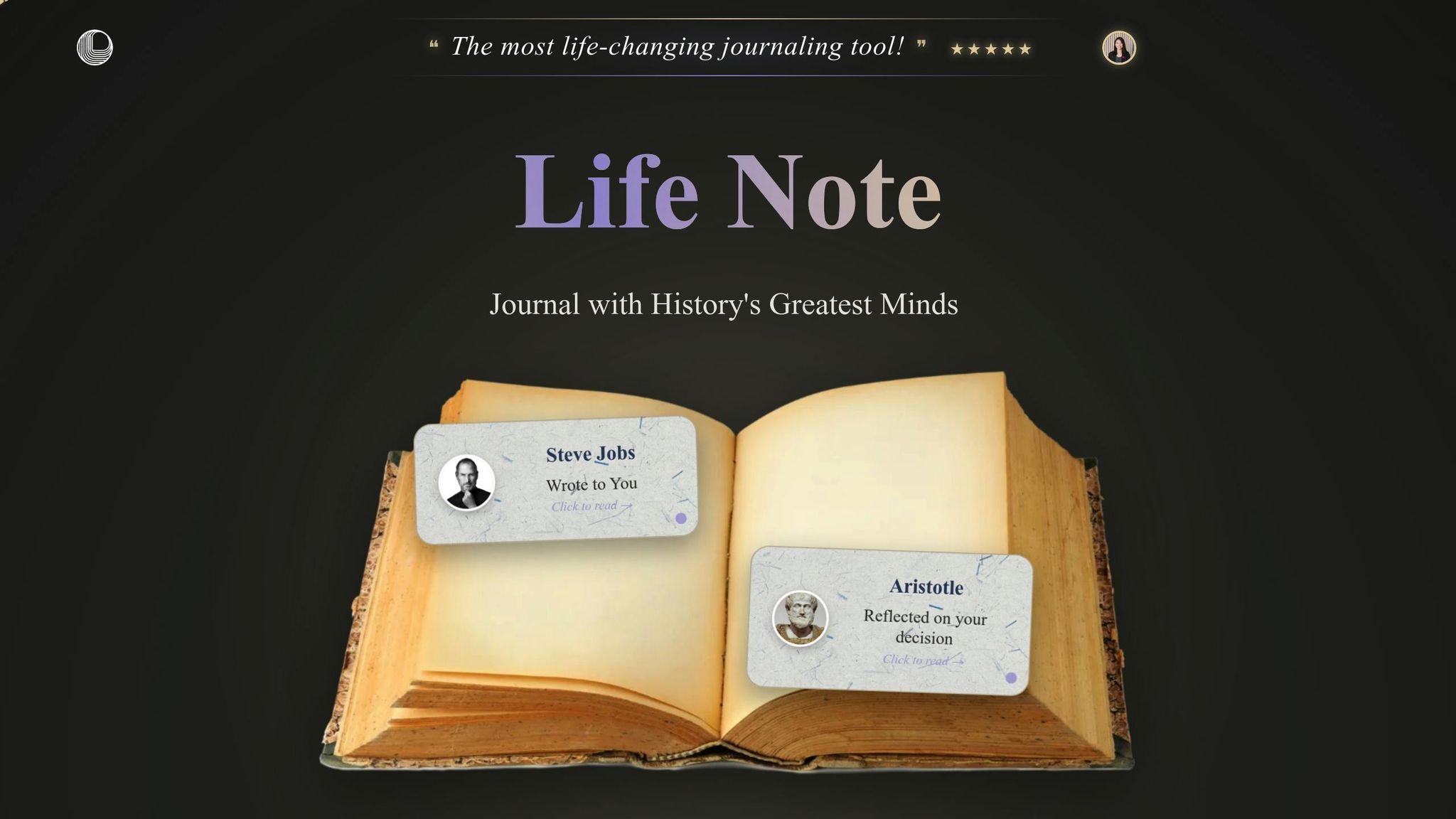
Life Note takes your written reflections and turns them into generative artwork, creating a dynamic Inner Gallery that visually represents your emotional patterns. Each week, it generates custom art based on your journal entries, offering a fresh perspective on your emotional journey. The app also features AI mentors inspired by figures like Carl Jung, Marcus Aurelius, and J.K. Rowling, providing personalized insights that align with your experiences. You can even create an "AI Council" to gain multiple philosophical and creative viewpoints on a single entry.
"Most AI journaling apps feel like chatbots that flatter you. Life Note balances empathy and challenge - gentle nudges, thoughtful invitations, and wisdom from many fields." - Sergio Rodriguez Castillo, Licensed Psychotherapist & University Professor [4]
Life Note ensures privacy with secure weekly mentor letters and offers flexible subscription plans [4]. Its blend of self-discovery and creative expression makes it a standout choice for art therapy enthusiasts.
Lifelight: AI Journal & Memory
Lifelight takes a multimedia approach to journaling, letting you combine photos, videos, and voice recordings with your written entries. The app organizes everything into a Visual Timeline, creating a chronological archive of your personal journey. Its AI Helper analyzes your multimedia entries to identify how factors like location or weather influence your mood. Lifelight offers a free version, but full access to analytics and storage comes with a premium subscription [8].
Reflection: Guided Emotional Journaling

Reflection uses AI to guide you through structured journaling prompts, asking follow-up questions tailored to your entries. This approach helps you explore the deeper emotions behind your thoughts, encouraging healing and self-awareness. While the standard version is free, advanced features powered by AI require a paid subscription [7].
DeepJournal: Mindful Creativity
DeepJournal integrates art therapy into mindfulness with guided drawing exercises and visual dashboards. It includes psychology-based art tests, like the "vase test", which interprets your drawings to reveal personality traits and relationship dynamics [1].
The app also features 15-minute, science-backed art therapy activities paired with calming illustrations, making drawing a gateway to self-discovery. DeepJournal is free to download, with a Lifetime Premium option priced at $39.99 or a Weekly Premium at $7.99 [9].
Feature Comparison of Art Therapy Journaling Apps
Art therapy journaling combines visual expression with reflective writing, using drawing, color, and imagery to process emotions that words alone cannot fully capture or release.
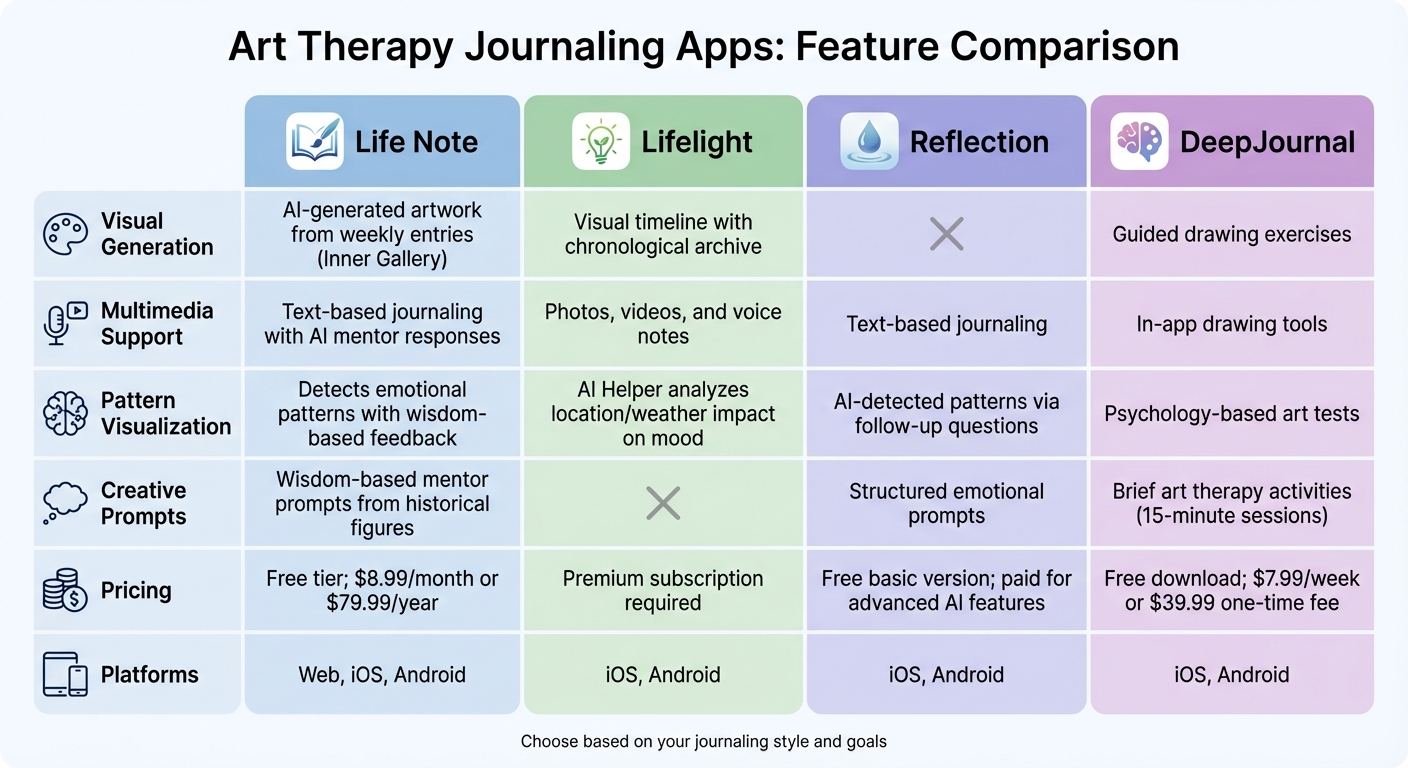
Art Therapy Journaling Apps Feature Comparison Chart
Feature Comparison Table
Below is a comparison of key features across different art therapy journaling apps, focusing on aspects like visual generation, multimedia support, pattern detection, creative prompts, pricing, and platform availability.
| App | Visual Generation | Multimedia Support | Pattern Visualization | Creative Prompts | Pricing (USD) | Platforms |
|---|---|---|---|---|---|---|
| Life Note | AI-generated artwork from weekly entries (Inner Gallery) [4] | Text-based journaling with AI mentor responses | Detects emotional patterns and provides wisdom-based feedback [4] | Wisdom-based mentor prompts from historical figures [4] | Free tier; $10.99/month or $99.99/year | Web, iOS, Android |
| Lifelight | Visual timeline with a chronological archive | Supports photos, videos, and voice notes | N/A | N/A | Premium subscription | iOS, Android |
| Reflection | N/A | Text-based journaling | AI-detected patterns via follow-up questions | Structured emotional prompts | N/A | iOS, Android |
| DeepJournal | Guided drawing exercises | In-app drawing tools | Psychology-based art tests | Brief art therapy activities | N/A | iOS, Android |
Each app brings a unique approach to art therapy journaling, catering to different needs and preferences. For instance:
- Life Note stands out with its ability to generate symbolic artwork from your journal entries, offering visual insights inspired by philosophical wisdom [4].
- DeepJournal focuses on guided drawing exercises and art therapy activities, encouraging creative self-expression.
- Lifelight emphasizes preserving multimedia memories through photos, videos, and voice notes, creating a visual timeline of your journey.
- Reflection takes a structured approach, using AI to detect patterns and providing prompts to help explore deeper emotions.
This breakdown helps you identify which app aligns best with your goals for self-reflection and creativity.
How to Choose an Art Therapy Journaling App
Art therapy journaling combines visual expression with reflective writing, using drawing, color, and imagery to process emotions that words alone cannot fully capture or release.
What to Consider When Choosing
Finding the right art therapy journaling app starts with understanding your personal needs and preferences. If creative expression is your focus, look for apps that allow you to include multimedia elements like photos, videos, voice notes, and sketches. For those who enjoy adding decorative touches, apps with stickers, templates, or customizable layouts can mimic the feel of a traditional art journal.
Some apps take journaling a step further by offering AI-guided emotional insights. These features can turn your entries into tools for self-discovery, helping you uncover emotional patterns rather than just tracking moods. Check for apps that use structured prompts or feedback rooted in established approaches, like Cognitive Behavioral Therapy or philosophical frameworks, to deepen the experience.
Privacy is another key factor. Sharing your innermost thoughts requires trust, so look for apps with strong security measures, such as end-to-end encryption (like AES-GCM), to ensure your data stays private and isn’t used for external purposes. A simple, intuitive interface and quick check-in options can also make it easier to journal consistently.
Lastly, think about long-term value and pricing. Some apps come with a one-time fee, while others use subscription models. Evaluate what works best for your budget and whether the app helps you recognize patterns and apply insights in your life. Also, check if the app allows you to export your entries to formats like PDF, so your progress isn’t tied to a single platform.
Among the many options available, Life Note sets itself apart by blending creative reflection with AI-driven insights that go deeper than basic journaling.
What Makes Life Note Different
Life Note redefines journaling by turning it into a dynamic, interactive experience. Instead of writing into a void, you can engage with over 1,000 mentors from history - figures like Carl Jung, Maya Angelou, and Steve Jobs - who provide reflections that challenge and expand your thinking. As licensed psychotherapist Sergio Rodriguez Castillo puts it:
"Most AI journaling apps feel like chatbots that flatter you. Life Note balances empathy and challenge - gentle nudges, thoughtful invitations, and wisdom from many fields."
One standout feature, the Inner Gallery, creates personalized artwork inspired by your weekly entries. This visual representation of your emotional journey adds a unique layer to text-based journaling, bridging the gap between writing and art therapy. The app also tracks emotional patterns across entries, offering weekly reflection letters that highlight recurring themes and provide psychological insights to guide your growth.
Life Note’s AI Council feature allows you to form "dream teams" of mentors, giving you diverse perspectives on a single topic - imagine getting advice on a career choice from both a philosopher and an entrepreneur. Another unique tool, Talk to Your Past Self, facilitates AI-guided conversations with your previous entries, helping you reflect on your personal growth over time.
With a free tier and subscriptions priced at $10.99 monthly or $99.99 annually, Life Note goes beyond simple mood tracking, offering tools for meaningful self-discovery and creative exploration.
Conclusion
Art therapy journaling creates a unique connection between artistic expression and emotional well-being, offering a way to process feelings that go beyond what words can convey. The apps highlighted here make this practice easier to access, combining guided prompts, digital sketching tools, and AI-driven insights to uncover emotional patterns and encourage growth. This combination of creativity and emotional exploration opens the door to meaningful self-care experiences.
Studies show that digital journaling can boost mindfulness and help reduce anxiety. Features like those found in Life Note take this further by blending AI-guided mentoring with visual art. The app’s Inner Gallery feature, for example, transforms your weekly entries into generative artwork - a striking reflection of your emotional journey. This shift from simply recording thoughts to actively reflecting on them changes the way we think about self-care. Modern journaling tools don’t just store your ideas - they offer insights that help you identify patterns and question unexamined beliefs. Each journal entry becomes an opportunity to learn and grow.
The key is finding an art therapy journaling method that fits your personal style. By combining creativity with thoughtful reflection, these apps reshape self-care and encourage lasting personal development. Whether you prefer reflective conversations, visual storytelling, or a mix of both, regular and mindful journaling can lead to greater self-awareness and ongoing transformation.
FAQs
How does Life Note turn journal entries into AI-generated art?
Life Note takes your journal entries and turns them into AI-crafted artwork, capturing the emotional tones and themes in your writing. These personalized visuals are stored in your Inner Gallery, offering a calming and introspective way to revisit your personal growth and emotional experiences.
Every artwork represents the moments and reflections you've shared, allowing you to view your life's journey through a creative and meaningful lens.
What are the benefits of using art therapy journaling apps like Life Note?
Art therapy journaling apps blend creativity with self-reflection, offering a unique way to work through emotions and ease stress. By expressing feelings through visual elements like sketches or colors, these tools allow you to release pent-up tension and gain a clearer perspective. They also promote mindfulness and self-awareness, helping you stay present and cultivate a gentler, more compassionate relationship with yourself.
Life Note takes these benefits a step further by offering personalized insights. The app connects your journal entries with wisdom from historical mentors - psychologists, artists, and philosophers - who share thoughtful reflections to broaden your outlook. It even transforms your journal into stunning visual artwork, turning your personal growth into something tangible and inspiring. Over time, this approach can lift your mood, spark creativity, and support lasting mental well-being - all while ensuring your data stays private and secure.
How does Life Note protect my privacy and secure my journaling data?
Life Note takes your privacy seriously. All your journal entries are encrypted to keep them safe, and you maintain full control over your data. Your personal thoughts and reflections are never shared with third parties, ensuring they stay completely private and secure.
Related Blog Posts
Journal with 1,000+ of History's Greatest Minds
Marcus Aurelius, Maya Angelou, Carl Jung — real wisdom from real thinkers, not internet summaries. A licensed psychotherapist called it "life-changing."
Try Life Note Free