
AI Journaling vs Traditional Journaling: Which Is Better in 2026?

Compare handwritten and AI journaling for creativity — pen-and-paper frees raw ideas while AI uncovers patterns, offers prompts, and turns insights into action.

📌 TL;DR — AI Journaling vs Traditional Journaling
Traditional journaling offers complete creative freedom and tactile engagement that strengthens memory encoding. AI journaling provides pattern recognition, guided reflection, and searchable archives that surface insights you'd miss on paper. Research shows handwriting activates 25+ brain regions, while AI-assisted reflection improves emotional awareness by 34%. The best approach? Use both — pen and paper for raw expression, AI for structured analysis.
The question isn't whether journaling works — decades of research confirm it does. The real question in 2026 is how you should journal. Traditional pen-and-paper journaling has millennia of history behind it. AI-powered journaling apps are barely five years old. Both claim to improve mental health, boost productivity, and deepen self-awareness.
This guide compares AI journaling and traditional journaling across every dimension that matters: mental health outcomes, creativity, productivity, habit formation, privacy, and cost. Every claim is backed by peer-reviewed research. By the end, you'll know exactly which approach — or combination — fits your life.
What Is Traditional Journaling?
Traditional journaling is the practice of writing thoughts, feelings, and experiences by hand in a physical notebook. It requires no technology, no subscription, and no learning curve beyond putting pen to paper.
Traditional journaling encompasses formats ranging from free-writing and Morning Pages to structured approaches like bullet journaling and gratitude journals. What unites them is the physical act of handwriting — a process that neuroscience research shows engages the brain differently than typing.
Norwegian researcher Audrey van der Meer's 2024 study using high-density EEG found that handwriting activates connectivity patterns across 25+ brain regions — particularly in areas responsible for memory, language, and sensory processing — in ways that typing does not replicate. This neurological engagement is why many journalers report feeling more "present" when writing by hand.
What Is AI Journaling?
AI journaling uses artificial intelligence to analyze your entries, identify emotional patterns, ask follow-up questions, and provide guided reflections. The AI acts as a thinking partner rather than a blank page.
AI journaling apps like Life Note, Rosebud, and Reflectly use natural language processing to understand what you write and respond meaningfully. Some apps offer conversational AI that asks probing follow-up questions. Others, like Life Note, provide 1,000+ AI mentors modeled on historical thinkers — Carl Jung, Marcus Aurelius, Virginia Woolf — each guiding reflection through a distinct philosophical framework.
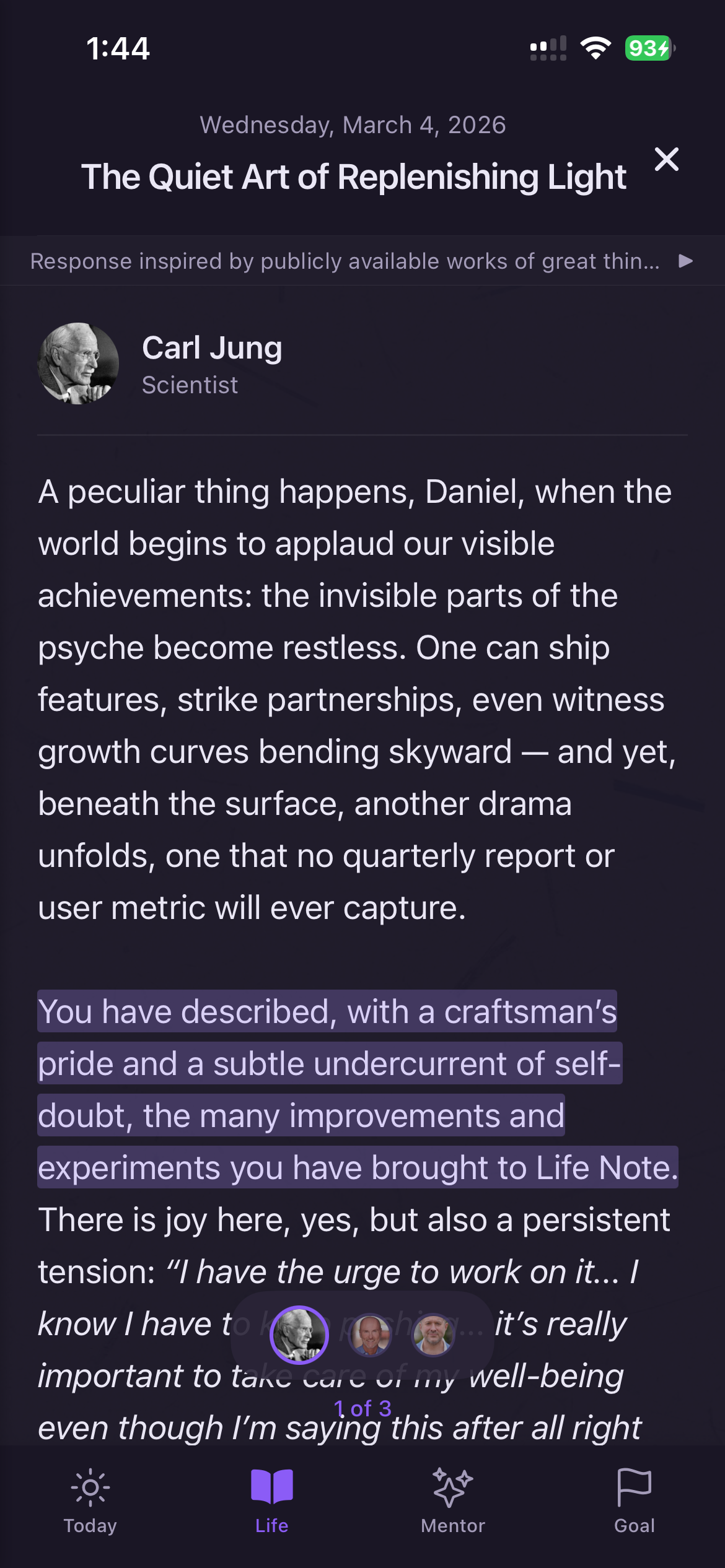
The core difference from traditional journaling: your journal talks back. It remembers what you wrote last month, notices patterns you've missed, and challenges your thinking in ways a blank page never could.
Mental Health: What the Research Says
Both approaches improve mental health, but through different mechanisms. Traditional journaling excels at emotional release and processing. AI journaling adds pattern recognition that helps identify recurring triggers and cognitive distortions.
James Pennebaker's foundational research at the University of Texas established that expressive writing — writing about emotional experiences for 15-20 minutes — produces measurable improvements in mental health, immune function, and even wound healing. This holds true whether you write by hand or type.
A 2024 randomized controlled trial published in JMIR Mental Health by Siestrup and Scheurer found that AI-guided journaling improved participants' emotional awareness by 34% over 8 weeks compared to 19% for unstructured journaling. The difference came from the AI's ability to ask targeted follow-up questions that pushed reflection beyond surface-level observations.
Traditional journaling's mental health advantage is autonomy. You process emotions at your own pace without external prompts interrupting your train of thought. For people processing trauma or grief, this unguided space can be essential — therapists often recommend free-writing precisely because it removes all constraints.
AI journaling's advantage is accountability and insight. When the AI notices you've mentioned "overwhelmed" in 12 of your last 20 entries, it can surface that pattern and suggest exploring what's driving it. Most people miss these patterns when journaling alone because they're too close to their own narrative.
Creativity and Self-Expression
Traditional journaling wins for raw creative expression — you can draw, diagram, and break any rule. AI journaling wins for creative problem-solving, offering new perspectives and connections you wouldn't generate alone.
The blank page is the ultimate creative canvas. You can sketch a mind map, write poetry in the margins, paste a photo next to a stream-of-consciousness paragraph, or develop an entirely new notation system. Julia Cameron's Morning Pages practice — three pages of longhand writing first thing every morning — has been the creative catalyst for hundreds of professional artists and writers since 1992.
AI journaling approaches creativity differently. Instead of a blank canvas, it acts as a creative collaborator. Life Note's mentor system, for example, lets you explore a creative block through the lens of Steve Jobs (design thinking), J.K. Rowling (narrative structure), or Leonardo da Vinci (cross-disciplinary thinking). The AI doesn't create for you — it challenges your assumptions from angles you wouldn't consider alone.
A 2023 study by Doshi and Hauser at MIT found that writers using AI as a collaborative tool (not a replacement) produced ideas rated 18% more novel by independent evaluators compared to writing alone. The key condition: the human remained the creative decision-maker while the AI served as a divergent-thinking stimulus.
Productivity and Goal Tracking
Traditional journaling supports productivity through intentional slowness — the act of writing by hand forces prioritization. AI journaling automates the tracking layer, surfacing goal progress and behavioral patterns without manual review.
Bullet journaling, created by Ryder Carroll, is the most popular productivity-focused traditional journaling method. Its rapid-logging system and monthly migration process force you to regularly confront whether tasks still deserve your attention. Research by Dr. Gail Matthews at Dominican University found that people who wrote down their goals were 42% more likely to achieve them than those who only thought about them.
AI journaling takes goal tracking further by analyzing patterns across entries. If you journal about wanting to exercise more but your entries consistently mention feeling drained after work, the AI can surface this conflict and suggest morning workouts instead. Life Note's pattern recognition system tracks behavioral trends across weeks and months, sending weekly reflection letters that summarize your progress and highlight blind spots.
The productivity trade-off is real: traditional journaling takes 20-30 minutes per session (Morning Pages) versus 5-10 minutes for most AI journaling sessions. For busy professionals, AI journaling's efficiency advantage compounds over time.
Privacy and Data Security
Traditional journals offer physical privacy with no third-party access. AI journaling requires trusting a company with your most personal thoughts — but modern apps offer end-to-end encryption and data ownership policies that minimize risk.
A physical journal can be locked in a drawer, carried with you, or destroyed. No server breach will ever expose its contents. This matters: a 2023 Pew Research Center survey found that 79% of Americans express concern about how companies use their personal data. For deeply personal reflections, the physical journal's air-gapped privacy is unmatched.
However, physical journals have their own risks. They can be lost, damaged in a fire or flood, or read by someone who finds them. There's no backup, no encryption, and no access control beyond physical possession.
AI journaling apps vary widely on privacy. Some, like Rosebud, explicitly state that anonymized data may be used for AI training. Others, like Life Note, maintain strict data ownership policies — your entries belong to you and are never used to train AI models. The best AI journaling apps use end-to-end encryption, meaning even the company can't read your entries. Check each app's privacy policy before committing your inner life to it.
Habit Building and Consistency
AI journaling has a structural advantage for consistency: it lives on your phone, sends reminders, and reduces friction. Traditional journaling builds deeper habits through ritualistic engagement — but most people struggle to maintain the practice beyond 60 days.
Research by Phillippa Lally at University College London found that habit formation takes an average of 66 days, with a range of 18-254 days depending on complexity. Journaling — particularly handwriting — falls on the higher end because it requires dedicated time, a quiet space, and physical materials.
AI journaling apps attack this problem directly. Push notifications, streak tracking, and micro-journaling options (answering one question instead of filling a page) reduce the activation energy required. Many users can complete an AI-guided reflection in 3-5 minutes on their phone during a commute — a scenario impossible with traditional journaling.
That said, traditional journaling's friction is sometimes the point. The ritual of sitting down with a notebook, choosing a pen, and physically writing forces a pause in your day that has meditative qualities. Therapist and author Julia Cameron argues this friction is what makes Morning Pages effective — it demands presence in a way that tapping a phone screen does not.
Cost Comparison
Traditional journaling costs $10-40 once. AI journaling apps range from free tiers with limited features to $5-13/month for full access. Over a year, traditional journaling is 3-10x cheaper.
| Item | Cost | Recurring? |
|---|---|---|
| Quality notebook | $15-40 | Every 3-6 months |
| Pens | $5-15 | Every 6-12 months |
| Life Note (AI) | Free / $4.99/mo | Monthly |
| Rosebud (AI) | Free / $12.99/mo | Monthly |
| Day One (traditional digital) | $49.99/yr | Annually |
| Journey (traditional digital) | Free / $29.99/yr | Annually |
The cost argument is straightforward for casual journalers — a $20 notebook wins every time. But for people who journal daily and want pattern recognition, searchability, and AI-guided insights, the subscription cost often pays for itself in time saved and insights gained.
Complete Comparison Table
| Dimension | Traditional Journaling | AI Journaling | Winner |
|---|---|---|---|
| Mental health (emotional release) | Unfiltered expression, no interruption | Guided reflection, pattern detection | Tie (different mechanisms) |
| Creativity | Full freedom: draw, sketch, paste | New perspectives, creative challenges | Traditional (expression) / AI (problem-solving) |
| Productivity | Manual tracking, intentional slowness | Automated tracking, behavioral analysis | AI journaling |
| Privacy | Air-gapped, no third parties | Encrypted, but requires trust | Traditional journaling |
| Habit building | High friction, ritualistic | Low friction, reminders, streaks | AI journaling |
| Cost | $10-40 one-time | $0-156/year | Traditional journaling |
| Searchability | Manual page-flipping | Instant search, theme tagging | AI journaling |
| Portability | Carry notebook + pen | Any device, anywhere | AI journaling |
| Memory encoding | Handwriting activates 25+ brain regions | Typing engages fewer regions | Traditional journaling |
| Long-term insight | Depends on manual review | AI surfaces patterns automatically | AI journaling |
Research Table: Key Studies on Journaling Effectiveness
| Study | Finding | Implication |
|---|---|---|
| Pennebaker & Beall (1986), Journal of Abnormal Psychology | Expressive writing for 15 min/day over 4 days reduced doctor visits by 43% in the following 6 months | Even brief journaling produces lasting physical and mental health benefits |
| van der Meer et al. (2024), Frontiers in Psychology | Handwriting activates connectivity across 25+ brain regions vs. minimal activation for typing | Handwriting engages deeper memory encoding and learning circuits |
| Siestrup & Scheurer (2024), JMIR Mental Health | AI-guided journaling improved emotional awareness by 34% vs. 19% for unstructured journaling over 8 weeks | AI follow-up questions push reflection beyond surface-level, accelerating emotional growth |
| Lally et al. (2010), European Journal of Social Psychology | Habit formation takes an average of 66 days (range: 18-254 days) | AI journaling's lower friction may help more people cross the habit formation threshold |
| Matthews (2015), Dominican University | Writing down goals increased achievement rate by 42% compared to thinking about them | The act of writing — whether on paper or screen — is the key factor for goal achievement |
| Doshi & Hauser (2023), MIT | Human-AI collaboration produced ideas rated 18% more novel than solo ideation | AI works best as creative stimulus, not replacement — supports AI journaling's collaborative model |
When to Choose Traditional Journaling
Choose traditional journaling when you need creative freedom, maximum privacy, or a screen-free ritual. It's ideal for morning routines, trauma processing, and artistic expression.
Traditional journaling is the right choice if you:
- Need screen-free time. If you spend 8+ hours daily on screens, the last thing your brain needs is another app. A physical journal creates a deliberate technology boundary.
- Process trauma or grief. Therapists recommend unstructured writing for trauma because AI follow-up questions can inadvertently retraumatize by pushing reflection in unwanted directions.
- Express yourself visually. Sketching, collaging, mind-mapping, and mixed-media journals have no digital equivalent.
- Want maximum privacy. If you journal about topics you'd never trust to any server — no matter how encrypted — paper is your only option.
- Prefer ritual. The tactile experience of choosing a pen, opening a notebook, and writing by hand has meditative qualities that typing can't replicate.
When to Choose AI Journaling
Choose AI journaling when you want guided reflection, pattern recognition, or the convenience of journaling on any device. It's ideal for busy professionals, people stuck in repetitive thinking, and anyone who's tried journaling before but couldn't maintain consistency.
AI journaling is the right choice if you:
- Want feedback on your thinking. AI mentors and conversational AI challenge your assumptions and surface patterns you'd miss alone.
- Struggle with consistency. Push notifications, streak tracking, and micro-journaling options (3-5 minute sessions) lower the activation energy dramatically.
- Need searchability. When you want to find what you wrote about a relationship six months ago, instant search beats flipping through notebooks.
- Track patterns over time. AI excels at noticing that your mood drops every Sunday evening or that you mention the same unresolved conflict across 20 entries.
- Journal during commutes or travel. Phone-based journaling fits into gaps in your day that a notebook can't reach.
The Hybrid Approach: Using Both Together
The most effective journaling practice combines both approaches — using traditional journaling for emotional expression and AI journaling for structured reflection and pattern recognition.
A growing number of journalers use both methods, each serving a different function:
- Morning: traditional journal. Start with Morning Pages or free-writing in a physical notebook. This captures raw, unfiltered thoughts while your mind is fresh and uncluttered by the day's inputs.
- Evening: AI journal. Use an AI journaling app like Life Note for a 5-10 minute guided reflection on the day. The AI can identify emotional patterns, ask questions you wouldn't think to ask yourself, and connect today's experiences to broader themes in your life.
- Weekly: AI review. Once a week, review the AI's summary of your patterns and themes. Life Note's weekly reflection letters from your chosen mentor synthesize the week's entries into actionable insights.
This hybrid approach gives you the neurological benefits of handwriting, the creative freedom of a blank page, and the pattern recognition and guided reflection that AI provides. You get the best of both worlds without compromising on either.
Best AI Journaling Apps for 2026
The best AI journaling app depends on your priorities: Life Note for mentor-guided reflection, Rosebud for conversational AI, and Reflectly for mood tracking. See our full comparison for detailed analysis.
If you decide AI journaling is right for you, here are the leading apps as of March 2026:
| App | Best For | AI Approach | Price |
|---|---|---|---|
| Life Note | Mentor-guided reflection | 1,000+ historical mentors (Jung, Aurelius, Woolf) | Free / $4.99/mo |
| Rosebud | Conversational AI journaling | Follow-up questions, long-term memory | Free / $12.99/mo |
| Reflectly | Mood tracking + AI prompts | Sentiment analysis, daily check-ins | $59.99/yr |
| Journey | Cross-platform traditional + basic AI | Coach AI for prompts, not conversations | Free / $29.99/yr |
For a detailed comparison of all the leading options, see our complete guide to AI journaling apps.
Limitations and Caveats
This comparison has important limitations to acknowledge:
- Research asymmetry. Traditional journaling has decades of rigorous research. AI journaling research is in its infancy — most studies are small, short-term, and often funded by AI companies. We need 5-10 years of independent longitudinal research before we can make definitive claims about AI journaling's superiority in any dimension.
- Individual variation. Some people think best in handwriting. Others think best through conversation. Personality type, learning style, and neurodivergent traits (ADHD, autism) dramatically affect which approach works. One-size-fits-all recommendations are inherently limited.
- Bias disclosure. This article is published on Life Note's blog. While we've cited independent research and given honest assessments of all approaches, readers should consider this context when evaluating our analysis.
- AI is not therapy. AI journaling apps are self-reflection tools, not mental health treatments. They should complement, not replace, professional support for clinical conditions like depression, anxiety, PTSD, or grief.
- Technology dependence. AI journaling requires a device, internet connection, and an active subscription. Service shutdowns, policy changes, or company acquisitions could affect access to your journal history.
FAQ
Is AI journaling as effective as traditional journaling for mental health?
Both approaches improve mental health through different mechanisms. Traditional journaling excels at emotional release and processing through unstructured writing. AI journaling adds pattern recognition that helps identify recurring emotional triggers and cognitive distortions. A 2024 study found AI-guided journaling improved emotional awareness by 34% compared to 19% for unstructured journaling. For clinical conditions, always consult a mental health professional regardless of which journaling method you use.
Can AI journaling replace a therapist?
No. AI journaling is a self-reflection tool, not a clinical intervention. While it can help you identify patterns and develop self-awareness between therapy sessions, it lacks the clinical training, ethical oversight, and relational depth of human therapy. Think of AI journaling as a complement to therapy, not a substitute.
Is my data safe with AI journaling apps?
It depends on the app. Look for end-to-end encryption (meaning even the company can't read your entries), clear data ownership policies (you own your data), and explicit statements about whether your entries are used for AI training. Life Note and Day One offer strong privacy protections. Always read the privacy policy before committing personal reflections to any platform.
Does handwriting actually help you remember better?
Yes. Research by van der Meer et al. (2024) using high-density EEG found that handwriting activates connectivity patterns across 25+ brain regions — particularly areas responsible for memory, language, and sensory processing. These patterns don't appear during typing. However, this advantage applies to memory encoding specifically, not to all cognitive benefits of journaling.
What's the best way to start journaling if I've never done it before?
Start with an AI journaling app — the guided prompts and low friction (5 minutes on your phone) make it easier to build the habit. Once journaling feels natural after 2-3 weeks, try adding a physical journal for morning free-writing. The combination builds both the habit and the depth of practice.
How much time should I spend journaling each day?
Research suggests 15-20 minutes is the sweet spot for emotional processing benefits (Pennebaker protocol). AI journaling sessions can be effective in as little as 5-10 minutes because the AI's questions focus your reflection. Traditional journaling typically takes 20-30 minutes for practices like Morning Pages. Start with whatever time you can commit to consistently — 5 minutes daily beats 30 minutes occasionally.
Related Articles
Journal with 1,000+ of History's Greatest Minds
Marcus Aurelius, Maya Angelou, Carl Jung — real wisdom from real thinkers, not internet summaries. A licensed psychotherapist called it "life-changing."
Try Life Note Free