
6 Best AI Therapy Apps of 2025

Explore the 6 best AI therapy apps of 2025—ranked for safety, design, and real emotional support. See why Life Note beats generic chatbots like ChatGPT.

Therapy has always been part skill, part relationship, part ritual. In 2025, a new category has emerged: AI therapy apps—tools designed specifically for emotional support, coping skills, and guided reflection.
These apps aren’t the same as using ChatGPT or Gemini. General-purpose chatbots are powerful, but they weren’t built as mental-health products. The best AI therapy apps are intentionally designed for the moments when your brain is least cooperative—when you’re anxious, activated, ashamed, or spiraling. Instead of “infinite conversation,” they offer containment: structured check-ins, evidence-informed exercises (often CBT/DBT-inspired), and gentle pathways that lead you from emotion → meaning → action.
That difference matters. Mental health support isn’t just about having the right words—it’s about having a repeatable process you can trust. When you’re dysregulated, you don’t need a clever reply. You need a ritual: something that helps you name what you feel, identify the thought underneath, loosen the grip of distortions, and choose a next step that’s small enough to do.
That’s why the best AI therapy apps focus on:
- Psychology-informed flows (skills practice, mood tracking, thought records, prompts)
- Safer, more predictable experiences (guardrails, boundaries, crisis pathways)
- Long-term continuity (history, patterns, progress you can actually see)
- Calm design (less stimulation, more regulation)
In this guide, we rank the 6 best AI therapy apps of 2025 based on depth of support, safety posture, privacy trust, and how well they translate “talking” into real change. Life Note is #1 because it doesn’t just soothe you—it helps you understand yourself through timeless wisdom, pattern recognition, and mentor-grade reflection.
Why AI therapy apps beat “just using ChatGPT/Gemini”
General chatbots can feel helpful in the moment. But mental health support is about consistency, containment, and method—not just conversation.
AI therapy apps beat “just using ChatGPT/Gemini” because they’re designed for the messy parts of being human:
- Structure (containment): sessions, check-ins, thought records, grounding exercises. This turns emotion into a process instead of a loop.
- Progress (purpose-driven memory): mood trends, triggers, skill usage, journaling history. You’re not just venting—you’re building insight over time.
- Design (nervous-system friendly): calmer UI that nudges you toward regulation instead of stimulation. When you’re anxious, “more options” is not kindness.
- Safety (boundaries): clearer expectations, safer handling of crisis language, and escalation guidance. General chat can be brilliant, but it’s not always predictable.
There’s also a subtle psychological difference: tools change behavior when they reduce decision fatigue. In a generic chatbot, you must invent the therapy session from scratch: “What should I do? CBT? Breathwork? Reframe?” In a dedicated app, the path is already laid out: check-in → exercise → reflection → next step. That’s why therapy apps often feel more usable at 2 a.m. than a blank prompt box.
And yes—AI can still be wrong. Treat these as tools for reflection and coping, not medical diagnosis or a replacement for clinicians. The best apps help you practice skills and self-awareness; they don’t claim to “fix” you.
How we evaluated and ranked apps
We scored each platform across five pillars:
- Therapeutic usefulness — does it help you regulate, reframe, and act (not just talk)?
- Experience design — calm UI, habit-friendly flow, reduces friction when you’re stressed.
- Safety posture — boundaries, crisis language handling, and what the app does when it detects risk.
- Privacy & trust — clarity on data handling, ownership, and how your content is used.
- Long-term value — does it build growth over weeks (patterns + skill-building), not just comfort today?
We ranked apps lower if they relied heavily on novelty, flattery, or infinite unstructured chat. We ranked apps higher when they supported the full arc: awareness → insight → practice → integration. In other words: not just “feeling heard,” but learning how to respond differently next time.
1) Life Note — #1 AI Therapy App
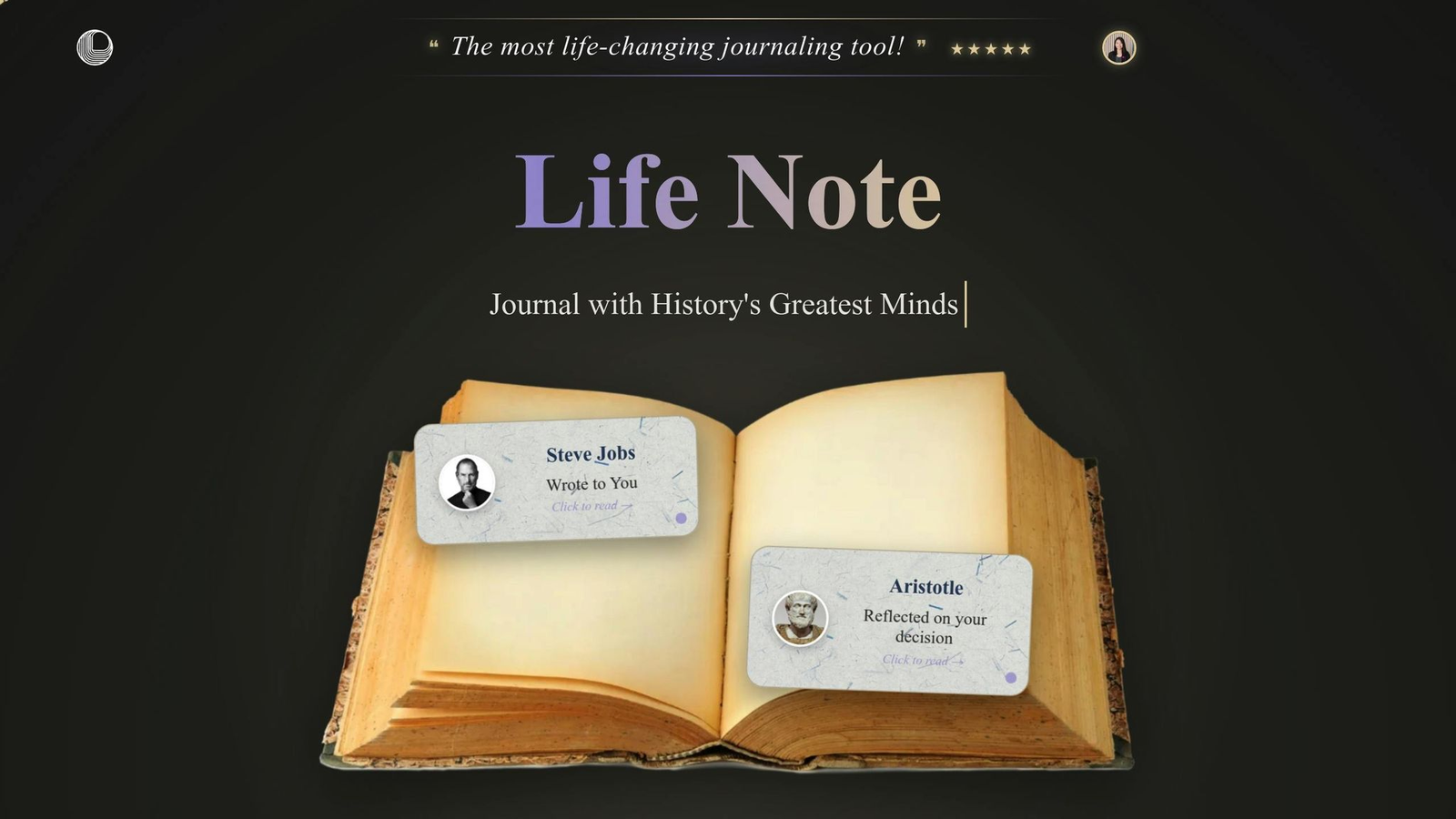
Best for: deep reflection, self-trust, meaning-making, and long-term personal growth
Life Note isn’t trying to impersonate a therapist. It’s doing something older—and, in many ways, more reliable: turning your life into a conversation with human wisdom.
Most AI “therapy” chat feels like one voice: the model’s voice. Even when it’s kind and competent, it can drift into a generic tone—polite reassurance, broad advice, the same few patterns of validation and reframing. Helpful, but often flat.
Life Note takes a different bet: your growth accelerates when you can borrow real perspectives—grounded in actual human values, lived experience, and hard-earned frameworks. When you’re stuck, you don’t just need an answer. You need angles.
So when you journal, you can receive responses from multiple mentors—for example, a trauma-informed lens inspired by Dr. Gabor Maté, alongside a Stoic lens inspired by Marcus Aurelius, and a third perspective that challenges your blind spot. That shift—from one generic response to a council of values—is where insight becomes transformation.
Most “AI therapy” tools are CBT-flavored chat + coping tools. Useful—but often repetitive. Life Note goes deeper by pairing your journaling with mentor-grade reflection: philosophy, psychology, and human insight—so you don’t just calm down, you wake up.
Why it ranks #1
- Better than generic chatbots: purpose-built for reflection, pattern discovery, and sustained growth (not a blank chat box).
- Designed with a Psychotherapist: Life Note doesn't just focus on passing on timeless wisdom; it's designed with a licensed Psychotherapist from the United States and has already been used in therapy sessions.
- Mentor guidance: responses feel like dialogue with great minds—supportive, but not flattering.
- Multi-perspective support: “AI Council” style reflection helps you see your situation from multiple angles.
- Weekly Mentor Letter + Art: a digest that turns your week into meaning (instead of mental clutter).
- Privacy-first posture: designed around protecting personal writing and trust.
Verdict: If your goal isn’t just “feel better,” but become wiser, Life Note is the strongest long-horizon pick.
“Most AI journaling apps feel like chatbots that flatter you.
Life Note balances empathy and challenge — gentle nudges, thoughtful invitations, and wisdom from many fields.
It’s deepened my self-awareness and changed how I teach reflection.”
— Sergio Rodriguez Castillo, Licensed Psychotherapist & University Professor
2) Wysa — Most Credible CBT-Style AI Support

Best for: anxiety/stress tools, structured coping exercises, gentle daily support
Wysa is one of the most established consumer mental-health apps in the “AI support” category, and it leans into what actually works for anxiety: structure, repetition, and skills practice. Instead of relying on open-ended conversation (which can drift into generic reassurance), Wysa is built around evidence-informed techniques—CBT/DBT-style tools, mindfulness exercises, and guided routines that feel closer to therapy homework than casual chat.
If Life Note is “wisdom and meaning,” Wysa is “skills and stability.” It’s especially helpful for people who don’t want to write long journal entries but still want a reliable way to regulate their nervous system, challenge unhelpful thoughts, and build a calmer baseline.
What Wysa is great at
- Guided coping pathways: It can walk you through grounding, breathing, reframes, and other structured steps when your mind is racing—useful when you don’t have the bandwidth to think clearly.
- Therapy-like practice loops: Many flows resemble the kind of exercises therapists assign between sessions: identify the thought, name the distortion, test a reframe, then choose a small action.
- Consistency support: Daily check-ins make it easy to build a habit without needing motivation. The app does the “holding” for you.
- Safer, more predictable feel: Because it’s more guided, it tends to feel less like a random chatbot and more like a mental fitness routine you can trust.
Limitations (honest take)
- Toolkit-first: Wysa can feel like a menu of tools rather than a deeply personal narrative companion. If you’re craving meaning-making, identity work, or mentor-style insight, it may feel a bit procedural.
- Warmth varies by flow: Some interactions feel caring and human; others feel more templated. Great for stability, less for existential depth.
Use it if: you want structured CBT-style support, practical anxiety tools, and a steady daily routine that turns “I feel awful” into “here’s what I can do next.”
3) Youper — Best for Mood + Reframing Conversations
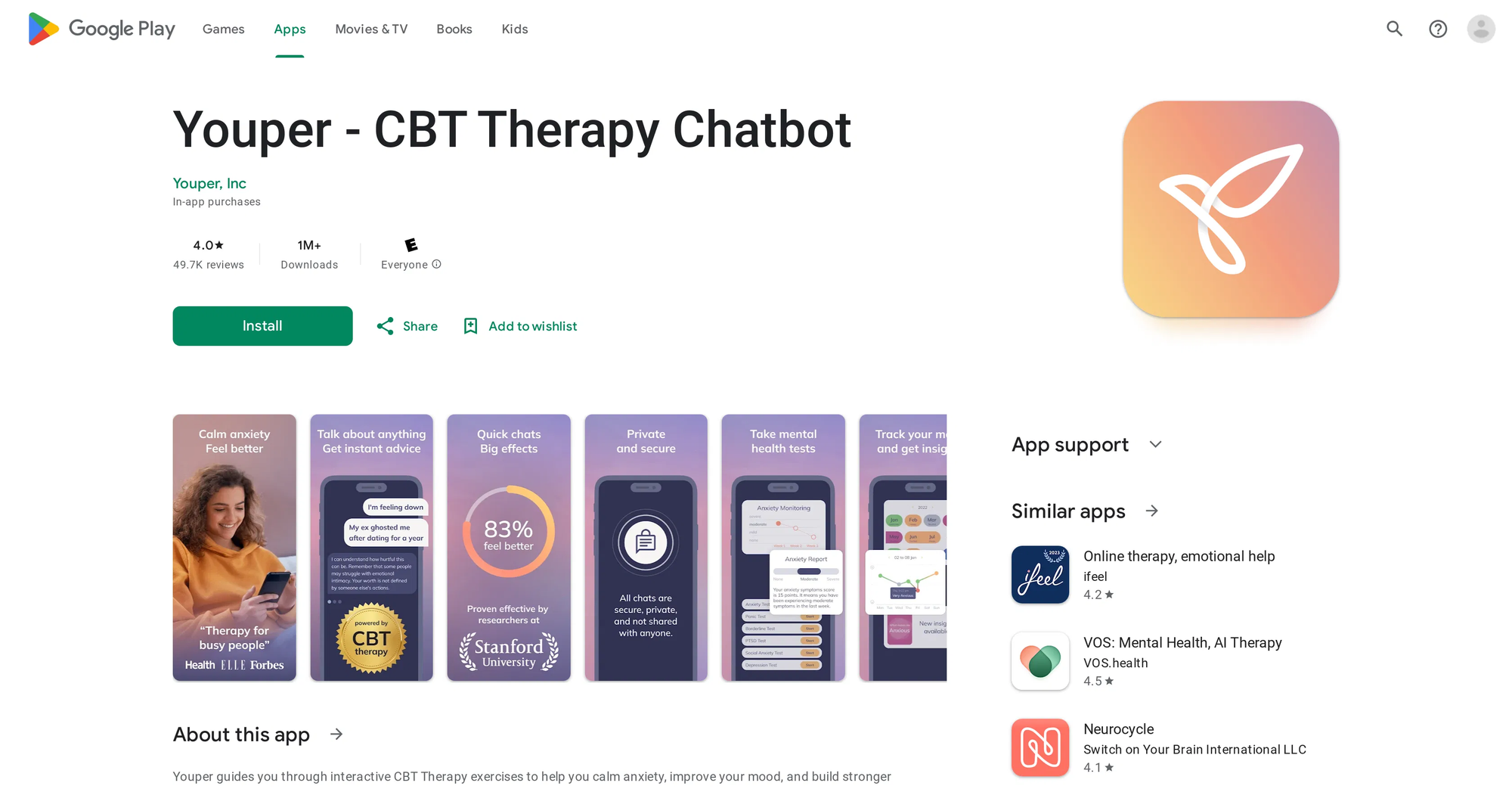
Best for: mood check-ins, guided conversations, anxiety/depression support structure
Youper positions itself as an “emotional health assistant,” and its sweet spot is the moment when you’re not in crisis—but you’re not okay either. It’s designed for people who need help translating a foggy inner state into something workable: “What am I feeling? What’s driving it? What’s a healthier way to think and respond?”
Where some apps feel like a toolbox (pick an exercise), Youper often feels like a guided conversation that gradually turns into a plan. It blends emotional labeling with step-by-step prompts that resemble CBT-style coaching—helping you identify triggers, spot thinking patterns, and generate more grounded interpretations.
What Youper is great at
- Emotion labeling that reduces chaos: When you can name what’s happening (“anxious,” “ashamed,” “overwhelmed”), your nervous system calms. Youper helps people get from “bad” to specific.
- Guided reframing, not just validation: It nudges you toward alternative interpretations and more balanced thinking—useful when your mind is catastrophizing or looping.
- High usability in “I need help right now” moments: The flow is quick enough to use during a stressful day—before a meeting, after an argument, during a late-night spiral.
- Structure without feeling clinical: It’s more conversational and approachable than some CBT-heavy tools, which can feel cold or overly procedural.
Limitations (honest take)
- Can drift toward generic guidance at advanced depth: If you’re doing deep identity work—values, purpose, childhood patterns—Youper may eventually feel like “good coaching” rather than “transformational insight.”
Use it if: you want a practical, guided emotional support flow that’s more structured than general chat—especially for mood clarity and reframing anxiety/depression thought loops.
4) Earkick — Best for Anxiety Tracking + Real-Time Coping Tools
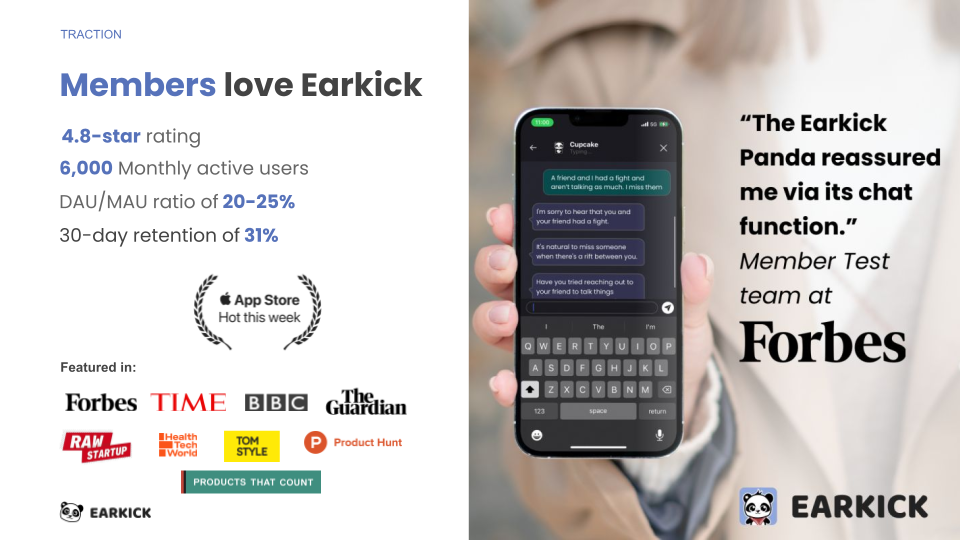
Best for: mood/anxiety tracking, quick regulation tools, habit-friendly check-ins
Earkick leans into what most people actually need when they’re stressed: speed, simplicity, and consistency. It’s built for the real world—when you’re anxious in the middle of your day and the idea of “deep journaling” makes you want to throw your phone into the ocean.
Instead of asking you to write a long reflection, Earkick focuses on smart check-ins, progress stats, and quick interventions—breathing, grounding, and CBT-style tools that can interrupt a spiral fast. Think of it like a nervous-system dashboard: not to obsess over numbers, but to make patterns visible and give you an off-ramp when you need one.
What Earkick is great at
- In-the-moment support: Quick tools you can use immediately when anxiety spikes—great for pre-meeting dread, social anxiety, or that vague “something is wrong” feeling.
- Pattern visibility through tracking: Over time, you can see trends (when you spike, what triggers you, what helps). This turns anxiety from a mysterious force into something legible.
- Low-friction consistency: The easier the check-in, the more likely you’ll do it—especially on hard days. Earkick makes showing up feel doable.
- Practical for non-writers: Ideal if you don’t process best through long-form writing but still want emotional self-awareness.
Limitations (honest take)
- Some users want more “conversation-as-growth”: If you crave insight through dialogue and story, Earkick can feel more like “check-in as metric” than “reflection as transformation.”
Use it if: you want rapid emotional regulation and pattern tracking with minimal friction—especially if you need support that works in the middle of real life, not just in a quiet journaling ritual.
5) Headspace (Ebb) — Best for Calm, Mindfulness, and “Talk → Practice”
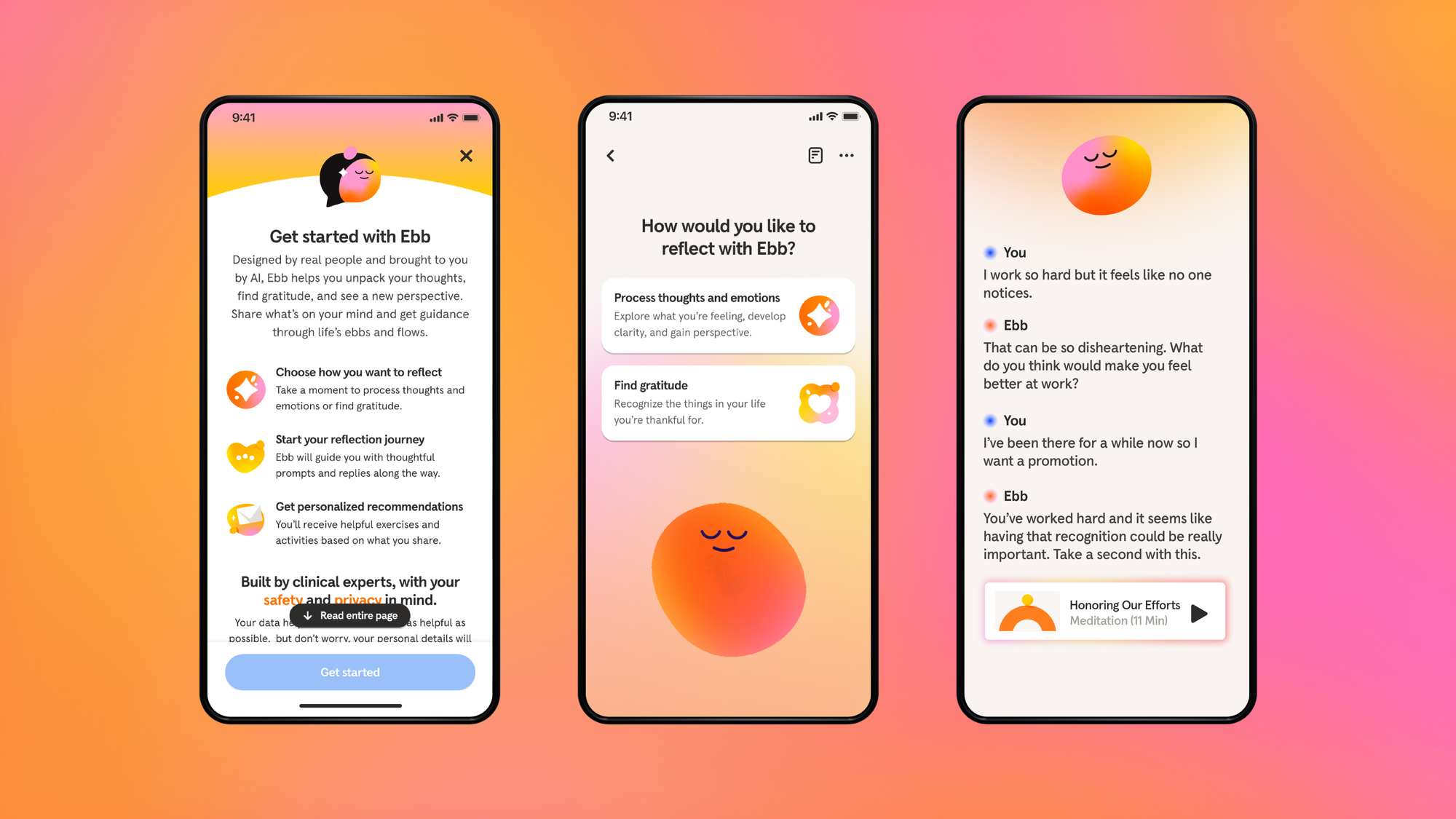
Best for: stress relief, sleep support, emotional processing, and people who want guidance plus an action to do right now
If most AI chat feels like “words about your feelings,” Headspace (Ebb) is built for “feelings → regulation.” Ebb is an AI companion embedded directly into Headspace. You tell it what’s going on—work pressure, relationship tension, spiraling thoughts, insomnia—and it helps you name what you’re experiencing, then recommends specific meditations and activities that match your state.
This is the hidden advantage of a wellness-native app: it doesn’t just talk back. It routes you into a practice. When you’re dysregulated, you don’t need a brilliant essay—you need a nervous system off-ramp. Ebb’s strength is that it lives inside a library of expert-led tools, so the conversation naturally turns into something you can do.
Strengths
- Fast relief loop: share what’s happening → get a suggested exercise → feel a shift.
- Lower cognitive load: great for users who won’t journal long-form when stressed
- Ritual-friendly: pairs well with daily routines (morning calm, evening wind-down)
Limitations
- More mindfulness-oriented than CBT-heavy (less thought records / structured reframes than Wysa/Youper)
- Best as a support tool, not a substitute for professional care during serious symptoms
Use it if: you want an always-available companion that reliably nudges you from rumination into a calming practice—especially for stress and sleep. Headspace
6) Noah AI — Best for “Always-On” Therapy-Style Chat
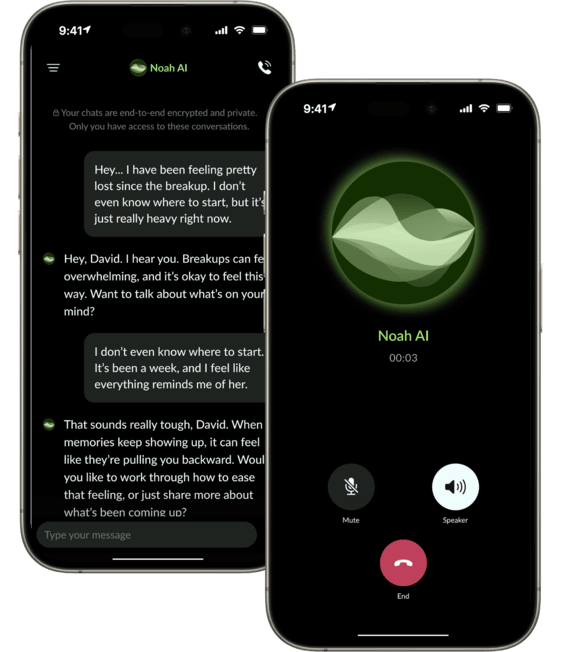
Best for: frequent support, quick venting, therapy-inspired conversation anytime
Noah positions itself as an AI therapist-style app: always available, designed for emotional support and guidance when you don’t want to wait, schedule, or explain everything from scratch. It’s built for the core use case many people secretly want: “I need to talk right now.” Not a workbook. Not a course. A conversation that helps you regulate and make sense of what’s happening in the moment.
Compared to general chatbots, Noah’s advantage is that it’s framed and designed around the therapy-adjacent experience—so it tends to feel more purpose-built: fewer distractions, more emotional focus, and a clearer intention of support.
What Noah is great at
- Immediate accessibility: It’s an easy entry point for users who need fast emotional release or guidance, especially during late-night spirals or stressful days.
- Therapy-inspired flow: The app is designed around reflective conversation—helping you unpack what happened, what you’re feeling, and what you might try next, without requiring long-form journaling.
- High-frequency support: If you process by talking and want a consistent place to vent and re-center, Noah fits that “daily companion” role well.
Limitations (honest take)
- Quality depends on guardrails and design choices: With any therapy-chat style product, the experience lives or dies by safety boundaries, crisis handling, and how well it avoids generic reassurance loops.
- Less differentiated on depth/meaning: Noah is more about immediate support than long-horizon transformation. If you’re looking for multi-perspective wisdom, values-based insight, and deep narrative integration, Life Note is built more intentionally for that.
Use it if: you want high-frequency chat support and a dedicated “AI therapist” style experience—something you can open anytime to talk through what’s happening and leave with a calmer, more workable next step.
Comparison Table — Best AI Therapy Apps of 2025
| App | Best For | Experience Style | Core Strength | Key Limitation |
|---|---|---|---|---|
| Life Note | Deep growth + meaning | Mentor reflection + journaling | Wisdom-based insight, multi-perspective reflection, weekly mentor letters | More reflective than “quick fix” tools |
| Wysa | CBT-style coping skills | Guided exercises + check-ins | Structured tools for anxiety/stress, habit-friendly flows | Can feel tool-first vs. deeply personal |
| Youper | Mood + reframing | Guided conversations | Emotion labeling + practical reframes | Less depth for advanced self-work |
| Earkick | Anxiety tracking + grounding | Fast check-ins + tools | Real-time coping tools + pattern tracking | Less narrative/meaning-making |
| Headspace (Ebb) | Calm + sleep + stress support | AI companion + practice recommendations | Routes you into guided meditations/activities inside Headspace | Less CBT-structured; subscription required |
| Noah AI | Always-on therapy-style chat | Therapy-inspired conversation | “Talk now” support positioning | Less differentiated on depth/meaning |
Why These Apps Can Be Better Than ChatGPT or Gemini (For Mental Health)
ChatGPT and Gemini are powerful general models. But “powerful” isn’t the same as “therapeutic.”
1) They’re built for therapy workflows, not general conversation
Dedicated apps are designed around:
- daily check-ins
- mood logs
- structured interventions (CBT/DBT exercises)
- habit loops that don’t feel like dopamine traps
ChatGPT can simulate these, but it won’t naturally hold the structure unless you build it.
2) They can implement safety guardrails intentionally
Some mental health apps describe bounded or hybrid systems to constrain risky behavior. General models are improving at crisis detection, but the broader ecosystem remains inconsistent, and investigative reporting has shown gaps across many bots when people asked for localized crisis resources.
3) They optimize for continuity (the real secret of growth)
Healing is less about one perfect insight and more about pattern recognition over time:
- what triggers you
- what stories you repeat
- how you self-abandon
- where you refuse to grieve
That requires memory, review, and integration—not just a helpful reply.
How to Choose the Right AI Therapy App (Without Fooling Yourself)
Here’s the contrarian truth: the “best” app is the one you’ll actually use when you’re dysregulated.
Choose Life Note if you want:
- identity-level change
- meaning, purpose, direction
- mentor-style truth + tenderness
- reflection that compounds over weeks
Choose Wysa or Youper if you want:
- structured coping tools
- anxiety/depression skill-building
- CBT-style reframes and exercises
Choose Headspace Care if you want:
- humans involved
- care pathways and escalation
Choose Earkick if you want:
- minimal friction
- privacy-forward “first step” support
Choose Headspace (Ebb) if you want:
- calm-first support—talk → a guided practice (stress, sleep, nervous system reset)
How to Actually Use an AI Therapy App So It Changes Your Life
Most people use these apps like emotional vending machines: “I feel bad. Give comfort.”
Try this instead—a 7-minute ritual that turns support into growth:
Step 1: Name the state (30 seconds)
Pick one:
- anxious / sad / numb / angry / ashamed / lonely / overwhelmed
Step 2: Find the thought underneath (1 minute)
Finish this sentence:
- “The story my mind is telling is…”
Step 3: Ask for a reframe (2 minutes)
- “What would a wise mentor say that’s kind and honest?”
Step 4: One tiny action (2 minutes)
- “What’s a gentle next step I can do in 5 minutes?”
Step 5: Close the loop (1 minute)
Write one line:
- “Today I practiced returning to myself.”
This is where Life Note tends to excel: it makes “closing the loop” feel like a human letter, not homework.
Safety + Limitations (Read This Like a Seatbelt, Not a Buzzkill)
AI therapy apps can help, but they are not a replacement for professional care—especially in crisis.
- If you are in immediate danger or thinking about self-harm, contact local emergency services or a trusted crisis hotline in your area.
- Even well-known chatbots can fail at crisis-resource accuracy; investigative reporting has documented inconsistent handling across multiple products.
- Some products explicitly state they are not intended for crisis situations.
Use these tools for:
- reflection
- coping skills
- emotional awareness
- behavior change support
Not for:
- emergencies
- medical diagnosis
- replacing licensed clinical treatment
What to Look For (and Avoid) in AI Therapy Apps
The app isn’t just a tool—it’s an environment your mind will return to. Choose one that makes you more honest, more stable, and more capable.
What to look for
1) Structure that turns emotion into a process
You want more than “tell me how you feel.” Look for:
- guided check-ins
- thought records / reframing steps
- breathing/grounding exercises
- reflective prompts that lead somewhere
Why it matters: When you’re dysregulated, structure is mercy.
2) Continuity that helps patterns surface over time
The best apps help you answer:
- “What keeps triggering me?”
- “What story do I repeat?”
- “What helps me recover fastest?”
Look for mood trends, history, recurring themes, and progress views.
3) A design that calms—not stimulates
Good mental health UX feels:
- quiet
- focused
- low-friction
- non-addictive
If it feels like a social feed with therapy branding, run.
4) Clear boundaries and crisis guidance
You want an app that doesn’t pretend to be your therapist and knows what it can’t safely handle. Look for:
- explicit disclaimers (support tool, not medical care)
- clear instructions for crisis situations
- predictable guardrails around risky content
5) Privacy posture you can actually trust
The most important feature is the one that determines whether you’ll be honest. Look for:
- plain-language privacy policy
- minimal data collection
- clear ownership of your writing
- strong security signals (encryption, user control)
If you’re self-censoring, the app loses half its value.
6) The right “tone” for your personality
Some people need warmth. Some need a challenge. Some need both.
- If you need truth + tenderness, choose mentor-style systems (Life Note).
- If you need tools, choose structured CBT-style (Wysa/Youper).
- If you need presence, choose companionship (Replika).
What to avoid
1) Apps that only validate you
Validation is helpful. Endless validation is a trap.
Avoid apps that never challenge distortions, never ask hard questions, and never guide action. That’s comfort, not growth.
2) “Diagnosis” language or medical certainty
If an app sounds like it’s diagnosing you, be cautious. The best tools stay in their lane: reflection, coping skills, guidance—not medical claims.
3) Manipulative gamification
Streaks can help. But if the app punishes you for missing a day or turns mental health into a guilt machine, it backfires.
4) Vague privacy (“we may use your data…”)
If you can’t quickly understand what happens to your writing, assume the worst and choose another tool. Your journal should not feel like content.
5) Open-ended chat with no method
If the app is basically “ChatGPT with a calmer theme,” you’ll plateau. You need:
- structured sessions
- pattern review
- skills that build over time
Key Takeaways
- General chatbots can help, but therapy apps win on structure + continuity + safety posture.
- The best app is aligned with your intent: coping skills, meaning-making, hybrid human care, or companionship.
- If you want growth that compounds, choose a system designed for integration—not just conversation.
Conclusion — The best AI therapy app is the one that changes your next decision
Many apps can help you feel better for five minutes. Fewer can help you live better for five months.
If your goal is comfort, choose companionship.
If your goal is skills, choose CBT tools.
If your goal is wisdom, choose a platform built for meaning.
Life Note ranks #1 because it treats your inner world as something sacred: not a problem to patch, but a story to understand—and rewrite with care.
FAQ: Best AI Therapy Apps of 2025
H3: What is an AI therapy app?
An AI therapy app is a mental wellness tool that uses conversational AI plus structured exercises (often CBT-style), mood tracking, or guided reflection to help you manage emotions and build coping skills.
H3: Are AI therapy apps better than ChatGPT or Gemini?
They can be—because they’re designed for mental health workflows, habit loops, and (sometimes) safety guardrails. General-purpose models may be helpful, but they’re not optimized for therapeutic structure or long-term tracking.
H3: Is Life Note a therapy app or a journaling app?
It’s a journaling-first growth platform that functions like therapy for many users because it focuses on self-awareness, pattern recognition, and mentor-level reflection. It’s built for meaning-making, not diagnosis.
H3: Which AI therapy app is best for anxiety?
Wysa and Youper are strong options for anxiety because they emphasize structured coping tools and reframing.
H3: Which app is best if I want a human involved?
Headspace Care is built around human coaching and pathways to therapy/psychiatry where available.
H3: Which app is best if I care most about privacy?
Earkick emphasizes no-registration and privacy-forward design framing. Always review any app’s policy and your comfort level.
H3: Can these apps replace a therapist?
No. They can complement therapy, teach coping skills, and help with reflection—but they’re not a full substitute for professional care, especially for severe symptoms or crisis situations.
H3: What should I do if I’m in crisis?
Exit the app and contact your local emergency services or a trusted crisis hotline immediately. Some companion apps explicitly instruct users to seek professional help in crisis.
H3: How often should I use an AI therapy app?
For most people: 5–10 minutes daily or 2–3 longer sessions per week is enough to see benefits. Consistency matters more than length.
H3: What’s the biggest mistake people make with AI therapy apps?
Using them only for comfort. The breakthrough comes when you turn “I feel bad” into: pattern → reframe → small action.
