
Life Advice That’s Relevant in the Era of Artificial Intelligence

As AI transforms the way we live and work, timeless wisdom is more important than ever. Discover actionable life advice that will help you thrive in a world shaped by artificial intelligence.

📌 TL;DR — Life Advice in the AI Era
AI changes what skills matter. Key advice: develop uniquely human capabilities—creativity, emotional intelligence, complex judgment, and authentic connection. Use AI as a tool, not a replacement for thinking. The future belongs to those who combine human wisdom with AI capability.
Artificial intelligence isn’t just transforming industries—it’s reshaping how we live, think, and grow. But despite the tide of automation and algorithmic change, many traditional life lessons still hold—and some take on a new significance. Drawing inspiration from Silicon Valley thinkers, ethics scholars, and research on AI-augmented work, here’s how to navigate life in an AI-driven world.
1. Adapt Quickly—or Become Obsolete
In the age of AI, adaptability is your most valuable asset. It’s no longer enough to master one skill and ride it for decades. Jobs, industries, and even the frameworks of knowledge are evolving rapidly.
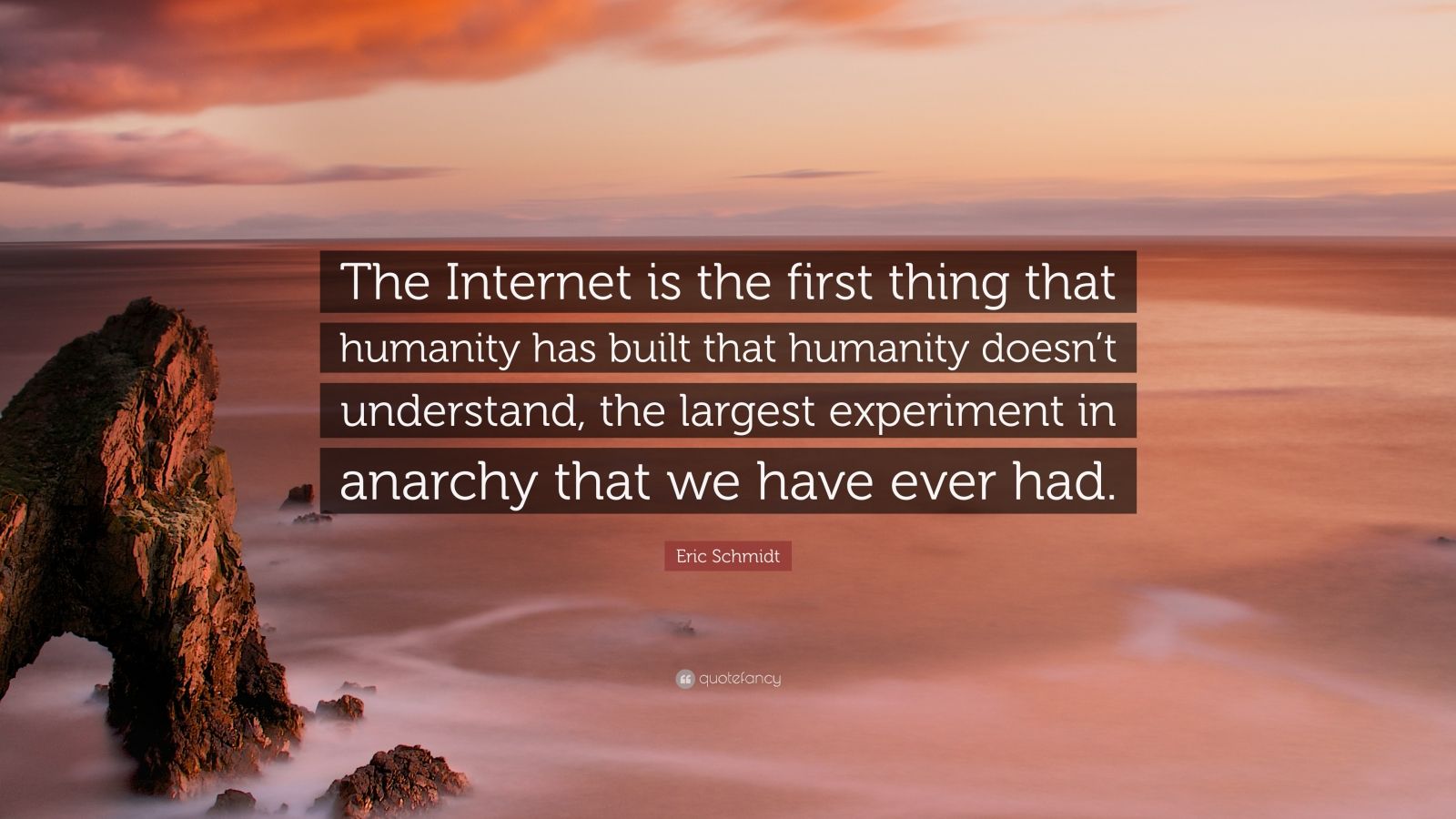
Former Google CEO Eric Schmidt once said: “The Internet is the first thing that humanity has built that humanity doesn’t understand, the largest experiment in anarchy that we have ever had.” He captured the essence of technological disruption: knowing it’s coming isn’t enough—you have to ride the wave.
Key Insight: Change is the only constant in an AI-enabled world. Learning how to pivot, embrace new tools, and remain curious ensures long-term success.
Action Step: Schedule a recurring “learning hour” each week. Explore an emerging tool or trend—not for mastery, but for exposure. Use platforms like Coursera, AI sandbox tools, or industry YouTube deep dives.
Research note: The OECD’s analysis of future skills shows that human capabilities “too difficult for AI and robotics to reproduce” are increasing in importance.
2. Focus on What Machines Cannot Replicate
AI may outperform humans in tasks involving massive data, pattern recognition, and optimisation—but it still lacks the full capacity for human creativity, empathy, and moral judgement.
At Apple Inc., co-founder Steve Jobs famously stated: “It’s in Apple’s DNA that technology alone is not enough — it’s technology married with liberal arts, married with the humanities, that yields us the results that make our heart sing.”
Counter-intuitive truth: As AI gets better, the most irreplaceable people will be those who use emotional intelligence and creativity.
Action Step: Actively cultivate human-centric skills. Take an art class, volunteer in a mentorship role, or deliberately practice active listening in one conversation daily.
Research: A recent article observed that “while algorithms can simulate empathy, self-awareness, or social skills, they cannot feel them.”
3. Learn to Collaborate with AI, Not Compete
AI is not your enemy—it’s a tool. The future isn’t about replacing humans with machines; it’s about augmented human intelligence—human + AI working together.
Entrepreneur Elon Musk has warned that “AI will make jobs kind of pointless.” The point isn’t to fear that statement—but to recognise its implication: if machines handle the mundane, humans must rise to higher-order thinking.
Key Insight: Success in the AI era will stem from integrating AI into your workflow, not racing to beat it.
Action Step: Identify one repetitive task in your work or life (scheduling, summarising, data-entry, etc.). Find an AI tool (e.g., ChatGPT, Zapier, automation scripts) to handle it. Then use the time saved to focus on strategy, creativity, or relationship-building.
Research: A study analyzing 12 million job postings found that AI-complementary skills (teamwork, resilience, digital literacy) saw increased demand even as AI automation grew.
4. Prioritise Deep Work Over Constant Connectivity
In an AI-driven world, your attention becomes one of the rarest resources. With endless notifications, social-media pulls, and algorithmic distractions, the ability to focus deeply is increasingly rare—yet essential.
Author Cal Newport wrote in Deep Work: “To produce at your peak level you need to work for extended periods with full concentration on a single task free from distraction.” That principle is more crucial now than ever.
Counter-intuitive truth: While AI can handle many tasks, it cannot replicate the depth and nuance produced by a deeply focused human mind.
Action Step: Block out two uninterrupted hour-long sessions per week labelled “Deep Work.” During each block, disable notifications, close unrelated tabs, and work on something only you can do.
Research note: Harvard Business School found that as AI advances, soft skills such as critical thinking and sustained focus become even more crucial. Harvard Business School Library
5. Embrace Ethics in Technology
As AI systems proliferate across sectors—from healthcare to justice to advertising—the ethical implications become more urgent. It’s not just “Can we build this?” but “Should we?”
Tech thinker Tim O’Reilly once posed: “It’s not what you upload, it’s the fact that you upload. What will you do with the tools you have?” The question frames the moral dimension of technology.
Key Insight: In an AI-powered world, ethical decision-making will define not just the workplace—but the kind of society we build. Efficiency alone isn’t enough.
Action Step: For every major decision (in work or life), ask: “Who benefits? Who might be harmed? Are there unintended consequences?” Write down the answers.
Research note: According to the World Economic Forum’s Future of Jobs Report 2026, skills related to ethics, transparency, and responsible use of AI are among the most future-proof. The Times of India
6. Build Authentic Relationships in a Virtual World
As AI and automation handle more of our interactions, the value of real human relationships only increases. Quality relationships become a core differentiator.
LinkedIn co-founder Reid Hoffman said: “No matter how brilliant your mind or strategy, if you’re playing a solo game, you’ll always lose out to a team.” His point stands even more today.
Counter-intuitive truth: AI may enhance communication, but it cannot build the deep trust and connections that humans can.
Action Step: Every month, schedule one “offline” interaction—a coffee, a walk-and-talk, a handwritten note. Invest in relationships where technology hasn’t yet replaced presence.
Research note: Studies show that jobs involving interpersonal skills remain among the least exposed to automation.
7. Practice Stoicism in a World of Exponential Change
When the pace of change speeds up—thanks to AI—you can either feel knocked around or build internal resilience to navigate it. Stoicism offers tools for the latter.
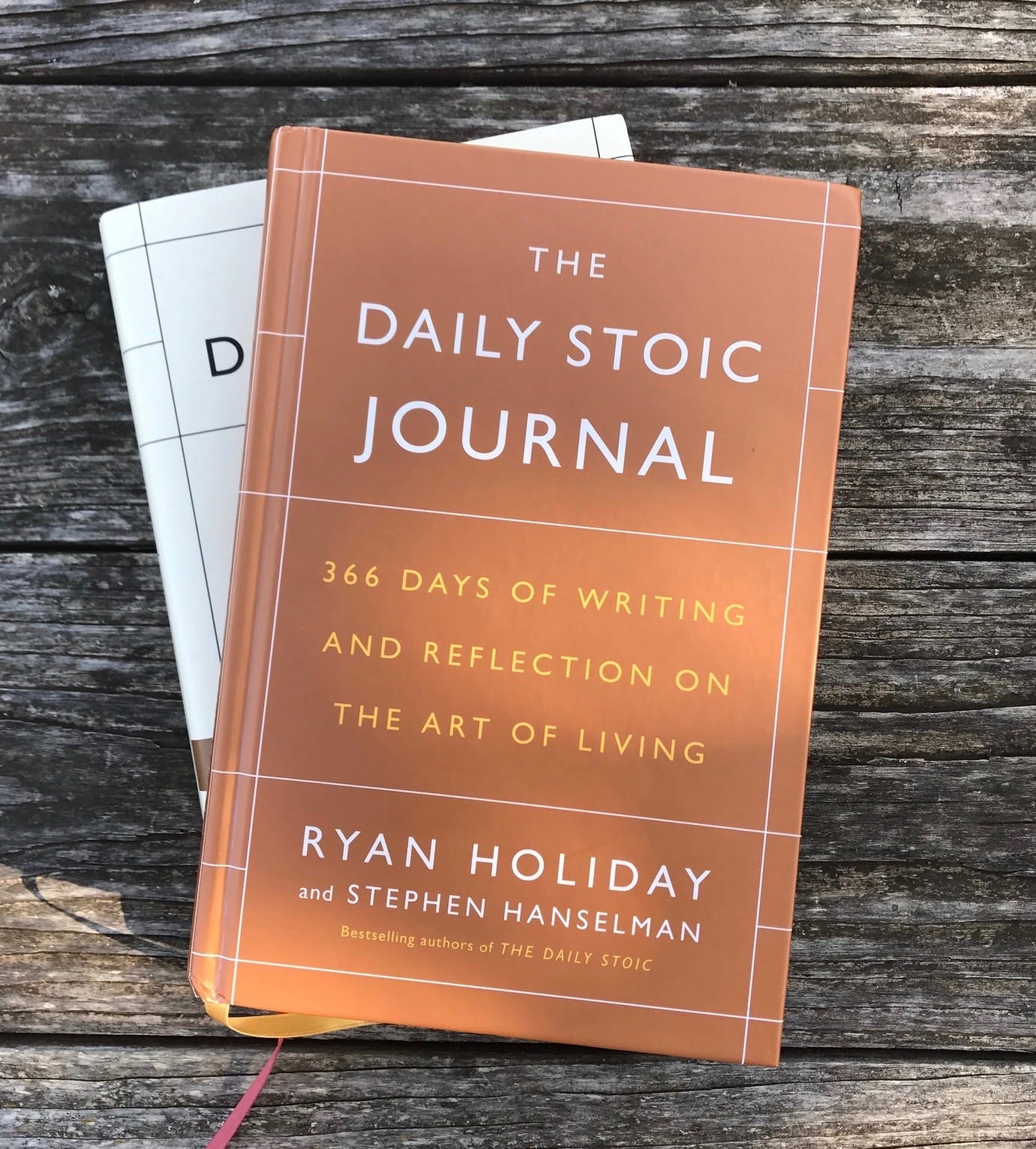
Lifestyle designer Tim Ferriss often cites Stoic wisdom: “We suffer more in imagination than in reality.” As AI reshapes the world, the constant lies not in technology—but in your reaction to it.
Key Insight: You can’t control external change—but you can control your mindset.
Action Step: Every evening, journal one thing you can’t change and one thing you chose to do in response. Use this to train your internal locus of control.
Research note: Because AI complements many human roles, demand for resilience, self-regulation and ethical leadership rises.
8. Cultivate Continuous Learning as a Lifestyle
In AI’s rapid evolution, the best skill may not be a specific tool or language—but the ability to learn how to learn.
Demis Hassabis, CEO of DeepMind and 2024 Nobel laureate, emphasised this point clearly: “Learning how to learn will be the most essential skill for the next generation.” The Economic Times
Key Insight: Knowledge of what to learn is outpaced by how fast you can learn it.
Action Step: Pick a non-related topic each quarter (e.g., music, a language, physics) and commit 30 minutes weekly. Reflect on your progress at month’s end.
Research note: The World Economic Forum predicts that 170 million new jobs will be created this decade—with distinct new skill demands in the AI era.
9. Maintain a Growth Mindset About AI—not a Fear Mindset
Fear of replacement by AI can trigger paralysis or resistance. Instead, view AI as an amplifier of human capacity—not a threat.
According to research, individuals with a growth mindset—who believe abilities can be developed—have better outcomes navigating technology transitions than those focusing only on technical skills.
Action Step: Replace “AI will take my job” with “How can I use AI to change my job?” Write down at least two high-value tasks you can delegate to AI this year.
Research note: A study found that AI adoption increased demand for human skills in workplaces, rather than simply replacing them.
10. Stay Grounded: The Ultimate Hack—Remain Human
With AI optimizing many of the tasks we once did manually, the most valuable advice becomes simple—but hard: stay human.
Entrepreneur Naval Ravikant often says: “Happiness is a skill you develop, and the first step is unlearning all the things that make you unhappy.” In the AI world, it’s not about chasing external achievements—it’s about cultivating internal well-being.
Key Takeaway: AI will automate and enhance many of what we do, but your capacity for empathy, creativity, integrity, and resilience keeps you grounded and fulfilled.
Final Action: Every Sunday evening, ask yourself: “In the past week, when did I feel most human?” Write it down. Then ask: “How will I feel most human next week?”
Keeping that question at the centre of your work, life, and relationships will guide you through disruption—not just survive it.
Using Life Note's Features for Better Reflection
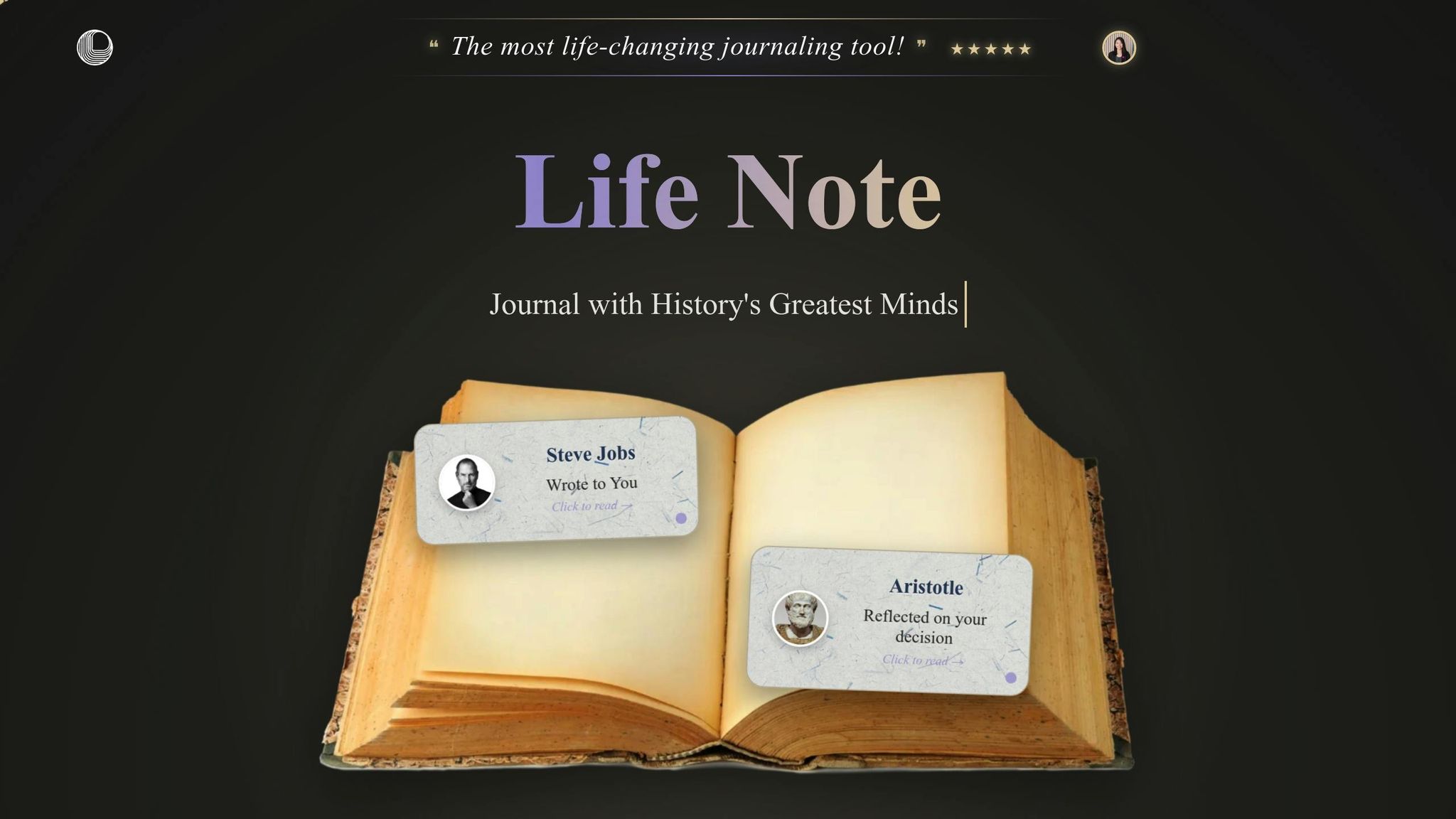
If the speed at which things are changing feels overwhelming, you don’t have to do it alone. With Life Note, you can journal with AI mentors inspired by the world’s greatest thinkers—from Carl Jung to Marcus Aurelius- to gain personal insights that'll help you navigate the AI era.
Your mentor can guide you with personalized journal prompts, help you reframe limiting beliefs, and reflect your own patterns back to you—just like a compassionate therapist or wise teacher would.
Instead of a blank page, you get an intelligent mirror. And when you write consistently, your journal becomes a living record of your transformation.
👉 Try Life Note to begin your journey toward wholeness.
Related Blogs
 Daniel W. Chen
 Daniel W. Chen
Explore More
Continue your journey:
- AI Journaling: The Complete Guide — The complete guide
Journal with 1,000+ of History's Greatest Minds
Marcus Aurelius, Maya Angelou, Carl Jung — real wisdom from real thinkers, not internet summaries. A licensed psychotherapist called it "life-changing."
Try Life Note Free